 Add to Chrome
 Add to Firefox
 Add to Edge
CutClean: Neural Network Pruning for Privacy-Preserving Inference
Aug 13, 2026
Neural networks are increasingly deployed in high-stakes applications with growing privacy leakage concerns. We show that this privacy leakage can occur even in the absence of representation imbalances that lead to traditional dataset biases. This poses significant privacy risks when deploying models that process sensitive attributes. In this context, we propose CutClean, a privacy-aware pruning method that allows to reduce privacy information flow through the network, while increasing its sparsity. Our approach employs auxiliary linear privacy heads placed at each network's block to quantify information leakage, and further applies increasing levels of sparsity to remove the private attribute leakage, measured in terms of the accuracy of the privacy head attached to the last block. Experiments on synthetic and real-world datasets demonstrate that our approach effectively minimizes private information flow while achieving high sparsity rates and preserving classification target accuracy.

Current Injection Spiking Neural Network for Infrared and Visible Image Fusion
Jul 22, 2026Infrared and visible image fusion (IVIF) integrates the complementary information of two modalities into a single image with richer scene content. While existing methods are largely built on artificial neural networks (ANNs), which densely compute over all activations, spiking neural networks (SNNs) communicate through sparse binary spikes and compute only where and when a spike occurs, offering a route to more energy-efficient fusion. However, directly applying SNNs to IVIF creates a fundamental tension: cross-modal fusion relies on fine-grained responses from both modalities, whereas binary spikes can discard complementary cues that remain below the firing threshold. The membrane potential retains these subthreshold responses before firing, letting both modalities jointly shape the output when integrated at this stage. Building on this, we propose CIS-Fuse, a spiking network that performs cross-modal fusion directly at the membrane-potential level. At its core is the current injection spiking (CIS) operator, which injects one modality as a gated auxiliary current into the driving neuron of the other, so the two integrate before spike firing, with a per-channel learnable injection strength that adaptively regulates the modulation magnitude. Building on CIS, we construct a bidirectional cross-modal fusion (BCMF) module and deploy it on a dual-branch architecture with asymmetric stacking depths, where the two branches develop a clear functional specialization. Extensive experiments on four IVIF benchmarks and on downstream detection and segmentation show that CIS-Fuse achieves fusion quality on par with state-of-the-art ANN-based methods while inheriting the energy efficiency of spike-based computation, with roughly an order of magnitude lower inference energy than the similarly-sized ANN-based DCEvo. Code will be released upon publication.
Generative Models at the Frontier of Compression: A Survey on Generative Face Video Coding
Jun 09, 2025The rise of deep generative models has greatly advanced video compression, reshaping the paradigm of face video coding through their powerful capability for semantic-aware representation and lifelike synthesis. Generative Face Video Coding (GFVC) stands at the forefront of this revolution, which could characterize complex facial dynamics into compact latent codes for bitstream compactness at the encoder side and leverages powerful deep generative models to reconstruct high-fidelity face signal from the compressed latent codes at the decoder side. As such, this well-designed GFVC paradigm could enable high-fidelity face video communication at ultra-low bitrate ranges, far surpassing the capabilities of the latest Versatile Video Coding (VVC) standard. To pioneer foundational research and accelerate the evolution of GFVC, this paper presents the first comprehensive survey of GFVC technologies, systematically bridging critical gaps between theoretical innovation and industrial standardization. In particular, we first review a broad range of existing GFVC methods with different feature representations and optimization strategies, and conduct a thorough benchmarking analysis. In addition, we construct a large-scale GFVC-compressed face video database with subjective Mean Opinion Scores (MOSs) based on human perception, aiming to identify the most appropriate quality metrics tailored to GFVC. Moreover, we summarize the GFVC standardization potentials with a unified high-level syntax and develop a low-complexity GFVC system which are both expected to push forward future practical deployments and applications. Finally, we envision the potential of GFVC in industrial applications and deliberate on the current challenges and future opportunities.
Language-Guided Visual Perception Disentanglement for Image Quality Assessment and Conditional Image Generation
Mar 04, 2025Contrastive vision-language models, such as CLIP, have demonstrated excellent zero-shot capability across semantic recognition tasks, mainly attributed to the training on a large-scale I&1T (one Image with one Text) dataset. This kind of multimodal representations often blend semantic and perceptual elements, placing a particular emphasis on semantics. However, this could be problematic for popular tasks like image quality assessment (IQA) and conditional image generation (CIG), which typically need to have fine control on perceptual and semantic features. Motivated by the above facts, this paper presents a new multimodal disentangled representation learning framework, which leverages disentangled text to guide image disentanglement. To this end, we first build an I&2T (one Image with a perceptual Text and a semantic Text) dataset, which consists of disentangled perceptual and semantic text descriptions for an image. Then, the disentangled text descriptions are utilized as supervisory signals to disentangle pure perceptual representations from CLIP's original `coarse' feature space, dubbed DeCLIP. Finally, the decoupled feature representations are used for both image quality assessment (technical quality and aesthetic quality) and conditional image generation. Extensive experiments and comparisons have demonstrated the advantages of the proposed method on the two popular tasks. The dataset, code, and model will be available.
Generative AI for RF Sensing in IoT systems
Jul 10, 2024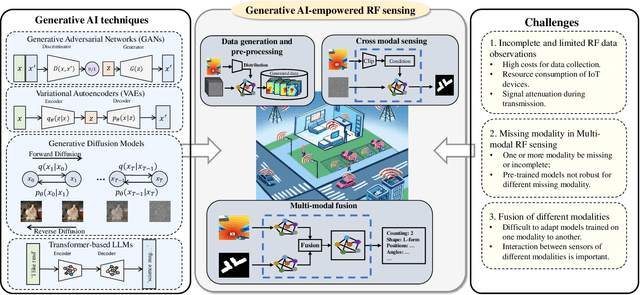
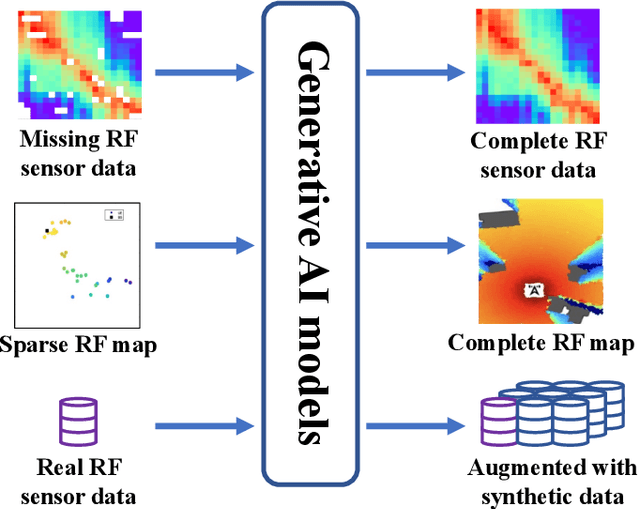
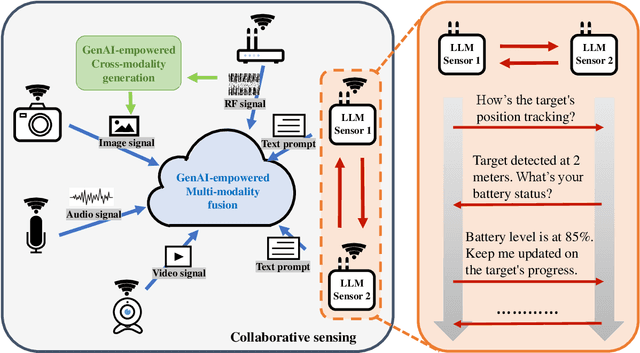
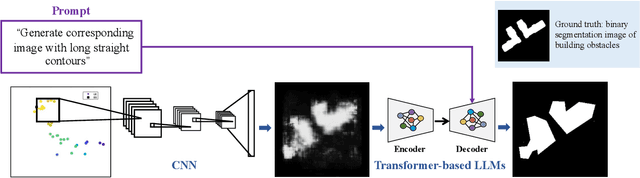
The development of wireless sensing technologies, using signals such as Wi-Fi, infrared, and RF to gather environmental data, has significantly advanced within Internet of Things (IoT) systems. Among these, Radio Frequency (RF) sensing stands out for its cost-effective and non-intrusive monitoring of human activities and environmental changes. However, traditional RF sensing methods face significant challenges, including noise, interference, incomplete data, and high deployment costs, which limit their effectiveness and scalability. This paper investigates the potential of Generative AI (GenAI) to overcome these limitations within the IoT ecosystem. We provide a comprehensive review of state-of-the-art GenAI techniques, focusing on their application to RF sensing problems. By generating high-quality synthetic data, enhancing signal quality, and integrating multi-modal data, GenAI offers robust solutions for RF environment reconstruction, localization, and imaging. Additionally, GenAI's ability to generalize enables IoT devices to adapt to new environments and unseen tasks, improving their efficiency and performance. The main contributions of this article include a detailed analysis of the challenges in RF sensing, the presentation of innovative GenAI-based solutions, and the proposal of a unified framework for diverse RF sensing tasks. Through case studies, we demonstrate the effectiveness of integrating GenAI models, leading to advanced, scalable, and intelligent IoT systems.
Predictive Coding For Animation-Based Video Compression
Jul 09, 2023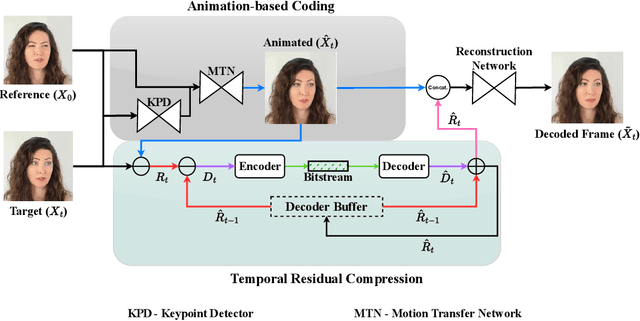
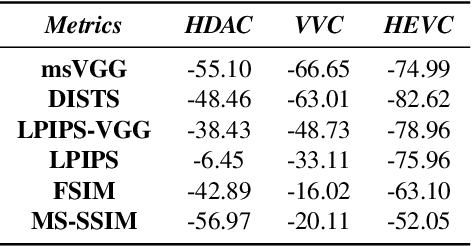

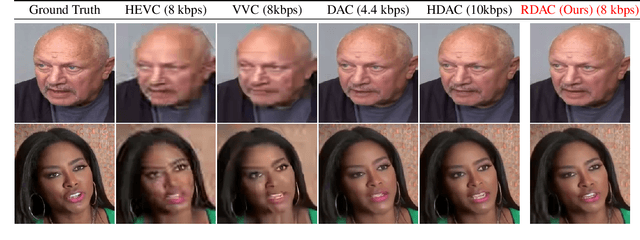
We address the problem of efficiently compressing video for conferencing-type applications. We build on recent approaches based on image animation, which can achieve good reconstruction quality at very low bitrate by representing face motions with a compact set of sparse keypoints. However, these methods encode video in a frame-by-frame fashion, i.e. each frame is reconstructed from a reference frame, which limits the reconstruction quality when the bandwidth is larger. Instead, we propose a predictive coding scheme which uses image animation as a predictor, and codes the residual with respect to the actual target frame. The residuals can be in turn coded in a predictive manner, thus removing efficiently temporal dependencies. Our experiments indicate a significant bitrate gain, in excess of 70% compared to the HEVC video standard and over 30% compared to VVC, on a datasetof talking-head videos
Quality evaluation of point clouds: a novel no-reference approach using transformer-based architecture
Mar 15, 2023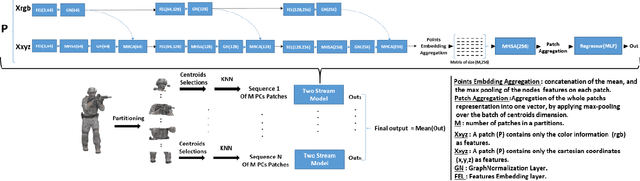
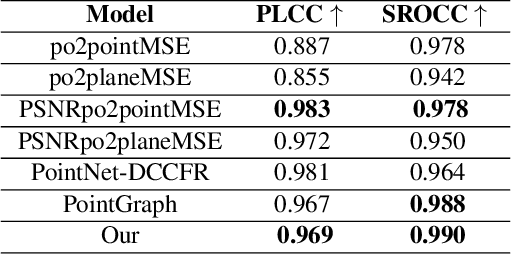
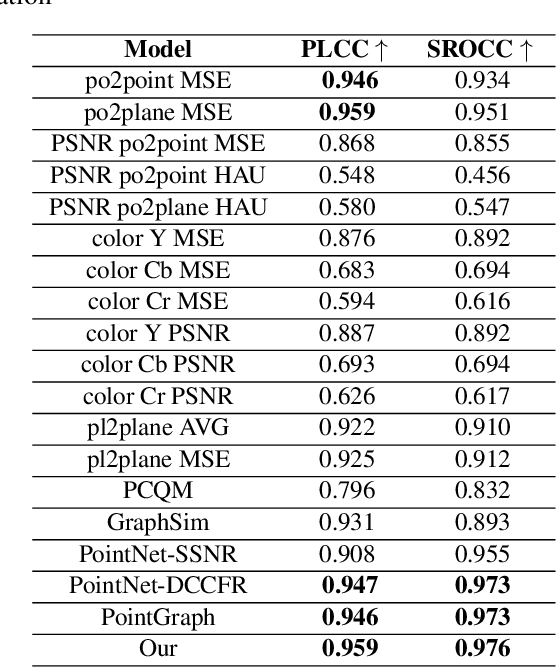
With the increased interest in immersive experiences, point cloud came to birth and was widely adopted as the first choice to represent 3D media. Besides several distortions that could affect the 3D content spanning from acquisition to rendering, efficient transmission of such volumetric content over traditional communication systems stands at the expense of the delivered perceptual quality. To estimate the magnitude of such degradation, employing quality metrics became an inevitable solution. In this work, we propose a novel deep-based no-reference quality metric that operates directly on the whole point cloud without requiring extensive pre-processing, enabling real-time evaluation over both transmission and rendering levels. To do so, we use a novel model design consisting primarily of cross and self-attention layers, in order to learn the best set of local semantic affinities while keeping the best combination of geometry and color information in multiple levels from basic features extraction to deep representation modeling.
BASICS: Broad quality Assessment of Static point clouds In Compression Scenarios
Feb 09, 2023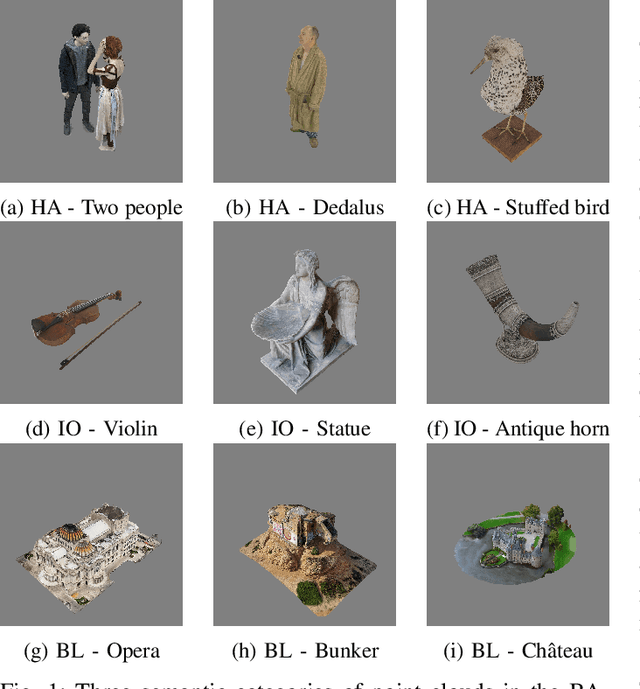


Point clouds are now commonly used to represent 3D scenes in virtual world, in addition to 3D meshes. Their ease of capture enable various applications on mobile devices, such as smartphones or other microcontrollers. Point cloud compression is now at an advanced level and being standardized. Nevertheless, quality assessment databases, which is needed to develop better objective quality metrics, are still limited. In this work, we create a broad quality assessment database for static point clouds, mainly for telepresence scenario. For the sake of completeness, the created database is analyzed using the mean opinion scores, and it is used to benchmark several state-of-the-art quality estimators. The generated database is named Broad quality Assessment of Static point clouds In Compression Scenario (BASICS). Currently, the BASICS database is used as part of the ICIP 2023 Grand Challenge on Point Cloud Quality Assessment, and therefore only a part of the database has been made publicly available at the challenge website. The rest of the database will be made available once the challenge is over.
PCQA-GRAPHPOINT: Efficients Deep-Based Graph Metric For Point Cloud Quality Assessment
Nov 04, 2022Following the advent of immersive technologies and the increasing interest in representing interactive geometrical format, 3D Point Clouds (PC) have emerged as a promising solution and effective means to display 3D visual information. In addition to other challenges in immersive applications, objective and subjective quality assessments of compressed 3D content remain open problems and an area of research interest. Yet most of the efforts in the research area ignore the local geometrical structures between points representation. In this paper, we overcome this limitation by introducing a novel and efficient objective metric for Point Clouds Quality Assessment, by learning local intrinsic dependencies using Graph Neural Network (GNN). To evaluate the performance of our method, two well-known datasets have been used. The results demonstrate the effectiveness and reliability of our solution compared to state-of-the-art metrics.
A Hybrid Deep Animation Codec for Low-bitrate Video Conferencing
Jul 27, 2022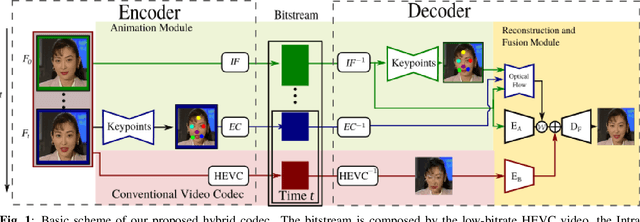
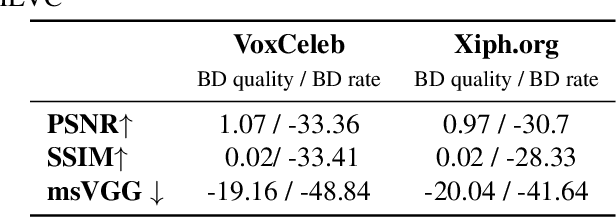
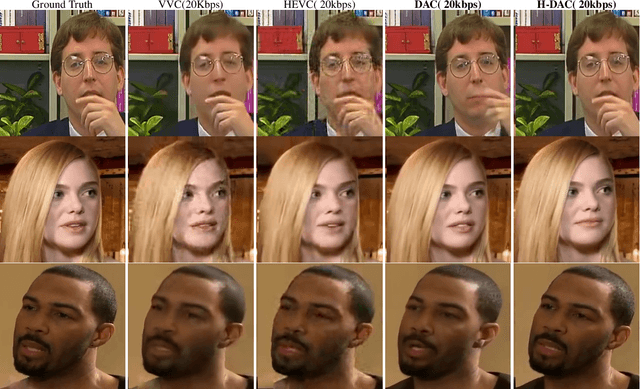
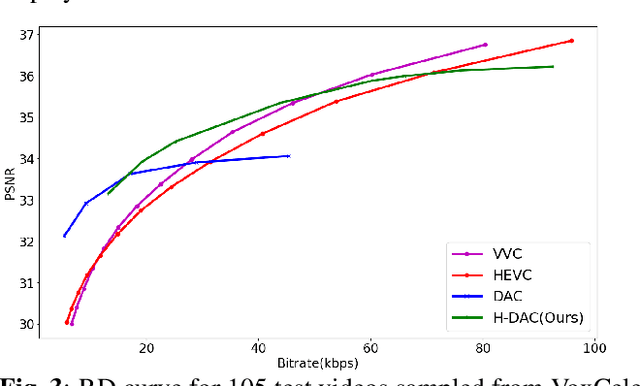
Deep generative models, and particularly facial animation schemes, can be used in video conferencing applications to efficiently compress a video through a sparse set of keypoints, without the need to transmit dense motion vectors. While these schemes bring significant coding gains over conventional video codecs at low bitrates, their performance saturates quickly when the available bandwidth increases. In this paper, we propose a layered, hybrid coding scheme to overcome this limitation. Specifically, we extend a codec based on facial animation by adding an auxiliary stream consisting of a very low bitrate version of the video, obtained through a conventional video codec (e.g., HEVC). The animated and auxiliary videos are combined through a novel fusion module. Our results show consistent average BD-Rate gains in excess of -30% on a large dataset of video conferencing sequences, extending the operational range of bitrates of a facial animation codec alone