 Add to Chrome
 Add to Firefox
 Add to Edge
Benchmark Agreement Testing Done Right: A Guide for LLM Benchmark Evaluation
Jul 18, 2024


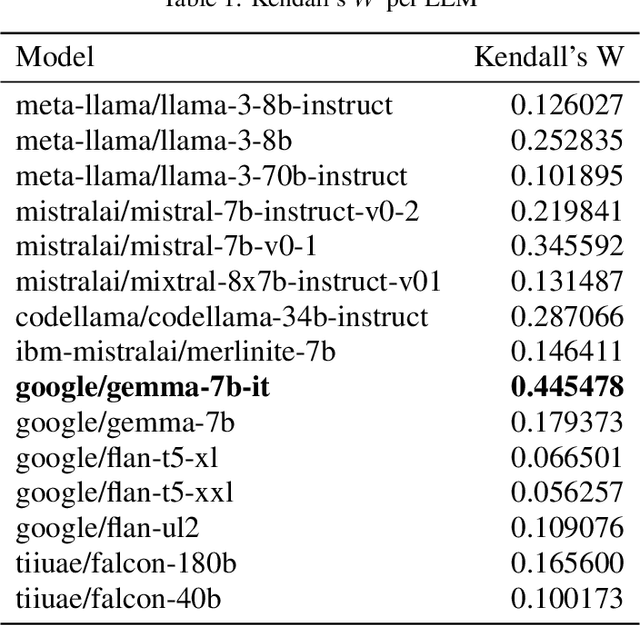
Recent advancements in Language Models (LMs) have catalyzed the creation of multiple benchmarks, designed to assess these models' general capabilities. A crucial task, however, is assessing the validity of the benchmarks themselves. This is most commonly done via Benchmark Agreement Testing (BAT), where new benchmarks are validated against established ones using some agreement metric (e.g., rank correlation). Despite the crucial role of BAT for benchmark builders and consumers, there are no standardized procedures for such agreement testing. This deficiency can lead to invalid conclusions, fostering mistrust in benchmarks and upending the ability to properly choose the appropriate benchmark to use. By analyzing over 40 prominent benchmarks, we demonstrate how some overlooked methodological choices can significantly influence BAT results, potentially undermining the validity of conclusions. To address these inconsistencies, we propose a set of best practices for BAT and demonstrate how utilizing these methodologies greatly improves BAT robustness and validity. To foster adoption and facilitate future research,, we introduce BenchBench, a python package for BAT, and release the BenchBench-leaderboard, a meta-benchmark designed to evaluate benchmarks using their peers. Our findings underscore the necessity for standardized BAT, ensuring the robustness and validity of benchmark evaluations in the evolving landscape of language model research. BenchBench Package: https://github.com/IBM/BenchBench Leaderboard: https://huggingface.co/spaces/per/BenchBench

Learning from Naturally Occurring Feedback
Jul 15, 2024Human feedback data is a critical component in developing language models. However, collecting this feedback is costly and ultimately not scalable. We propose a scalable method for extracting feedback that users naturally include when interacting with chat models, and leveraging it for model training. We are further motivated by previous work that showed there are also qualitative advantages to using naturalistic (rather than auto-generated) feedback, such as less hallucinations and biases. We manually annotated conversation data to confirm the presence of naturally occurring feedback in a standard corpus, finding that as much as 30% of the chats include explicit feedback. We apply our method to over 1M conversations to obtain hundreds of thousands of feedback samples. Training with the extracted feedback shows significant performance improvements over baseline models, demonstrating the efficacy of our approach in enhancing model alignment to human preferences.
Compress then Serve: Serving Thousands of LoRA Adapters with Little Overhead
Jun 17, 2024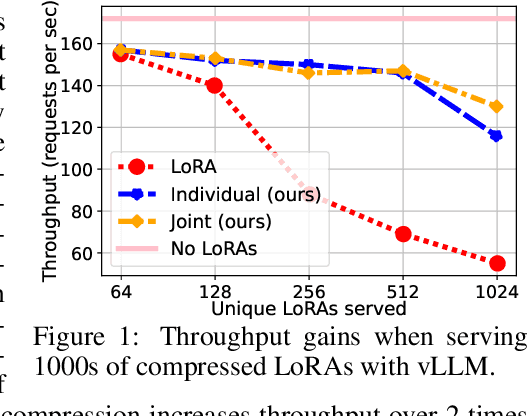
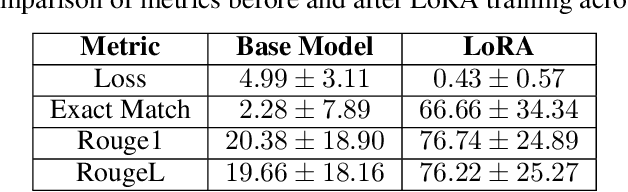
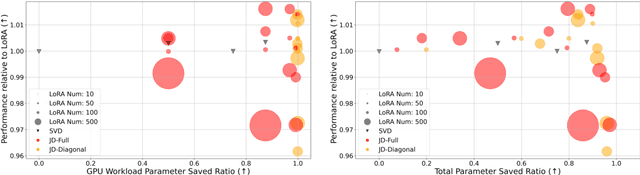
Fine-tuning large language models (LLMs) with low-rank adapters (LoRAs) has become common practice, often yielding numerous copies of the same LLM differing only in their LoRA updates. This paradigm presents challenges for systems that serve real-time responses to queries that each involve a different LoRA. Prior works optimize the design of such systems but still require continuous loading and offloading of LoRAs, as it is infeasible to store thousands of LoRAs in GPU memory. To mitigate this issue, we investigate the efficacy of compression when serving LoRA adapters. We consider compressing adapters individually via SVD and propose a method for joint compression of LoRAs into a shared basis paired with LoRA-specific scaling matrices. Our experiments with up to 500 LoRAs demonstrate that compressed LoRAs preserve performance while offering major throughput gains in realistic serving scenarios with over a thousand LoRAs, maintaining 75% of the throughput of serving a single LoRA.
Efficient multi-prompt evaluation of LLMs
May 27, 2024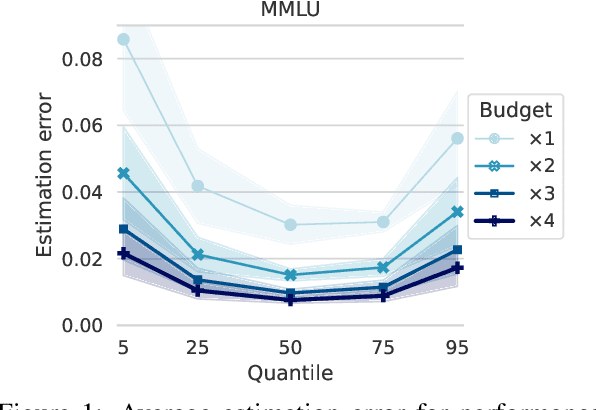
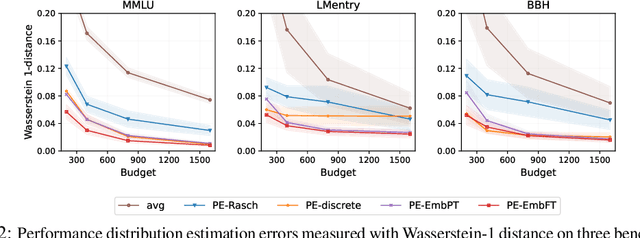
Most popular benchmarks for comparing LLMs rely on a limited set of prompt templates, which may not fully capture the LLMs' abilities and can affect the reproducibility of results on leaderboards. Many recent works empirically verify prompt sensitivity and advocate for changes in LLM evaluation. In this paper, we consider the problem of estimating the performance distribution across many prompt variants instead of finding a single prompt to evaluate with. We introduce PromptEval, a method for estimating performance across a large set of prompts borrowing strength across prompts and examples to produce accurate estimates under practical evaluation budgets. The resulting distribution can be used to obtain performance quantiles to construct various robust performance metrics (e.g., top 95% quantile or median). We prove that PromptEval consistently estimates the performance distribution and demonstrate its efficacy empirically on three prominent LLM benchmarks: MMLU, BIG-bench Hard, and LMentry. For example, PromptEval can accurately estimate performance quantiles across 100 prompt templates on MMLU with a budget equivalent to two single-prompt evaluations. Our code and data can be found at https://github.com/felipemaiapolo/prompt-eval.
Elements of World Knowledge (EWOK): A cognition-inspired framework for evaluating basic world knowledge in language models
May 15, 2024


The ability to build and leverage world models is essential for a general-purpose AI agent. Testing such capabilities is hard, in part because the building blocks of world models are ill-defined. We present Elements of World Knowledge (EWOK), a framework for evaluating world modeling in language models by testing their ability to use knowledge of a concept to match a target text with a plausible/implausible context. EWOK targets specific concepts from multiple knowledge domains known to be vital for world modeling in humans. Domains range from social interactions (help/hinder) to spatial relations (left/right). Both, contexts and targets are minimal pairs. Objects, agents, and locations in the items can be flexibly filled in enabling easy generation of multiple controlled datasets. We then introduce EWOK-CORE-1.0, a dataset of 4,374 items covering 11 world knowledge domains. We evaluate 20 openweights large language models (1.3B--70B parameters) across a battery of evaluation paradigms along with a human norming study comprising 12,480 measurements. The overall performance of all tested models is worse than human performance, with results varying drastically across domains. These data highlight simple cases where even large models fail and present rich avenues for targeted research on LLM world modeling capabilities.
Holmes: Benchmark the Linguistic Competence of Language Models
Apr 29, 2024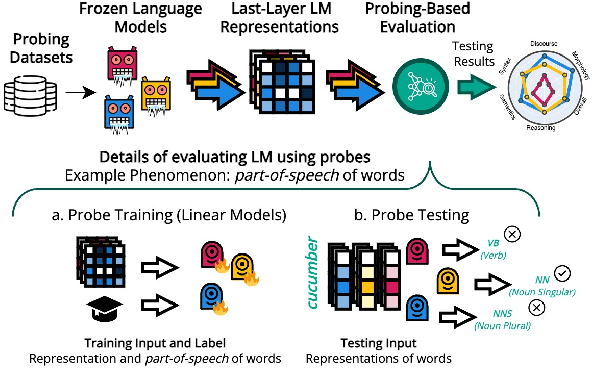
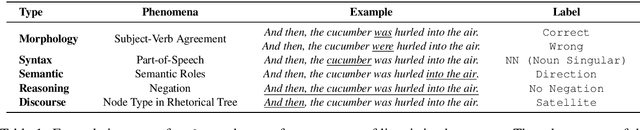

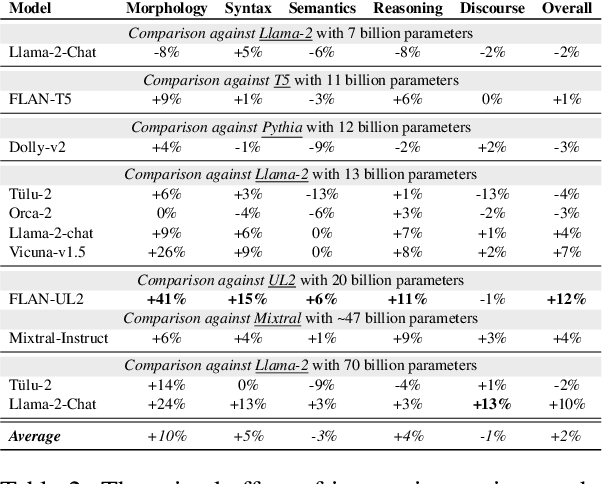
We introduce Holmes, a benchmark to assess the linguistic competence of language models (LMs) - their ability to grasp linguistic phenomena. Unlike prior prompting-based evaluations, Holmes assesses the linguistic competence of LMs via their internal representations using classifier-based probing. In doing so, we disentangle specific phenomena (e.g., part-of-speech of words) from other cognitive abilities, like following textual instructions, and meet recent calls to assess LMs' linguistic competence in isolation. Composing Holmes, we review over 250 probing studies and feature more than 200 datasets to assess syntax, morphology, semantics, reasoning, and discourse phenomena. Analyzing over 50 LMs reveals that, aligned with known trends, their linguistic competence correlates with model size. However, surprisingly, model architecture and instruction tuning also significantly influence performance, particularly in morphology and syntax. Finally, we propose FlashHolmes, a streamlined version of Holmes designed to lower the high computation load while maintaining high-ranking precision.
[Call for Papers] The 2nd BabyLM Challenge: Sample-efficient pretraining on a developmentally plausible corpus
Apr 09, 2024![Figure 1 for [Call for Papers] The 2nd BabyLM Challenge: Sample-efficient pretraining on a developmentally plausible corpus](/_next/image?url=https%3A%2F%2Ffigures.semanticscholar.org%2F6c552d900eadfcedce23c16cbd70fdf6d3024125%2F3-Table1-1.png&w=640&q=75)
After last year's successful BabyLM Challenge, the competition will be hosted again in 2024/2025. The overarching goals of the challenge remain the same; however, some of the competition rules will be different. The big changes for this year's competition are as follows: First, we replace the loose track with a paper track, which allows (for example) non-model-based submissions, novel cognitively-inspired benchmarks, or analysis techniques. Second, we are relaxing the rules around pretraining data, and will now allow participants to construct their own datasets provided they stay within the 100M-word or 10M-word budget. Third, we introduce a multimodal vision-and-language track, and will release a corpus of 50% text-only and 50% image-text multimodal data as a starting point for LM model training. The purpose of this CfP is to provide rules for this year's challenge, explain these rule changes and their rationale in greater detail, give a timeline of this year's competition, and provide answers to frequently asked questions from last year's challenge.
NumeroLogic: Number Encoding for Enhanced LLMs' Numerical Reasoning
Mar 30, 2024
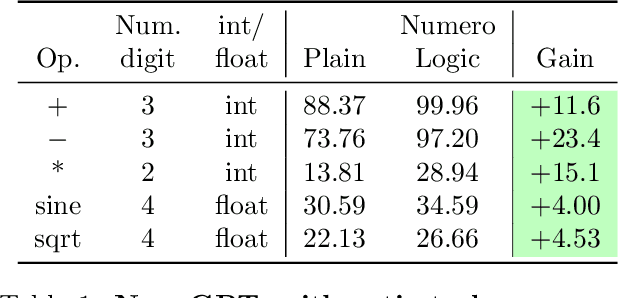
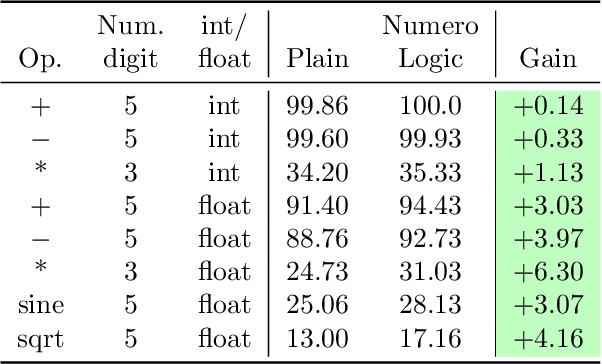
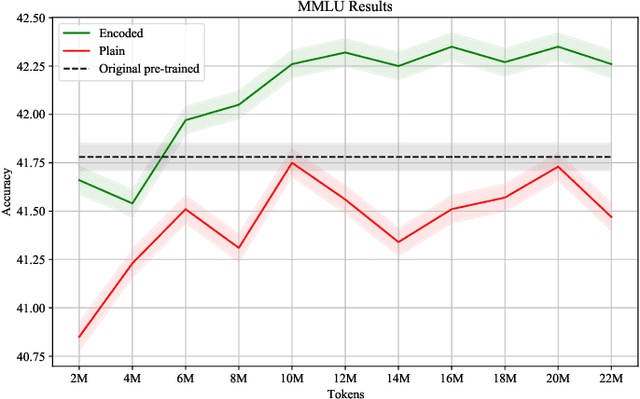
Language models struggle with handling numerical data and performing arithmetic operations. We hypothesize that this limitation can be partially attributed to non-intuitive textual numbers representation. When a digit is read or generated by a causal language model it does not know its place value (e.g. thousands vs. hundreds) until the entire number is processed. To address this issue, we propose a simple adjustment to how numbers are represented by including the count of digits before each number. For instance, instead of "42", we suggest using "{2:42}" as the new format. This approach, which we term NumeroLogic, offers an added advantage in number generation by serving as a Chain of Thought (CoT). By requiring the model to consider the number of digits first, it enhances the reasoning process before generating the actual number. We use arithmetic tasks to demonstrate the effectiveness of the NumeroLogic formatting. We further demonstrate NumeroLogic applicability to general natural language modeling, improving language understanding performance in the MMLU benchmark.
Asymmetry in Low-Rank Adapters of Foundation Models
Feb 27, 2024
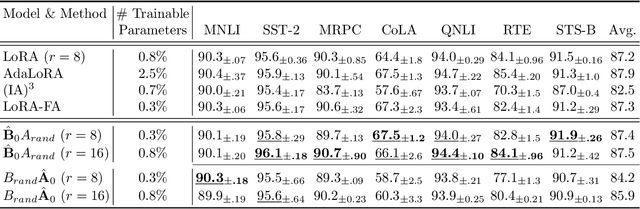

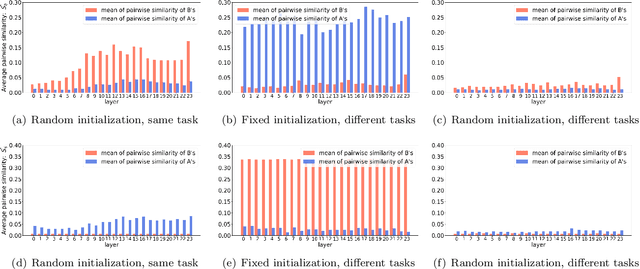
Parameter-efficient fine-tuning optimizes large, pre-trained foundation models by updating a subset of parameters; in this class, Low-Rank Adaptation (LoRA) is particularly effective. Inspired by an effort to investigate the different roles of LoRA matrices during fine-tuning, this paper characterizes and leverages unexpected asymmetry in the importance of low-rank adapter matrices. Specifically, when updating the parameter matrices of a neural network by adding a product $BA$, we observe that the $B$ and $A$ matrices have distinct functions: $A$ extracts features from the input, while $B$ uses these features to create the desired output. Based on this observation, we demonstrate that fine-tuning $B$ is inherently more effective than fine-tuning $A$, and that a random untrained $A$ should perform nearly as well as a fine-tuned one. Using an information-theoretic lens, we also bound the generalization of low-rank adapters, showing that the parameter savings of exclusively training $B$ improves the bound. We support our conclusions with experiments on RoBERTa, BART-Large, LLaMA-2, and ViTs.
tinyBenchmarks: evaluating LLMs with fewer examples
Feb 22, 2024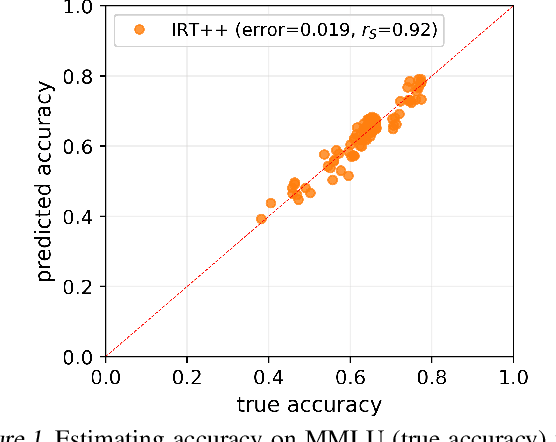

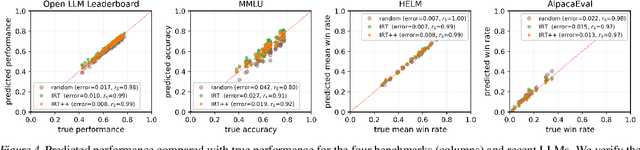
The versatility of large language models (LLMs) led to the creation of diverse benchmarks that thoroughly test a variety of language models' abilities. These benchmarks consist of tens of thousands of examples making evaluation of LLMs very expensive. In this paper, we investigate strategies to reduce the number of evaluations needed to assess the performance of an LLM on several key benchmarks. For example, we show that to accurately estimate the performance of an LLM on MMLU, a popular multiple-choice QA benchmark consisting of 14K examples, it is sufficient to evaluate this LLM on 100 curated examples. We release evaluation tools and tiny versions of popular benchmarks: Open LLM Leaderboard, MMLU, HELM, and AlpacaEval 2.0. Our empirical analysis demonstrates that these tools and tiny benchmarks are sufficient to reliably and efficiently reproduce the original evaluation results.