 Add to Chrome
 Add to Firefox
 Add to Edge
Apt-Serve: Adaptive Request Scheduling on Hybrid Cache for Scalable LLM Inference Serving
Apr 10, 2025
Large language model (LLM) inference serving systems are essential to various LLM-based applications. As demand for LLM services continues to grow, scaling these systems to handle high request rates while meeting latency Service-Level Objectives (SLOs), referred to as effective throughput, becomes critical. However, existing systems often struggle to improve effective throughput, primarily due to a significant decline in Time To First Token (TTFT) SLO attainment. We identify two major causes of this bottleneck: (1) memory-intensive KV cache that limits batch size expansion under GPU memory constraints, and (2) rigid batch composition enforced by the default First-Come-First-Serve scheduling policy. In this paper, we introduce Apt-Serve, a scalable framework designed to enhance effective throughput in LLM inference serving. Apt-Serve features a new hybrid cache scheme that combines KV cache with a memory-efficient hidden cache for reusable input hidden state vectors, allowing large batch sizes and improving request concurrency. Based on the hybrid cache, Apt-Serve employs an adaptive runtime scheduling mechanism that dynamically optimizes batch composition. We formally define the adaptive scheduling optimization problem and propose an efficient algorithm with theoretical guarantees. Extensive evaluations on three real-world datasets and LLMs ranging from 13B to 66B parameters demonstrate that Apt-Serve achieves up to 8.8x improvement in effective throughput compared to the state-of-the-art inference serving systems.

Graph-Structured Driven Dual Adaptation for Mitigating Popularity Bias
Mar 30, 2025Popularity bias challenges recommender systems by causing uneven recommendation performance and amplifying the Matthew effect. Limited user-item interactions confine unpopular items within embedding neighborhoods of few users, leading to representation collapse and reduced model generalization. Existing supervised alignment and reweighting methods mitigate this bias but have key limitations: (1) ignoring inherent variability across Graph Convolutional Networks (GCNs) layers, causing negative effects in deeper layers; (2) reliance on fixed hyperparameters to balance item popularity, restricting adaptability and increasing complexity. To address these issues, we propose the Graph-Structured Dual Adaptation Framework (GSDA). Our theoretical analysis identifies a crucial limitation of supervised alignment methods caused by over-smoothing in GCNs. As GCN layers deepen, popular and unpopular items increasingly lose distinctiveness, quantified by reduced conditional entropy. This diminished distinctiveness weakens supervised alignment effectiveness in mitigating popularity bias. Motivated by this, GSDA captures structural and distribution characteristics from the adjacency matrix through a dual adaptive strategy. First, a hierarchical adaptive alignment mechanism uses the adjacency matrix's Frobenius norm for layer-specific weight decay, countering conditional entropy reduction effects at deeper layers. Second, a distribution-aware dynamic contrast weighting strategy, guided by a real-time Gini coefficient, removes dependence on fixed hyperparameters, enabling adaptability to diverse data. Experiments on three benchmark datasets demonstrate GSDA significantly alleviates popularity bias and consistently outperforms state-of-the-art recommendation methods.
FakeReasoning: Towards Generalizable Forgery Detection and Reasoning
Mar 27, 2025Accurate and interpretable detection of AI-generated images is essential for mitigating risks associated with AI misuse. However, the substantial domain gap among generative models makes it challenging to develop a generalizable forgery detection model. Moreover, since every pixel in an AI-generated image is synthesized, traditional saliency-based forgery explanation methods are not well suited for this task. To address these challenges, we propose modeling AI-generated image detection and explanation as a Forgery Detection and Reasoning task (FDR-Task), leveraging vision-language models (VLMs) to provide accurate detection through structured and reliable reasoning over forgery attributes. To facilitate this task, we introduce the Multi-Modal Forgery Reasoning dataset (MMFR-Dataset), a large-scale dataset containing 100K images across 10 generative models, with 10 types of forgery reasoning annotations, enabling comprehensive evaluation of FDR-Task. Additionally, we propose FakeReasoning, a forgery detection and reasoning framework with two key components. First, Forgery-Aligned Contrastive Learning enhances VLMs' understanding of forgery-related semantics through both cross-modal and intra-modal contrastive learning between images and forgery attribute reasoning. Second, a Classification Probability Mapper bridges the optimization gap between forgery detection and language modeling by mapping the output logits of VLMs to calibrated binary classification probabilities. Experiments across multiple generative models demonstrate that FakeReasoning not only achieves robust generalization but also outperforms state-of-the-art methods on both detection and reasoning tasks.
FuXi-RTM: A Physics-Guided Prediction Framework with Radiative Transfer Modeling
Mar 25, 2025


Similar to conventional video generation, current deep learning-based weather prediction frameworks often lack explicit physical constraints, leading to unphysical outputs that limit their reliability for operational forecasting. Among various physical processes requiring proper representation, radiation plays a fundamental role as it drives Earth's weather and climate systems. However, accurate simulation of radiative transfer processes remains challenging for traditional numerical weather prediction (NWP) models due to their inherent complexity and high computational costs. Here, we propose FuXi-RTM, a hybrid physics-guided deep learning framework designed to enhance weather forecast accuracy while enforcing physical consistency. FuXi-RTM integrates a primary forecasting model (FuXi) with a fixed deep learning-based radiative transfer model (DLRTM) surrogate that efficiently replaces conventional radiation parameterization schemes. This represents the first deep learning-based weather forecasting framework to explicitly incorporate physical process modeling. Evaluated over a comprehensive 5-year dataset, FuXi-RTM outperforms its unconstrained counterpart in 88.51% of 3320 variable and lead time combinations, with improvements in radiative flux predictions. By incorporating additional physical processes, FuXi-RTM paves the way for next-generation weather forecasting systems that are both accurate and physically consistent.
E-SAM: Training-Free Segment Every Entity Model
Mar 15, 2025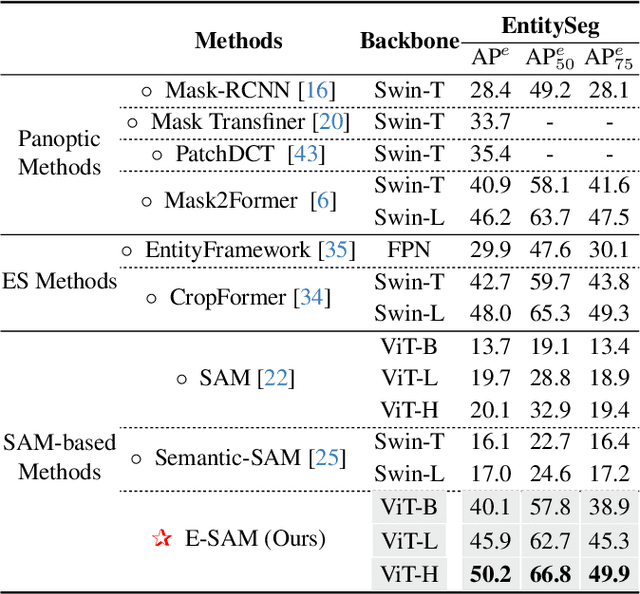
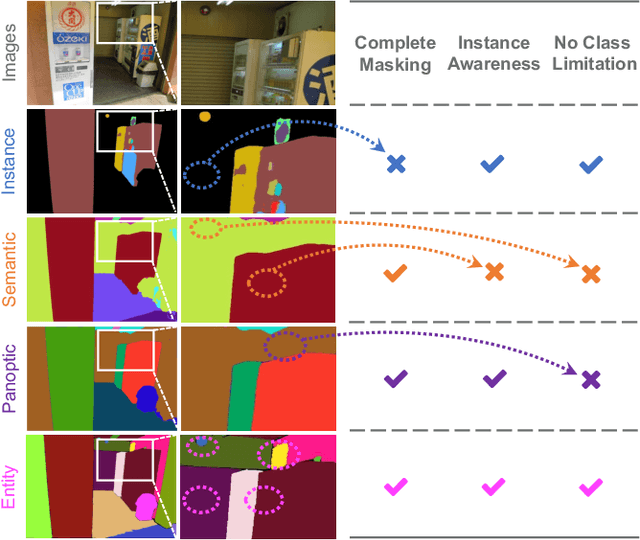
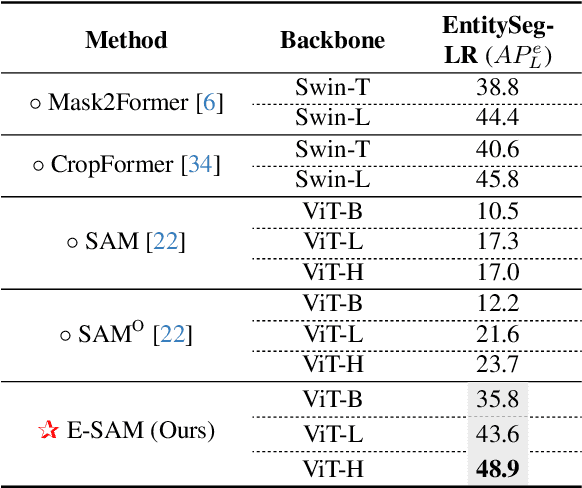
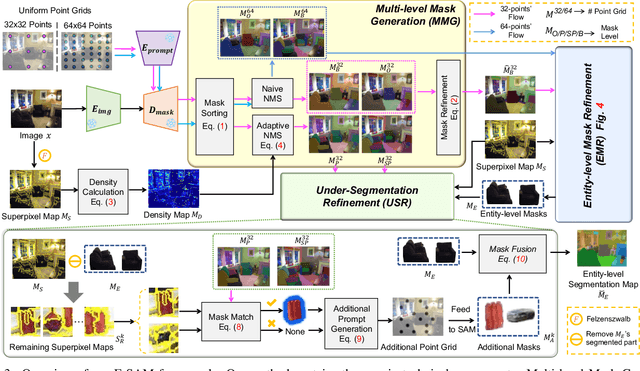
Entity Segmentation (ES) aims at identifying and segmenting distinct entities within an image without the need for predefined class labels. This characteristic makes ES well-suited to open-world applications with adaptation to diverse and dynamically changing environments, where new and previously unseen entities may appear frequently. Existing ES methods either require large annotated datasets or high training costs, limiting their scalability and adaptability. Recently, the Segment Anything Model (SAM), especially in its Automatic Mask Generation (AMG) mode, has shown potential for holistic image segmentation. However, it struggles with over-segmentation and under-segmentation, making it less effective for ES. In this paper, we introduce E-SAM, a novel training-free framework that exhibits exceptional ES capability. Specifically, we first propose Multi-level Mask Generation (MMG) that hierarchically processes SAM's AMG outputs to generate reliable object-level masks while preserving fine details at other levels. Entity-level Mask Refinement (EMR) then refines these object-level masks into accurate entity-level masks. That is, it separates overlapping masks to address the redundancy issues inherent in SAM's outputs and merges similar masks by evaluating entity-level consistency. Lastly, Under-Segmentation Refinement (USR) addresses under-segmentation by generating additional high-confidence masks fused with EMR outputs to produce the final ES map. These three modules are seamlessly optimized to achieve the best ES without additional training overhead. Extensive experiments demonstrate that E-SAM achieves state-of-the-art performance compared to prior ES methods, demonstrating a significant improvement by +30.1 on benchmark metrics.
PLM: Efficient Peripheral Language Models Hardware-Co-Designed for Ubiquitous Computing
Mar 15, 2025

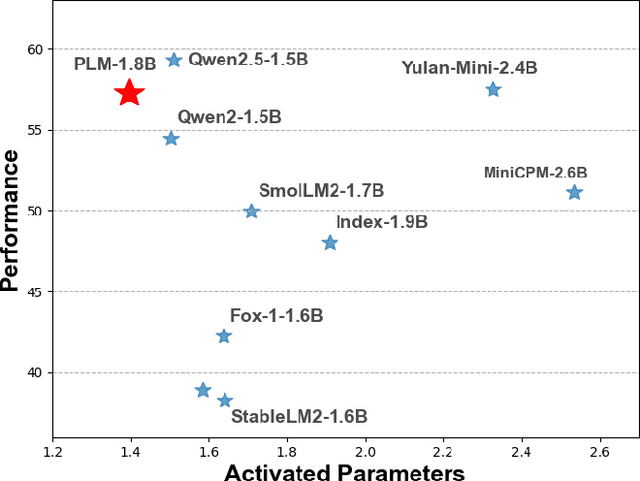

While scaling laws have been continuously validated in large language models (LLMs) with increasing model parameters, the inherent tension between the inference demands of LLMs and the limited resources of edge devices poses a critical challenge to the development of edge intelligence. Recently, numerous small language models have emerged, aiming to distill the capabilities of LLMs into smaller footprints. However, these models often retain the fundamental architectural principles of their larger counterparts, still imposing considerable strain on the storage and bandwidth capacities of edge devices. In this paper, we introduce the PLM, a Peripheral Language Model, developed through a co-design process that jointly optimizes model architecture and edge system constraints. The PLM utilizes a Multi-head Latent Attention mechanism and employs the squared ReLU activation function to encourage sparsity, thereby reducing peak memory footprint during inference. During training, we collect and reorganize open-source datasets, implement a multi-phase training strategy, and empirically investigate the Warmup-Stable-Decay-Constant (WSDC) learning rate scheduler. Additionally, we incorporate Reinforcement Learning from Human Feedback (RLHF) by adopting the ARIES preference learning approach. Following a two-phase SFT process, this method yields performance gains of 2% in general tasks, 9% in the GSM8K task, and 11% in coding tasks. In addition to its novel architecture, evaluation results demonstrate that PLM outperforms existing small language models trained on publicly available data while maintaining the lowest number of activated parameters. Furthermore, deployment across various edge devices, including consumer-grade GPUs, mobile phones, and Raspberry Pis, validates PLM's suitability for peripheral applications. The PLM series models are publicly available at https://github.com/plm-team/PLM.
OpenRAG: Optimizing RAG End-to-End via In-Context Retrieval Learning
Mar 11, 2025In this paper, we analyze and empirically show that the learned relevance for conventional information retrieval (IR) scenarios may be inconsistent in retrieval-augmented generation (RAG) scenarios. To bridge this gap, we introduce OpenRAG, a RAG framework that is optimized end-to-end by tuning the retriever to capture in-context relevance, enabling adaptation to the diverse and evolving needs. Extensive experiments across a wide range of tasks demonstrate that OpenRAG, by tuning a retriever end-to-end, leads to a consistent improvement of 4.0% over the original retriever, consistently outperforming existing state-of-the-art retrievers by 2.1%. Additionally, our results indicate that for some tasks, an end-to-end tuned 0.2B retriever can achieve improvements that surpass those of RAG-oriented or instruction-tuned 8B large language models (LLMs), highlighting the cost-effectiveness of our approach in enhancing RAG systems.
Rule-Based Conflict-Free Decision Framework in Swarm Confrontation
Mar 10, 2025Traditional rule-based decision-making methods with interpretable advantage, such as finite state machine, suffer from the jitter or deadlock(JoD) problems in extremely dynamic scenarios. To realize agent swarm confrontation, decision conflicts causing many JoD problems are a key issue to be solved. Here, we propose a novel decision-making framework that integrates probabilistic finite state machine, deep convolutional networks, and reinforcement learning to implement interpretable intelligence into agents. Our framework overcomes state machine instability and JoD problems, ensuring reliable and adaptable decisions in swarm confrontation. The proposed approach demonstrates effective performance via enhanced human-like cooperation and competitive strategies in the rigorous evaluation of real experiments, outperforming other methods.
UniGenX: Unified Generation of Sequence and Structure with Autoregressive Diffusion
Mar 09, 2025Unified generation of sequence and structure for scientific data (e.g., materials, molecules, proteins) is a critical task. Existing approaches primarily rely on either autoregressive sequence models or diffusion models, each offering distinct advantages and facing notable limitations. Autoregressive models, such as GPT, Llama, and Phi-4, have demonstrated remarkable success in natural language generation and have been extended to multimodal tasks (e.g., image, video, and audio) using advanced encoders like VQ-VAE to represent complex modalities as discrete sequences. However, their direct application to scientific domains is challenging due to the high precision requirements and the diverse nature of scientific data. On the other hand, diffusion models excel at generating high-dimensional scientific data, such as protein, molecule, and material structures, with remarkable accuracy. Yet, their inability to effectively model sequences limits their potential as general-purpose multimodal foundation models. To address these challenges, we propose UniGenX, a unified framework that combines autoregressive next-token prediction with conditional diffusion models. This integration leverages the strengths of autoregressive models to ease the training of conditional diffusion models, while diffusion-based generative heads enhance the precision of autoregressive predictions. We validate the effectiveness of UniGenX on material and small molecule generation tasks, achieving a significant leap in state-of-the-art performance for material crystal structure prediction and establishing new state-of-the-art results for small molecule structure prediction, de novo design, and conditional generation. Notably, UniGenX demonstrates significant improvements, especially in handling long sequences for complex structures, showcasing its efficacy as a versatile tool for scientific data generation.
A Selective Learning Method for Temporal Graph Continual Learning
Mar 03, 2025Node classification is a key task in temporal graph learning (TGL). Real-life temporal graphs often introduce new node classes over time, but existing TGL methods assume a fixed set of classes. This assumption brings limitations, as updating models with full data is costly, while focusing only on new classes results in forgetting old ones. Graph continual learning (GCL) methods mitigate forgetting using old-class subsets but fail to account for their evolution. We define this novel problem as temporal graph continual learning (TGCL), which focuses on efficiently maintaining up-to-date knowledge of old classes. To tackle TGCL, we propose a selective learning framework that substitutes the old-class data with its subsets, Learning Towards the Future (LTF). We derive an upper bound on the error caused by such replacement and transform it into objectives for selecting and learning subsets that minimize classification error while preserving the distribution of the full old-class data. Experiments on three real-world datasets validate the effectiveness of LTF on TGCL.