 Add to Chrome
 Add to Firefox
 Add to Edge
expo: Exploration-prioritized policy optimization via adaptive kl regulation and gaussian curriculum sampling
May 11, 2026
Reinforcement Learning with Verifiable Rewards (RLVR) has become the standard paradigm for LLM mathematical reasoning, where Group Relative Policy Optimization (GRPO) serves as the mainstream algorithm. We point out two understudied inefficiencies existing in GRPO. First, the fixed KL penalty coefficient overly restricts policy exploration at stages where the model requires significant deviation from the reference policy. Second, uniform sampling of training questions ignores that moderately difficult problems provide the most informative gradient signals for optimization. We propose Exploration-Prioritized Policy Optimization (EXPO) with two lightweight plug-in modules. The Accuracy-Conditioned KL Scaling (AKL) dynamically adjusts KL regularization strength through a smooth nonlinear function of batch average accuracy, relaxing the penalty when the model underperforms and strengthening it when the model achieves good results. The Gaussian Curriculum Sampling (GCS) assigns sampling weights to questions following a Gaussian distribution centered at moderate accuracy around 0.5, focusing training on the model's learning frontier. We conduct extensive experiments on DeepSeek-R1-Distill-Qwen-1.5B and Qwen3-8B-Base over six mathematical reasoning benchmarks. The results show EXPO steadily surpasses vanilla GRPO. It obtains an absolute gain of 13.34 on AIME 2025 pass@32, rising from 63.33 percent to 76.67 percent, and achieves an average pass@32 improvement of 2.66 on the 8B model. The much larger performance gains on pass@32 compared with pass@1 demonstrate that EXPO effectively enlarges the model's exploration boundary under a fixed inference cost budget.

OlaGPT: Empowering LLMs With Human-like Problem-Solving Abilities
May 23, 2023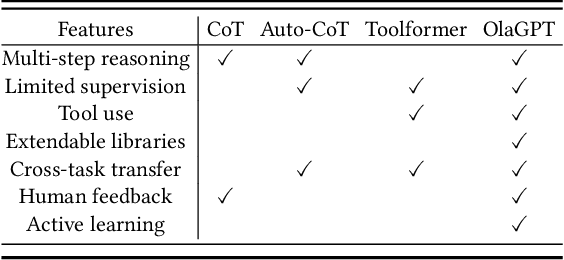
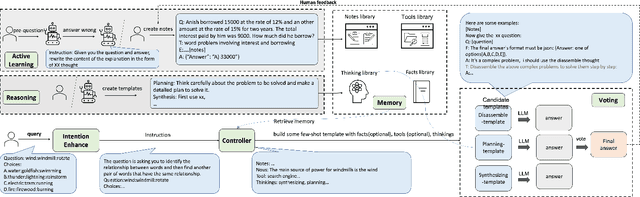
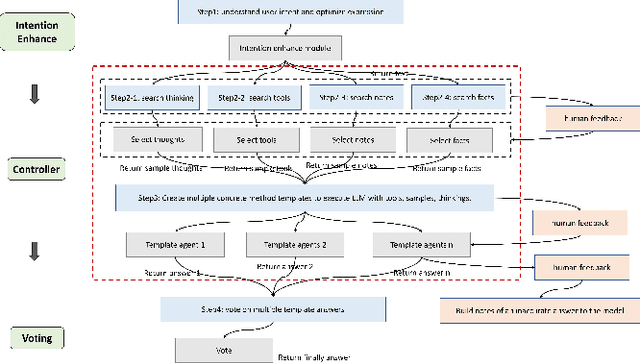
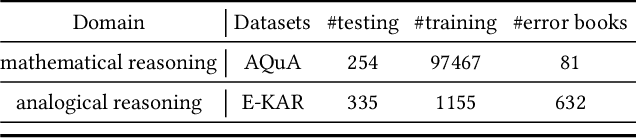
In most current research, large language models (LLMs) are able to perform reasoning tasks by generating chains of thought through the guidance of specific prompts. However, there still exists a significant discrepancy between their capability in solving complex reasoning problems and that of humans. At present, most approaches focus on chains of thought (COT) and tool use, without considering the adoption and application of human cognitive frameworks. It is well-known that when confronting complex reasoning challenges, humans typically employ various cognitive abilities, and necessitate interaction with all aspects of tools, knowledge, and the external environment information to accomplish intricate tasks. This paper introduces a novel intelligent framework, referred to as OlaGPT. OlaGPT carefully studied a cognitive architecture framework, and propose to simulate certain aspects of human cognition. The framework involves approximating different cognitive modules, including attention, memory, reasoning, learning, and corresponding scheduling and decision-making mechanisms. Inspired by the active learning mechanism of human beings, it proposes a learning unit to record previous mistakes and expert opinions, and dynamically refer to them to strengthen their ability to solve similar problems. The paper also outlines common effective reasoning frameworks for human problem-solving and designs Chain-of-Thought (COT) templates accordingly. A comprehensive decision-making mechanism is also proposed to maximize model accuracy. The efficacy of OlaGPT has been stringently evaluated on multiple reasoning datasets, and the experimental outcomes reveal that OlaGPT surpasses state-of-the-art benchmarks, demonstrating its superior performance. Our implementation of OlaGPT is available on GitHub: \url{https://github.com/oladata-team/OlaGPT}.