 Add to Chrome
 Add to Firefox
 Add to Edge
MS MARCO Web Search: a Large-scale Information-rich Web Dataset with Millions of Real Click Labels
May 13, 2024
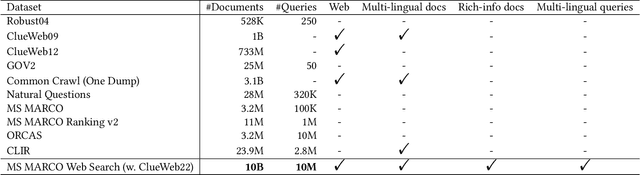
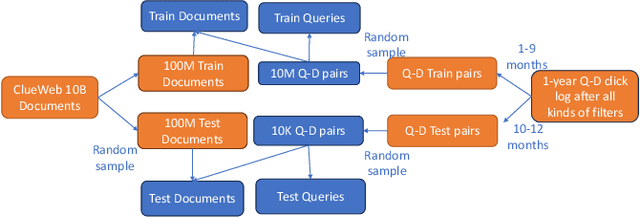

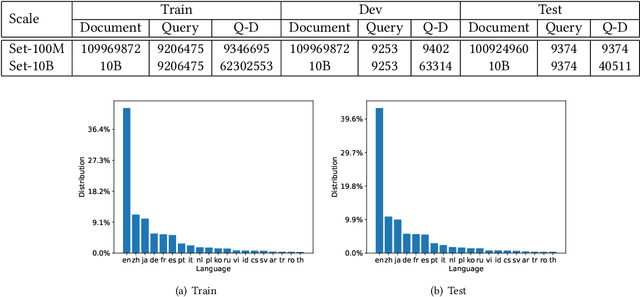
Recent breakthroughs in large models have highlighted the critical significance of data scale, labels and modals. In this paper, we introduce MS MARCO Web Search, the first large-scale information-rich web dataset, featuring millions of real clicked query-document labels. This dataset closely mimics real-world web document and query distribution, provides rich information for various kinds of downstream tasks and encourages research in various areas, such as generic end-to-end neural indexer models, generic embedding models, and next generation information access system with large language models. MS MARCO Web Search offers a retrieval benchmark with three web retrieval challenge tasks that demand innovations in both machine learning and information retrieval system research domains. As the first dataset that meets large, real and rich data requirements, MS MARCO Web Search paves the way for future advancements in AI and system research. MS MARCO Web Search dataset is available at: https://github.com/microsoft/MS-MARCO-Web-Search.

X-SLAM: Scalable Dense SLAM for Task-aware Optimization using CSFD
May 03, 2024We present X-SLAM, a real-time dense differentiable SLAM system that leverages the complex-step finite difference (CSFD) method for efficient calculation of numerical derivatives, bypassing the need for a large-scale computational graph. The key to our approach is treating the SLAM process as a differentiable function, enabling the calculation of the derivatives of important SLAM parameters through Taylor series expansion within the complex domain. Our system allows for the real-time calculation of not just the gradient, but also higher-order differentiation. This facilitates the use of high-order optimizers to achieve better accuracy and faster convergence. Building on X-SLAM, we implemented end-to-end optimization frameworks for two important tasks: camera relocalization in wide outdoor scenes and active robotic scanning in complex indoor environments. Comprehensive evaluations on public benchmarks and intricate real scenes underscore the improvements in the accuracy of camera relocalization and the efficiency of robotic navigation achieved through our task-aware optimization. The code and data are available at https://gapszju.github.io/X-SLAM.
3D Gaussian Blendshapes for Head Avatar Animation
May 02, 2024We introduce 3D Gaussian blendshapes for modeling photorealistic head avatars. Taking a monocular video as input, we learn a base head model of neutral expression, along with a group of expression blendshapes, each of which corresponds to a basis expression in classical parametric face models. Both the neutral model and expression blendshapes are represented as 3D Gaussians, which contain a few properties to depict the avatar appearance. The avatar model of an arbitrary expression can be effectively generated by combining the neutral model and expression blendshapes through linear blending of Gaussians with the expression coefficients. High-fidelity head avatar animations can be synthesized in real time using Gaussian splatting. Compared to state-of-the-art methods, our Gaussian blendshape representation better captures high-frequency details exhibited in input video, and achieves superior rendering performance.
Converting Anyone's Voice: End-to-End Expressive Voice Conversion with a Conditional Diffusion Model
May 02, 2024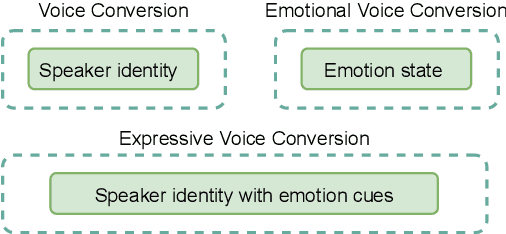
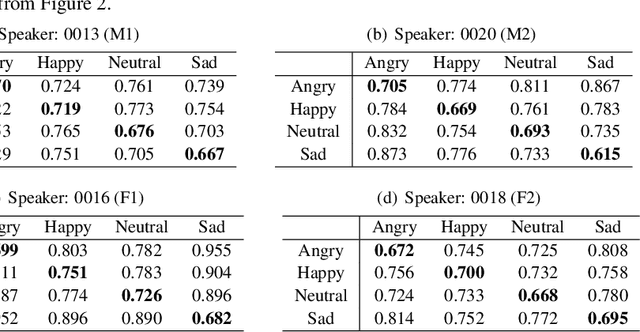
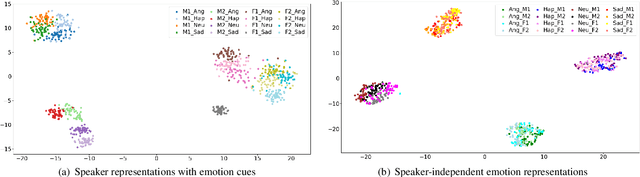

Expressive voice conversion (VC) conducts speaker identity conversion for emotional speakers by jointly converting speaker identity and emotional style. Emotional style modeling for arbitrary speakers in expressive VC has not been extensively explored. Previous approaches have relied on vocoders for speech reconstruction, which makes speech quality heavily dependent on the performance of vocoders. A major challenge of expressive VC lies in emotion prosody modeling. To address these challenges, this paper proposes a fully end-to-end expressive VC framework based on a conditional denoising diffusion probabilistic model (DDPM). We utilize speech units derived from self-supervised speech models as content conditioning, along with deep features extracted from speech emotion recognition and speaker verification systems to model emotional style and speaker identity. Objective and subjective evaluations show the effectiveness of our framework. Codes and samples are publicly available.
RTG-SLAM: Real-time 3D Reconstruction at Scale using Gaussian Splatting
May 01, 2024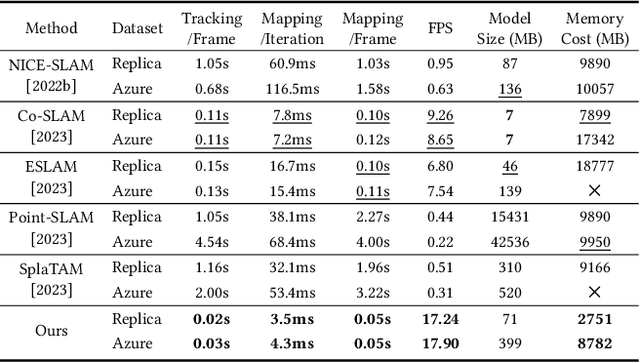
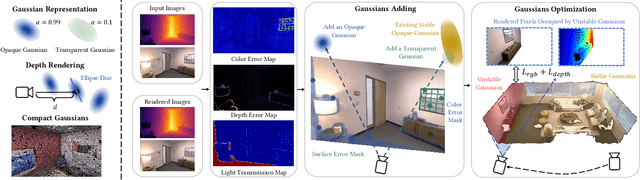
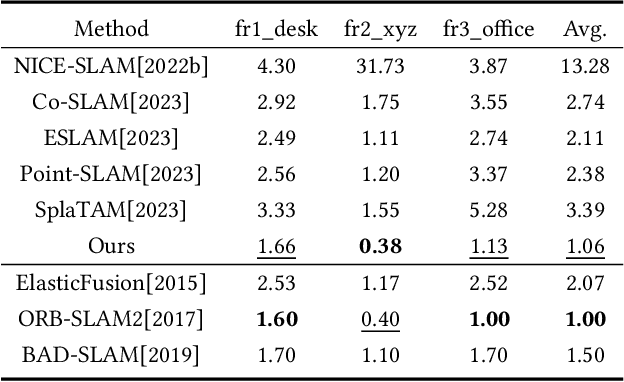
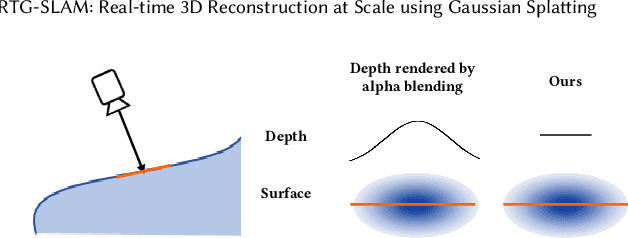
We present Real-time Gaussian SLAM (RTG-SLAM), a real-time 3D reconstruction system with an RGBD camera for large-scale environments using Gaussian splatting. The system features a compact Gaussian representation and a highly efficient on-the-fly Gaussian optimization scheme. We force each Gaussian to be either opaque or nearly transparent, with the opaque ones fitting the surface and dominant colors, and transparent ones fitting residual colors. By rendering depth in a different way from color rendering, we let a single opaque Gaussian well fit a local surface region without the need of multiple overlapping Gaussians, hence largely reducing the memory and computation cost. For on-the-fly Gaussian optimization, we explicitly add Gaussians for three types of pixels per frame: newly observed, with large color errors, and with large depth errors. We also categorize all Gaussians into stable and unstable ones, where the stable Gaussians are expected to well fit previously observed RGBD images and otherwise unstable. We only optimize the unstable Gaussians and only render the pixels occupied by unstable Gaussians. In this way, both the number of Gaussians to be optimized and pixels to be rendered are largely reduced, and the optimization can be done in real time. We show real-time reconstructions of a variety of large scenes. Compared with the state-of-the-art NeRF-based RGBD SLAM, our system achieves comparable high-quality reconstruction but with around twice the speed and half the memory cost, and shows superior performance in the realism of novel view synthesis and camera tracking accuracy.
3D Gaussian Splatting with Deferred Reflection
Apr 29, 2024The advent of neural and Gaussian-based radiance field methods have achieved great success in the field of novel view synthesis. However, specular reflection remains non-trivial, as the high frequency radiance field is notoriously difficult to fit stably and accurately. We present a deferred shading method to effectively render specular reflection with Gaussian splatting. The key challenge comes from the environment map reflection model, which requires accurate surface normal while simultaneously bottlenecks normal estimation with discontinuous gradients. We leverage the per-pixel reflection gradients generated by deferred shading to bridge the optimization process of neighboring Gaussians, allowing nearly correct normal estimations to gradually propagate and eventually spread over all reflective objects. Our method significantly outperforms state-of-the-art techniques and concurrent work in synthesizing high-quality specular reflection effects, demonstrating a consistent improvement of peak signal-to-noise ratio (PSNR) for both synthetic and real-world scenes, while running at a frame rate almost identical to vanilla Gaussian splatting.
MonoHair: High-Fidelity Hair Modeling from a Monocular Video
Mar 27, 2024


Undoubtedly, high-fidelity 3D hair is crucial for achieving realism, artistic expression, and immersion in computer graphics. While existing 3D hair modeling methods have achieved impressive performance, the challenge of achieving high-quality hair reconstruction persists: they either require strict capture conditions, making practical applications difficult, or heavily rely on learned prior data, obscuring fine-grained details in images. To address these challenges, we propose MonoHair,a generic framework to achieve high-fidelity hair reconstruction from a monocular video, without specific requirements for environments. Our approach bifurcates the hair modeling process into two main stages: precise exterior reconstruction and interior structure inference. The exterior is meticulously crafted using our Patch-based Multi-View Optimization (PMVO). This method strategically collects and integrates hair information from multiple views, independent of prior data, to produce a high-fidelity exterior 3D line map. This map not only captures intricate details but also facilitates the inference of the hair's inner structure. For the interior, we employ a data-driven, multi-view 3D hair reconstruction method. This method utilizes 2D structural renderings derived from the reconstructed exterior, mirroring the synthetic 2D inputs used during training. This alignment effectively bridges the domain gap between our training data and real-world data, thereby enhancing the accuracy and reliability of our interior structure inference. Lastly, we generate a strand model and resolve the directional ambiguity by our hair growth algorithm. Our experiments demonstrate that our method exhibits robustness across diverse hairstyles and achieves state-of-the-art performance. For more results, please refer to our project page https://keyuwu-cs.github.io/MonoHair/.
Less is More: Data Value Estimation for Visual Instruction Tuning
Mar 21, 2024Visual instruction tuning is the key to building multimodal large language models (MLLMs), which greatly improves the reasoning capabilities of large language models (LLMs) in vision scenario. However, existing MLLMs mostly rely on a mixture of multiple highly diverse visual instruction datasets for training (even more than a million instructions), which may introduce data redundancy. To investigate this issue, we conduct a series of empirical studies, which reveal a significant redundancy within the visual instruction datasets, and show that greatly reducing the amount of several instruction dataset even do not affect the performance. Based on the findings, we propose a new data selection approach TIVE, to eliminate redundancy within visual instruction data. TIVE first estimates the task-level and instance-level value of the visual instructions based on computed gradients. Then, according to the estimated values, TIVE determines the task proportion within the visual instructions, and selects representative instances to compose a smaller visual instruction subset for training. Experiments on LLaVA-1.5 show that our approach using only about 7.5% data can achieve comparable performance as the full-data fine-tuned model across seven benchmarks, even surpassing it on four of the benchmarks. Our code and data will be publicly released.
Images are Achilles' Heel of Alignment: Exploiting Visual Vulnerabilities for Jailbreaking Multimodal Large Language Models
Mar 14, 2024In this paper, we study the harmlessness alignment problem of multimodal large language models~(MLLMs). We conduct a systematic empirical analysis of the harmlessness performance of representative MLLMs and reveal that the image input poses the alignment vulnerability of MLLMs. Inspired by this, we propose a novel jailbreak method named HADES, which hides and amplifies the harmfulness of the malicious intent within the text input, using meticulously crafted images. Experimental results show that HADES can effectively jailbreak existing MLLMs, which achieves an average Attack Success Rate~(ASR) of 90.26% for LLaVA-1.5 and 71.60% for Gemini Pro Vision. Our code and data will be publicly released.
Fine-Grained Quantitative Emotion Editing for Speech Generation
Mar 04, 2024It remains a significant challenge how to quantitatively control the expressiveness of speech emotion in speech generation. In this work, we present a novel approach for manipulating the rendering of emotions for speech generation. We propose a hierarchical emotion distribution extractor, i.e. Hierarchical ED, that quantifies the intensity of emotions at different levels of granularity. Support vector machines (SVMs) are employed to rank emotion intensity, resulting in a hierarchical emotional embedding. Hierarchical ED is subsequently integrated into the FastSpeech2 framework, guiding the model to learn emotion intensity at phoneme, word, and utterance levels. During synthesis, users can manually edit the emotional intensity of the generated voices. Both objective and subjective evaluations demonstrate the effectiveness of the proposed network in terms of fine-grained quantitative emotion editing.