 Add to Chrome
 Add to Firefox
 Add to Edge
Auditing Instruction-Trajectory Mismatches in Multimodal Robot Demonstrations
Aug 08, 2026
Robot demonstration datasets used to train vision-language-action policies can contain a subtle but harmful failure mode: trajectories that are behaviorally correct but paired with the wrong language instruction. We study post-hoc auditing of these Instruction-Trajectory Mismatches (ITMs). Unlike failed rollouts, ITMs often look plausible, and can corrupt the language-behavior mapping learned by the policy. We propose Multimodal Probabilistic Fusion (MMPF), a training-free auditing framework that treats each modality as an expert, estimates a task-label distribution from local neighborhood agreement and global prototype similarity, and then fuses modalities with predictive-entropy weighting in a product of experts. Across LIBERO benchmarks with injected instruction mismatches and noisy real-robot data, MMPF achieves the strongest overall ITM detection and label correction accuracy. We also show that auditing improves most downstream policy learning in settings where language is needed to disambiguate the task. We demonstrate in real robot experiments that our method can achieve improved policy performance and show the trade-off of filtering demonstrations compared to relabeling.

YUBI: Yielding Universal Bidigital Interface for Bimanual Dexterous Manipulation at Scale
Jun 08, 2026We introduce Yielding Universal Bidigital Interface (YUBI), a finger-aligned gripper designed to enable intuitive, ergonomic, and scalable data collection for bimanual dexterous manipulation. While handheld data collection systems such as Universal Manipulation Interface (UMI) enable affordable data collection, their bulky pistol-grip designs can pose ergonomic and usability challenges for fine-grained, dexterous manipulation tasks. To address this, YUBI presents a distinct design principle: yielding, finger-driven actuation that directly maps human finger movements to gripper jaw motion. Using the YUBI devices, we set up a data collection system with integrated VR-based 6 DoF tracking of the gripper, ensuring high-fidelity trajectory data acquisition. We curate a UMI-based dataset of unprecedented scale: 8,434 hours across 1.20M episodes and 119 tasks. Experiments show that YUBI offers advantages over the UMI gripper in versatility for complex bimanual tasks, dexterity, and operational efficiency. A single policy trained on the YUBI dataset transfers across multiple bimanual robots (UR, Franka, and ELEY) simply by mounting the gripper on each platform, confirming that the collected data are directly executable as policy supervision. We release the gripper hardware, data-collection software, and dataset as one integrated stack, offering the open community a reproducible path to large-scale data acquisition for advancing robotic foundation models.
See Less, Specify More: Visual Evidence Budgets for Generalizable VLAs
Jun 01, 2026Generalization remains a central bottleneck for vision-language-action (VLA) models: under distractors, appearance shifts, and semantically similar tasks, the policy must often infer local execution details from coarse instructions while also deciding which parts of the image matter for control. We present S2 (See Less, Specify More), a framework for improving VLA generalization by training the executor under a cleaner interface. Specify More preserves the original instruction as a stable high-level goal while relabeling each trajectory into refined trajectory- and subtask-level language that disambiguates the current execution mode. Unlike native attention, See Less imposes an explicit visual evidence budget, training the executor to act from task-sufficient evidence rather than unconstrained visual context, without any region or mask annotation. This interface lets the executor follow detailed guidance without relying on distracting visual patches or resolving avoidable ambiguity on its own, and it remains compatible with off-the-shelf VLM planners through in-context learning. Across our main evaluation settings, S2 improves overall generalization metrics by changing the executor's learning problem: coarse instructions induce avoidable supervision aliasing, goal-preserving local guidance outperforms instruction replacement in our main ablations, and explicit evidence budgeting reduces dependence on broad visual context beyond efficiency considerations. Across eight real-robot tasks on TX-G2 (an AgiBot G2-compatible variant) and HSR, S2 raises mean subtask success from 54.2% to 79.0% over pi0.5. Together, these results suggest that VLA generalization improves when the executor is trained to act from informative local guidance and task-sufficient visual evidence, rather than recovering both from weak supervision.
Continuous Reasoning for Vision-Language-Action
May 29, 2026Natural language is a powerful reasoning medium for language and vision-language models, but it is mismatched to the granularity of continuous control. Text and explicit subgoals operate at task-level granularity, whereas vision-language-action (VLA) policies must choose actions at a much finer temporal scale; a single reasoning step can therefore span many action chunks while remaining only weakly coupled to the action needed now. This suggests a different question for VLA: what should play the role of language? We argue that a useful VLA reasoning medium must be shareable across model instances, verifiable through downstream action improvement, and aligned with temporally extended control structure. Based on this view, we propose Continuous Reasoning for Vision-Language-Action. Our model first predicts continuous reasoning in the form of a structured set of continuous thoughts, then reuses them as shared context for chunk-structured action generation. Better action prediction alone does not certify good reasoning: if the same internal medium cannot be shared across model instances and independently verified through improved downstream control, the added latent may simply become a model-private shortcut that helps on seen behaviors without supporting generalizable control. We therefore instantiate continuous reasoning as a shared Gaussian latent interface and train it with a self-verification objective in which an exponential-moving-average teacher must successfully consume the student's reasoning when predicting target actions. Empirically, Continuous Reasoning improves LIBERO-PRO robustness and performs strongly on real robots, raising mean subtask success over π0.5 by 40.4% on TX-G2, an AgiBot G2-compatible variant, and 26.3% on HSR. This suggests that reasoning in VLA is less about extra tokens than about a shareable, verifiable internal language for action.
Touch2Insert: Zero-Shot Peg Insertion by Touching Intersections of Peg and Hole
Mar 04, 2026Reliable insertion of industrial connectors remains a central challenge in robotics, requiring sub-millimeter precision under uncertainty and often without full visual access. Vision-based approaches struggle with occlusion and limited generalization, while learning-based policies frequently fail to transfer to unseen geometries. To address these limitations, we leverage tactile sensing, which captures local surface geometry at the point of contact and thus provides reliable information even under occlusion and across novel connector shapes. Building on this capability, we present \emph{Touch2Insert}, a tactile-based framework for arbitrary peg insertion. Our method reconstructs cross-sectional geometry from high-resolution tactile images and estimates the relative pose of the hole with respect to the peg in a zero-shot manner. By aligning reconstructed shapes through registration, the framework enables insertion from a single contact without task-specific training. To evaluate its performance, we conducted experiments with three diverse connectors in both simulation and real-robot settings. The results indicate that Touch2Insert achieved sub-millimeter pose estimation accuracy for all connectors in simulation, and attained an average success rate of 86.7\% on the real robot, thereby confirming the robustness and generalizability of tactile sensing for real-world robotic connector insertion.
Simultaneous Extrinsic Contact and In-Hand Pose Estimation via Distributed Tactile Sensing
Dec 29, 2025Prehensile autonomous manipulation, such as peg insertion, tool use, or assembly, require precise in-hand understanding of the object pose and the extrinsic contacts made during interactions. Providing accurate estimation of pose and contacts is challenging. Tactile sensors can provide local geometry at the sensor and force information about the grasp, but the locality of sensing means resolving poses and contacts from tactile alone is often an ill-posed problem, as multiple configurations can be consistent with the observations. Adding visual feedback can help resolve ambiguities, but can suffer from noise and occlusions. In this work, we propose a method that pairs local observations from sensing with the physical constraints of contact. We propose a set of factors that ensure local consistency with tactile observations as well as enforcing physical plausibility, namely, that the estimated pose and contacts must respect the kinematic and force constraints of quasi-static rigid body interactions. We formalize our problem as a factor graph, allowing for efficient estimation. In our experiments, we demonstrate that our method outperforms existing geometric and contact-informed estimation pipelines, especially when only tactile information is available. Video results can be found at https://tacgraph.github.io/.
Analytic Conditions for Differentiable Collision Detection in Trajectory Optimization
Sep 30, 2025Optimization-based methods are widely used for computing fast, diverse solutions for complex tasks such as collision-free movement or planning in the presence of contacts. However, most of these methods require enforcing non-penetration constraints between objects, resulting in a non-trivial and computationally expensive problem. This makes the use of optimization-based methods for planning and control challenging. In this paper, we present a method to efficiently enforce non-penetration of sets while performing optimization over their configuration, which is directly applicable to problems like collision-aware trajectory optimization. We introduce novel differentiable conditions with analytic expressions to achieve this. To enforce non-collision between non-smooth bodies using these conditions, we introduce a method to approximate polytopes as smooth semi-algebraic sets. We present several numerical experiments to demonstrate the performance of the proposed method and compare the performance with other baseline methods recently proposed in the literature.
FlowLoss: Dynamic Flow-Conditioned Loss Strategy for Video Diffusion Models
Apr 20, 2025Video Diffusion Models (VDMs) can generate high-quality videos, but often struggle with producing temporally coherent motion. Optical flow supervision is a promising approach to address this, with prior works commonly employing warping-based strategies that avoid explicit flow matching. In this work, we explore an alternative formulation, FlowLoss, which directly compares flow fields extracted from generated and ground-truth videos. To account for the unreliability of flow estimation under high-noise conditions in diffusion, we propose a noise-aware weighting scheme that modulates the flow loss across denoising steps. Experiments on robotic video datasets suggest that FlowLoss improves motion stability and accelerates convergence in early training stages. Our findings offer practical insights for incorporating motion-based supervision into noise-conditioned generative models.
Modality Selection and Skill Segmentation via Cross-Modality Attention
Apr 20, 2025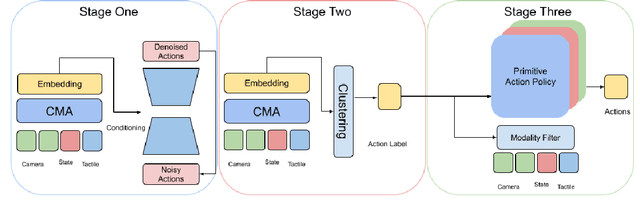
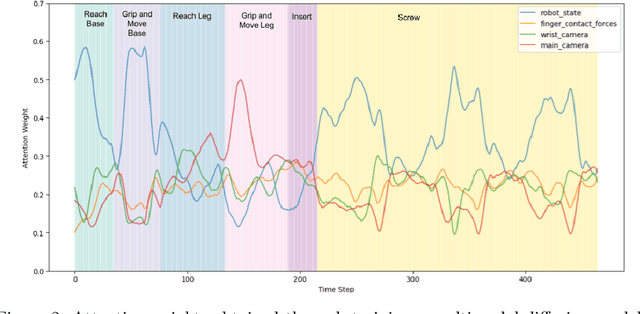
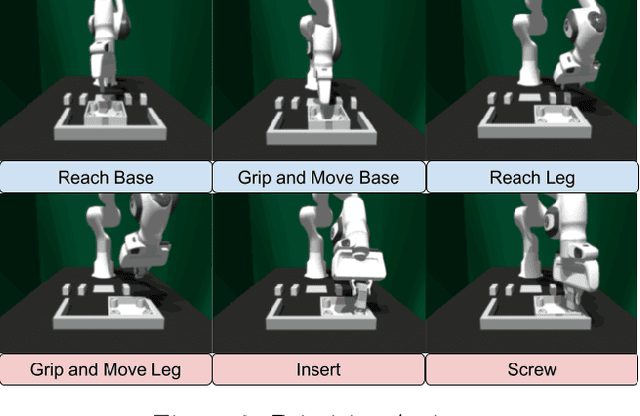
Incorporating additional sensory modalities such as tactile and audio into foundational robotic models poses significant challenges due to the curse of dimensionality. This work addresses this issue through modality selection. We propose a cross-modality attention (CMA) mechanism to identify and selectively utilize the modalities that are most informative for action generation at each timestep. Furthermore, we extend the application of CMA to segment primitive skills from expert demonstrations and leverage this segmentation to train a hierarchical policy capable of solving long-horizon, contact-rich manipulation tasks.
Zero-Shot Peg Insertion: Identifying Mating Holes and Estimating SE(2) Poses with Vision-Language Models
Mar 08, 2025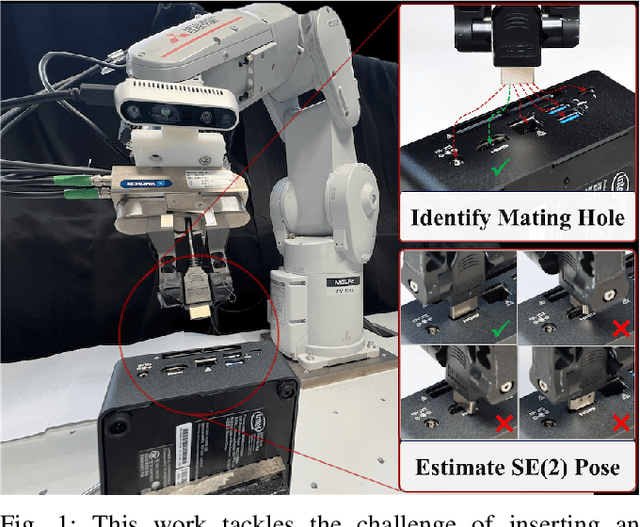
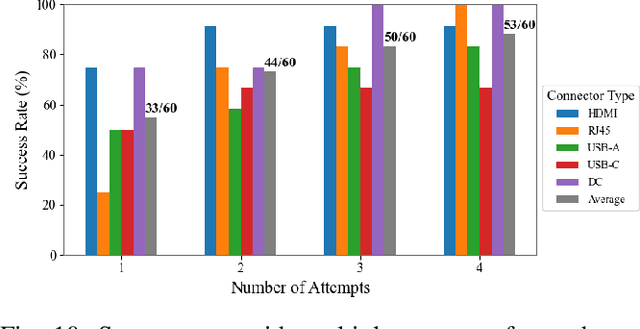
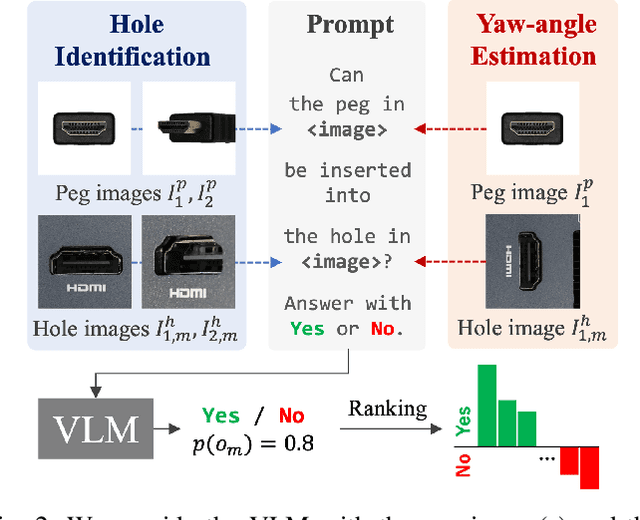

Achieving zero-shot peg insertion, where inserting an arbitrary peg into an unseen hole without task-specific training, remains a fundamental challenge in robotics. This task demands a highly generalizable perception system capable of detecting potential holes, selecting the correct mating hole from multiple candidates, estimating its precise pose, and executing insertion despite uncertainties. While learning-based methods have been applied to peg insertion, they often fail to generalize beyond the specific peg-hole pairs encountered during training. Recent advancements in Vision-Language Models (VLMs) offer a promising alternative, leveraging large-scale datasets to enable robust generalization across diverse tasks. Inspired by their success, we introduce a novel zero-shot peg insertion framework that utilizes a VLM to identify mating holes and estimate their poses without prior knowledge of their geometry. Extensive experiments demonstrate that our method achieves 90.2% accuracy, significantly outperforming baselines in identifying the correct mating hole across a wide range of previously unseen peg-hole pairs, including 3D-printed objects, toy puzzles, and industrial connectors. Furthermore, we validate the effectiveness of our approach in a real-world connector insertion task on a backpanel of a PC, where our system successfully detects holes, identifies the correct mating hole, estimates its pose, and completes the insertion with a success rate of 88.3%. These results highlight the potential of VLM-driven zero-shot reasoning for enabling robust and generalizable robotic assembly.