 Add to Chrome
 Add to Firefox
 Add to Edge
Towards Multimodal Lifelong Understanding: A Dataset and Agentic Baseline
Mar 05, 2026
While datasets for video understanding have scaled to hour-long durations, they typically consist of densely concatenated clips that differ from natural, unscripted daily life. To bridge this gap, we introduce MM-Lifelong, a dataset designed for Multimodal Lifelong Understanding. Comprising 181.1 hours of footage, it is structured across Day, Week, and Month scales to capture varying temporal densities. Extensive evaluations reveal two critical failure modes in current paradigms: end-to-end MLLMs suffer from a Working Memory Bottleneck due to context saturation, while representative agentic baselines experience Global Localization Collapse when navigating sparse, month-long timelines. To address this, we propose the Recursive Multimodal Agent (ReMA), which employs dynamic memory management to iteratively update a recursive belief state, significantly outperforming existing methods. Finally, we establish dataset splits designed to isolate temporal and domain biases, providing a rigorous foundation for future research in supervised learning and out-of-distribution generalization.

Ground-SLAM: Ground Constrained LiDAR SLAM for Structured Multi-Floor Environments
Mar 05, 2021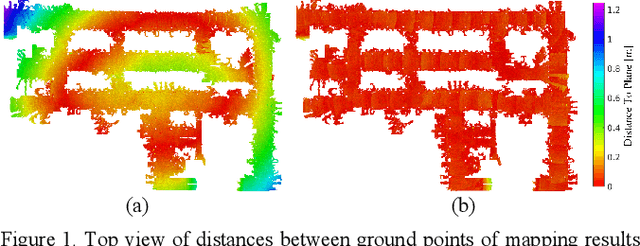
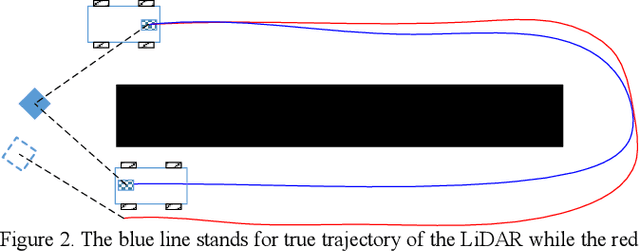
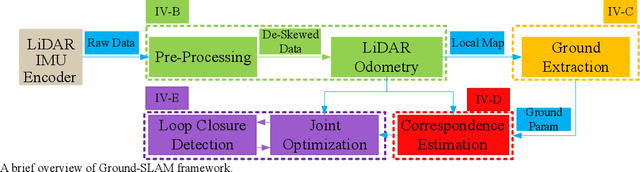
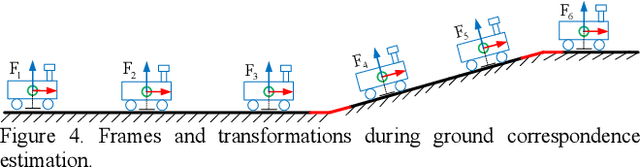
This paper proposes a 3D LiDAR SLAM algorithm named Ground-SLAM, which exploits grounds in structured multi-floor environments to compress the pose drift mainly caused by LiDAR measurement bias. Ground-SLAM is developed based on the well-known pose graph optimization framework. In the front-end, motion estimation is conducted using LiDAR Odometry (LO) with a novel sensor-centric sliding map introduced, which is maintained by filtering out expired features based on the model of error propagation. At each key-frame, the sliding map is recorded as a local map. The ground nearby is extracted and modelled as an infinite planar landmark in the form of Closest Point (CP) parameterization. Then, ground planes observed at different key-frames are associated, and the ground constraints are fused into the pose graph optimization framework to compress the pose drift of LO. Finally, loop-closure detection is carried out, and the residual error is jointly minimized, which could lead to a globally consistent map. Experimental results demonstrate superior performances in the accuracy of the proposed approach.