 Add to Chrome
 Add to Firefox
 Add to Edge
Kimi K3: Open Frontier Intelligence
Jul 27, 2026
We introduce Kimi K3, a 2.8T parameter Mixture-of-Experts model with 104 billion activated parameters, native vision capabilities, and a 1-million-token context window. Kimi K3 is built on Kimi Delta Attention and Attention Residuals, which improve information flow across sequence length and model depth. Together with Stable LatentMoE, which effectively activates 16 of 896 routed experts per token, and refined training and data recipes, these advances yield an approximately 2.5x improvement in overall scaling efficiency over Kimi K2. Post-training highlights reinforcement learning across general, agentic, and coding domains and multiple reasoning-effort levels, enabling compositional generalization and robust long-horizon execution. At 2.8T scale, Kimi K3 is supported by infrastructure advances in multiple areas: algorithm-system co-design for KDA, perfectly balanced expert-parallel training with efficient memory management, million-token agentic RL with persistent rollout and sandbox states, and deployment innovations. Extensive evaluations show that Kimi K3 achieves frontier-level performance across long-horizon coding, agentic, knowledge, reasoning, and vision tasks. While its overall performance still trails the most powerful proprietary models, namely Claude Fable 5 and GPT-5.6 Sol, Kimi K3 consistently outperforms other open and proprietary models evaluated in our suite. We release the full Kimi K3 model weights to facilitate future research and accelerate the broader deployment and adoption of frontier intelligence.

UniStitch: Unifying Semantic and Geometric Features for Image Stitching
Mar 11, 2026Traditional image stitching methods estimate warps from hand-crafted geometric features, whereas recent learning-based solutions leverage semantic features from neural networks instead. These two lines of research have largely diverged along separate evolution, with virtually no meaningful convergence to date. In this paper, we take a pioneering step to bridge this gap by unifying semantic and geometric features with UniStitch, a unified image stitching framework from multimodal features. To align discrete geometric features (i.e., keypoint) with continuous semantic feature maps, we present a Neural Point Transformer (NPT) module, which transforms unordered, sparse 1D geometric keypoints into ordered, dense 2D semantic maps. Then, to integrate the advantages of both representations, an Adaptive Mixture of Experts (AMoE) module is designed to fuse geometric and semantic representations. It dynamically shifts focus toward more reliable features during the fusion process, allowing the model to handle complex scenes, especially when either modality might be compromised. The fused representation can be adopted into common deep stitching pipelines, delivering significant performance gains over any single feature. Experiments show that UniStitch outperforms existing state-of-the-art methods with a large margin, paving the way for a unified paradigm between traditional and learning-based image stitching.
Kimi K2.5: Visual Agentic Intelligence
Feb 02, 2026We introduce Kimi K2.5, an open-source multimodal agentic model designed to advance general agentic intelligence. K2.5 emphasizes the joint optimization of text and vision so that two modalities enhance each other. This includes a series of techniques such as joint text-vision pre-training, zero-vision SFT, and joint text-vision reinforcement learning. Building on this multimodal foundation, K2.5 introduces Agent Swarm, a self-directed parallel agent orchestration framework that dynamically decomposes complex tasks into heterogeneous sub-problems and executes them concurrently. Extensive evaluations show that Kimi K2.5 achieves state-of-the-art results across various domains including coding, vision, reasoning, and agentic tasks. Agent Swarm also reduces latency by up to $4.5\times$ over single-agent baselines. We release the post-trained Kimi K2.5 model checkpoint to facilitate future research and real-world applications of agentic intelligence.
PFL-MoE: Personalized Federated Learning Based on Mixture of Experts
Dec 31, 2020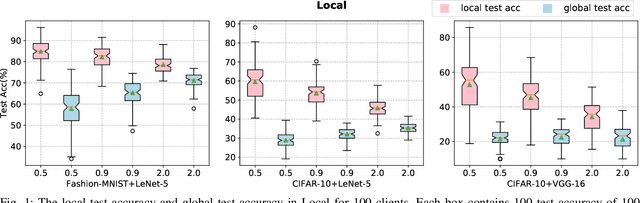
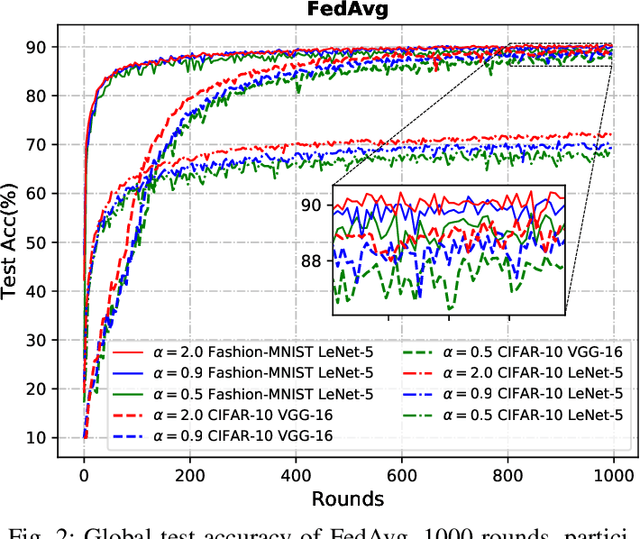
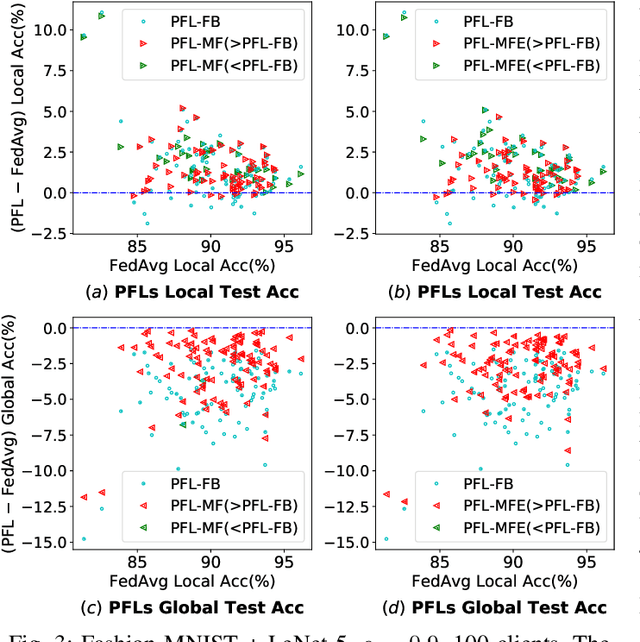
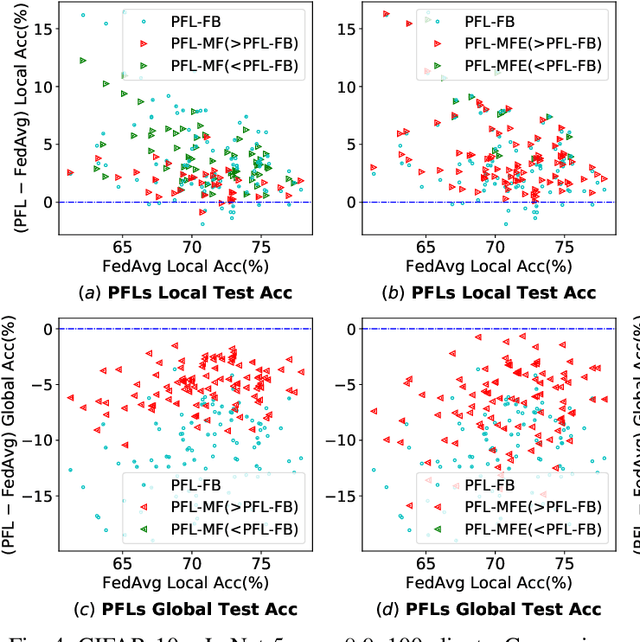
Federated learning (FL) is an emerging distributed machine learning paradigm that avoids data sharing among training nodes so as to protect data privacy. Under coordination of the FL server, each client conducts model training using its own computing resource and private data set. The global model can be created by aggregating the training results of clients. To cope with highly non-IID data distributions, personalized federated learning (PFL) has been proposed to improve overall performance by allowing each client to learn a personalized model. However, one major drawback of a personalized model is the loss of generalization. To achieve model personalization while maintaining generalization, in this paper, we propose a new approach, named PFL-MoE, which mixes outputs of the personalized model and global model via the MoE architecture. PFL-MoE is a generic approach and can be instantiated by integrating existing PFL algorithms. Particularly, we propose the PFL-MF algorithm which is an instance of PFL-MoE based on the freeze-base PFL algorithm. We further improve PFL-MF by enhancing the decision-making ability of MoE gating network and propose a variant algorithm PFL-MFE. We demonstrate the effectiveness of PFL-MoE by training the LeNet-5 and VGG-16 models on the Fashion-MNIST and CIFAR-10 datasets with non-IID partitions.