 Add to Chrome
 Add to Firefox
 Add to Edge
NoveltyRank: Estimating Conceptual Novelty of AI Papers
Dec 12, 2025
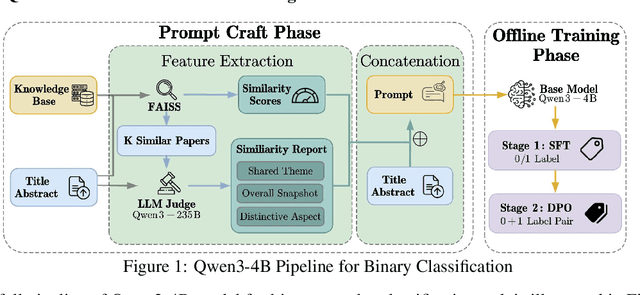
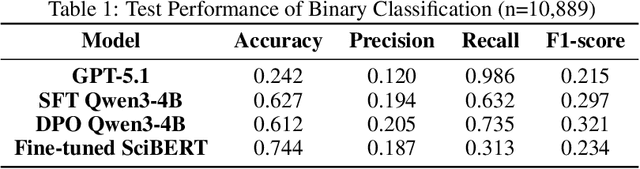
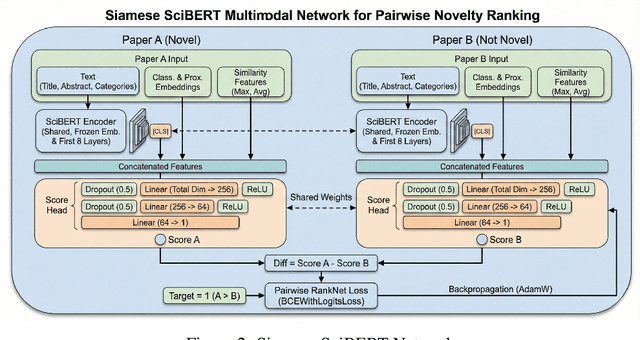

With the growing ease of academic publishing, the volume of research papers, especially in AI-related fields, has surged dramatically. This flood of publications makes it difficult for truly novel and impactful work to stand out, and manual novelty assessment is often unstable and time-consuming. Our project aims to develop a model that estimates and ranks the conceptual novelty of AI papers, enabling a data-driven and scalable assessment of research originality. Such a system can help researchers efficiently identify submissions that introduce genuinely innovative ideas rather than minor variants, and provide conference reviewers with a quantitative and consistent signal of novelty. Our approach evaluates novelty primarily through a paper's title, abstract, and semantic similarity to prior literature. Given the motivation of novelty estimation, we explore two task formulations with different modeling objectives, each offering a different perspective: (1) binary classification, which predicts the paper's absolute novelty from learned patterns of prior novel works, and (2) pairwise novelty comparison, which learns to distinguish papers by relative novelty over others. We fine-tune Qwen3-4B-Instruct-2507 and SciBERT on both tasks, benchmarking against GPT-5.1 to analyze how task formulation and modeling choices affect performance. The implementation is publicly available at https://github.com/ZhengxuYan/NoveltyRank.

VERINA: Benchmarking Verifiable Code Generation
May 29, 2025Large language models (LLMs) are increasingly integrated in software development, but ensuring correctness in LLM-generated code remains challenging and often requires costly manual review. Verifiable code generation -- jointly generating code, specifications, and proofs of code-specification alignment -- offers a promising path to address this limitation and further unleash LLMs' benefits in coding. Yet, there exists a significant gap in evaluation: current benchmarks often lack support for end-to-end verifiable code generation. In this paper, we introduce Verina (Verifiable Code Generation Arena), a high-quality benchmark enabling a comprehensive and modular evaluation of code, specification, and proof generation as well as their compositions. Verina consists of 189 manually curated coding tasks in Lean, with detailed problem descriptions, reference implementations, formal specifications, and extensive test suites. Our extensive evaluation of state-of-the-art LLMs reveals significant challenges in verifiable code generation, especially in proof generation, underscoring the need for improving LLM-based theorem provers in verification domains. The best model, OpenAI o4-mini, generates only 61.4% correct code, 51.0% sound and complete specifications, and 3.6% successful proofs, with one trial per task. We hope Verina will catalyze progress in verifiable code generation by providing a rigorous and comprehensive benchmark. We release our dataset on https://huggingface.co/datasets/sunblaze-ucb/verina and our evaluation code on https://github.com/sunblaze-ucb/verina.