 Add to Chrome
 Add to Firefox
 Add to Edge
Text-aware Speech Separation for Multi-talker Keyword Spotting
Jun 18, 2024


For noisy environments, ensuring the robustness of keyword spotting (KWS) systems is essential. While much research has focused on noisy KWS, less attention has been paid to multi-talker mixed speech scenarios. Unlike the usual cocktail party problem where multi-talker speech is separated using speaker clues, the key challenge here is to extract the target speech for KWS based on text clues. To address it, this paper proposes a novel Text-aware Permutation Determinization Training method for multi-talker KWS with a clue-based Speech Separation front-end (TPDT-SS). Our research highlights the critical role of SS front-ends and shows that incorporating keyword-specific clues into these models can greatly enhance the effectiveness. TPDT-SS shows remarkable success in addressing permutation problems in mixed keyword speech, thereby greatly boosting the performance of the backend. Additionally, fine-tuning our system on unseen mixed speech results in further performance improvement.

GigaSpeech 2: An Evolving, Large-Scale and Multi-domain ASR Corpus for Low-Resource Languages with Automated Crawling, Transcription and Refinement
Jun 17, 2024The evolution of speech technology has been spurred by the rapid increase in dataset sizes. Traditional speech models generally depend on a large amount of labeled training data, which is scarce for low-resource languages. This paper presents GigaSpeech 2, a large-scale, multi-domain, multilingual speech recognition corpus. It is designed for low-resource languages and does not rely on paired speech and text data. GigaSpeech 2 comprises about 30,000 hours of automatically transcribed speech, including Thai, Indonesian, and Vietnamese, gathered from unlabeled YouTube videos. We also introduce an automated pipeline for data crawling, transcription, and label refinement. Specifically, this pipeline uses Whisper for initial transcription and TorchAudio for forced alignment, combined with multi-dimensional filtering for data quality assurance. A modified Noisy Student Training is developed to further refine flawed pseudo labels iteratively, thus enhancing model performance. Experimental results on our manually transcribed evaluation set and two public test sets from Common Voice and FLEURS confirm our corpus's high quality and broad applicability. Notably, ASR models trained on GigaSpeech 2 can reduce the word error rate for Thai, Indonesian, and Vietnamese on our challenging and realistic YouTube test set by 25% to 40% compared to the Whisper large-v3 model, with merely 10% model parameters. Furthermore, our ASR models trained on Gigaspeech 2 yield superior performance compared to commercial services. We believe that our newly introduced corpus and pipeline will open a new avenue for low-resource speech recognition and significantly facilitate research in this area.
Common and Rare Fundus Diseases Identification Using Vision-Language Foundation Model with Knowledge of Over 400 Diseases
Jun 13, 2024

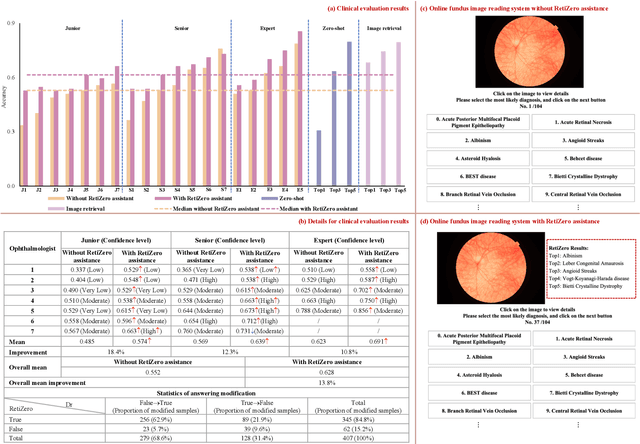

The current retinal artificial intelligence models were trained using data with a limited category of diseases and limited knowledge. In this paper, we present a retinal vision-language foundation model (RetiZero) with knowledge of over 400 fundus diseases. Specifically, we collected 341,896 fundus images paired with text descriptions from 29 publicly available datasets, 180 ophthalmic books, and online resources, encompassing over 400 fundus diseases across multiple countries and ethnicities. RetiZero achieved outstanding performance across various downstream tasks, including zero-shot retinal disease recognition, image-to-image retrieval, internal domain and cross-domain retinal disease classification, and few-shot fine-tuning. Specially, in the zero-shot scenario, RetiZero achieved a Top5 score of 0.8430 and 0.7561 on 15 and 52 fundus diseases respectively. In the image-retrieval task, RetiZero achieved a Top5 score of 0.9500 and 0.8860 on 15 and 52 retinal diseases respectively. Furthermore, clinical evaluations by ophthalmology experts from different countries demonstrate that RetiZero can achieve performance comparable to experienced ophthalmologists using zero-shot and image retrieval methods without requiring model retraining. These capabilities of retinal disease identification strengthen our RetiZero foundation model in clinical implementation.
FakeSound: Deepfake General Audio Detection
Jun 12, 2024
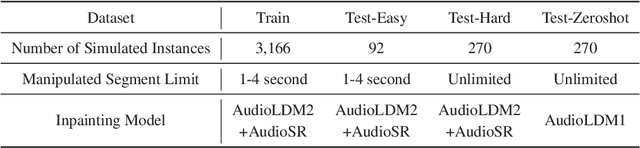

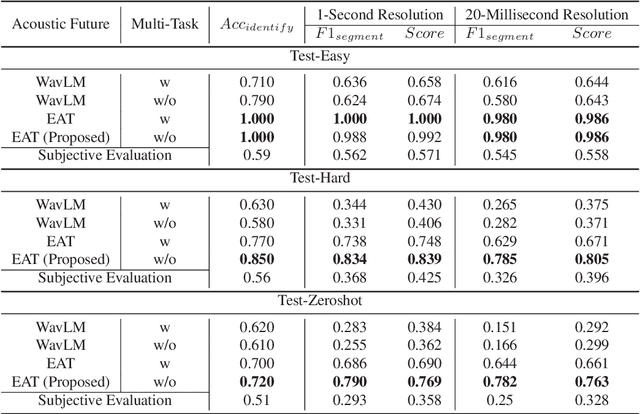
With the advancement of audio generation, generative models can produce highly realistic audios. However, the proliferation of deepfake general audio can pose negative consequences. Therefore, we propose a new task, deepfake general audio detection, which aims to identify whether audio content is manipulated and to locate deepfake regions. Leveraging an automated manipulation pipeline, a dataset named FakeSound for deepfake general audio detection is proposed, and samples can be viewed on website https://FakeSoundData.github.io. The average binary accuracy of humans on all test sets is consistently below 0.6, which indicates the difficulty humans face in discerning deepfake audio and affirms the efficacy of the FakeSound dataset. A deepfake detection model utilizing a general audio pre-trained model is proposed as a benchmark system. Experimental results demonstrate that the performance of the proposed model surpasses the state-of-the-art in deepfake speech detection and human testers.
Evolving Subnetwork Training for Large Language Models
Jun 11, 2024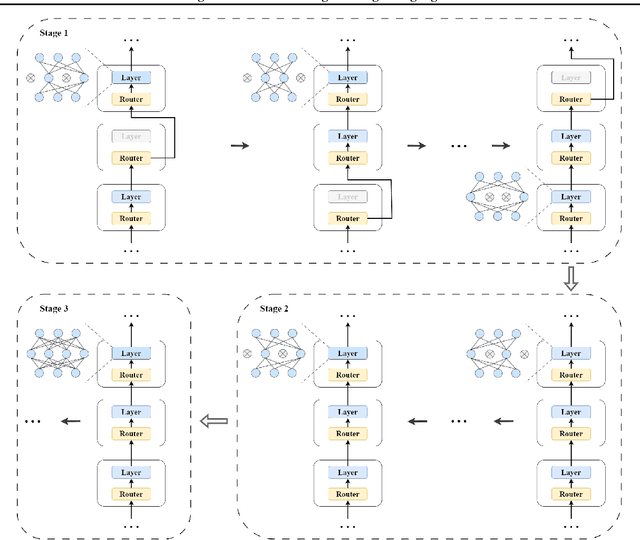
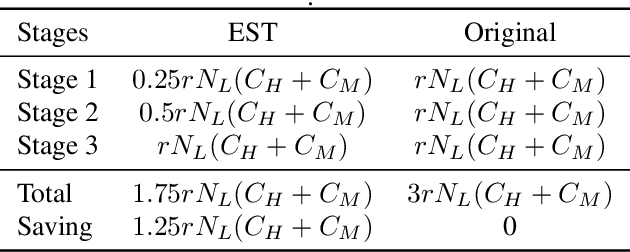
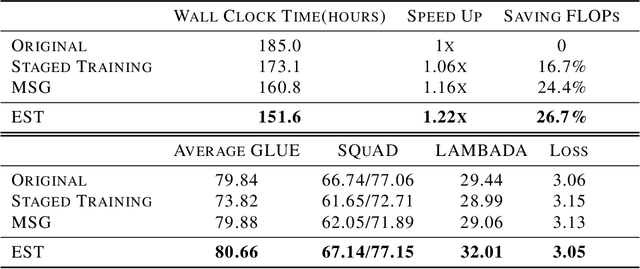
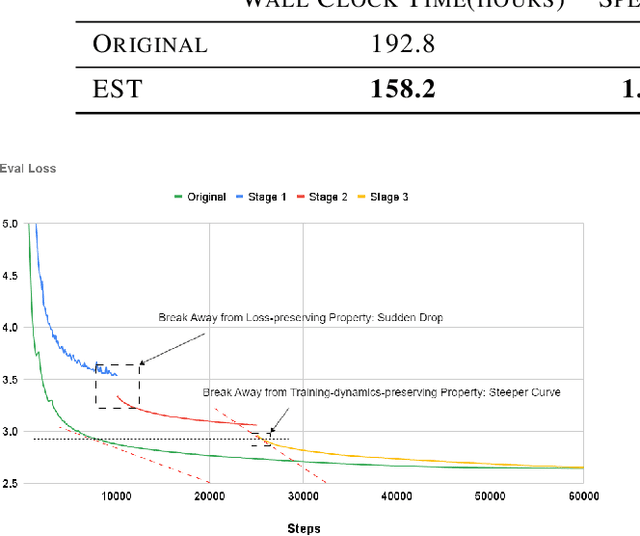
Large language models have ushered in a new era of artificial intelligence research. However, their substantial training costs hinder further development and widespread adoption. In this paper, inspired by the redundancy in the parameters of large language models, we propose a novel training paradigm: Evolving Subnetwork Training (EST). EST samples subnetworks from the layers of the large language model and from commonly used modules within each layer, Multi-Head Attention (MHA) and Multi-Layer Perceptron (MLP). By gradually increasing the size of the subnetworks during the training process, EST can save the cost of training. We apply EST to train GPT2 model and TinyLlama model, resulting in 26.7\% FLOPs saving for GPT2 and 25.0\% for TinyLlama without an increase in loss on the pre-training dataset. Moreover, EST leads to performance improvements in downstream tasks, indicating that it benefits generalization. Additionally, we provide intuitive theoretical studies based on training dynamics and Dropout theory to ensure the feasibility of EST. Our code is available at https://github.com/OpenDFM/EST.
Sparsity-Accelerated Training for Large Language Models
Jun 03, 2024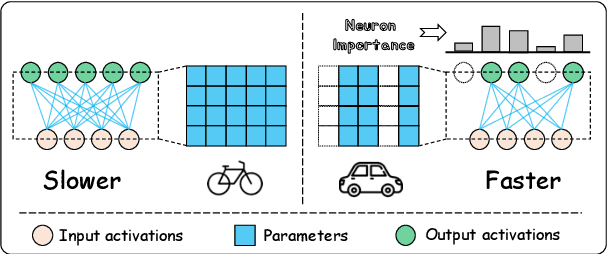
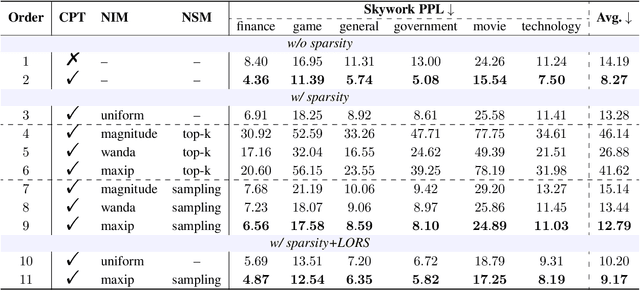
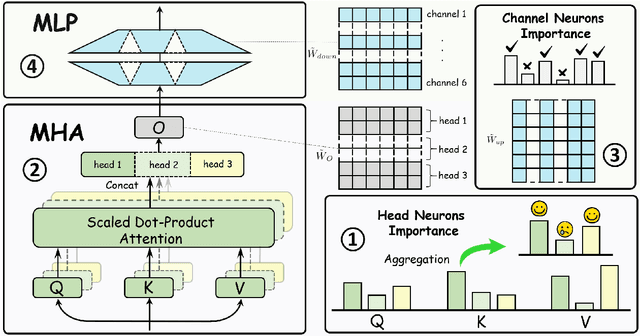
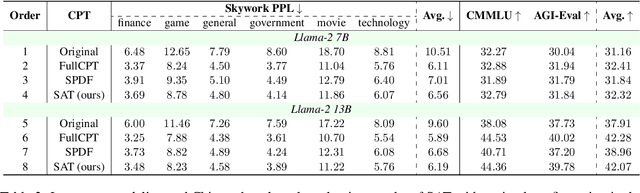
Large language models (LLMs) have demonstrated proficiency across various natural language processing (NLP) tasks but often require additional training, such as continual pre-training and supervised fine-tuning. However, the costs associated with this, primarily due to their large parameter count, remain high. This paper proposes leveraging \emph{sparsity} in pre-trained LLMs to expedite this training process. By observing sparsity in activated neurons during forward iterations, we identify the potential for computational speed-ups by excluding inactive neurons. We address associated challenges by extending existing neuron importance evaluation metrics and introducing a ladder omission rate scheduler. Our experiments on Llama-2 demonstrate that Sparsity-Accelerated Training (SAT) achieves comparable or superior performance to standard training while significantly accelerating the process. Specifically, SAT achieves a $45\%$ throughput improvement in continual pre-training and saves $38\%$ training time in supervised fine-tuning in practice. It offers a simple, hardware-agnostic, and easily deployable framework for additional LLM training. Our code is available at https://github.com/OpenDFM/SAT.
Disentangling Foreground and Background Motion for Enhanced Realism in Human Video Generation
May 28, 2024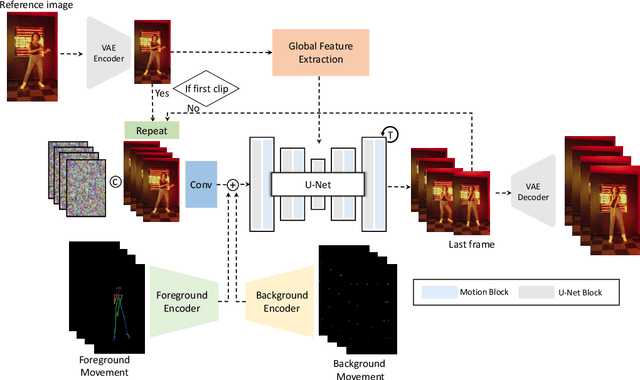
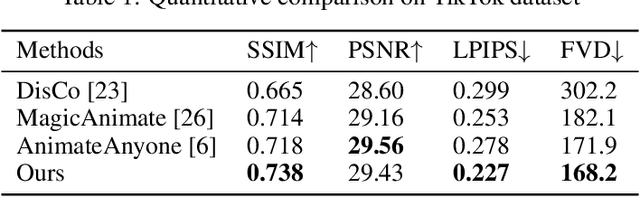
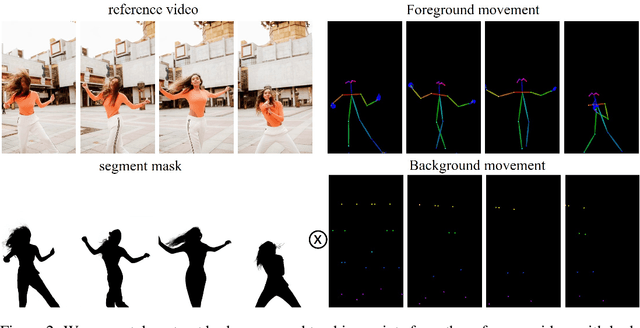

Recent advancements in human video synthesis have enabled the generation of high-quality videos through the application of stable diffusion models. However, existing methods predominantly concentrate on animating solely the human element (the foreground) guided by pose information, while leaving the background entirely static. Contrary to this, in authentic, high-quality videos, backgrounds often dynamically adjust in harmony with foreground movements, eschewing stagnancy. We introduce a technique that concurrently learns both foreground and background dynamics by segregating their movements using distinct motion representations. Human figures are animated leveraging pose-based motion, capturing intricate actions. Conversely, for backgrounds, we employ sparse tracking points to model motion, thereby reflecting the natural interaction between foreground activity and environmental changes. Training on real-world videos enhanced with this innovative motion depiction approach, our model generates videos exhibiting coherent movement in both foreground subjects and their surrounding contexts. To further extend video generation to longer sequences without accumulating errors, we adopt a clip-by-clip generation strategy, introducing global features at each step. To ensure seamless continuity across these segments, we ingeniously link the final frame of a produced clip with input noise to spawn the succeeding one, maintaining narrative flow. Throughout the sequential generation process, we infuse the feature representation of the initial reference image into the network, effectively curtailing any cumulative color inconsistencies that may otherwise arise. Empirical evaluations attest to the superiority of our method in producing videos that exhibit harmonious interplay between foreground actions and responsive background dynamics, surpassing prior methodologies in this regard.
Performance Analysis of Uplink/Downlink Decoupled Access in Cellular-V2X Networks
May 10, 2024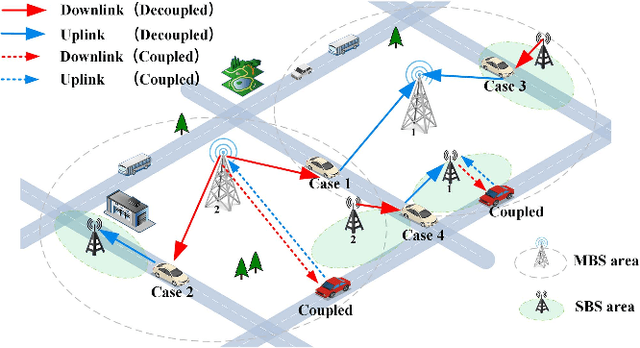
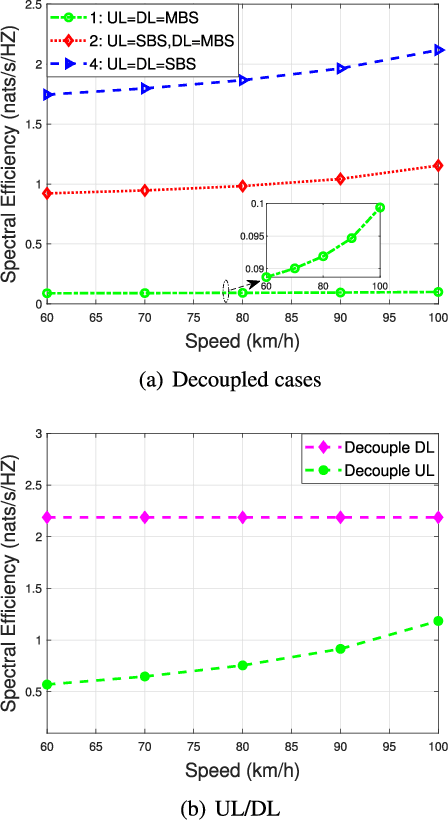
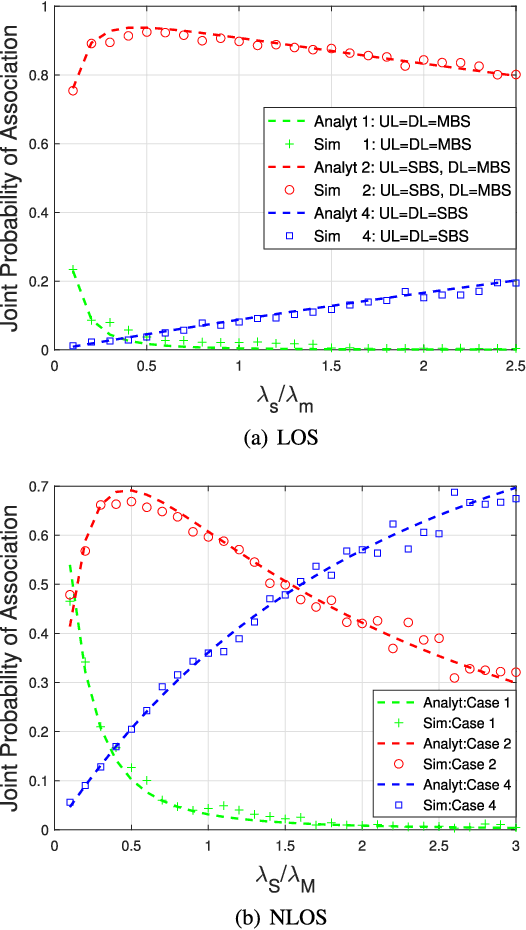
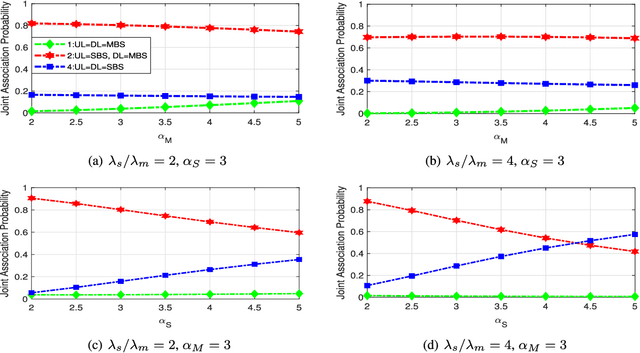
This paper firstly develops an analytical framework to investigate the performance of uplink (UL) / downlink (DL) decoupled access in cellular vehicle-to-everything (C-V2X) networks, in which a vehicle's UL/DL can be connected to different macro/small base stations (MBSs/SBSs) separately. Using the stochastic geometry analytical tool, the UL/DL decoupled access C-V2X is modeled as a Cox process, and we obtain the following theoretical results, i.e., 1) the probability of different UL/DL joint association cases i.e., both the UL and DL are associated with the different MBSs or SBSs, or they are associated with different types of BSs; 2) the distance distribution of a vehicle to its serving BSs in each case; 3) the spectral efficiency of UL/DL in each case; and 4) the UL/DL coverage probability of MBS/SBS. The analyses reveal the insights and performance gain of UL/DL decoupled access. Through extensive simulations, \textcolor{black}{the accuracy of the proposed analytical framework is validated.} Both the analytical and simulation results show that UL/DL decoupled access can improve spectral efficiency. The theoretical results can be directly used for estimating the statistical performance of a UL/DL decoupled access C-V2X network.
* 15 pages, 10 figures
AniTalker: Animate Vivid and Diverse Talking Faces through Identity-Decoupled Facial Motion Encoding
May 06, 2024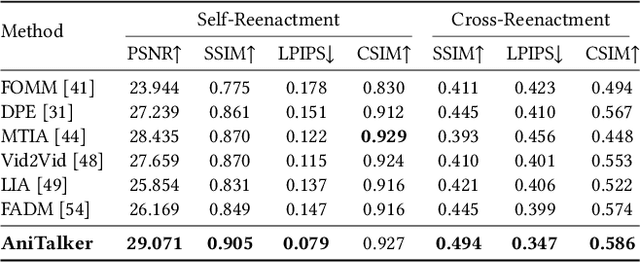
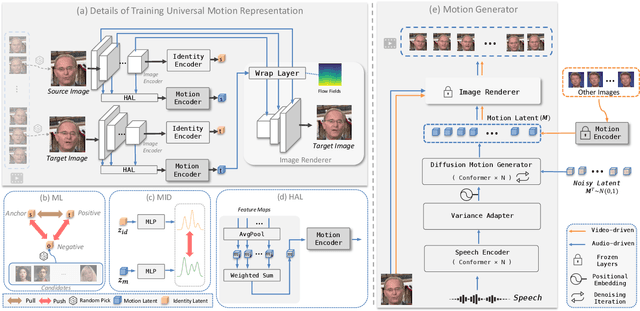
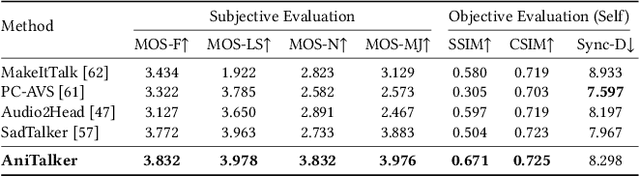
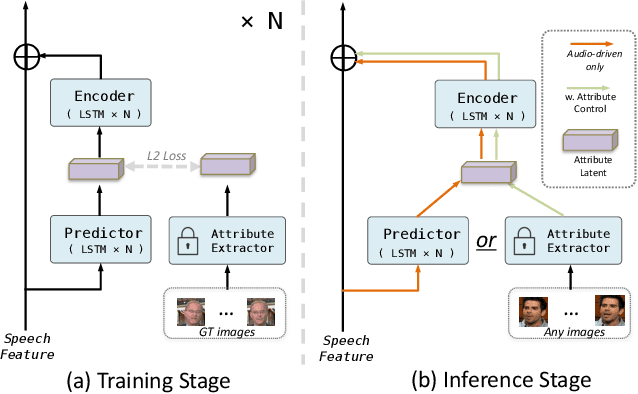
The paper introduces AniTalker, an innovative framework designed to generate lifelike talking faces from a single portrait. Unlike existing models that primarily focus on verbal cues such as lip synchronization and fail to capture the complex dynamics of facial expressions and nonverbal cues, AniTalker employs a universal motion representation. This innovative representation effectively captures a wide range of facial dynamics, including subtle expressions and head movements. AniTalker enhances motion depiction through two self-supervised learning strategies: the first involves reconstructing target video frames from source frames within the same identity to learn subtle motion representations, and the second develops an identity encoder using metric learning while actively minimizing mutual information between the identity and motion encoders. This approach ensures that the motion representation is dynamic and devoid of identity-specific details, significantly reducing the need for labeled data. Additionally, the integration of a diffusion model with a variance adapter allows for the generation of diverse and controllable facial animations. This method not only demonstrates AniTalker's capability to create detailed and realistic facial movements but also underscores its potential in crafting dynamic avatars for real-world applications. Synthetic results can be viewed at https://github.com/X-LANCE/AniTalker.
CoE-SQL: In-Context Learning for Multi-Turn Text-to-SQL with Chain-of-Editions
May 04, 2024Recently, Large Language Models (LLMs) have been demonstrated to possess impressive capabilities in a variety of domains and tasks. We investigate the issue of prompt design in the multi-turn text-to-SQL task and attempt to enhance the LLMs' reasoning capacity when generating SQL queries. In the conversational context, the current SQL query can be modified from the preceding SQL query with only a few operations due to the context dependency. We introduce our method called CoE-SQL which can prompt LLMs to generate the SQL query based on the previously generated SQL query with an edition chain. We also conduct extensive ablation studies to determine the optimal configuration of our approach. Our approach outperforms different in-context learning baselines stably and achieves state-of-the-art performances on two benchmarks SParC and CoSQL using LLMs, which is also competitive to the SOTA fine-tuned models.