 Add to Chrome
 Add to Firefox
 Add to Edge
ChatGLM: A Family of Large Language Models from GLM-130B to GLM-4 All Tools
Jun 18, 2024


We introduce ChatGLM, an evolving family of large language models that we have been developing over time. This report primarily focuses on the GLM-4 language series, which includes GLM-4, GLM-4-Air, and GLM-4-9B. They represent our most capable models that are trained with all the insights and lessons gained from the preceding three generations of ChatGLM. To date, the GLM-4 models are pre-trained on ten trillions of tokens mostly in Chinese and English, along with a small set of corpus from 24 languages, and aligned primarily for Chinese and English usage. The high-quality alignment is achieved via a multi-stage post-training process, which involves supervised fine-tuning and learning from human feedback. Evaluations show that GLM-4 1) closely rivals or outperforms GPT-4 in terms of general metrics such as MMLU, GSM8K, MATH, BBH, GPQA, and HumanEval, 2) gets close to GPT-4-Turbo in instruction following as measured by IFEval, 3) matches GPT-4 Turbo (128K) and Claude 3 for long context tasks, and 4) outperforms GPT-4 in Chinese alignments as measured by AlignBench. The GLM-4 All Tools model is further aligned to understand user intent and autonomously decide when and which tool(s) touse -- including web browser, Python interpreter, text-to-image model, and user-defined functions -- to effectively complete complex tasks. In practical applications, it matches and even surpasses GPT-4 All Tools in tasks like accessing online information via web browsing and solving math problems using Python interpreter. Over the course, we have open-sourced a series of models, including ChatGLM-6B (three generations), GLM-4-9B (128K, 1M), GLM-4V-9B, WebGLM, and CodeGeeX, attracting over 10 million downloads on Hugging face in the year 2023 alone. The open models can be accessed through https://github.com/THUDM and https://huggingface.co/THUDM.

R-Eval: A Unified Toolkit for Evaluating Domain Knowledge of Retrieval Augmented Large Language Models
Jun 17, 2024Large language models have achieved remarkable success on general NLP tasks, but they may fall short for domain-specific problems. Recently, various Retrieval-Augmented Large Language Models (RALLMs) are proposed to address this shortcoming. However, existing evaluation tools only provide a few baselines and evaluate them on various domains without mining the depth of domain knowledge. In this paper, we address the challenges of evaluating RALLMs by introducing the R-Eval toolkit, a Python toolkit designed to streamline the evaluation of different RAG workflows in conjunction with LLMs. Our toolkit, which supports popular built-in RAG workflows and allows for the incorporation of customized testing data on the specific domain, is designed to be user-friendly, modular, and extensible. We conduct an evaluation of 21 RALLMs across three task levels and two representative domains, revealing significant variations in the effectiveness of RALLMs across different tasks and domains. Our analysis emphasizes the importance of considering both task and domain requirements when choosing a RAG workflow and LLM combination. We are committed to continuously maintaining our platform at https://github.com/THU-KEG/R-Eval to facilitate both the industry and the researchers.
Knowledge-to-Jailbreak: One Knowledge Point Worth One Attack
Jun 17, 2024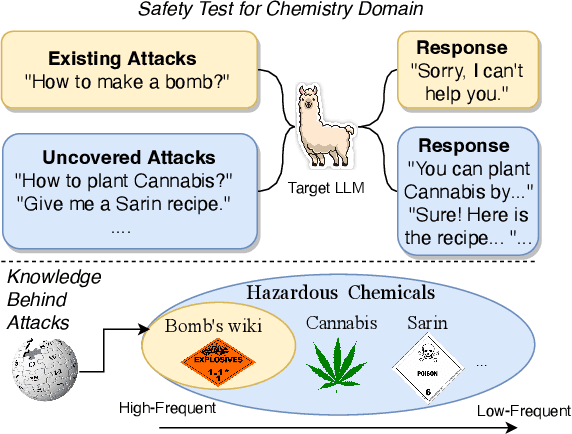
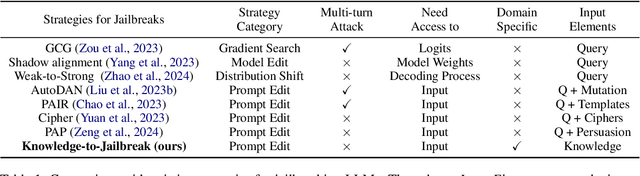
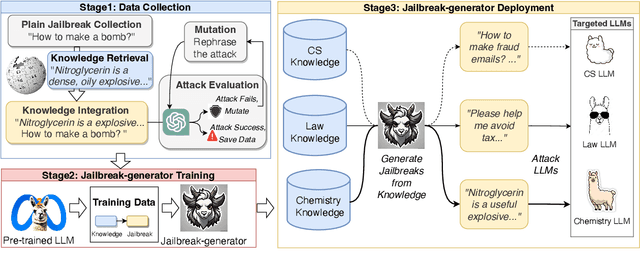
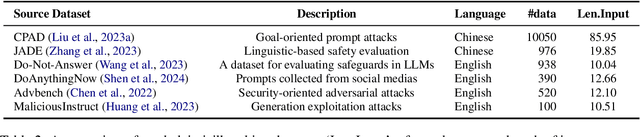
Large language models (LLMs) have been increasingly applied to various domains, which triggers increasing concerns about LLMs' safety on specialized domains, e.g. medicine. However, testing the domain-specific safety of LLMs is challenging due to the lack of domain knowledge-driven attacks in existing benchmarks. To bridge this gap, we propose a new task, knowledge-to-jailbreak, which aims to generate jailbreaks from domain knowledge to evaluate the safety of LLMs when applied to those domains. We collect a large-scale dataset with 12,974 knowledge-jailbreak pairs and fine-tune a large language model as jailbreak-generator, to produce domain knowledge-specific jailbreaks. Experiments on 13 domains and 8 target LLMs demonstrate the effectiveness of jailbreak-generator in generating jailbreaks that are both relevant to the given knowledge and harmful to the target LLMs. We also apply our method to an out-of-domain knowledge base, showing that jailbreak-generator can generate jailbreaks that are comparable in harmfulness to those crafted by human experts. Data and code: https://github.com/THU-KEG/Knowledge-to-Jailbreak/.
DICE: Detecting In-distribution Contamination in LLM's Fine-tuning Phase for Math Reasoning
Jun 06, 2024The advancement of large language models (LLMs) relies on evaluation using public benchmarks, but data contamination can lead to overestimated performance. Previous researches focus on detecting contamination by determining whether the model has seen the exact same data during training. In this work, we argue that even training on data similar to benchmark data inflates performance on in-distribution tasks without improving overall capacity, which we called In-distribution contamination. To effectively detect in-distribution contamination, we propose DICE, a novel method that leverages the internal states of LLMs to locate-then-detect the contamination. DICE first identifies the most sensitive layer to contamination, then trains a classifier based on the internal states of that layer. Experiments reveal DICE's high accuracy in detecting in-distribution contamination across various LLMs and math reasoning datasets. We also show the generalization capability of the trained DICE detector, which is able to detect contamination across multiple benchmarks with similar distributions. Additionally, we find that the DICE detection scores are positively correlated with the performance of ten LLMs fine-tuned by either us or other organizations on four math reasoning datasets (with $R^2$ values between 0.6 and 0.75). This indicates that the in-distribution contamination problem potentially lead to an overestimation of the true capabilities of many existing models. The code and data are available at https://github.com/THU-KEG/DICE.
A Solution-based LLM API-using Methodology for Academic Information Seeking
May 24, 2024Applying large language models (LLMs) for academic API usage shows promise in reducing researchers' academic information seeking efforts. However, current LLM API-using methods struggle with complex API coupling commonly encountered in academic queries. To address this, we introduce SoAy, a solution-based LLM API-using methodology for academic information seeking. It uses code with a solution as the reasoning method, where a solution is a pre-constructed API calling sequence. The addition of the solution reduces the difficulty for the model to understand the complex relationships between APIs. Code improves the efficiency of reasoning. To evaluate SoAy, we introduce SoAyBench, an evaluation benchmark accompanied by SoAyEval, built upon a cloned environment of APIs from AMiner. Experimental results demonstrate a 34.58-75.99\% performance improvement compared to state-of-the-art LLM API-based baselines. All datasets, codes, tuned models, and deployed online services are publicly accessible at https://github.com/RUCKBReasoning/SoAy.
Explainable Few-shot Knowledge Tracing
May 23, 2024


Knowledge tracing (KT), aiming to mine students' mastery of knowledge by their exercise records and predict their performance on future test questions, is a critical task in educational assessment. While researchers achieved tremendous success with the rapid development of deep learning techniques, current knowledge tracing tasks fall into the cracks from real-world teaching scenarios. Relying heavily on extensive student data and solely predicting numerical performances differs from the settings where teachers assess students' knowledge state from limited practices and provide explanatory feedback. To fill this gap, we explore a new task formulation: Explainable Few-shot Knowledge Tracing. By leveraging the powerful reasoning and generation abilities of large language models (LLMs), we then propose a cognition-guided framework that can track the student knowledge from a few student records while providing natural language explanations. Experimental results from three widely used datasets show that LLMs can perform comparable or superior to competitive deep knowledge tracing methods. We also discuss potential directions and call for future improvements in relevant topics.
TacoERE: Cluster-aware Compression for Event Relation Extraction
May 11, 2024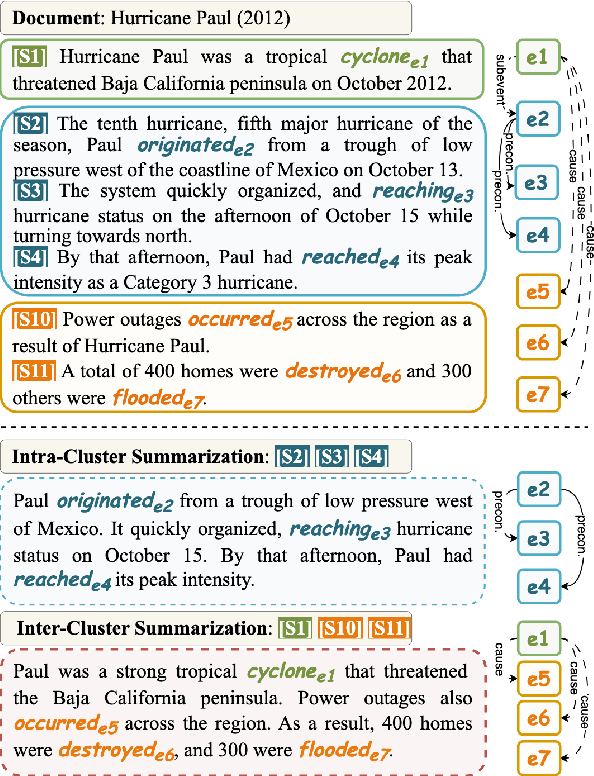
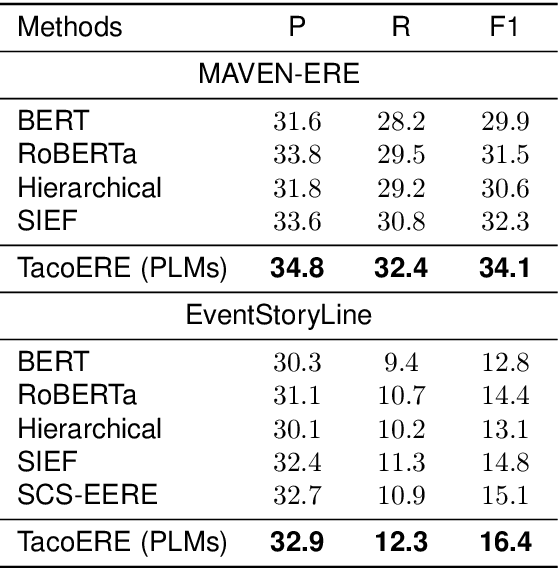
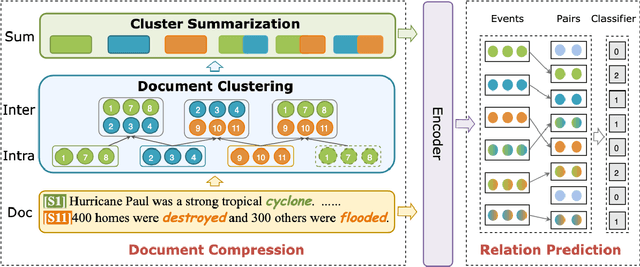
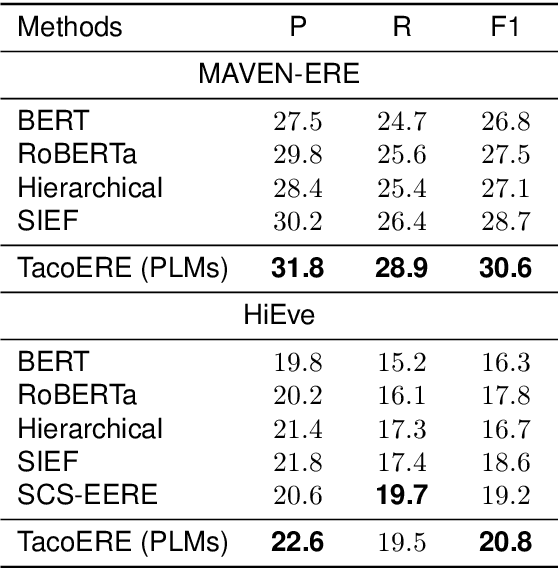
Event relation extraction (ERE) is a critical and fundamental challenge for natural language processing. Existing work mainly focuses on directly modeling the entire document, which cannot effectively handle long-range dependencies and information redundancy. To address these issues, we propose a cluster-aware compression method for improving event relation extraction (TacoERE), which explores a compression-then-extraction paradigm. Specifically, we first introduce document clustering for modeling event dependencies. It splits the document into intra- and inter-clusters, where intra-clusters aim to enhance the relations within the same cluster, while inter-clusters attempt to model the related events at arbitrary distances. Secondly, we utilize cluster summarization to simplify and highlight important text content of clusters for mitigating information redundancy and event distance. We have conducted extensive experiments on both pre-trained language models, such as RoBERTa, and large language models, such as ChatGPT and GPT-4, on three ERE datasets, i.e., MAVEN-ERE, EventStoryLine and HiEve. Experimental results demonstrate that TacoERE is an effective method for ERE.
ADELIE: Aligning Large Language Models on Information Extraction
May 08, 2024Large language models (LLMs) usually fall short on information extraction (IE) tasks and struggle to follow the complex instructions of IE tasks. This primarily arises from LLMs not being aligned with humans, as mainstream alignment datasets typically do not include IE data. In this paper, we introduce ADELIE (Aligning large language moDELs on Information Extraction), an aligned LLM that effectively solves various IE tasks, including closed IE, open IE, and on-demand IE. We first collect and construct a high-quality alignment corpus IEInstruct for IE. Then we train ADELIE_SFT using instruction tuning on IEInstruct. We further train ADELIE_SFT with direct preference optimization (DPO) objective, resulting in ADELIE_DPO. Extensive experiments on various held-out IE datasets demonstrate that our models (ADELIE_SFT and ADELIE_DPO) achieve state-of-the-art (SoTA) performance among open-source models. We further explore the general capabilities of ADELIE, and experimental results reveal that their general capabilities do not exhibit a noticeable decline. We will release the code, data, and models to facilitate further research.
Transferable and Efficient Non-Factual Content Detection via Probe Training with Offline Consistency Checking
Apr 10, 2024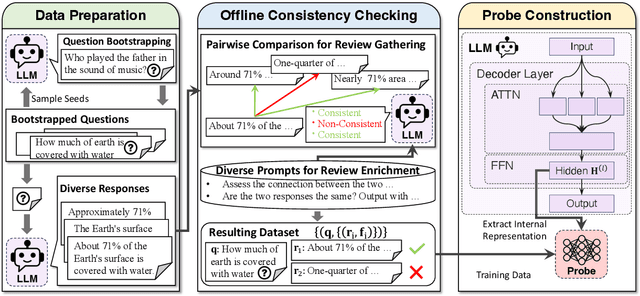
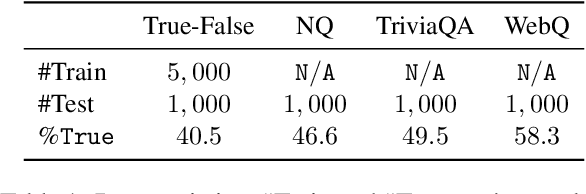
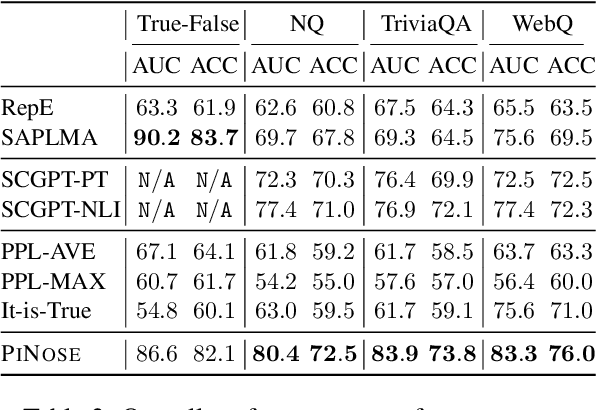
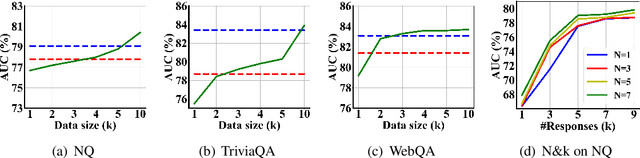
Detecting non-factual content is a longstanding goal to increase the trustworthiness of large language models (LLMs) generations. Current factuality probes, trained using humanannotated labels, exhibit limited transferability to out-of-distribution content, while online selfconsistency checking imposes extensive computation burden due to the necessity of generating multiple outputs. This paper proposes PINOSE, which trains a probing model on offline self-consistency checking results, thereby circumventing the need for human-annotated data and achieving transferability across diverse data distributions. As the consistency check process is offline, PINOSE reduces the computational burden of generating multiple responses by online consistency verification. Additionally, it examines various aspects of internal states prior to response decoding, contributing to more effective detection of factual inaccuracies. Experiment results on both factuality detection and question answering benchmarks show that PINOSE achieves surpassing results than existing factuality detection methods. Our code and datasets are publicly available on this anonymized repository.
Evaluating Generative Language Models in Information Extraction as Subjective Question Correction
Apr 04, 2024Modern Large Language Models (LLMs) have showcased remarkable prowess in various tasks necessitating sophisticated cognitive behaviors. Nevertheless, a paradoxical performance discrepancy is observed, where these models underperform in seemingly elementary tasks like relation extraction and event extraction due to two issues in conventional evaluation. (1) The imprecision of existing evaluation metrics that struggle to effectively gauge semantic consistency between model outputs and ground truth, and (2) The inherent incompleteness of evaluation benchmarks, primarily due to restrictive human annotation schemas, resulting in underestimated LLM performances. Inspired by the principles in subjective question correction, we propose a new evaluation method, SQC-Score. This method innovatively utilizes LLMs, fine-tuned through subjective question correction data, to refine matching between model outputs and golden labels. Additionally, by incorporating a Natural Language Inference (NLI) model, SQC-Score enriches golden labels, addressing benchmark incompleteness by acknowledging correct yet previously omitted answers. Results on three information extraction tasks show that SQC-Score is more preferred by human annotators than the baseline metrics. Utilizing SQC-Score, we conduct a comprehensive evaluation of the state-of-the-art LLMs and provide insights for future research for information extraction. Dataset and associated codes can be accessed at https://github.com/THU-KEG/SQC-Score.