 Add to Chrome
 Add to Firefox
 Add to Edge
Towards Automatic Soccer Commentary Generation with Knowledge-Enhanced Visual Reasoning
Mar 31, 2026
Soccer commentary plays a crucial role in enhancing the soccer game viewing experience for audiences. Previous studies in automatic soccer commentary generation typically adopt an end-to-end method to generate anonymous live text commentary. Such generated commentary is insufficient in the context of real-world live televised commentary, as it contains anonymous entities, context-dependent errors and lacks statistical insights of the game events. To bridge the gap, we propose GameSight, a two-stage model to address soccer commentary generation as a knowledge-enhanced visual reasoning task, enabling live-televised-like knowledgeable commentary with accurate reference to entities (players and teams). GameSight starts by performing visual reasoning to align anonymous entities with fine-grained visual and contextual analysis. Subsequently, the entity-aligned commentary is refined with knowledge by incorporating external historical statistics and iteratively updated internal game state information. Consequently, GameSight improves the player alignment accuracy by 18.5% on SN-Caption-test-align dataset compared to Gemini 2.5-pro. Combined with further knowledge enhancement, GameSight outperforms in segment-level accuracy and commentary quality, as well as game-level contextual relevance and structural composition. We believe that our work paves the way for a more informative and engaging human-centric experience with the AI sports application. Demo Page: https://gamesight2025.github.io/gamesight2025

Transferable and Efficient Non-Factual Content Detection via Probe Training with Offline Consistency Checking
Apr 10, 2024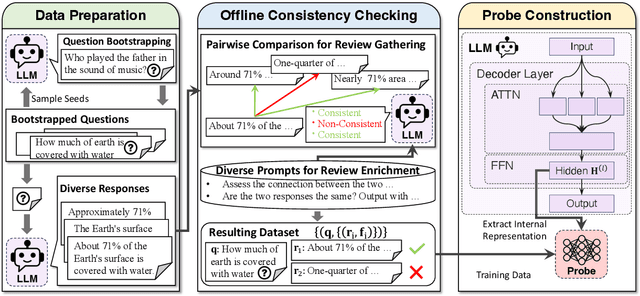
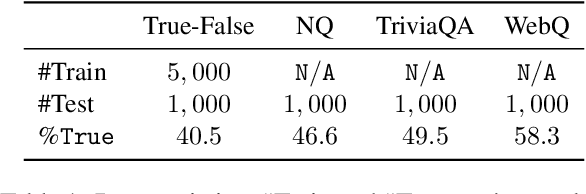
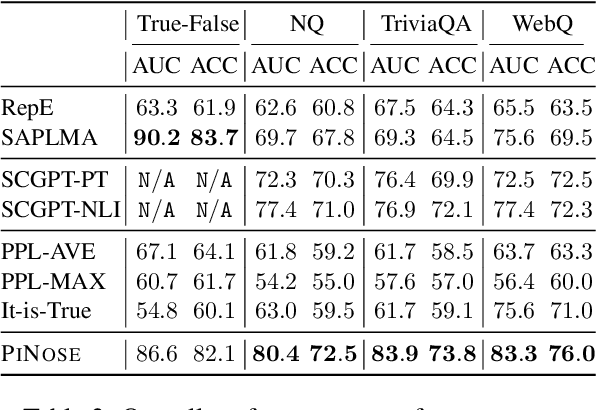
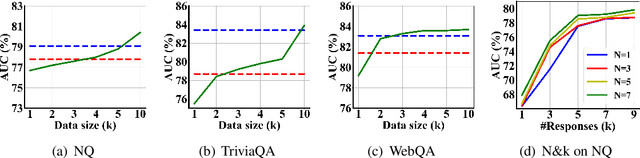
Detecting non-factual content is a longstanding goal to increase the trustworthiness of large language models (LLMs) generations. Current factuality probes, trained using humanannotated labels, exhibit limited transferability to out-of-distribution content, while online selfconsistency checking imposes extensive computation burden due to the necessity of generating multiple outputs. This paper proposes PINOSE, which trains a probing model on offline self-consistency checking results, thereby circumventing the need for human-annotated data and achieving transferability across diverse data distributions. As the consistency check process is offline, PINOSE reduces the computational burden of generating multiple responses by online consistency verification. Additionally, it examines various aspects of internal states prior to response decoding, contributing to more effective detection of factual inaccuracies. Experiment results on both factuality detection and question answering benchmarks show that PINOSE achieves surpassing results than existing factuality detection methods. Our code and datasets are publicly available on this anonymized repository.
KoLA: Carefully Benchmarking World Knowledge of Large Language Models
Jun 15, 2023
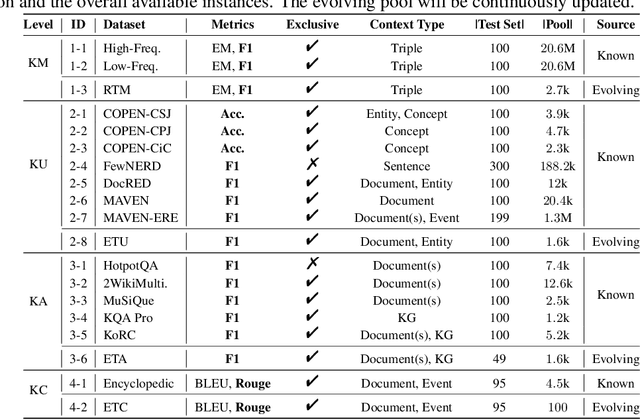
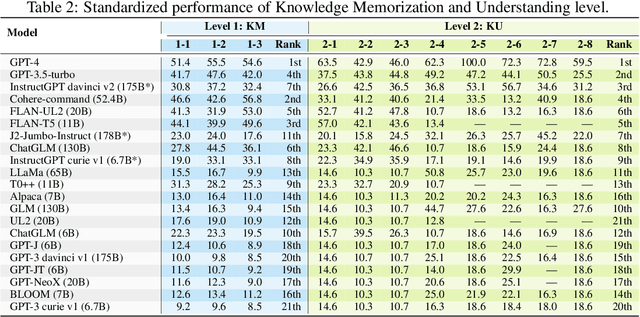

The unprecedented performance of large language models (LLMs) necessitates improvements in evaluations. Rather than merely exploring the breadth of LLM abilities, we believe meticulous and thoughtful designs are essential to thorough, unbiased, and applicable evaluations. Given the importance of world knowledge to LLMs, we construct a Knowledge-oriented LLM Assessment benchmark (KoLA), in which we carefully design three crucial factors: (1) For ability modeling, we mimic human cognition to form a four-level taxonomy of knowledge-related abilities, covering $19$ tasks. (2) For data, to ensure fair comparisons, we use both Wikipedia, a corpus prevalently pre-trained by LLMs, along with continuously collected emerging corpora, aiming to evaluate the capacity to handle unseen data and evolving knowledge. (3) For evaluation criteria, we adopt a contrastive system, including overall standard scores for better numerical comparability across tasks and models and a unique self-contrast metric for automatically evaluating knowledge hallucination. We evaluate $21$ open-source and commercial LLMs and obtain some intriguing findings. The KoLA dataset and open-participation leaderboard are publicly released at https://kola.xlore.cn and will be continuously updated to provide references for developing LLMs and knowledge-related systems.