 Add to Chrome
 Add to Firefox
 Add to Edge
Tencent Advertising Algorithm Challenge 2025: All-Modality Generative Recommendation
Apr 04, 2026
Generative recommender systems are rapidly emerging as a new paradigm for recommendation, where collaborative identifiers and/or multi-modal content are mapped into discrete token spaces and user behavior is modelled with autoregressive sequence models. Despite progress on multi-modal recommendation datasets, there is still a lack of public benchmarks that jointly offer large-scale, realistic and fully all-modality data designed specifically for generative recommendation (GR) in industrial advertising. To foster research in this direction, we organised the Tencent Advertising Algorithm Challenge 2025, a global competition built on top of two all-modality datasets for GR: TencentGR-1M and TencentGR-10M. Both datasets are constructed from real de-identified Tencent Ads logs and contain rich collaborative IDs and multi-modal representations extracted with state-of-the-art embedding models. The preliminary track (TencentGR-1M) provides 1 million user sequences with up to 100 interacted items each, where each interaction is labeled with exposure and click signals, while the final track (TencentGR-10M) scales this to 10 million users and explicitly distinguishes between click and conversion events at both the sequence and target level. This paper presents the task definition, data construction process, feature schema, baseline GR model, evaluation protocol, and key findings from top-ranked and award-winning solutions. Our datasets focus on multi-modal sequence generation in an advertising setting and introduce weighted evaluation for high-value conversion events. We release our datasets at https://huggingface.co/datasets/TAAC2025 and baseline implementations at https://github.com/TencentAdvertisingAlgorithmCompetition/baseline_2025 to enable future research on all-modality generative recommendation at an industrial scale. The official website is https://algo.qq.com/2025.

Knowledge-to-Jailbreak: One Knowledge Point Worth One Attack
Jun 17, 2024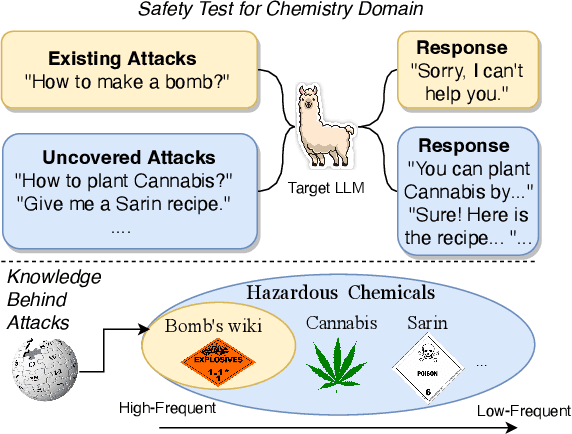
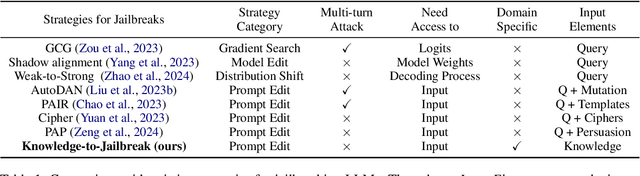
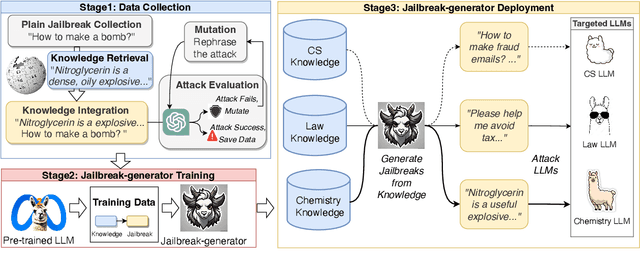
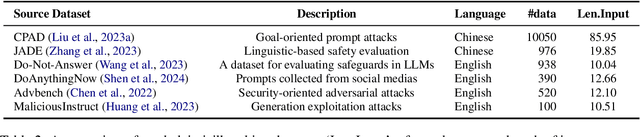
Large language models (LLMs) have been increasingly applied to various domains, which triggers increasing concerns about LLMs' safety on specialized domains, e.g. medicine. However, testing the domain-specific safety of LLMs is challenging due to the lack of domain knowledge-driven attacks in existing benchmarks. To bridge this gap, we propose a new task, knowledge-to-jailbreak, which aims to generate jailbreaks from domain knowledge to evaluate the safety of LLMs when applied to those domains. We collect a large-scale dataset with 12,974 knowledge-jailbreak pairs and fine-tune a large language model as jailbreak-generator, to produce domain knowledge-specific jailbreaks. Experiments on 13 domains and 8 target LLMs demonstrate the effectiveness of jailbreak-generator in generating jailbreaks that are both relevant to the given knowledge and harmful to the target LLMs. We also apply our method to an out-of-domain knowledge base, showing that jailbreak-generator can generate jailbreaks that are comparable in harmfulness to those crafted by human experts. Data and code: https://github.com/THU-KEG/Knowledge-to-Jailbreak/.
WaterBench: Towards Holistic Evaluation of Watermarks for Large Language Models
Nov 13, 2023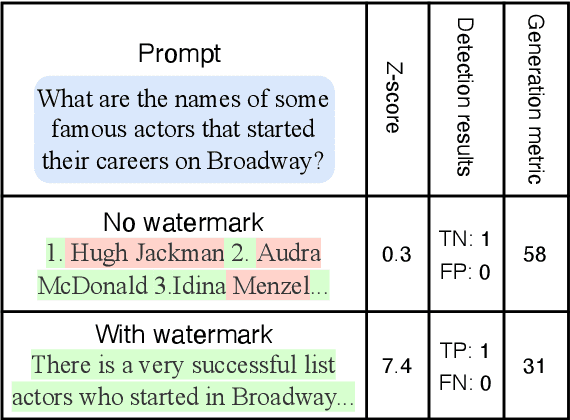
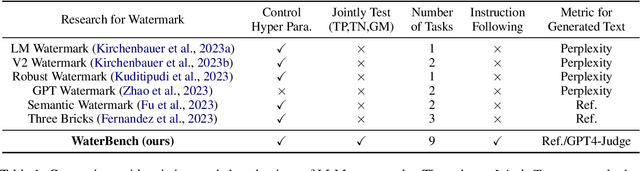
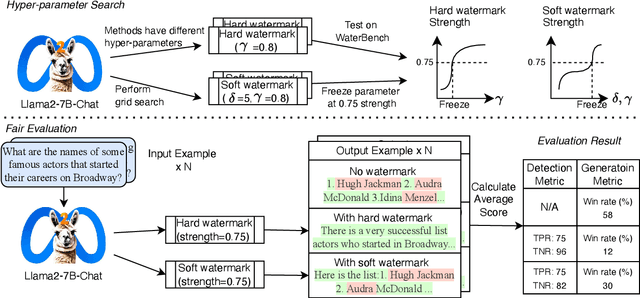
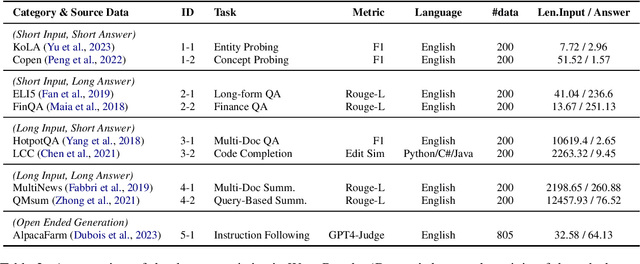
To mitigate the potential misuse of large language models (LLMs), recent research has developed watermarking algorithms, which restrict the generation process to leave an invisible trace for watermark detection. Due to the two-stage nature of the task, most studies evaluate the generation and detection separately, thereby presenting a challenge in unbiased, thorough, and applicable evaluations. In this paper, we introduce WaterBench, the first comprehensive benchmark for LLM watermarks, in which we design three crucial factors: (1) For \textbf{benchmarking procedure}, to ensure an apples-to-apples comparison, we first adjust each watermarking method's hyper-parameter to reach the same watermarking strength, then jointly evaluate their generation and detection performance. (2) For \textbf{task selection}, we diversify the input and output length to form a five-category taxonomy, covering $9$ tasks. (3) For \textbf{evaluation metric}, we adopt the GPT4-Judge for automatically evaluating the decline of instruction-following abilities after watermarking. We evaluate $4$ open-source watermarks on $2$ LLMs under $2$ watermarking strengths and observe the common struggles for current methods on maintaining the generation quality. The code and data are available at \url{https://github.com/THU-KEG/WaterBench}.