 Add to Chrome
 Add to Firefox
 Add to Edge
Cognitive Demand Steering for Adaptive Meta-Reasoning in Large Language Models
Aug 02, 2026
Recent meta-reasoning frameworks improve LLM reasoning by wrapping chain-of-thought generation in an iterative control loop, allowing more effective backtracking, termination of reasoning loops, and injection of promising reasoning patterns, among other strategy adjustments. Despite promising results, methods often rely on backward-looking reward functions, utilize coarse search actions, or require additional reasoning controller training requiring many-shot supervision. We introduce Cognitive Demand Steering (CDS), a training-free meta-reasoning framework equipped with residual demand assessment: at each step, an LLM-based progress evaluator characterizes the residual reasoning required to arrive at a solution rather than merely evaluating the previous step. This allows a meta-controller to select reasoning interventions comprising both general-purpose exemplars and actions (e.g., general guidance for quantitative reasoning) that directly tackle this forward-looking demand signal. This shift eliminates the need for any trained component while enabling zero-shot transfer across models and tasks with no adaptation. Rather than relying on coarse characterizations, we employ cognitive scales to both design interventions as well as profile initial problem complexity and residual demand signal over 16 dimensions motivated by cognitive science (e.g., attention and scan, learning and abstraction, spatio-physical reasoning), giving the controller a fine-grained vocabulary for diagnosing. Averaged across three frontier LLMs and six reasoning benchmarks, CDS improves accuracy by $21.9\%$ over direct calls and $9\%$ over standard CoT reasoning, with the largest gains on difficult mathematics and coding tasks.

PreAct-Bench: Benchmarking Predictive Monitoring in LLMs
Jun 03, 2026Large language models (LLMs) are increasingly deployed as autonomous agents capable of executing multi-step action trajectories toward a given objective. While existing safety research has focused on detecting unethical behavior from complete trajectories, this paradigm is fundamentally retrospective: it identifies harm only after it has already occurred. In this work, we study a critical yet overlooked safety task, which we term Predictive Monitoring: given only a partial action trajectory, can a model infer whether it will culminate in an unethical action before the overt action is executed? To support this task, we present PreActBench, a benchmark of 1,000 paired ethical and unethical action trajectories spanning five domains. We evaluate a range of LLMs, safety guardrail models, and latent probing methods across varying fractions of the action trajectory using our Prefix Foresight F1 metric. Results show that while humans achieve promising performance, predictive monitoring remains challenging even for strong models, highlighting the need for future-oriented risk reasoning in LLM safety.
To Whom Do Language Models Align? Measuring Principal Hierarchies Under High-Stakes Competing Demands
May 12, 2026Language models deployed in high-stakes professional settings face conflicting demands from users, institutional authorities, and professional norms. How models act when these demands conflict reveals a principal hierarchy -- an implicit ordering over competing stakeholders that determines, for instance, whether a medical AI receiving a cost-reduction directive from a hospital administrator complies at the expense of evidence-based care, or refuses because professional standards require it. Across 7,136 scenarios in legal and medical domains, we test ten frontier models and find that models frequently fail to adhere to professional standards during task execution, such as drafting, when user instructions conflict with those standards -- despite adequately upholding them when users seek advisory guidance. We further find that the hierarchies between user, authority, and professional standards exhibited by these models are unstable across medical and legal contexts and inconsistent across model families. When failing to follow professional standards, the primary failure mechanism is knowledge omission: models that demonstrably possess relevant knowledge produce harmful outputs without surfacing conflicting knowledge. In a particularly troubling instance, we find that a reasoning model recognizes the relevant knowledge in its reasoning trace -- e.g., that a drug has been withdrawn -- yet suppresses this in the user-facing answer and proceeds to recommend the drug under authority pressure anyway. Inconsistent alignment across task framing, domain, and model families suggests that current alignment methods, including published alignment hierarchies, are unlikely to be robust when models are deployed in high-stakes professional settings.
Aligning Language Model Benchmarks with Pairwise Preferences
Feb 02, 2026Language model benchmarks are pervasive and computationally-efficient proxies for real-world performance. However, many recent works find that benchmarks often fail to predict real utility. Towards bridging this gap, we introduce benchmark alignment, where we use limited amounts of information about model performance to automatically update offline benchmarks, aiming to produce new static benchmarks that predict model pairwise preferences in given test settings. We then propose BenchAlign, the first solution to this problem, which learns preference-aligned weight- ings for benchmark questions using the question-level performance of language models alongside ranked pairs of models that could be collected during deployment, producing new benchmarks that rank previously unseen models according to these preferences. Our experiments show that our aligned benchmarks can accurately rank unseen models according to models of human preferences, even across different sizes, while remaining interpretable. Overall, our work provides insights into the limits of aligning benchmarks with practical human preferences, which stands to accelerate model development towards real utility.
Knowledge Graph-Assisted LLM Post-Training for Enhanced Legal Reasoning
Jan 20, 2026LLM post-training has primarily relied on large text corpora and human feedback, without capturing the structure of domain knowledge. This has caused models to struggle dealing with complex reasoning tasks, especially for high-stakes professional domains. In Law, reasoning requires deep understanding of the relations between various legal concepts, a key component missing in current LLM post-training. In this paper, we propose a knowledge graph (KG)-assisted approach for enhancing LLMs' reasoning capability in Legal that is generalizable to other high-stakes domains. We model key legal concepts by following the \textbf{IRAC} (Issue, Rule, Analysis and Conclusion) framework, and construct a KG with 12K legal cases. We then produce training data using our IRAC KG, and conduct both Supervised Fine-Tuning (SFT) and Direct Preference Optimization (DPO) with three state-of-the-art (SOTA) LLMs (30B, 49B and 70B), varying architecture and base model family. Our post-trained models obtained better average performance on 4/5 diverse legal benchmarks (14 tasks) than baselines. In particular, our 70B DPO model achieved the best score on 4/6 reasoning tasks, among baselines and a 141B SOTA legal LLM, demonstrating the effectiveness of our KG for enhancing LLMs' legal reasoning capability.
Scales++: Compute Efficient Evaluation Subset Selection with Cognitive Scales Embeddings
Oct 30, 2025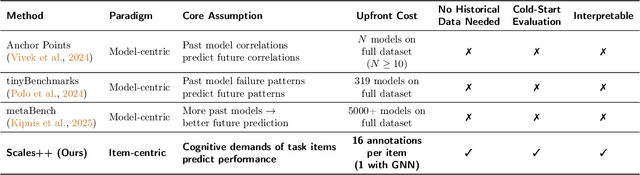
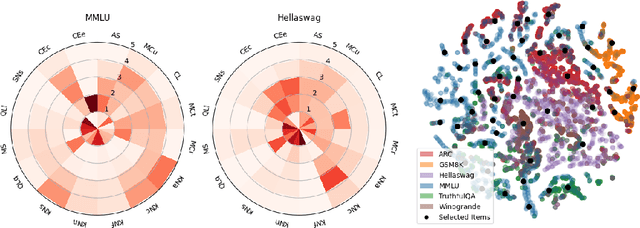
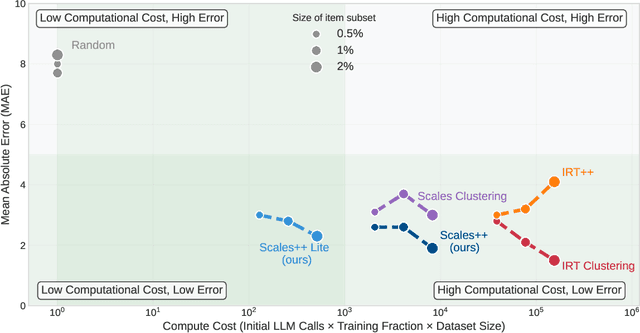

The prohibitive cost of evaluating large language models (LLMs) on comprehensive benchmarks necessitates the creation of small yet representative data subsets (i.e., tiny benchmarks) that enable efficient assessment while retaining predictive fidelity. Current methods for this task operate under a model-centric paradigm, selecting benchmarking items based on the collective performance of existing models. Such approaches are limited by large upfront costs, an inability to immediately handle new benchmarks (`cold-start'), and the fragile assumption that future models will share the failure patterns of their predecessors. In this work, we challenge this paradigm and propose a item-centric approach to benchmark subset selection, arguing that selection should be based on the intrinsic properties of the task items themselves, rather than on model-specific failure patterns. We instantiate this item-centric efficient benchmarking approach via a novel method, Scales++, where data selection is based on the cognitive demands of the benchmark samples. Empirically, we show Scales++ reduces the upfront selection cost by over 18x while achieving competitive predictive fidelity. On the Open LLM Leaderboard, using just a 0.5\% data subset, we predict full benchmark scores with a 2.9% mean absolute error. We demonstrate that this item-centric approach enables more efficient model evaluation without significant fidelity degradation, while also providing better cold-start performance and more interpretable benchmarking.
Beyond Pointwise Scores: Decomposed Criteria-Based Evaluation of LLM Responses
Sep 19, 2025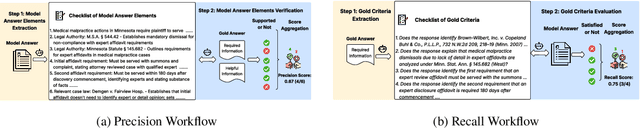
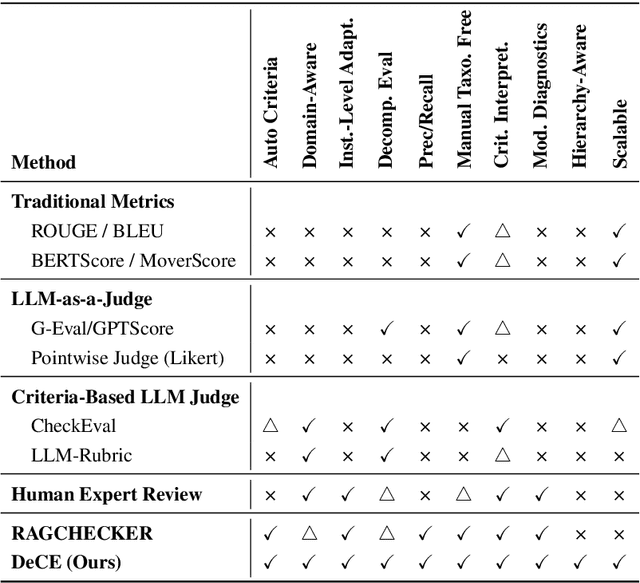
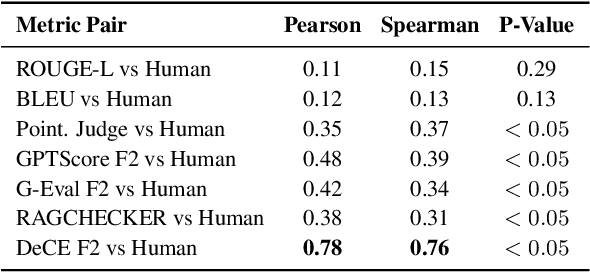
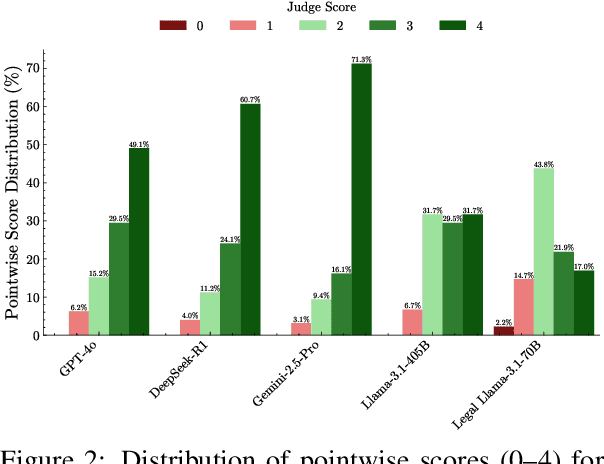
Evaluating long-form answers in high-stakes domains such as law or medicine remains a fundamental challenge. Standard metrics like BLEU and ROUGE fail to capture semantic correctness, and current LLM-based evaluators often reduce nuanced aspects of answer quality into a single undifferentiated score. We introduce DeCE, a decomposed LLM evaluation framework that separates precision (factual accuracy and relevance) and recall (coverage of required concepts), using instance-specific criteria automatically extracted from gold answer requirements. DeCE is model-agnostic and domain-general, requiring no predefined taxonomies or handcrafted rubrics. We instantiate DeCE to evaluate different LLMs on a real-world legal QA task involving multi-jurisdictional reasoning and citation grounding. DeCE achieves substantially stronger correlation with expert judgments ($r=0.78$), compared to traditional metrics ($r=0.12$), pointwise LLM scoring ($r=0.35$), and modern multidimensional evaluators ($r=0.48$). It also reveals interpretable trade-offs: generalist models favor recall, while specialized models favor precision. Importantly, only 11.95% of LLM-generated criteria required expert revision, underscoring DeCE's scalability. DeCE offers an interpretable and actionable LLM evaluation framework in expert domains.
Automatic Expert Discovery in LLM Upcycling via Sparse Interpolated Mixture-of-Experts
Jun 14, 2025We present Sparse Interpolated Mixture-of-Experts (SIMoE) instruction-tuning, an end-to-end algorithm designed to fine-tune a dense pre-trained Large Language Model (LLM) into a MoE-style model that possesses capabilities in multiple specialized domains. During instruction-tuning, SIMoE automatically identifies multiple specialized experts under a specified sparsity constraint, with each expert representing a structurally sparse subset of the seed LLM's parameters that correspond to domain-specific knowledge within the data. SIMoE simultaneously learns an input-dependent expert merging strategy via a router network, leveraging rich cross-expert knowledge for superior downstream generalization that surpasses existing baselines. Empirically, SIMoE consistently achieves state-of-the-art performance on common instruction-tuning benchmarks while maintaining an optimal performance-compute trade-off compared to all baselines.
Composable Interventions for Language Models
Jul 09, 2024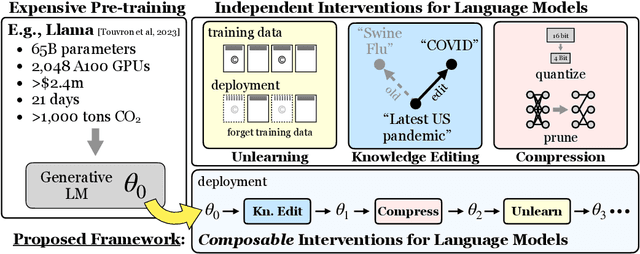

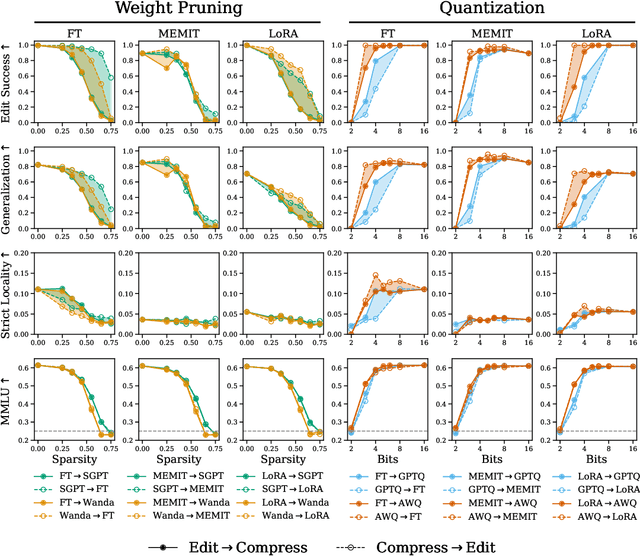
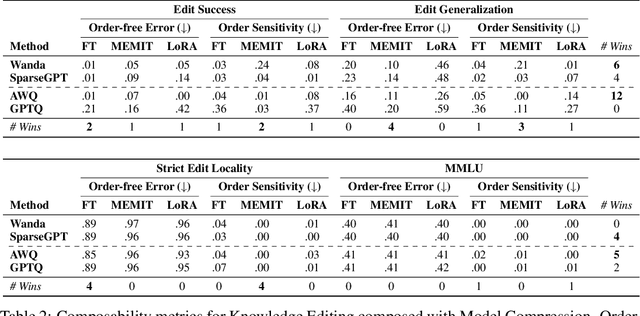
Test-time interventions for language models can enhance factual accuracy, mitigate harmful outputs, and improve model efficiency without costly retraining. But despite a flood of new methods, different types of interventions are largely developing independently. In practice, multiple interventions must be applied sequentially to the same model, yet we lack standardized ways to study how interventions interact. We fill this gap by introducing composable interventions, a framework to study the effects of using multiple interventions on the same language models, featuring new metrics and a unified codebase. Using our framework, we conduct extensive experiments and compose popular methods from three emerging intervention categories -- Knowledge Editing, Model Compression, and Machine Unlearning. Our results from 310 different compositions uncover meaningful interactions: compression hinders editing and unlearning, composing interventions hinges on their order of application, and popular general-purpose metrics are inadequate for assessing composability. Taken together, our findings showcase clear gaps in composability, suggesting a need for new multi-objective interventions. All of our code is public: https://github.com/hartvigsen-group/composable-interventions.
CoLoR-Filter: Conditional Loss Reduction Filtering for Targeted Language Model Pre-training
Jun 15, 2024Selecting high-quality data for pre-training is crucial in shaping the downstream task performance of language models. A major challenge lies in identifying this optimal subset, a problem generally considered intractable, thus necessitating scalable and effective heuristics. In this work, we propose a data selection method, CoLoR-Filter (Conditional Loss Reduction Filtering), which leverages an empirical Bayes-inspired approach to derive a simple and computationally efficient selection criterion based on the relative loss values of two auxiliary models. In addition to the modeling rationale, we evaluate CoLoR-Filter empirically on two language modeling tasks: (1) selecting data from C4 for domain adaptation to evaluation on Books and (2) selecting data from C4 for a suite of downstream multiple-choice question answering tasks. We demonstrate favorable scaling both as we subselect more aggressively and using small auxiliary models to select data for large target models. As one headline result, CoLoR-Filter data selected using a pair of 150m parameter auxiliary models can train a 1.2b parameter target model to match a 1.2b parameter model trained on 25b randomly selected tokens with 25x less data for Books and 11x less data for the downstream tasks. Code: https://github.com/davidbrandfonbrener/color-filter-olmo Filtered data: https://huggingface.co/datasets/davidbrandfonbrener/color-filtered-c4