 Add to Chrome
 Add to Firefox
 Add to Edge
InsufficiencyBench: Evaluating LLM legal advice on underspecified user queries
Aug 20, 2026
Legal AI systems are increasingly used to answer legal questions, yet existing benchmarks assume queries arrive fully specified. In practice, users omit facts that materially determine the legal outcome. We introduce InsufficiencyBench, the first legal benchmark targeting query-side insufficiency: whether a model recognizes when a query lacks legally material information, identifies what is missing, and refrains from premature conclusions. We formalize a taxonomy of eight canonical missing-element categories across three structural failure modes---switch, gating, and fatal prerequisite--- and construct 202 benchmark items (58 base queries, 144 deficient variants) spanning six legal domains and 24 US jurisdictions and annotated by practising attorneys. Evaluating ten frontier models, we find that no model exceeds F2 = 0.46 on missing-element identification and that the median recall is 0.44. Models either hedge indiscriminately or answer silently under fabricated presumptions. No model both identifies and qualifies responses to deficient queries while directly addressing complete ones.

ContractScrub: A benchmark for final review of legal contracts
Aug 20, 2026Legal work, with its heavy reliance on processing large amounts of text, is often considered one of the domains most exposed to the use of LLMs. Contract ``scrubbing,'' the final review of transactional agreements for errors and inconsistencies, is a particularly suitable task for automation, because it is routine, painstaking work requiring detailed attention to long documents. Scrubbing also seems to align naturally with the general capabilities expected of frontier LLMs around long-context reasoning, consistency checking, and named entity recognition (NER). Despite the economic value and potential for automation, no formal evaluations of LLMs performing contract scrubbing have been conducted. We introduce ContractScrub, the first benchmark designed to evaluate contract scrubbing capabilities, comprising contracts hand-crafted by experienced lawyers over diverse error categories such as misuse of defined terms, incorrect references, and inconsistent language. Frontier models perform surprisingly poorly with only one model reaching 0.75 macro average recall despite strong performance on seemingly related general benchmarks, demonstrating the practical limits of current models and the importance of narrowly targeted, domain-specific benchmarks for measuring real-world impact.
Every Eval Ever: A Unifying Schema and Community Repository for AI Evaluation Results
Jun 12, 2026AI evaluations are widely used for testing and understanding progress. However, the diverse evaluators bring with them inconsistencies that challenge analysis and comparison. First, results are saved in incompatible formats, scattered across leaderboards, papers, blog posts, evaluation harness logs, and custom repositories. Second, results are created by different evaluation frameworks, which produce divergent scores for nominally identical evaluations and record metadata inconsistently, hindering comparison, cross-community evaluation science, cost reduction, and reuse. We introduce Every Eval Ever, the first shared schema and community-crowdsourced repository for AI evaluation results. The schema standardizes how evaluations are represented in a unified, single JSON document. It is source-agnostic by design, ingesting results from evaluation harnesses and papers alike, and optionally stores per-instance outputs for fine-grained analysis. We contribute: (i) a community-governed metadata schema with a companion instance-level schema, the first standardization effort of its kind; (ii) automatic converters from popular formats, evaluation harnesses, and leaderboards to the unified schema; and (iii) a crowdsourced community database hosted on Hugging Face, currently spanning to date 22,235 models, 2,273 unique benchmarks, and 31 evaluation formats.
To Whom Do Language Models Align? Measuring Principal Hierarchies Under High-Stakes Competing Demands
May 12, 2026Language models deployed in high-stakes professional settings face conflicting demands from users, institutional authorities, and professional norms. How models act when these demands conflict reveals a principal hierarchy -- an implicit ordering over competing stakeholders that determines, for instance, whether a medical AI receiving a cost-reduction directive from a hospital administrator complies at the expense of evidence-based care, or refuses because professional standards require it. Across 7,136 scenarios in legal and medical domains, we test ten frontier models and find that models frequently fail to adhere to professional standards during task execution, such as drafting, when user instructions conflict with those standards -- despite adequately upholding them when users seek advisory guidance. We further find that the hierarchies between user, authority, and professional standards exhibited by these models are unstable across medical and legal contexts and inconsistent across model families. When failing to follow professional standards, the primary failure mechanism is knowledge omission: models that demonstrably possess relevant knowledge produce harmful outputs without surfacing conflicting knowledge. In a particularly troubling instance, we find that a reasoning model recognizes the relevant knowledge in its reasoning trace -- e.g., that a drug has been withdrawn -- yet suppresses this in the user-facing answer and proceeds to recommend the drug under authority pressure anyway. Inconsistent alignment across task framing, domain, and model families suggests that current alignment methods, including published alignment hierarchies, are unlikely to be robust when models are deployed in high-stakes professional settings.
Scales++: Compute Efficient Evaluation Subset Selection with Cognitive Scales Embeddings
Oct 30, 2025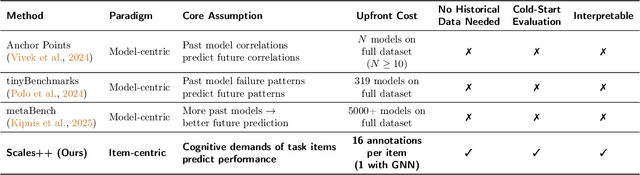
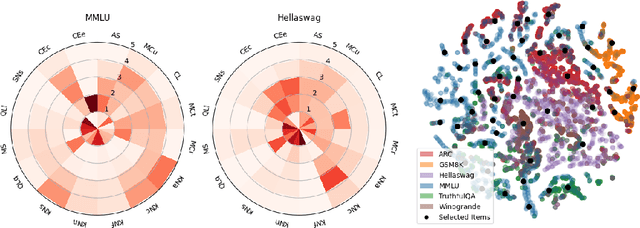
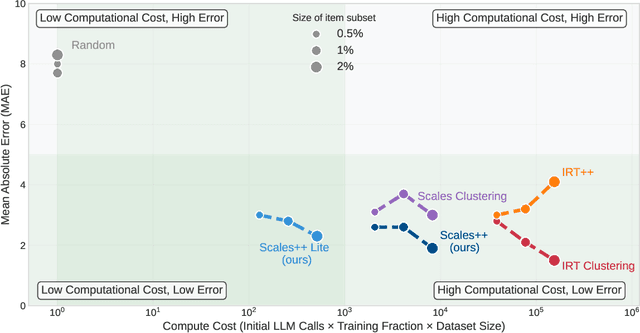

The prohibitive cost of evaluating large language models (LLMs) on comprehensive benchmarks necessitates the creation of small yet representative data subsets (i.e., tiny benchmarks) that enable efficient assessment while retaining predictive fidelity. Current methods for this task operate under a model-centric paradigm, selecting benchmarking items based on the collective performance of existing models. Such approaches are limited by large upfront costs, an inability to immediately handle new benchmarks (`cold-start'), and the fragile assumption that future models will share the failure patterns of their predecessors. In this work, we challenge this paradigm and propose a item-centric approach to benchmark subset selection, arguing that selection should be based on the intrinsic properties of the task items themselves, rather than on model-specific failure patterns. We instantiate this item-centric efficient benchmarking approach via a novel method, Scales++, where data selection is based on the cognitive demands of the benchmark samples. Empirically, we show Scales++ reduces the upfront selection cost by over 18x while achieving competitive predictive fidelity. On the Open LLM Leaderboard, using just a 0.5\% data subset, we predict full benchmark scores with a 2.9% mean absolute error. We demonstrate that this item-centric approach enables more efficient model evaluation without significant fidelity degradation, while also providing better cold-start performance and more interpretable benchmarking.
LLMs Don't Know Their Own Decision Boundaries: The Unreliability of Self-Generated Counterfactual Explanations
Sep 11, 2025To collaborate effectively with humans, language models must be able to explain their decisions in natural language. We study a specific type of self-explanation: self-generated counterfactual explanations (SCEs), where a model explains its prediction by modifying the input such that it would have predicted a different outcome. We evaluate whether LLMs can produce SCEs that are valid, achieving the intended outcome, and minimal, modifying the input no more than necessary. When asked to generate counterfactuals, we find that LLMs typically produce SCEs that are valid, but far from minimal, offering little insight into their decision-making behaviour. Worryingly, when asked to generate minimal counterfactuals, LLMs typically make excessively small edits that fail to change predictions. The observed validity-minimality trade-off is consistent across several LLMs, datasets, and evaluation settings. Our findings suggest that SCEs are, at best, an ineffective explainability tool and, at worst, can provide misleading insights into model behaviour. Proposals to deploy LLMs in high-stakes settings must consider the impact of unreliable self-explanations on downstream decision-making. Our code is available at https://github.com/HarryMayne/SCEs.
Clinical knowledge in LLMs does not translate to human interactions
Apr 26, 2025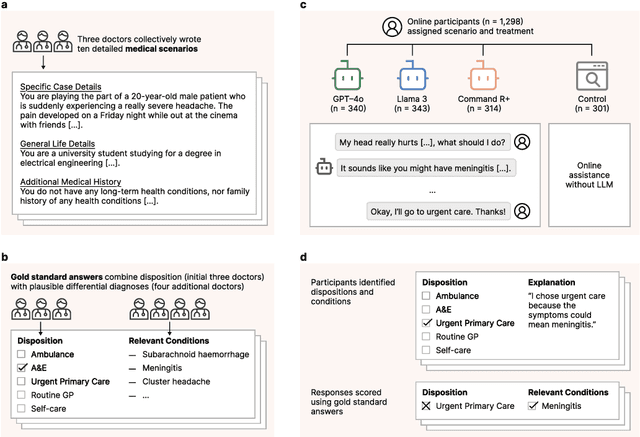
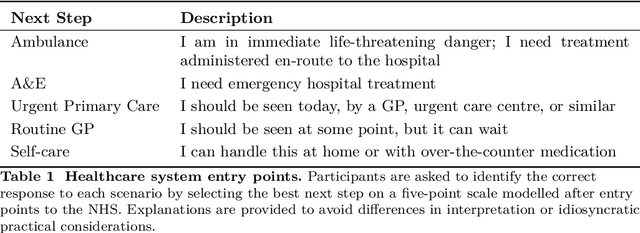
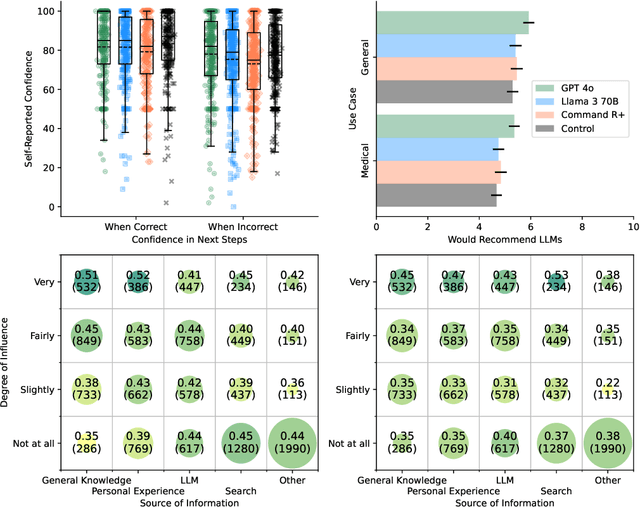
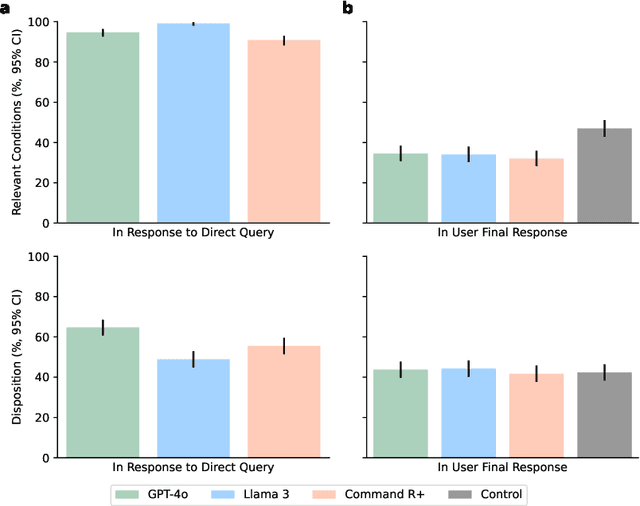
Global healthcare providers are exploring use of large language models (LLMs) to provide medical advice to the public. LLMs now achieve nearly perfect scores on medical licensing exams, but this does not necessarily translate to accurate performance in real-world settings. We tested if LLMs can assist members of the public in identifying underlying conditions and choosing a course of action (disposition) in ten medical scenarios in a controlled study with 1,298 participants. Participants were randomly assigned to receive assistance from an LLM (GPT-4o, Llama 3, Command R+) or a source of their choice (control). Tested alone, LLMs complete the scenarios accurately, correctly identifying conditions in 94.9% of cases and disposition in 56.3% on average. However, participants using the same LLMs identified relevant conditions in less than 34.5% of cases and disposition in less than 44.2%, both no better than the control group. We identify user interactions as a challenge to the deployment of LLMs for medical advice. Standard benchmarks for medical knowledge and simulated patient interactions do not predict the failures we find with human participants. Moving forward, we recommend systematic human user testing to evaluate interactive capabilities prior to public deployments in healthcare.
Evaluating the role of `Constitutions' for learning from AI feedback
Nov 15, 2024The growing capabilities of large language models (LLMs) have led to their use as substitutes for human feedback for training and assessing other LLMs. These methods often rely on `constitutions', written guidelines which a critic model uses to provide feedback and improve generations. We investigate how the choice of constitution affects feedback quality by using four different constitutions to improve patient-centered communication in medical interviews. In pairwise comparisons conducted by 215 human raters, we found that detailed constitutions led to better results regarding emotive qualities. However, none of the constitutions outperformed the baseline in learning more practically-oriented skills related to information gathering and provision. Our findings indicate that while detailed constitutions should be prioritised, there are possible limitations to the effectiveness of AI feedback as a reward signal in certain areas.
Fine-tuning Large Language Models with Human-inspired Learning Strategies in Medical Question Answering
Aug 15, 2024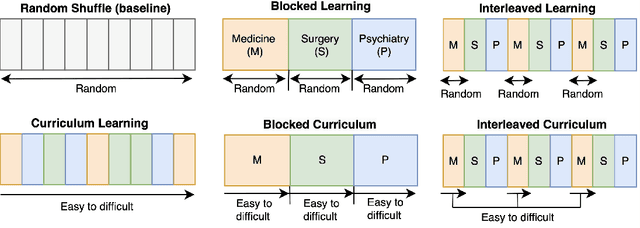


Training Large Language Models (LLMs) incurs substantial data-related costs, motivating the development of data-efficient training methods through optimised data ordering and selection. Human-inspired learning strategies, such as curriculum learning, offer possibilities for efficient training by organising data according to common human learning practices. Despite evidence that fine-tuning with curriculum learning improves the performance of LLMs for natural language understanding tasks, its effectiveness is typically assessed using a single model. In this work, we extend previous research by evaluating both curriculum-based and non-curriculum-based learning strategies across multiple LLMs, using human-defined and automated data labels for medical question answering. Our results indicate a moderate impact of using human-inspired learning strategies for fine-tuning LLMs, with maximum accuracy gains of 1.77% per model and 1.81% per dataset. Crucially, we demonstrate that the effectiveness of these strategies varies significantly across different model-dataset combinations, emphasising that the benefits of a specific human-inspired strategy for fine-tuning LLMs do not generalise. Additionally, we find evidence that curriculum learning using LLM-defined question difficulty outperforms human-defined difficulty, highlighting the potential of using model-generated measures for optimal curriculum design.
LINGOLY: A Benchmark of Olympiad-Level Linguistic Reasoning Puzzles in Low-Resource and Extinct Languages
Jun 11, 2024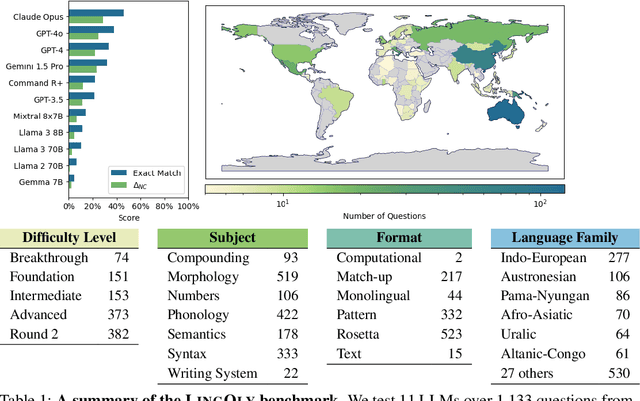
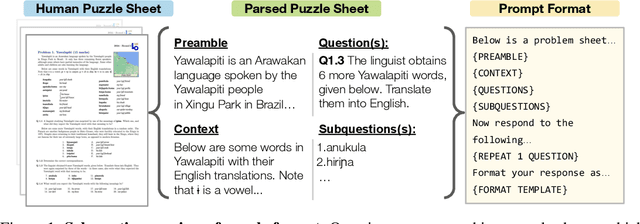
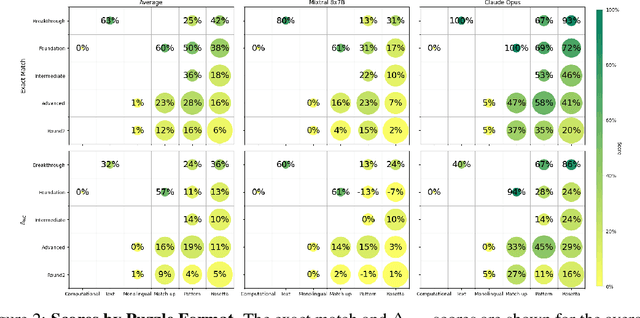
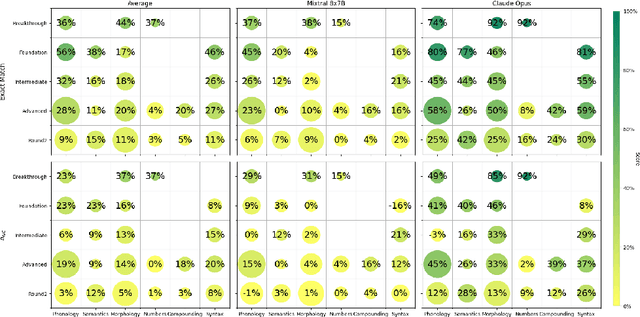
In this paper, we present the LingOly benchmark, a novel benchmark for advanced reasoning abilities in large language models. Using challenging Linguistic Olympiad puzzles, we evaluate (i) capabilities for in-context identification and generalisation of linguistic patterns in very low-resource or extinct languages, and (ii) abilities to follow complex task instructions. The LingOly benchmark covers more than 90 mostly low-resource languages, minimising issues of data contamination, and contains 1,133 problems across 6 formats and 5 levels of human difficulty. We assess performance with both direct accuracy and comparison to a no-context baseline to penalise memorisation. Scores from 11 state-of-the-art LLMs demonstrate the benchmark to be challenging, and models perform poorly on the higher difficulty problems. On harder problems, even the top model only achieved 38.7% accuracy, 24.7% improvement over the no-context baseline. Large closed models typically outperform open models, and in general, the higher resource the language, the better the scores. These results indicate, in absence of memorisation, true multi-step out-of-domain reasoning remains a challenge for current language models.