 Add to Chrome
 Add to Firefox
 Add to Edge
Token Reduction via Local and Global Contexts Optimization for Efficient Video Large Language Models
Mar 02, 2026
Video Large Language Models (VLLMs) demonstrate strong video understanding but suffer from inefficiency due to redundant visual tokens. Existing pruning primary targets intra-frame spatial redundancy or prunes inside the LLM with shallow-layer overhead, yielding suboptimal spatiotemporal reduction and underutilizing long-context compressibility. All of them often discard subtle yet informative context from merged or pruned tokens. In this paper, we propose a new perspective that elaborates token \textbf{A}nchors within intra-frame and inter-frame to comprehensively aggregate the informative contexts via local-global \textbf{O}ptimal \textbf{T}ransport (\textbf{AOT}). Specifically, we first establish local- and global-aware token anchors within each frame under the attention guidance, which then optimal transport aggregates the informative contexts from pruned tokens, constructing intra-frame token anchors. Then, building on the temporal frame clips, the first frame within each clip will be considered as the keyframe anchors to ensemble similar information from consecutive frames through optimal transport, while keeping distinct tokens to represent temporal dynamics, leading to efficient token reduction in a training-free manner. Extensive evaluations show that our proposed AOT obtains competitive performances across various short- and long-video benchmarks on leading video LLMs, obtaining substantial computational efficiency while preserving temporal and visual fidelity. Project webpage: \href{https://tyroneli.github.io/AOT}{AOT}.

Solve paint color effect prediction problem in trajectory optimization of spray painting robot using artificial neural network inspired by the Kubelka Munk model
Sep 06, 2024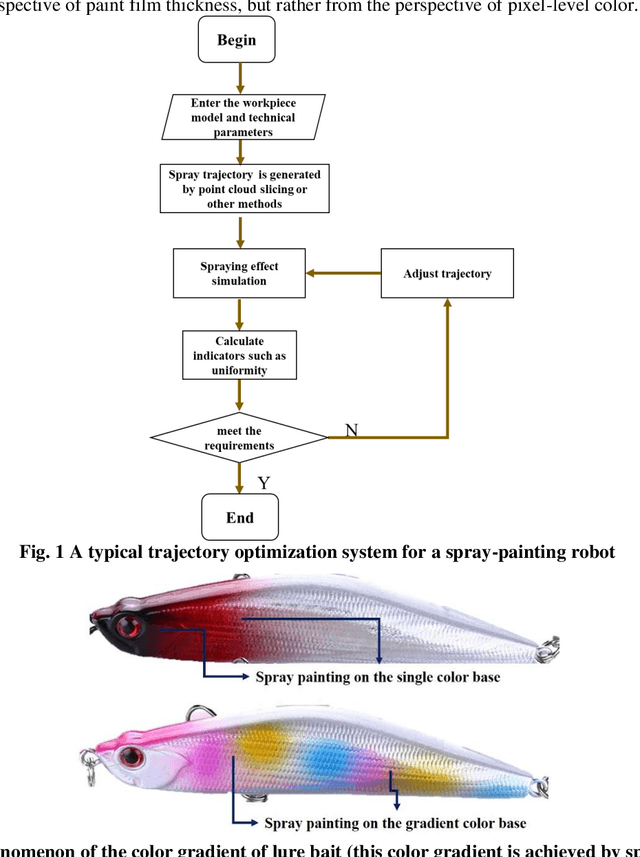
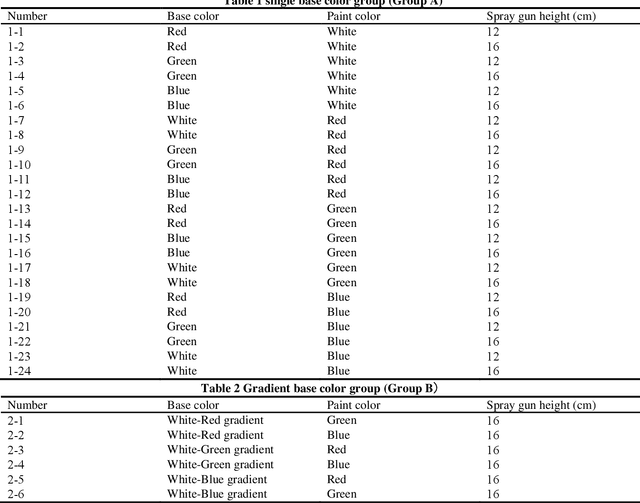
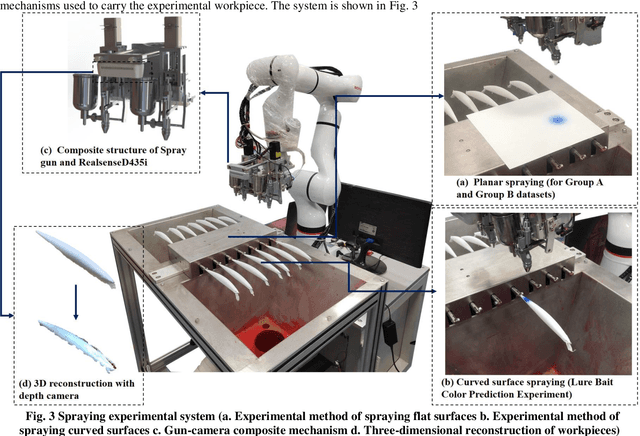
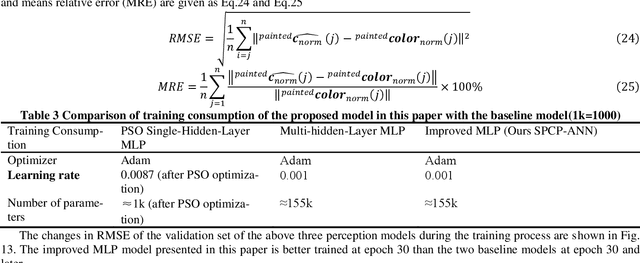
Currently, the spray-painting robot trajectory planning technology aiming at spray painting quality mainly applies to single-color spraying. Conventional methods of optimizing the spray gun trajectory based on simulated thickness can only qualitatively reflect the color distribution, and can not simulate the color effect of spray painting at the pixel level. Therefore, it is not possible to accurately control the area covered by the color and the gradation of the edges of the area, and it is also difficult to deal with the situation where multiple colors of paint are sprayed in combination. To solve the above problems, this paper is inspired by the Kubelka-Munk model and combines the 3D machine vision method and artificial neural network to propose a spray painting color effect prediction method. The method is enabled to predict the execution effect of the spray gun trajectory with pixel-level accuracy from the dimension of the surface color of the workpiece after spray painting. On this basis, the method can be used to replace the traditional thickness simulation method to establish the objective function of the spray gun trajectory optimization problem, and thus solve the difficult problem of spray gun trajectory optimization for multi-color paint combination spraying. In this paper, the mathematical model of the spray painting color effect prediction problem is first determined through the analysis of the Kubelka-Munk paint film color rendering model, and at the same time, the spray painting color effect dataset is established with the help of the depth camera and point cloud processing algorithm. After that, the multilayer perceptron model was improved with the help of gating and residual structure and was used for the color prediction task. To verify ...