 Add to Chrome
 Add to Firefox
 Add to Edge
Hidden Decoding at Scale: Latent Computation Scaling for Large Language Models
Jul 09, 2026
Scaling Large Language Models (LLMs) has been driven mainly by enlarging the Transformer backbone, but for an already-strong model this requires another round of costly pretraining. We study whether an existing backbone can keep improving by allocating more computation to each token while leaving the Transformer backbone fixed. Depth-recurrent (looped) Transformers pursue this goal but are hard to scale, because looped computation does not fit naturally with the pipeline parallelism used to train the largest models. We add computation along the sequence-length dimension, where the extra computation is simply a longer input and stays compatible with standard large-model training. We propose Hidden Decoding, a sequence-length scaling method applied during continued pretraining (CPT). It expands each token into n streams with independent embedding tables and keeps the intermediate streams' key-value cache as context, so each token performs more internal computation without adding or widening Transformer layers. To keep this affordable at scale, we introduce Stream-Factorized Attention, in which most layers attend only within each stream and only a few layers mix across streams, reducing the attention cost from quadratic to roughly linear in n. Experiments support two scaling results. At frontier scale, we train WeLM-HD4-80B and WeLM-HD4-617B at n=4 and improve their matched non-HD baselines, making Hidden Decoding the first demonstrated sequence-length scaling method at the 100B+ MoE scale. Across expansion factors, the gains grow as n increases, showing that sequence-length expansion is a practical fixed-backbone scaling path for frontier-scale LLMs.

A Survey of Physical-layer Authentication Enhanced by Emerging Spatial Domain Technologies
Jun 27, 2026This article surveys spatial-domain-enhanced Physical-layer Authentication (PLA), with Dual-polarized Antennas (DPA), Massive Multiple-Input Multiple-Output (MIMO), and Reconfigurable Intelligent Surfaces (RIS) as the primary focus. With the rapid growth of wireless deployments, authentication mechanisms face stringent requirements for high security, low overhead, and low latency. PLA offers lightweight identity verification by exploiting physical-layer characteristics. However, the effectiveness of PLA critically depends on how physical observations are constructed and validated under wireless channels. Unlike existing surveys that mainly organize PLA by authentication modality, feature source, and evaluation metrics, this work emphasizes the connection between spatial-domain enhancement mechanisms, the resulting feature representation, and the authentication procedure. We review how DPA, Massive MIMO, and RIS reshape PLA feature representation, and we summarize newly introduced security threats along with representative defense strategies. Case studies further illustrate the practical impact, such as representative detection-probability trends across Signal-to-Noise Ratio regimes and quantitative comparisons among representative schemes. Finally, we outline promising future opportunities enabled by Dynamic Metasurface Antennas, Extra-large MIMO, and spatial configuration with artificial intelligence.
Cross-channel Specific Emitter Identification and Verification via Signal Envelope
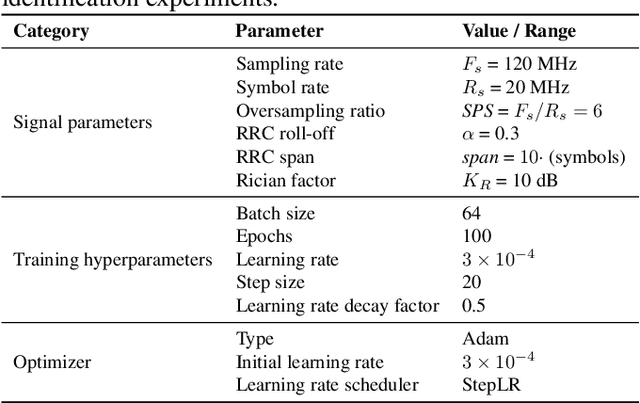
Jun 27, 2026Specific emitter identification (SEI) determines which known emitter a received signal originates from, while specific emitter verification (SEV) determines whether the received signal genuinely comes from its claimed emitter. In this paper, we consider the effect of wireless fading channels on SEI and SEV. When the Rician $K$-factor varies, the resulting distribution shift induced by the channel degrades both identification and verification performance. To address this issue, we first theoretically prove that the coefficient of variation of the signal envelope is strictly monotonic with respect to the Rician $K$-factor. Motivated by this property, we propose an envelope-guided adaptive feature modulation (EAFM) identifier for SEI and an EAFM with Mahalanobis distance metric learning (EAFM-MD) verifier for SEV. Specifically, the proposed EAFM identifier adopts a dual-branch neural network to extract device-oriented features from the IQ-domain input and channel-conditioning features from the normalized signal envelope, and adaptively modulates the former via feature-wise linear modulation. Then, we extend the EAFM identifier to an EAFM-MD verifier. The device-fingerprint library is constructed by storing the feature centroid and covariance for each enrolled device, along with the within-device Mahalanobis distances of training signals. For verification, the Mahalanobis distance between the extracted test features and each stored centroid is computed using the stored covariance matrix, and the minimum distance is compared to the corresponding device threshold to make a decision. Finally, numerical results show that the proposed EAFM identifier improves cross-channel identification performance, while the proposed EAFM-MD verifier achieves superior detection performance against unknown spoofing attacks.
Memorize Theorems, Not Instances: Probing SFT Generalization through Mathematical Reasoning
May 10, 2026Supervised Fine-Tuning (SFT) is widely used for task-specific adaptation, yet recent work shows it systematically undermines reasoning generalization. We argue the root cause is not memorization itself, but its target: vanilla SFT drives models to exploit and memorize spurious surface correlations in problem-solution pairs, leaving them brittle to superficial input variations. To address this, we propose Theorem-SFT, which reorients supervision toward explicit theorem application by teaching models how rules are invoked rather than what answers look like. Theorem-SFT yields consistent gains across benchmarks and model families: +8.8% on MATH (LLaMA3.2-3B-Instruct) and +20.27% on GeoQA (Qwen2.5-VL-7B-Instruct) without modality-specific re-training. Fine-tuning MLP layers alone matches full-layers performance, implicating feed-forward components as the primary locus of reasoning rules. Our findings reframe the debate: Generalization failures stem not from memorization as a mechanism, but from memorizing the wrong inductive targets.
Deeper Thought, Weaker Aim: Understanding and Mitigating Perceptual Impairment during Reasoning in Multimodal Large Language Models
Mar 15, 2026Multimodal large language models (MLLMs) often suffer from perceptual impairments under extended reasoning modes, particularly in visual question answering (VQA) tasks. We identify attention dispersion as the underlying cause: during multi-step reasoning, the model's visual attention becomes scattered and drifts away from question-relevant regions, effectively "losing focus" on the visual input. To better understand this phenomenon, we analyze the attention maps of MLLMs and observe that reasoning prompts significantly reduce attention to regions critical for answering the question. We further find a strong correlation between the model's overall attention on image tokens and the spatial dispersiveness of its attention within the image. Leveraging this insight, we propose a training-free Visual Region-Guided Attention (VRGA) framework that selects visual heads based on an entropy-focus criterion and reweights their attention, effectively guiding the model to focus on question-relevant regions during reasoning. Extensive experiments on vision-language benchmarks demonstrate that our method effectively alleviates perceptual degradation, leading to improvements in visual grounding and reasoning accuracy while providing interpretable insights into how MLLMs process visual information.
Joint Fractional Delay and Doppler Frequency Estimator Under Spectrum Wrapping Phenomenon for LEO-ICAN AFDM Signals
Feb 04, 2026With the rapid development of low earth orbit (LEO) satellites, the design of integrated communication and navigation (ICAN) signals has attracted increasing attention, especially in the field of vehicle-to-everything (V2X). As a new-generation waveform, Affine Frequency Division Multiplexing (AFDM) features high robustness against Doppler effects, a simple modulation structure, and low pilot overhead, making it a promising candidate for high-dynamic LEO satellite scenarios. However, LEO-ICAN AFDM signals face challenges in fractional delay and Doppler frequency estimation. Existing studies that ignore its inherent spectrum wrapping phenomenon may lead to deviations of varying degrees in model construction. This paper conducts an in-depth derivation of AFDM's input-output relationship under fractional cases, reveals the envelope characteristics of its equivalent channel, and proposes a joint estimation algorithm based on peak-to-sidelobe power ratio (PSPR) detection and early-late gate (ELG) to estimate fractional Doppler frequency and delay. Simulations show that the algorithm has low complexity, low guard interval overhead, and high precision compared with traditional methods.
Specific Multi-emitter Identification: Theoretical Limits and Low-complexity Design
Dec 22, 2025Specific emitter identification (SEI) distinguishes emitters by utilizing hardware-induced signal imperfections. However, conventional SEI techniques are primarily designed for single-emitter scenarios. This poses a fundamental limitation in distributed wireless networks, where simultaneous transmissions from multiple emitters result in overlapping signals that conventional single-emitter identification methods cannot effectively handle. To overcome this limitation, we present a specific multi-emitter identification (SMEI) framework via multi-label learning, treating identification as a problem of directly decoding emitter states from overlapping signals. Theoretically, we establish performance bounds using Fano's inequality. Methodologically, the multi-label formulation reduces output dimensionality from exponential to linear scale, thereby substantially decreasing computational complexity. Additionally, we propose an improved SMEI (I-SMEI), which incorporates multi-head attention to effectively capture features in correlated signal combinations. Experimental results demonstrate that SMEI achieves high identification accuracy with a linear computational complexity. Furthermore, the proposed I-SMEI scheme significantly improves identification accuracy across various overlapping scenarios compared to the proposed SMEI and other advanced methods.
Specific multi-emitter identification via multi-label learning
Sep 26, 2025
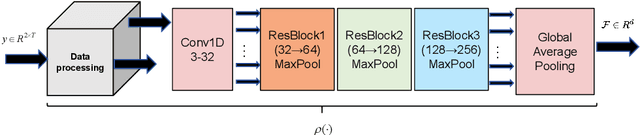
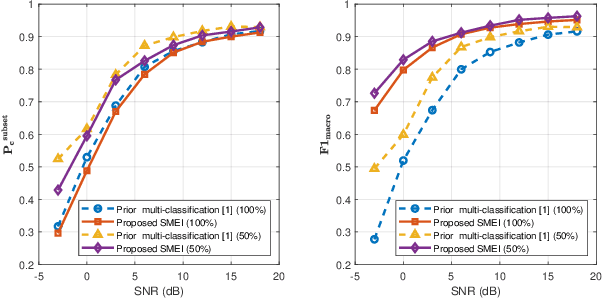
Specific emitter identification leverages hardware-induced impairments to uniquely determine a specific transmitter. However, existing approaches fail to address scenarios where signals from multiple emitters overlap. In this paper, we propose a specific multi-emitter identification (SMEI) method via multi-label learning to determine multiple transmitters. Specifically, the multi-emitter fingerprint extractor is designed to mitigate the mutual interference among overlapping signals. Then, the multi-emitter decision maker is proposed to assign the all emitter identification using the previous extracted fingerprint. Experimental results demonstrate that, compared with baseline approach, the proposed SMEI scheme achieves comparable identification accuracy under various overlapping conditions, while operating at significantly lower complexity. The significance of this paper is to identify multiple emitters from overlapped signal with a low complexity.
StablePCA: Learning Shared Representations across Multiple Sources via Minimax Optimization
May 02, 2025When synthesizing multisource high-dimensional data, a key objective is to extract low-dimensional feature representations that effectively approximate the original features across different sources. Such general feature extraction facilitates the discovery of transferable knowledge, mitigates systematic biases such as batch effects, and promotes fairness. In this paper, we propose Stable Principal Component Analysis (StablePCA), a novel method for group distributionally robust learning of latent representations from high-dimensional multi-source data. A primary challenge in generalizing PCA to the multi-source regime lies in the nonconvexity of the fixed rank constraint, rendering the minimax optimization nonconvex. To address this challenge, we employ the Fantope relaxation, reformulating the problem as a convex minimax optimization, with the objective defined as the maximum loss across sources. To solve the relaxed formulation, we devise an optimistic-gradient Mirror Prox algorithm with explicit closed-form updates. Theoretically, we establish the global convergence of the Mirror Prox algorithm, with the convergence rate provided from the optimization perspective. Furthermore, we offer practical criteria to assess how closely the solution approximates the original nonconvex formulation. Through extensive numerical experiments, we demonstrate StablePCA's high accuracy and efficiency in extracting robust low-dimensional representations across various finite-sample scenarios.
Winners with Confidence: Discrete Argmin Inference with an Application to Model Selection
Aug 04, 2024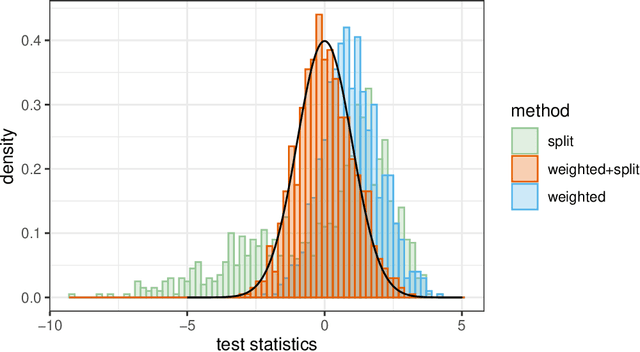
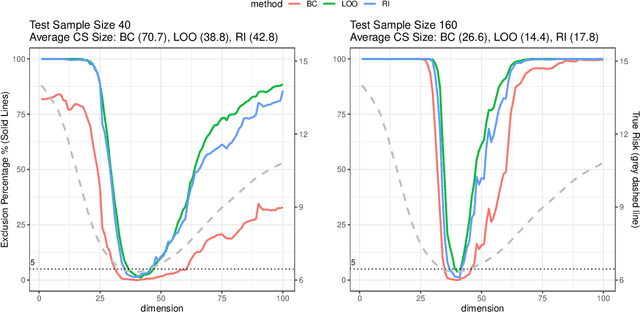
We study the problem of finding the index of the minimum value of a vector from noisy observations. This problem is relevant in population/policy comparison, discrete maximum likelihood, and model selection. We develop a test statistic that is asymptotically normal, even in high-dimensional settings and with potentially many ties in the population mean vector, by integrating concepts and tools from cross-validation and differential privacy. The key technical ingredient is a central limit theorem for globally dependent data. We also propose practical ways to select the tuning parameter that adapts to the signal landscape.