 Add to Chrome
 Add to Firefox
 Add to Edge
RT-SHCUA: Real-Time Self-Hosted Computer-Use Agent for UAV Control
Jul 20, 2026
Natural-language control offers a promising interface for unmanned aerial vehicles (UAVs), but directly applying self-hosted computer-use agents (SHCUAs) to UAV control introduces a structural mismatch. SHCUAs are designed for interactive host-side tool use, where delayed agent iterations are often acceptable. UAV control, however, is coupled with continuously changing physical states, strict timing constraints, safety risks, and security accountability. A stale, unauthorized, or tampered agent decision may therefore lead to unsafe or untraceable vehicle behavior. This paper proposes a real-time and security-oriented restructuring of SHCUA-based UAV control. Instead of allowing an SHCUA to directly issue flight commands, we transform its outputs into contract-bound UAV skill invocations with explicit timing, state, authority, fallback, and evidence semantics. Based on this abstraction, we design an architecture that separates semantic reasoning from onboard execution and security/safety enforcement. Slow cloud or edge reasoning is used for mission understanding, while onboard components validate and dispatch only timely, authorized, and state-consistent skills. Security-critical enforcement points can be protected by TEE-style or microcontroller isolation mechanisms without moving the full language agent or high-frequency flight-control loop into trusted components. Prototype evaluation shows that RT-SHCUA maintains bounded task-level responsiveness while supporting degraded handling, trusted admission, and auditable evidence preservation for SHCUA-mediated UAV actions.

Hidden Decoding at Scale: Latent Computation Scaling for Large Language Models
Jul 09, 2026Scaling Large Language Models (LLMs) has been driven mainly by enlarging the Transformer backbone, but for an already-strong model this requires another round of costly pretraining. We study whether an existing backbone can keep improving by allocating more computation to each token while leaving the Transformer backbone fixed. Depth-recurrent (looped) Transformers pursue this goal but are hard to scale, because looped computation does not fit naturally with the pipeline parallelism used to train the largest models. We add computation along the sequence-length dimension, where the extra computation is simply a longer input and stays compatible with standard large-model training. We propose Hidden Decoding, a sequence-length scaling method applied during continued pretraining (CPT). It expands each token into n streams with independent embedding tables and keeps the intermediate streams' key-value cache as context, so each token performs more internal computation without adding or widening Transformer layers. To keep this affordable at scale, we introduce Stream-Factorized Attention, in which most layers attend only within each stream and only a few layers mix across streams, reducing the attention cost from quadratic to roughly linear in n. Experiments support two scaling results. At frontier scale, we train WeLM-HD4-80B and WeLM-HD4-617B at n=4 and improve their matched non-HD baselines, making Hidden Decoding the first demonstrated sequence-length scaling method at the 100B+ MoE scale. Across expansion factors, the gains grow as n increases, showing that sequence-length expansion is a practical fixed-backbone scaling path for frontier-scale LLMs.
FastPano3D: Feed-Forward Indoor Panoramic 3D Reconstruction from a Single Image
Jun 29, 2026Recent advances in 3D scene reconstruction have highlighted the intricate trade-offs among rendering quality, inference efficiency, and data dependency. To address the challenge of rapidly reconstructing detailed 3D indoor scenes from minimal input, we introduce FastPano3D, an end-to-end framework that directly generates renderable 3D Gaussian representations from a single panoramic image. Unlike perspective-based methods, panoramic images inherently suffer from equirectangular projection distortions and spatially non-uniform feature distributions, making direct feed-forward Gaussian generation particularly challenging. In contrast to existing Gaussian Splatting based methods that rely on multi-view supervision or per-scene optimization, FastPano3D employs a lightweight feature encoder, adaptive Gaussian sampling, and a point-cloud-guided refinement strategy to achieve efficient and accurate scene generation without any test-time optimization. Our approach reconstructs high-fidelity 3D scenes within seconds, achieving up to 156 times faster inference than prior state-of-the-art methods such as Pano2Room, while using only half the parameters. Extensive experiments demonstrate that FastPano3D delivers rendering quality comparable to NeRF- and 3DGS-based reconstructions, establishing a new benchmark for rapid, single-view 3D scene inference.
When Convenience Becomes Risk: A Semantic View of Under-Specification in Host-Acting Agents
Mar 22, 2026Host-acting agents promise a convenient interaction model in which users specify goals and the system determines how to realize them. We argue that this convenience introduces a distinct security problem: semantic under-specification in goal specification. User instructions are typically goal-oriented, yet they often leave process constraints, safety boundaries, persistence, and exposure insufficiently specified. As a result, the agent must complete missing execution semantics before acting, and this completion can produce risky host-side plans even when the user-stated goal is benign. In this paper, we develop a semantic threat model, present a taxonomy of semantic-induced risky completion patterns, and study the phenomenon through an OpenClaw-centered case study and execution-trace analysis. We further derive defense design principles for making execution boundaries explicit and constraining risky completion. These findings suggest that securing host-acting agents requires governing not only which actions are allowed at execution time, but also how goal-only instructions are translated into executable plans.
Terminal-Bench: Benchmarking Agents on Hard, Realistic Tasks in Command Line Interfaces
Jan 17, 2026AI agents may soon become capable of autonomously completing valuable, long-horizon tasks in diverse domains. Current benchmarks either do not measure real-world tasks, or are not sufficiently difficult to meaningfully measure frontier models. To this end, we present Terminal-Bench 2.0: a carefully curated hard benchmark composed of 89 tasks in computer terminal environments inspired by problems from real workflows. Each task features a unique environment, human-written solution, and comprehensive tests for verification. We show that frontier models and agents score less than 65\% on the benchmark and conduct an error analysis to identify areas for model and agent improvement. We publish the dataset and evaluation harness to assist developers and researchers in future work at https://www.tbench.ai/ .
Sharp Eyes and Memory for VideoLLMs: Information-Aware Visual Token Pruning for Efficient and Reliable VideoLLM Reasoning
Nov 11, 2025Current Video Large Language Models (VideoLLMs) suffer from quadratic computational complexity and key-value cache scaling, due to their reliance on processing excessive redundant visual tokens. To address this problem, we propose SharpV, a minimalist and efficient method for adaptive pruning of visual tokens and KV cache. Different from most uniform compression approaches, SharpV dynamically adjusts pruning ratios based on spatial-temporal information. Remarkably, this adaptive mechanism occasionally achieves performance gains over dense models, offering a novel paradigm for adaptive pruning. During the KV cache pruning stage, based on observations of visual information degradation, SharpV prunes degraded visual features via a self-calibration manner, guided by similarity to original visual features. In this way, SharpV achieves hierarchical cache pruning from the perspective of information bottleneck, offering a new insight into VideoLLMs' information flow. Experiments on multiple public benchmarks demonstrate the superiority of SharpV. Moreover, to the best of our knowledge, SharpV is notably the first two-stage pruning framework that operates without requiring access to exposed attention scores, ensuring full compatibility with hardware acceleration techniques like Flash Attention.
CEHA: A Dataset of Conflict Events in the Horn of Africa
Dec 18, 2024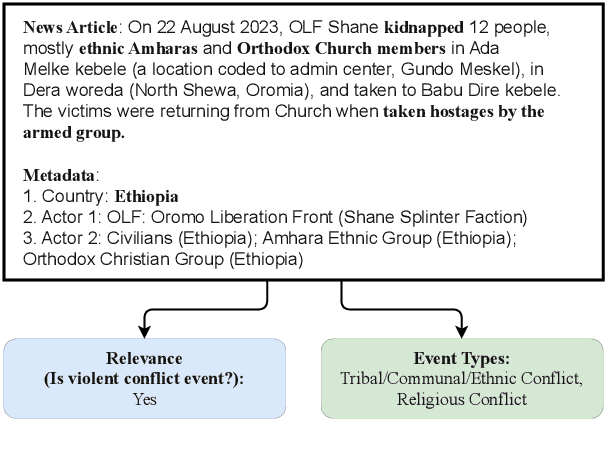
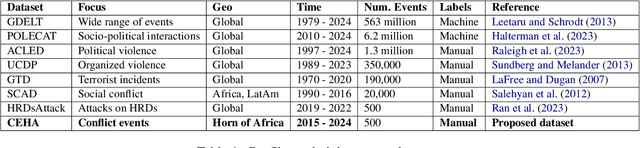
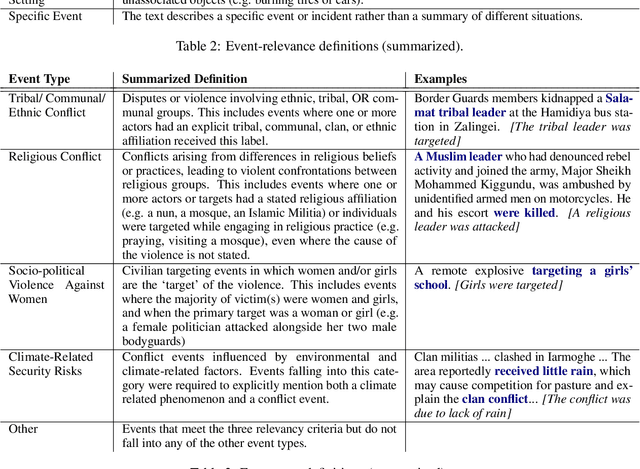
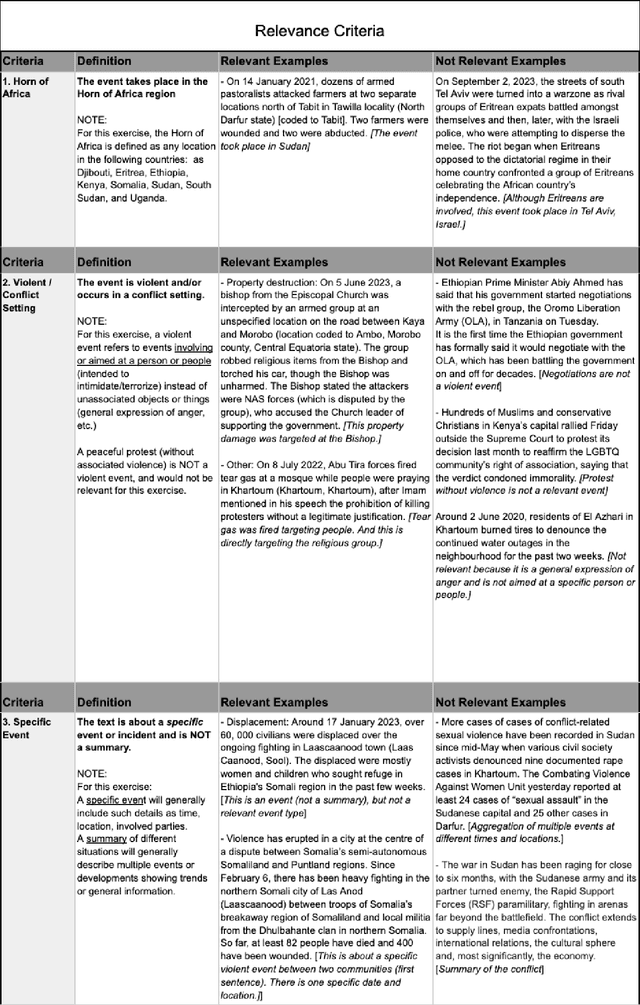
Natural Language Processing (NLP) of news articles can play an important role in understanding the dynamics and causes of violent conflict. Despite the availability of datasets categorizing various conflict events, the existing labels often do not cover all of the fine-grained violent conflict event types relevant to areas like the Horn of Africa. In this paper, we introduce a new benchmark dataset Conflict Events in the Horn of Africa region (CEHA) and propose a new task for identifying violent conflict events using online resources with this dataset. The dataset consists of 500 English event descriptions regarding conflict events in the Horn of Africa region with fine-grained event-type definitions that emphasize the cause of the conflict. This dataset categorizes the key types of conflict risk according to specific areas required by stakeholders in the Humanitarian-Peace-Development Nexus. Additionally, we conduct extensive experiments on two tasks supported by this dataset: Event-relevance Classification and Event-type Classification. Our baseline models demonstrate the challenging nature of these tasks and the usefulness of our dataset for model evaluations in low-resource settings with limited number of training data.
From Prohibition to Adoption: How Hong Kong Universities Are Navigating ChatGPT in Academic Workflows
Oct 02, 2024This paper aims at comparing the time when Hong Kong universities used to ban ChatGPT to the current periods where it has become integrated in the academic processes. Bolted by concerns of integrity and ethical issues in technologies, institutions have adapted by moving towards the center adopting AI literacy and responsibility policies. This study examines new paradigms which have been developed to help implement these positives while preventing negative effects on academia. Keywords: ChatGPT, Academic Integrity, AI Literacy, Ethical AI Use, Generative AI in Education, University Policy, AI Integration in Academia, Higher Education and Technology
AKEM: Aligning Knowledge Base to Queries with Ensemble Model for Entity Recognition and Linking
Sep 13, 2023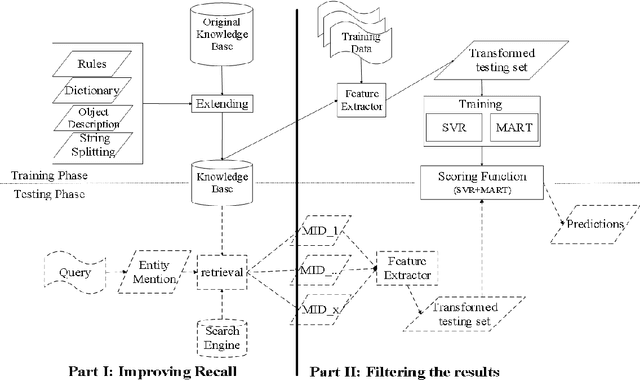

This paper presents a novel approach to address the Entity Recognition and Linking Challenge at NLPCC 2015. The task involves extracting named entity mentions from short search queries and linking them to entities within a reference Chinese knowledge base. To tackle this problem, we first expand the existing knowledge base and utilize external knowledge to identify candidate entities, thereby improving the recall rate. Next, we extract features from the candidate entities and utilize Support Vector Regression and Multiple Additive Regression Tree as scoring functions to filter the results. Additionally, we apply rules to further refine the results and enhance precision. Our method is computationally efficient and achieves an F1 score of 0.535.
FATRER: Full-Attention Topic Regularizer for Accurate and Robust Conversational Emotion Recognition
Jul 23, 2023This paper concentrates on the understanding of interlocutors' emotions evoked in conversational utterances. Previous studies in this literature mainly focus on more accurate emotional predictions, while ignoring model robustness when the local context is corrupted by adversarial attacks. To maintain robustness while ensuring accuracy, we propose an emotion recognizer augmented by a full-attention topic regularizer, which enables an emotion-related global view when modeling the local context in a conversation. A joint topic modeling strategy is introduced to implement regularization from both representation and loss perspectives. To avoid over-regularization, we drop the constraints on prior distributions that exist in traditional topic modeling and perform probabilistic approximations based entirely on attention alignment. Experiments show that our models obtain more favorable results than state-of-the-art models, and gain convincing robustness under three types of adversarial attacks.