 Add to Chrome
 Add to Firefox
 Add to Edge
Toward a Unified Statistical Theory of Unsupervised Pretraining and Supervised Neural Knowledge Graph Learning
Jul 28, 2026
Knowledge graph learning provides a powerful framework for representing and inferring structured knowledge, with broad practical applications. However, the scarcity of relation-specific labeled triples per entity hinders the training of expressive models, and the ad hoc design of scoring functions limits generalizability and lacks theoretical grounding. We address both issues with a theoretically grounded, end-to-end training framework that extends and subsumes existing methods. Our framework is a two-stage procedure: unsupervised pretraining over heterogeneous corpora followed by supervised learning with multiple relation types. We establish a nonasymptotic risk bound that disentangles pretraining representation error from labeled-sample complexity, formally quantifying the benefit of large-scale unlabeled data for downstream knowledge prediction. Synthetic experiments validate each theoretical component, and real-world experiments confirm the effectiveness of our approach on large-scale knowledge graph benchmarks.

LoViF 2026 The First Challenge on Weather Removal in Videos
Apr 14, 2026This paper presents a review of the LoViF 2026 Challenge on Weather Removal in Videos. The challenge encourages the development of methods for restoring clean videos from inputs degraded by adverse weather conditions such as rain and snow, with an emphasis on achieving visually plausible and temporally consistent results while preserving scene structure and motion dynamics. To support this task, we introduce a new short-form WRV dataset tailored for video weather removal. It consists of 18 videos 1,216 synthesized frames paired with 1,216 real-world ground-truth frames at a resolution of 832 x 480, and is split into training, validation, and test sets with a ratio of 1:1:1. The goal of this challenge is to advance robust and realistic video restoration under real-world weather conditions, with evaluation protocols that jointly consider fidelity and perceptual quality. The challenge attracted 37 participants and received 5 valid final submissions with corresponding fact sheets, contributing to progress in weather removal for videos. The project is publicly available at https://www.codabench.org/competitions/13462/.
Leum-VL Technical Report
Mar 20, 2026A short video succeeds not simply because of what it shows, but because of how it schedules attention -- yet current multimodal models lack the structural grammar to parse or produce this organization. Existing models can describe scenes, answer event-centric questions, and read on-screen text, but they are far less reliable at identifying timeline-grounded units such as hooks, cut rationales, shot-induced tension, and platform-facing packaging cues. We propose SV6D (Structured Video in Six Dimensions), inspired by professional storyboard practice in film and television production, a representation framework that decomposes internet-native video into six complementary structural dimensions -- subject, aesthetics, camera language, editing, narrative, and dissemination -- with each label tied to physically observable evidence on the timeline. We formalize a unified optimization objective over SV6D that combines Hungarian-matched temporal alignment, dimension-wise semantic label distance, and quality regularization. Building on this framework, we present Leum-VL-8B, an 8B video-language model that realizes the SV6D objective through an expert-driven post-training pipeline, further refined through verifiable reinforcement learning on perception-oriented tasks. Leum-VL-8B achieves 70.8 on VideoMME (w/o subtitles), 70.0 on MVBench, and 61.6 on MotionBench, while remaining competitive on general multimodal evaluations such as MMBench-EN. We also construct FeedBench, a benchmark for structure-sensitive short-video understanding. Our results indicate that the missing layer in video AI is not pixel generation but structural representation: grounded on the timeline, linked to visible evidence, and directly consumable by downstream workflows such as editing, retrieval, recommendation, and generation control, including text-heavy internet video formats with overlays and image-text layouts.
Unknown Aware AI-Generated Content Attribution
Jan 01, 2026The rapid advancement of photorealistic generative models has made it increasingly important to attribute the origin of synthetic content, moving beyond binary real or fake detection toward identifying the specific model that produced a given image. We study the problem of distinguishing outputs from a target generative model (e.g., OpenAI Dalle 3) from other sources, including real images and images generated by a wide range of alternative models. Using CLIP features and a simple linear classifier, shown to be effective in prior work, we establish a strong baseline for target generator attribution using only limited labeled data from the target model and a small number of known generators. However, this baseline struggles to generalize to harder, unseen, and newly released generators. To address this limitation, we propose a constrained optimization approach that leverages unlabeled wild data, consisting of images collected from the Internet that may include real images, outputs from unknown generators, or even samples from the target model itself. The proposed method encourages wild samples to be classified as non target while explicitly constraining performance on labeled data to remain high. Experimental results show that incorporating wild data substantially improves attribution performance on challenging unseen generators, demonstrating that unlabeled data from the wild can be effectively exploited to enhance AI generated content attribution in open world settings.
Stress-Testing Model Specs Reveals Character Differences among Language Models
Oct 09, 2025Large language models (LLMs) are increasingly trained from AI constitutions and model specifications that establish behavioral guidelines and ethical principles. However, these specifications face critical challenges, including internal conflicts between principles and insufficient coverage of nuanced scenarios. We present a systematic methodology for stress-testing model character specifications, automatically identifying numerous cases of principle contradictions and interpretive ambiguities in current model specs. We stress test current model specs by generating scenarios that force explicit tradeoffs between competing value-based principles. Using a comprehensive taxonomy we generate diverse value tradeoff scenarios where models must choose between pairs of legitimate principles that cannot be simultaneously satisfied. We evaluate responses from twelve frontier LLMs across major providers (Anthropic, OpenAI, Google, xAI) and measure behavioral disagreement through value classification scores. Among these scenarios, we identify over 70,000 cases exhibiting significant behavioral divergence. Empirically, we show this high divergence in model behavior strongly predicts underlying problems in model specifications. Through qualitative analysis, we provide numerous example issues in current model specs such as direct contradiction and interpretive ambiguities of several principles. Additionally, our generated dataset also reveals both clear misalignment cases and false-positive refusals across all of the frontier models we study. Lastly, we also provide value prioritization patterns and differences of these models.
Topology-Aware Conformal Prediction for Stream Networks
Mar 06, 2025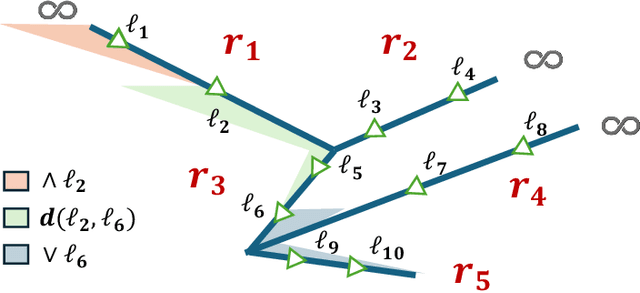
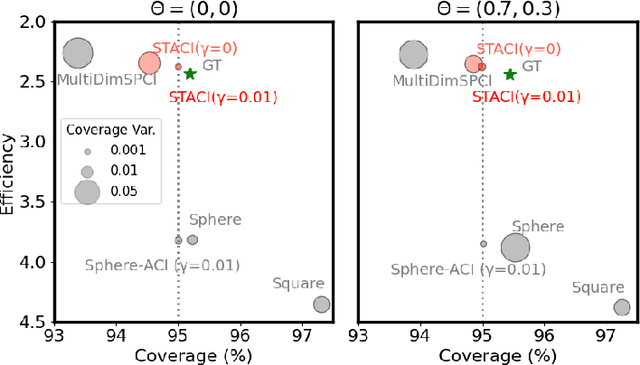
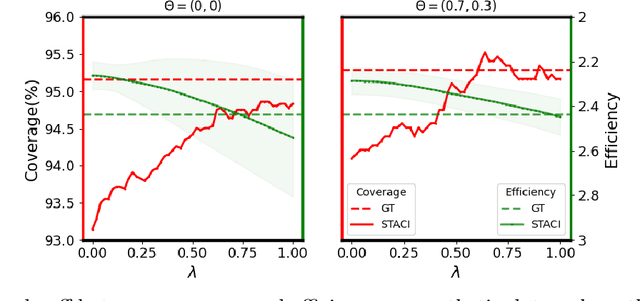
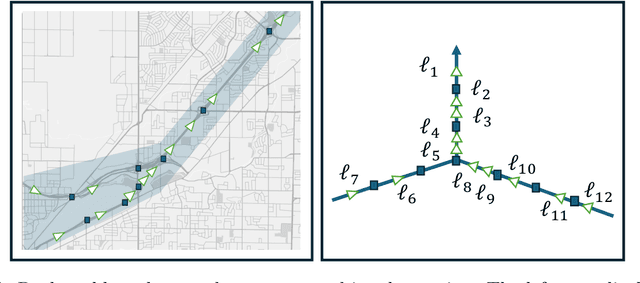
Stream networks, a unique class of spatiotemporal graphs, exhibit complex directional flow constraints and evolving dependencies, making uncertainty quantification a critical yet challenging task. Traditional conformal prediction methods struggle in this setting due to the need for joint predictions across multiple interdependent locations and the intricate spatio-temporal dependencies inherent in stream networks. Existing approaches either neglect dependencies, leading to overly conservative predictions, or rely solely on data-driven estimations, failing to capture the rich topological structure of the network. To address these challenges, we propose Spatio-Temporal Adaptive Conformal Inference (\texttt{STACI}), a novel framework that integrates network topology and temporal dynamics into the conformal prediction framework. \texttt{STACI} introduces a topology-aware nonconformity score that respects directional flow constraints and dynamically adjusts prediction sets to account for temporal distributional shifts. We provide theoretical guarantees on the validity of our approach and demonstrate its superior performance on both synthetic and real-world datasets. Our results show that \texttt{STACI} effectively balances prediction efficiency and coverage, outperforming existing conformal prediction methods for stream networks.
Bridging the Creativity Understanding Gap: Small-Scale Human Alignment Enables Expert-Level Humor Ranking in LLMs
Feb 27, 2025Large Language Models (LLMs) have shown significant limitations in understanding creative content, as demonstrated by Hessel et al. (2023)'s influential work on the New Yorker Cartoon Caption Contest (NYCCC). Their study exposed a substantial gap between LLMs and humans in humor comprehension, establishing that understanding and evaluating creative content is key challenge in AI development. We revisit this challenge by decomposing humor understanding into three components and systematically improve each: enhancing visual understanding through improved annotation, utilizing LLM-generated humor reasoning and explanations, and implementing targeted alignment with human preference data. Our refined approach achieves 82.4% accuracy in caption ranking, singificantly improving upon the previous 67% benchmark and matching the performance of world-renowned human experts in this domain. Notably, while attempts to mimic subgroup preferences through various persona prompts showed minimal impact, model finetuning with crowd preferences proved remarkably effective. These findings reveal that LLM limitations in creative judgment can be effectively addressed through focused alignment to specific subgroups and individuals. Lastly, we propose the position that achieving artificial general intelligence necessitates systematic collection of human preference data across creative domains. We advocate that just as human creativity is deeply influenced by individual and cultural preferences, training LLMs with diverse human preference data may be essential for developing true creative understanding.
Harnessing Multiple Correlated Networks for Exact Community Recovery
Dec 03, 2024We study the problem of learning latent community structure from multiple correlated networks, focusing on edge-correlated stochastic block models with two balanced communities. Recent work of Gaudio, R\'acz, and Sridhar (COLT 2022) determined the precise information-theoretic threshold for exact community recovery using two correlated graphs; in particular, this showcased the subtle interplay between community recovery and graph matching. Here we study the natural setting of more than two graphs. The main challenge lies in understanding how to aggregate information across several graphs when none of the pairwise latent vertex correspondences can be exactly recovered. Our main result derives the precise information-theoretic threshold for exact community recovery using any constant number of correlated graphs, answering a question of Gaudio, R\'acz, and Sridhar (COLT 2022). In particular, for every $K \geq 3$ we uncover and characterize a region of the parameter space where exact community recovery is possible using $K$ correlated graphs, even though (1) this is information-theoretically impossible using any $K-1$ of them and (2) none of the latent matchings can be exactly recovered.
From Prototypes to General Distributions: An Efficient Curriculum for Masked Image Modeling
Nov 16, 2024Masked Image Modeling (MIM) has emerged as a powerful self-supervised learning paradigm for visual representation learning, enabling models to acquire rich visual representations by predicting masked portions of images from their visible regions. While this approach has shown promising results, we hypothesize that its effectiveness may be limited by optimization challenges during early training stages, where models are expected to learn complex image distributions from partial observations before developing basic visual processing capabilities. To address this limitation, we propose a prototype-driven curriculum leagrning framework that structures the learning process to progress from prototypical examples to more complex variations in the dataset. Our approach introduces a temperature-based annealing scheme that gradually expands the training distribution, enabling more stable and efficient learning trajectories. Through extensive experiments on ImageNet-1K, we demonstrate that our curriculum learning strategy significantly improves both training efficiency and representation quality while requiring substantially fewer training epochs compared to standard Masked Auto-Encoding. Our findings suggest that carefully controlling the order of training examples plays a crucial role in self-supervised visual learning, providing a practical solution to the early-stage optimization challenges in MIM.
Deep Active Learning in the Open World
Nov 10, 2024Machine learning models deployed in open-world scenarios often encounter unfamiliar conditions and perform poorly in unanticipated situations. As AI systems advance and find application in safety-critical domains, effectively handling out-of-distribution (OOD) data is crucial to building open-world learning systems. In this work, we introduce ALOE, a novel active learning algorithm for open-world environments designed to enhance model adaptation by incorporating new OOD classes via a two-stage approach. First, diversity sampling selects a representative set of examples, followed by energy-based OOD detection to prioritize likely unknown classes for annotation. This strategy accelerates class discovery and learning, even under constrained annotation budgets. Evaluations on three long-tailed image classification benchmarks demonstrate that ALOE outperforms traditional active learning baselines, effectively expanding known categories while balancing annotation cost. Our findings reveal a crucial tradeoff between enhancing known-class performance and discovering new classes, setting the stage for future advancements in open-world machine learning.