 Add to Chrome
 Add to Firefox
 Add to Edge
High Rank Matrix Completion via Grassmannian Proxy Fusion
Jan 30, 2026
This paper approaches high-rank matrix completion (HRMC) by filling missing entries in a data matrix where columns lie near a union of subspaces, clustering these columns, and identifying the underlying subspaces. Current methods often lack theoretical support, produce uninterpretable results, and require more samples than theoretically necessary. We propose clustering incomplete vectors by grouping proxy subspaces and minimizing two criteria over the Grassmannian: (a) the chordal distance between each point and its corresponding subspace and (b) the geodesic distances between subspaces of all data points. Experiments on synthetic and real datasets demonstrate that our method performs comparably to leading methods in high sampling rates and significantly better in low sampling rates, thus narrowing the gap to the theoretical sampling limit of HRMC.

Subspace Clustering on Incomplete Data with Self-Supervised Contrastive Learning
Jan 30, 2026Subspace clustering aims to group data points that lie in a union of low-dimensional subspaces and finds wide application in computer vision, hyperspectral imaging, and recommendation systems. However, most existing methods assume fully observed data, limiting their effectiveness in real-world scenarios with missing entries. In this paper, we propose a contrastive self-supervised framework, Contrastive Subspace Clustering (CSC), designed for clustering incomplete data. CSC generates masked views of partially observed inputs and trains a deep neural network using a SimCLR-style contrastive loss to learn invariant embeddings. These embeddings are then clustered using sparse subspace clustering. Experiments on six benchmark datasets show that CSC consistently outperforms both classical and deep learning baselines, demonstrating strong robustness to missing data and scalability to large datasets.
From Prototypes to General Distributions: An Efficient Curriculum for Masked Image Modeling
Nov 16, 2024Masked Image Modeling (MIM) has emerged as a powerful self-supervised learning paradigm for visual representation learning, enabling models to acquire rich visual representations by predicting masked portions of images from their visible regions. While this approach has shown promising results, we hypothesize that its effectiveness may be limited by optimization challenges during early training stages, where models are expected to learn complex image distributions from partial observations before developing basic visual processing capabilities. To address this limitation, we propose a prototype-driven curriculum leagrning framework that structures the learning process to progress from prototypical examples to more complex variations in the dataset. Our approach introduces a temperature-based annealing scheme that gradually expands the training distribution, enabling more stable and efficient learning trajectories. Through extensive experiments on ImageNet-1K, we demonstrate that our curriculum learning strategy significantly improves both training efficiency and representation quality while requiring substantially fewer training epochs compared to standard Masked Auto-Encoding. Our findings suggest that carefully controlling the order of training examples plays a crucial role in self-supervised visual learning, providing a practical solution to the early-stage optimization challenges in MIM.
TransFusion: Contrastive Learning with Transformers
Mar 27, 2024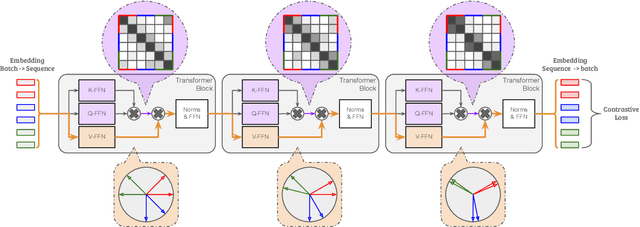
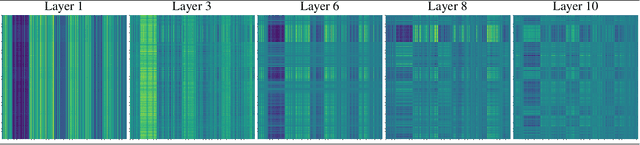

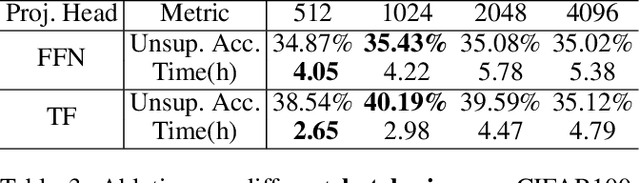
This paper proposes a novel framework, TransFusion, designed to make the process of contrastive learning more analytical and explainable. TransFusion consists of attention blocks whose softmax being replaced by ReLU, and its final block's weighted-sum operation is truncated to leave the adjacency matrix as the output. The model is trained by minimizing the Jensen-Shannon Divergence between its output and the target affinity matrix, which indicates whether each pair of samples belongs to the same or different classes. The main contribution of TransFusion lies in defining a theoretical limit for answering two fundamental questions in the field: the maximum level of data augmentation and the minimum batch size required for effective contrastive learning. Furthermore, experimental results indicate that TransFusion successfully extracts features that isolate clusters from complex real-world data, leading to improved classification accuracy in downstream tasks.
Contrastive Learning with Orthonormal Anchors (CLOA)
Mar 27, 2024This study focuses on addressing the instability issues prevalent in contrastive learning, specifically examining the InfoNCE loss function and its derivatives. We reveal a critical observation that these loss functions exhibit a restrictive behavior, leading to a convergence phenomenon where embeddings tend to merge into a singular point. This "over-fusion" effect detrimentally affects classification accuracy in subsequent supervised-learning tasks. Through theoretical analysis, we demonstrate that embeddings, when equalized or confined to a rank-1 linear subspace, represent a local minimum for InfoNCE. In response to this challenge, our research introduces an innovative strategy that leverages the same or fewer labeled data than typically used in the fine-tuning phase. The loss we proposed, Orthonormal Anchor Regression Loss, is designed to disentangle embedding clusters, significantly enhancing the distinctiveness of each embedding while simultaneously ensuring their aggregation into dense, well-defined clusters. Our method demonstrates remarkable improvements with just a fraction of the conventional label requirements, as evidenced by our results on CIFAR10 and CIFAR100 datasets.