 Add to Chrome
 Add to Firefox
 Add to Edge
Closing the Reflection Gap: A Free Calibration Bonus for Agentic RL
Jun 12, 2026
LLMs are increasingly deployed as agents that interact with external environments and observe feedback such as execution results, error messages, and tool outputs. A well-functioning agent should be able to leverage this feedback to accurately assess its own performance. Yet we find a persistent reflection gap: LLM agents tend to mis-assess their own outputs after observing concrete environment feedback -- even for questions they correctly answered -- and standard RL barely helps due to a credit-assignment mismatch. To close this gap, we propose RefGRPO, a simple yet effective fix that augments standard RL algorithms with two key ingredients: a free calibration bonus computed by contrasting the agent's own reflection with the actual outcome (requiring no additional reward model, LLM judge, or external annotation), and a dynamic schedule on its coefficient. Compared to standard RL baselines, our method simultaneously improves reflection calibration (e.g., reduces underconfidence rate $44.4\% \to 7.7\%$) and task accuracy (e.g., $75.1\% \to 76.5\%$) on text-to-SQL across five benchmarks. The resulting calibrated reflection turns the agent into its own verifier grounded in environment feedback, which further enables (i) better self-improvement that uses reflections as pseudo-rewards without outcome supervision, and (ii) more effective test-time selective prediction by committing only to rollouts flagged as correct.

Active Testing of Large Language Models via Approximate Neyman Allocation
May 11, 2026Large language models (LLMs) require reliable evaluation from pre-training to test-time scaling, making evaluation a recurring rather than one-off cost. As model scales grow and target tasks increasingly demand expert annotators, both the compute and labeling costs needed for each evaluation rise rapidly. Active testing aims to alleviate this bottleneck by approximating the evaluation result from a small but informative subset of the evaluation pool. However, existing approaches primarily target classification and break down on generative tasks. We introduce a novel active testing algorithm tailored to generative tasks. Our method leverages semantic entropy from surrogate models to stratify the evaluation pool and then conducts approximate Neyman allocation based on signals extracted from these surrogates. Across multiple language and multimodal benchmarks and a range of surrogate-target model pairs, our method significantly improves on baselines and closely tracks Oracle-Neyman, delivering up to 28\% MSE reduction over Uniform Sampling and an average of 22.9\% budget savings.
Adaptive Test-Time Compute Allocation with Evolving In-Context Demonstrations
Apr 22, 2026While scaling test-time compute can substantially improve model performance, existing approaches either rely on static compute allocation or sample from fixed generation distributions. In this work, we introduce a test-time compute allocation framework that jointly adapts where computation is spent and how generation is performed. Our method begins with a warm-up phase that identifies easy queries and assembles an initial pool of question-response pairs from the test set itself. An adaptive phase then concentrates further computation on unresolved queries while reshaping their generation distributions through evolving in-context demonstrations -- conditioning each generation on successful responses from semantically related queries rather than resampling from a fixed distribution. Experiments across math, coding, and reasoning benchmarks demonstrate that our approach consistently outperforms existing baselines while consuming substantially less inference-time compute.
Online Finetuning Decision Transformers with Pure RL Gradients
Jan 01, 2026Decision Transformers (DTs) have emerged as a powerful framework for sequential decision making by formulating offline reinforcement learning (RL) as a sequence modeling problem. However, extending DTs to online settings with pure RL gradients remains largely unexplored, as existing approaches continue to rely heavily on supervised sequence-modeling objectives during online finetuning. We identify hindsight return relabeling -- a standard component in online DTs -- as a critical obstacle to RL-based finetuning: while beneficial for supervised learning, it is fundamentally incompatible with importance sampling-based RL algorithms such as GRPO, leading to unstable training. Building on this insight, we propose new algorithms that enable online finetuning of Decision Transformers using pure reinforcement learning gradients. We adapt GRPO to DTs and introduce several key modifications, including sub-trajectory optimization for improved credit assignment, sequence-level likelihood objectives for enhanced stability and efficiency, and active sampling to encourage exploration in uncertain regions. Through extensive experiments, we demonstrate that our methods outperform existing online DT baselines and achieve new state-of-the-art performance across multiple benchmarks, highlighting the effectiveness of pure-RL-based online finetuning for Decision Transformers.
Interactive Machine Learning: From Theory to Scale
Dec 30, 2025Machine learning has achieved remarkable success across a wide range of applications, yet many of its most effective methods rely on access to large amounts of labeled data or extensive online interaction. In practice, acquiring high-quality labels and making decisions through trial-and-error can be expensive, time-consuming, or risky, particularly in large-scale or high-stakes settings. This dissertation studies interactive machine learning, in which the learner actively influences how information is collected or which actions are taken, using past observations to guide future interactions. We develop new algorithmic principles and establish fundamental limits for interactive learning along three dimensions: active learning with noisy data and rich model classes, sequential decision making with large action spaces, and model selection under partial feedback. Our results include the first computationally efficient active learning algorithms achieving exponential label savings without low-noise assumptions; the first efficient, general-purpose contextual bandit algorithms whose guarantees are independent of the size of the action space; and the first tight characterizations of the fundamental cost of model selection in sequential decision making. Overall, this dissertation advances the theoretical foundations of interactive learning by developing algorithms that are statistically optimal and computationally efficient, while also providing principled guidance for deploying interactive learning methods in large-scale, real-world settings.
Strategic Scaling of Test-Time Compute: A Bandit Learning Approach
Jun 15, 2025Scaling test-time compute has emerged as an effective strategy for improving the performance of large language models. However, existing methods typically allocate compute uniformly across all queries, overlooking variation in query difficulty. To address this inefficiency, we formulate test-time compute allocation as a novel bandit learning problem and propose adaptive algorithms that estimate query difficulty on the fly and allocate compute accordingly. Compared to uniform allocation, our algorithms allocate more compute to challenging queries while maintaining accuracy on easier ones. Among challenging queries, our algorithms further learn to prioritize solvable instances, effectively reducing excessive computing on unsolvable queries. We theoretically prove that our algorithms achieve better compute efficiency than uniform allocation and empirically validate their effectiveness on math and code benchmarks. Specifically, our algorithms achieve up to an 11.10% performance improvement (15.04% relative) on the MATH-500 dataset and up to a 7.41% performance improvement (14.40% relative) on LiveCodeBench.
Mixtraining: A Better Trade-Off Between Compute and Performance
Feb 26, 2025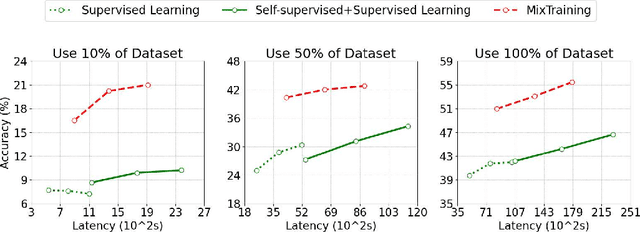
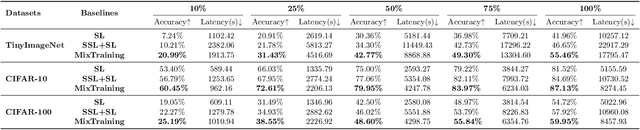

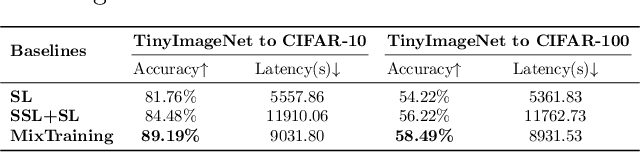
Incorporating self-supervised learning (SSL) before standard supervised learning (SL) has become a widely used strategy to enhance model performance, particularly in data-limited scenarios. However, this approach introduces a trade-off between computation and performance: while SSL helps with representation learning, it requires a separate, often time-consuming training phase, increasing computational overhead and limiting efficiency in resource-constrained settings. To address these challenges, we propose MixTraining, a novel framework that interleaves several SSL and SL epochs within a unified mixtraining training phase, featuring a smooth transition between two learning objectives. MixTraining enhances synergy between SSL and SL for improved accuracy and consolidates shared computation steps to reduce computation overhead. MixTraining is versatile and applicable to both single-task and multi-task learning scenarios. Extensive experiments demonstrate that MixTraining offers a superior compute-performance trade-off compared to conventional pipelines, achieving an 8.81% absolute accuracy gain (18.89% relative accuracy gain) on the TinyImageNet dataset while accelerating training by up to 1.29x with the ViT-Tiny model.
Efficient Sparse PCA via Block-Diagonalization
Oct 18, 2024
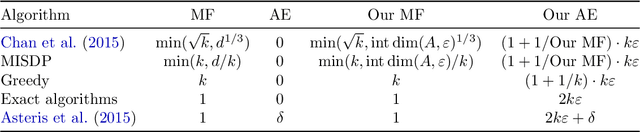

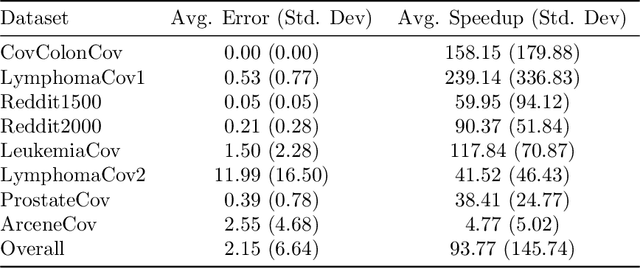
Sparse Principal Component Analysis (Sparse PCA) is a pivotal tool in data analysis and dimensionality reduction. However, Sparse PCA is a challenging problem in both theory and practice: it is known to be NP-hard and current exact methods generally require exponential runtime. In this paper, we propose a novel framework to efficiently approximate Sparse PCA by (i) approximating the general input covariance matrix with a re-sorted block-diagonal matrix, (ii) solving the Sparse PCA sub-problem in each block, and (iii) reconstructing the solution to the original problem. Our framework is simple and powerful: it can leverage any off-the-shelf Sparse PCA algorithm and achieve significant computational speedups, with a minor additive error that is linear in the approximation error of the block-diagonal matrix. Suppose $g(k, d)$ is the runtime of an algorithm (approximately) solving Sparse PCA in dimension $d$ and with sparsity value $k$. Our framework, when integrated with this algorithm, reduces the runtime to $\mathcal{O}\left(\frac{d}{d^\star} \cdot g(k, d^\star) + d^2\right)$, where $d^\star \leq d$ is the largest block size of the block-diagonal matrix. For instance, integrating our framework with the Branch-and-Bound algorithm reduces the complexity from $g(k, d) = \mathcal{O}(k^3\cdot d^k)$ to $\mathcal{O}(k^3\cdot d \cdot (d^\star)^{k-1})$, demonstrating exponential speedups if $d^\star$ is small. We perform large-scale evaluations on many real-world datasets: for exact Sparse PCA algorithm, our method achieves an average speedup factor of 93.77, while maintaining an average approximation error of 2.15%; for approximate Sparse PCA algorithm, our method achieves an average speedup factor of 6.77 and an average approximation error of merely 0.37%.
Efficient Sequential Decision Making with Large Language Models
Jun 17, 2024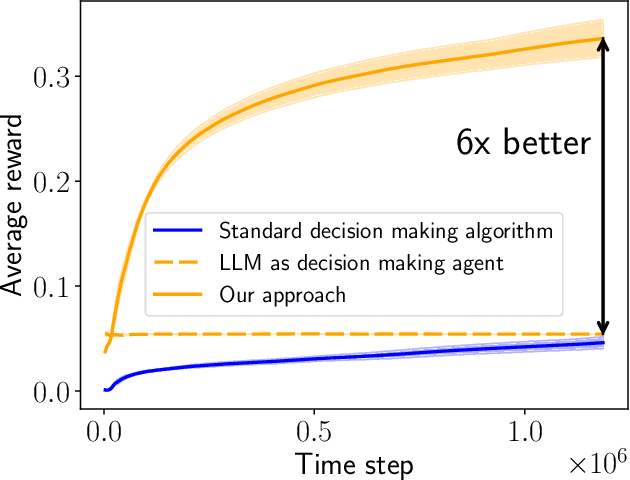
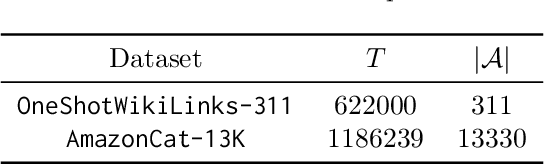
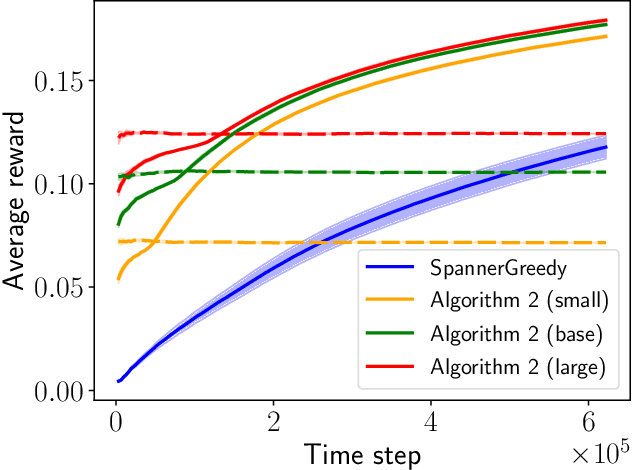
This paper focuses on extending the success of large language models (LLMs) to sequential decision making. Existing efforts either (i) re-train or finetune LLMs for decision making, or (ii) design prompts for pretrained LLMs. The former approach suffers from the computational burden of gradient updates, and the latter approach does not show promising results. In this paper, we propose a new approach that leverages online model selection algorithms to efficiently incorporate LLMs agents into sequential decision making. Statistically, our approach significantly outperforms both traditional decision making algorithms and vanilla LLM agents. Computationally, our approach avoids the need for expensive gradient updates of LLMs, and throughout the decision making process, it requires only a small number of LLM calls. We conduct extensive experiments to verify the effectiveness of our proposed approach. As an example, on a large-scale Amazon dataset, our approach achieves more than a $6$x performance gain over baselines while calling LLMs in only $1.5$\% of the time steps.
An Experimental Design Framework for Label-Efficient Supervised Finetuning of Large Language Models
Jan 12, 2024


Supervised finetuning (SFT) on instruction datasets has played a crucial role in achieving the remarkable zero-shot generalization capabilities observed in modern large language models (LLMs). However, the annotation efforts required to produce high quality responses for instructions are becoming prohibitively expensive, especially as the number of tasks spanned by instruction datasets continues to increase. Active learning is effective in identifying useful subsets of samples to annotate from an unlabeled pool, but its high computational cost remains a barrier to its widespread applicability in the context of LLMs. To mitigate the annotation cost of SFT and circumvent the computational bottlenecks of active learning, we propose using experimental design. Experimental design techniques select the most informative samples to label, and typically maximize some notion of uncertainty and/or diversity. In our work, we implement a framework that evaluates several existing and novel experimental design techniques and find that these methods consistently yield significant gains in label efficiency with little computational overhead. On generative tasks, our methods achieve the same generalization performance with only $50\%$ of annotation cost required by random sampling.