 Add to Chrome
 Add to Firefox
 Add to Edge
Under-Sampled High-Dimensional Data Recovery via Symbiotic Multi-Prior Tensor Reconstruction
Apr 08, 2025
The advancement of sensing technology has driven the widespread application of high-dimensional data. However, issues such as missing entries during acquisition and transmission negatively impact the accuracy of subsequent tasks. Tensor reconstruction aims to recover the underlying complete data from under-sampled observed data by exploring prior information in high-dimensional data. However, due to insufficient exploration, reconstruction methods still face challenges when sampling rate is extremely low. This work proposes a tensor reconstruction method integrating multiple priors to comprehensively exploit the inherent structure of the data. Specifically, the method combines learnable tensor decomposition to enforce low-rank constraints of the reconstructed data, a pre-trained convolutional neural network for smoothing and denoising, and block-matching and 3D filtering regularization to enhance the non-local similarity in the reconstructed data. An alternating direction method of the multipliers algorithm is designed to decompose the resulting optimization problem into three subproblems for efficient resolution. Extensive experiments on color images, hyperspectral images, and grayscale videos datasets demonstrate the superiority of our method in extreme cases as compared with state-of-the-art methods.

Cross-Asset Risk Management: Integrating LLMs for Real-Time Monitoring of Equity, Fixed Income, and Currency Markets
Apr 05, 2025Large language models (LLMs) have emerged as powerful tools in the field of finance, particularly for risk management across different asset classes. In this work, we introduce a Cross-Asset Risk Management framework that utilizes LLMs to facilitate real-time monitoring of equity, fixed income, and currency markets. This innovative approach enables dynamic risk assessment by aggregating diverse data sources, ultimately enhancing decision-making processes. Our model effectively synthesizes and analyzes market signals to identify potential risks and opportunities while providing a holistic view of asset classes. By employing advanced analytics, we leverage LLMs to interpret financial texts, news articles, and market reports, ensuring that risks are contextualized within broader market narratives. Extensive backtesting and real-time simulations validate the framework, showing increased accuracy in predicting market shifts compared to conventional methods. The focus on real-time data integration enhances responsiveness, allowing financial institutions to manage risks adeptly under varying market conditions and promoting financial stability through the advanced application of LLMs in risk analysis.
Dynamic Hedging Strategies in Derivatives Markets with LLM-Driven Sentiment and News Analytics
Apr 05, 2025Dynamic hedging strategies are essential for effective risk management in derivatives markets, where volatility and market sentiment can greatly impact performance. This paper introduces a novel framework that leverages large language models (LLMs) for sentiment analysis and news analytics to inform hedging decisions. By analyzing textual data from diverse sources like news articles, social media, and financial reports, our approach captures critical sentiment indicators that reflect current market conditions. The framework allows for real-time adjustments to hedging strategies, adapting positions based on continuous sentiment signals. Backtesting results on historical derivatives data reveal that our dynamic hedging strategies achieve superior risk-adjusted returns compared to conventional static approaches. The incorporation of LLM-driven sentiment analysis into hedging practices presents a significant advancement in decision-making processes within derivatives trading. This research showcases how sentiment-informed dynamic hedging can enhance portfolio management and effectively mitigate associated risks.
Style over Substance: Distilled Language Models Reason Via Stylistic Replication
Apr 02, 2025Specialized reasoning language models (RLMs) have demonstrated that scaling test-time computation through detailed reasoning traces significantly enhances performance. Although these traces effectively facilitate knowledge distillation into smaller, instruction-tuned models, the precise nature of transferred reasoning remains unclear. In this study, we investigate to what extent distilled models internalize replicated stylistic patterns during reasoning. To this end, we systematically analyze reasoning traces, identifying structural and lexical patterns that characterize successful reasoning. We then introduce two new datasets -- a dataset of emergent reasoning traces and a synthetic dataset explicitly constructed to replicate these stylistic patterns -- to precisely examine their influence on distilled models' reasoning capabilities. We find that models trained on the synthetic traces achieve comparable performance, indicating that distilled reasoning abilities rely significantly on surface-level patterns. Surprisingly, we observe an increase in performance even when the synthetic traces are altered to lead to the wrong answer. Our findings highlight how stylistic patterns can be leveraged to efficiently enhance LM reasoning across diverse model families.
Automatic MILP Model Construction for Multi-Robot Task Allocation and Scheduling Based on Large Language Models
Mar 18, 2025With the accelerated development of Industry 4.0, intelligent manufacturing systems increasingly require efficient task allocation and scheduling in multi-robot systems. However, existing methods rely on domain expertise and face challenges in adapting to dynamic production constraints. Additionally, enterprises have high privacy requirements for production scheduling data, which prevents the use of cloud-based large language models (LLMs) for solution development. To address these challenges, there is an urgent need for an automated modeling solution that meets data privacy requirements. This study proposes a knowledge-augmented mixed integer linear programming (MILP) automated formulation framework, integrating local LLMs with domain-specific knowledge bases to generate executable code from natural language descriptions automatically. The framework employs a knowledge-guided DeepSeek-R1-Distill-Qwen-32B model to extract complex spatiotemporal constraints (82% average accuracy) and leverages a supervised fine-tuned Qwen2.5-Coder-7B-Instruct model for efficient MILP code generation (90% average accuracy). Experimental results demonstrate that the framework successfully achieves automatic modeling in the aircraft skin manufacturing case while ensuring data privacy and computational efficiency. This research provides a low-barrier and highly reliable technical path for modeling in complex industrial scenarios.
Unlock the Power of Unlabeled Data in Language Driving Model
Mar 13, 2025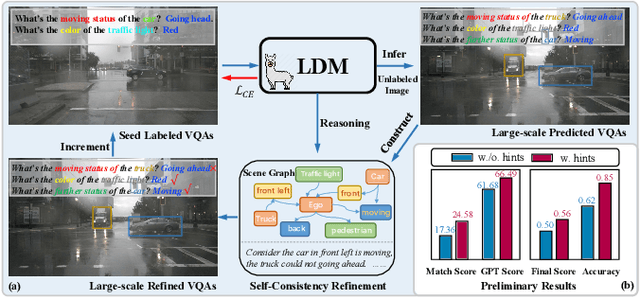
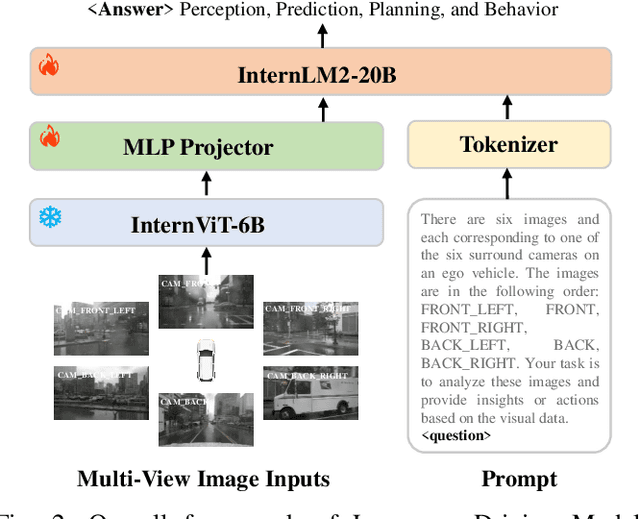
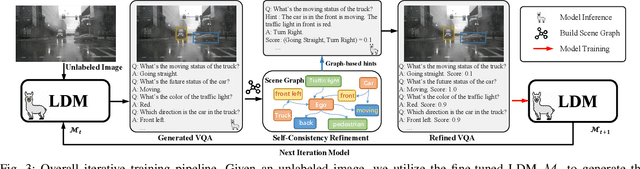
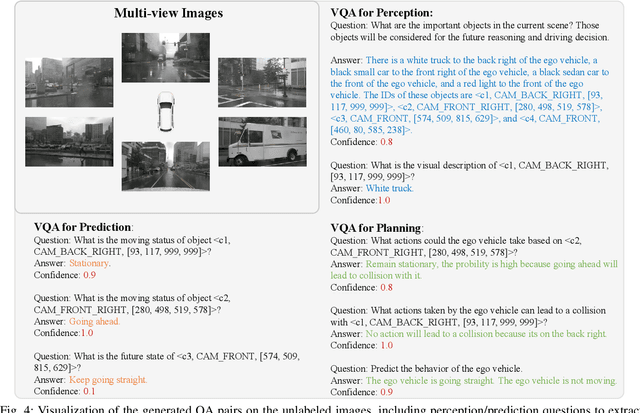
Recent Vision-based Large Language Models~(VisionLLMs) for autonomous driving have seen rapid advancements. However, such promotion is extremely dependent on large-scale high-quality annotated data, which is costly and labor-intensive. To address this issue, we propose unlocking the value of abundant yet unlabeled data to improve the language-driving model in a semi-supervised learning manner. Specifically, we first introduce a series of template-based prompts to extract scene information, generating questions that create pseudo-answers for the unlabeled data based on a model trained with limited labeled data. Next, we propose a Self-Consistency Refinement method to improve the quality of these pseudo-annotations, which are later used for further training. By utilizing a pre-trained VisionLLM (e.g., InternVL), we build a strong Language Driving Model (LDM) for driving scene question-answering, outperforming previous state-of-the-art methods. Extensive experiments on the DriveLM benchmark show that our approach performs well with just 5% labeled data, achieving competitive performance against models trained with full datasets. In particular, our LDM achieves 44.85% performance with limited labeled data, increasing to 54.27% when using unlabeled data, while models trained with full datasets reach 60.68% on the DriveLM benchmark.
Integrated Communication and Learned Recognizer with Customized RIS Phases and Sensing Durations
Mar 04, 2025


Future wireless communication networks are expected to be smarter and more aware of their surroundings, enabling a wide range of context-aware applications. Reconfigurable intelligent surfaces (RISs) are set to play a critical role in supporting various sensing tasks, such as target recognition. However, current methods typically use RIS configurations optimized once and applied over fixed sensing durations, limiting their ability to adapt to different targets and reducing sensing accuracy. To overcome these limitations, this study proposes an advanced wireless communication system that multiplexes downlink signals for environmental sensing and introduces an intelligent recognizer powered by deep learning techniques. Specifically, we design a novel neural network based on the long short-term memory architecture and the physical channel model. This network iteratively captures and fuses information from previous measurements, adaptively customizing RIS phases to gather the most relevant information for the recognition task at subsequent moments. These configurations are dynamically adjusted according to scene, task, target, and quantization priors. Furthermore, the recognizer includes a decision-making module that dynamically allocates different sensing durations, determining whether to continue or terminate the sensing process based on the collected measurements. This approach maximizes resource utilization efficiency. Simulation results demonstrate that the proposed method significantly outperforms state-of-the-art techniques while minimizing the impact on communication performance, even when sensing and communication occur simultaneously. Part of the source code for this paper can be accessed at https://github.com/kiwi1944/CRISense.
Efficient 4D Gaussian Stream with Low Rank Adaptation
Feb 23, 2025Recent methods have made significant progress in synthesizing novel views with long video sequences. This paper proposes a highly scalable method for dynamic novel view synthesis with continual learning. We leverage the 3D Gaussians to represent the scene and a low-rank adaptation-based deformation model to capture the dynamic scene changes. Our method continuously reconstructs the dynamics with chunks of video frames, reduces the streaming bandwidth by $90\%$ while maintaining high rendering quality comparable to the off-line SOTA methods.
Multi-Class Imbalanced Learning with Support Vector Machines via Differential Evolution
Feb 20, 2025Support vector machine (SVM) is a powerful machine learning algorithm to handle classification tasks. However, the classical SVM is developed for binary problems with the assumption of balanced datasets. Obviously, the multi-class imbalanced classification problems are more complex. In this paper, we propose an improved SVM via Differential Evolution (i-SVM-DE) method to deal with it. An improved SVM (i-SVM) model is proposed to handle the data imbalance by combining cost sensitive technique and separation margin modification in the constraints, which formalize a parameter optimization problem. By using one-versus-one (OVO) scheme, a multi-class problem is decomposed into a number of binary subproblems. A large optimization problem is formalized through concatenating the parameters in the binary subproblems. To find the optimal model effectively and learn the support vectors for each class simultaneously, an improved differential evolution (DE) algorithm is applied to solve this large optimization problem. Instead of the validation set, we propose the fitness functions to evaluate the learned model and obtain the optimal parameters in the search process of DE. A series of experiments are carried out to verify the benefits of our proposed method. The results indicate that i-SVM-DE is statistically superior by comparing with the other baseline methods.
Step-Audio: Unified Understanding and Generation in Intelligent Speech Interaction
Feb 18, 2025Real-time speech interaction, serving as a fundamental interface for human-machine collaboration, holds immense potential. However, current open-source models face limitations such as high costs in voice data collection, weakness in dynamic control, and limited intelligence. To address these challenges, this paper introduces Step-Audio, the first production-ready open-source solution. Key contributions include: 1) a 130B-parameter unified speech-text multi-modal model that achieves unified understanding and generation, with the Step-Audio-Chat version open-sourced; 2) a generative speech data engine that establishes an affordable voice cloning framework and produces the open-sourced lightweight Step-Audio-TTS-3B model through distillation; 3) an instruction-driven fine control system enabling dynamic adjustments across dialects, emotions, singing, and RAP; 4) an enhanced cognitive architecture augmented with tool calling and role-playing abilities to manage complex tasks effectively. Based on our new StepEval-Audio-360 evaluation benchmark, Step-Audio achieves state-of-the-art performance in human evaluations, especially in terms of instruction following. On open-source benchmarks like LLaMA Question, shows 9.3% average performance improvement, demonstrating our commitment to advancing the development of open-source multi-modal language technologies. Our code and models are available at https://github.com/stepfun-ai/Step-Audio.