 Add to Chrome
 Add to Firefox
 Add to Edge
Indoor 3D Reconstruction with an Unknown Camera-Projector Pair
Jul 02, 2024
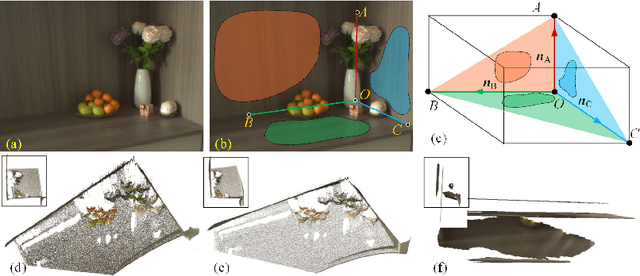
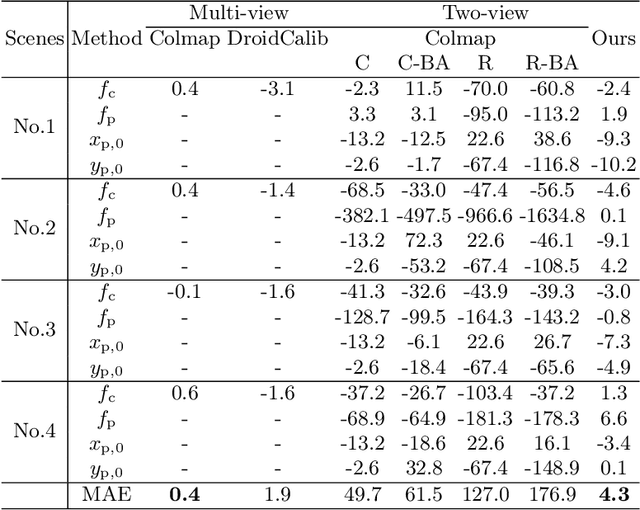
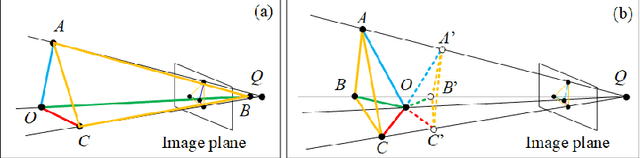
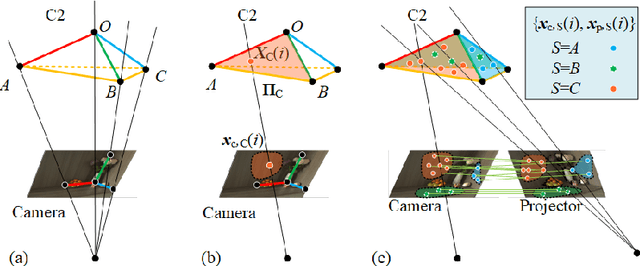
Structured light-based method with a camera-projector pair (CPP) plays a vital role in indoor 3D reconstruction, especially for scenes with weak textures. Previous methods usually assume known intrinsics, which are pre-calibrated from known objects, or self-calibrated from multi-view observations. It is still challenging to reliably recover CPP intrinsics from only two views without any known objects. In this paper, we provide a simple yet reliable solution. We demonstrate that, for the first time, sufficient constraints on CPP intrinsics can be derived from an unknown cuboid corner (C2), e.g. a room's corner, which is a common structure in indoor scenes. In addition, with only known camera principal point, the complex multi-variable estimation of all CPP intrinsics can be simplified to a simple univariable optimization problem, leading to reliable calibration and thus direct 3D reconstruction with unknown CPP. Extensive results have demonstrated the superiority of the proposed method over both traditional and learning-based counterparts. Furthermore, the proposed method also demonstrates impressive potential to solve similar tasks without active lighting, such as sparse-view structure from motion.

HyperSIGMA: Hyperspectral Intelligence Comprehension Foundation Model
Jun 17, 2024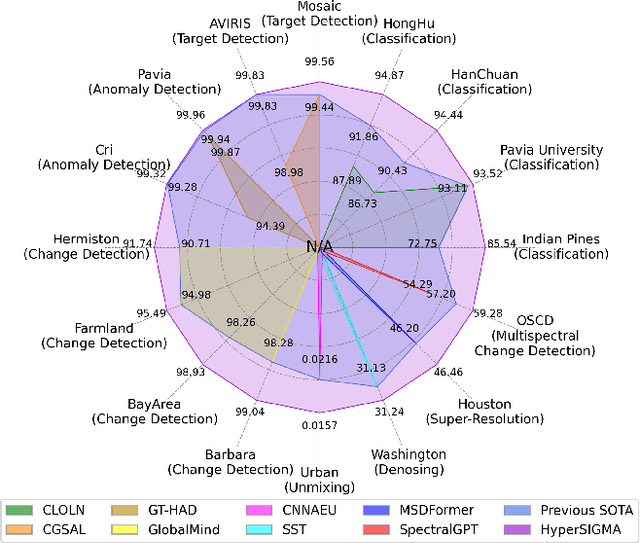
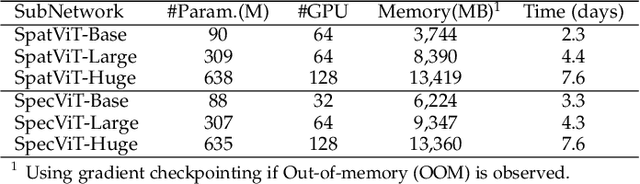
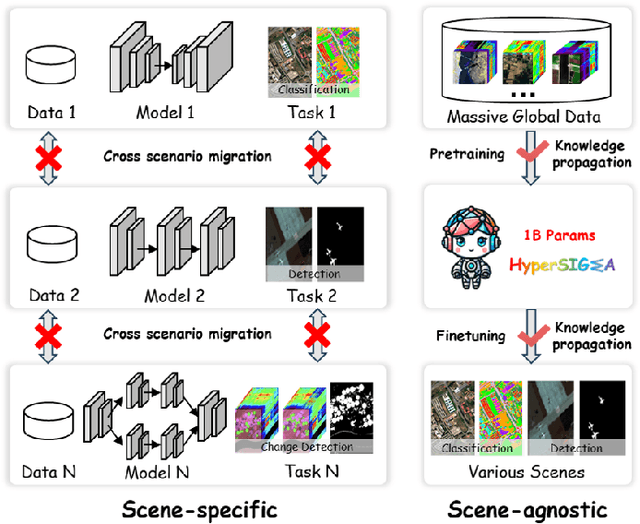
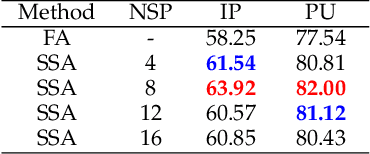
Foundation models (FMs) are revolutionizing the analysis and understanding of remote sensing (RS) scenes, including aerial RGB, multispectral, and SAR images. However, hyperspectral images (HSIs), which are rich in spectral information, have not seen much application of FMs, with existing methods often restricted to specific tasks and lacking generality. To fill this gap, we introduce HyperSIGMA, a vision transformer-based foundation model for HSI interpretation, scalable to over a billion parameters. To tackle the spectral and spatial redundancy challenges in HSIs, we introduce a novel sparse sampling attention (SSA) mechanism, which effectively promotes the learning of diverse contextual features and serves as the basic block of HyperSIGMA. HyperSIGMA integrates spatial and spectral features using a specially designed spectral enhancement module. In addition, we construct a large-scale hyperspectral dataset, HyperGlobal-450K, for pre-training, which contains about 450K hyperspectral images, significantly surpassing existing datasets in scale. Extensive experiments on various high-level and low-level HSI tasks demonstrate HyperSIGMA's versatility and superior representational capability compared to current state-of-the-art methods. Moreover, HyperSIGMA shows significant advantages in scalability, robustness, cross-modal transferring capability, and real-world applicability.
APSeg: Auto-Prompt Network for Cross-Domain Few-Shot Semantic Segmentatio
Jun 12, 2024Few-shot semantic segmentation (FSS) endeavors to segment unseen classes with only a few labeled samples. Current FSS methods are commonly built on the assumption that their training and application scenarios share similar domains, and their performances degrade significantly while applied to a distinct domain. To this end, we propose to leverage the cutting-edge foundation model, the Segment Anything Model (SAM), for generalization enhancement. The SAM however performs unsatisfactorily on domains that are distinct from its training data, which primarily comprise natural scene images, and it does not support automatic segmentation of specific semantics due to its interactive prompting mechanism. In our work, we introduce APSeg, a novel auto-prompt network for cross-domain few-shot semantic segmentation (CD-FSS), which is designed to be auto-prompted for guiding cross-domain segmentation. Specifically, we propose a Dual Prototype Anchor Transformation (DPAT) module that fuses pseudo query prototypes extracted based on cycle-consistency with support prototypes, allowing features to be transformed into a more stable domain-agnostic space. Additionally, a Meta Prompt Generator (MPG) module is introduced to automatically generate prompt embeddings, eliminating the need for manual visual prompts. We build an efficient model which can be applied directly to target domains without fine-tuning. Extensive experiments on four cross-domain datasets show that our model outperforms the state-of-the-art CD-FSS method by 5.24% and 3.10% in average accuracy on 1-shot and 5-shot settings, respectively.
Learning Long-form Video Prior via Generative Pre-Training
Apr 24, 2024
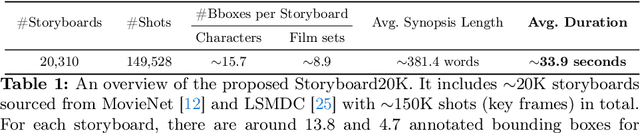


Concepts involved in long-form videos such as people, objects, and their interactions, can be viewed as following an implicit prior. They are notably complex and continue to pose challenges to be comprehensively learned. In recent years, generative pre-training (GPT) has exhibited versatile capacities in modeling any kind of text content even visual locations. Can this manner work for learning long-form video prior? Instead of operating on pixel space, it is efficient to employ visual locations like bounding boxes and keypoints to represent key information in videos, which can be simply discretized and then tokenized for consumption by GPT. Due to the scarcity of suitable data, we create a new dataset called \textbf{Storyboard20K} from movies to serve as a representative. It includes synopses, shot-by-shot keyframes, and fine-grained annotations of film sets and characters with consistent IDs, bounding boxes, and whole body keypoints. In this way, long-form videos can be represented by a set of tokens and be learned via generative pre-training. Experimental results validate that our approach has great potential for learning long-form video prior. Code and data will be released at \url{https://github.com/showlab/Long-form-Video-Prior}.
Pneumonia App: a mobile application for efficient pediatric pneumonia diagnosis using explainable convolutional neural networks (CNN)
Mar 31, 2024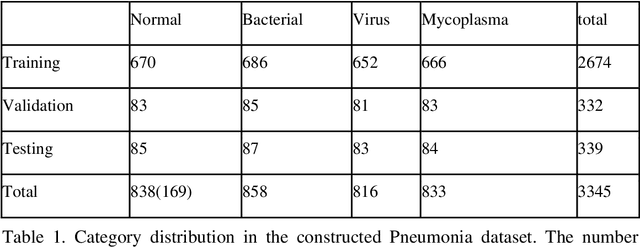
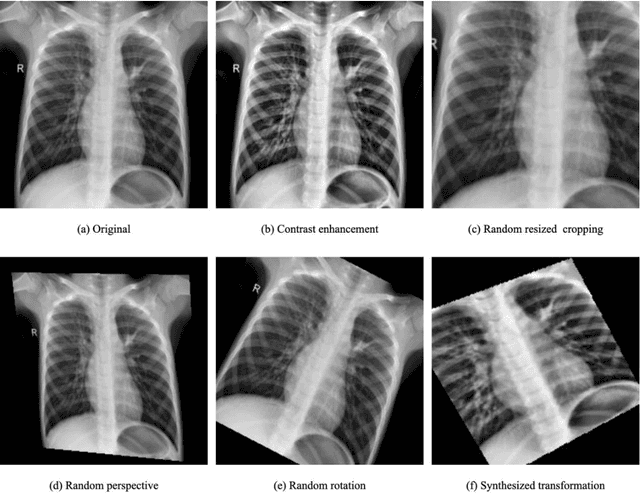
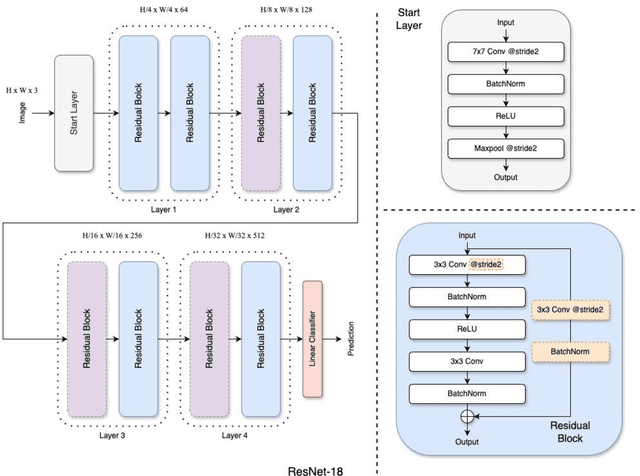
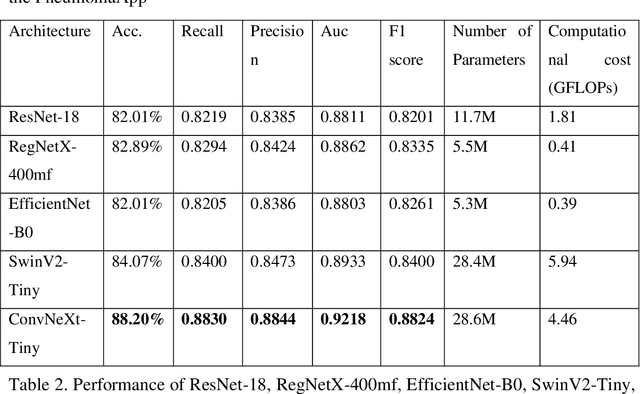
Mycoplasma pneumoniae pneumonia (MPP) poses significant diagnostic challenges in pediatric healthcare, especially in regions like China where it's prevalent. We introduce PneumoniaAPP, a mobile application leveraging deep learning techniques for rapid MPP detection. Our approach capitalizes on convolutional neural networks (CNNs) trained on a comprehensive dataset comprising 3345 chest X-ray (CXR) images, which includes 833 CXR images revealing MPP and additionally augmented with samples from a public dataset. The CNN model achieved an accuracy of 88.20% and an AUROC of 0.9218 across all classes, with a specific accuracy of 97.64% for the mycoplasma class, as demonstrated on the testing dataset. Furthermore, we integrated explainability techniques into PneumoniaAPP to aid respiratory physicians in lung opacity localization. Our contribution extends beyond existing research by targeting pediatric MPP, emphasizing the age group of 0-12 years, and prioritizing deployment on mobile devices. This work signifies a significant advancement in pediatric pneumonia diagnosis, offering a reliable and accessible tool to alleviate diagnostic burdens in healthcare settings.
Superior and Pragmatic Talking Face Generation with Teacher-Student Framework
Mar 26, 2024Talking face generation technology creates talking videos from arbitrary appearance and motion signal, with the "arbitrary" offering ease of use but also introducing challenges in practical applications. Existing methods work well with standard inputs but suffer serious performance degradation with intricate real-world ones. Moreover, efficiency is also an important concern in deployment. To comprehensively address these issues, we introduce SuperFace, a teacher-student framework that balances quality, robustness, cost and editability. We first propose a simple but effective teacher model capable of handling inputs of varying qualities to generate high-quality results. Building on this, we devise an efficient distillation strategy to acquire an identity-specific student model that maintains quality with significantly reduced computational load. Our experiments validate that SuperFace offers a more comprehensive solution than existing methods for the four mentioned objectives, especially in reducing FLOPs by 99\% with the student model. SuperFace can be driven by both video and audio and allows for localized facial attributes editing.
Instance by Instance: An Iterative Framework for Multi-instance 3D Registration
Feb 06, 2024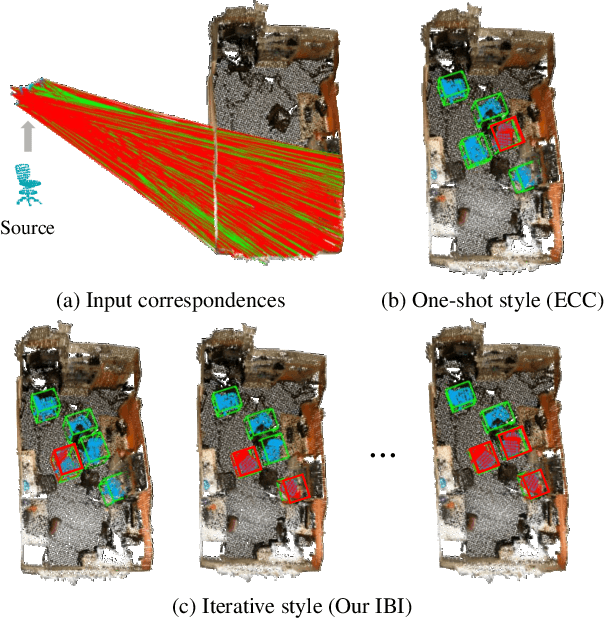
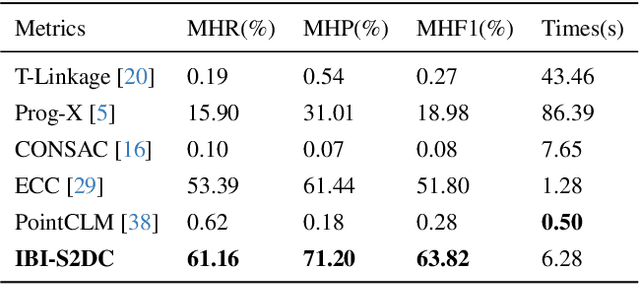

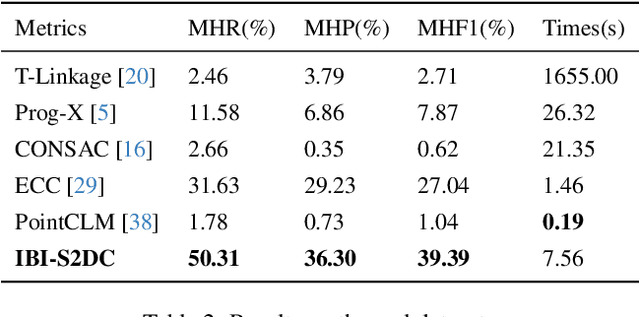
Multi-instance registration is a challenging problem in computer vision and robotics, where multiple instances of an object need to be registered in a standard coordinate system. In this work, we propose the first iterative framework called instance-by-instance (IBI) for multi-instance 3D registration (MI-3DReg). It successively registers all instances in a given scenario, starting from the easiest and progressing to more challenging ones. Throughout the iterative process, outliers are eliminated continuously, leading to an increasing inlier rate for the remaining and more challenging instances. Under the IBI framework, we further propose a sparse-to-dense-correspondence-based multi-instance registration method (IBI-S2DC) to achieve robust MI-3DReg. Experiments on the synthetic and real datasets have demonstrated the effectiveness of IBI and suggested the new state-of-the-art performance of IBI-S2DC, e.g., our MHF1 is 12.02%/12.35% higher than the existing state-of-the-art method ECC on the synthetic/real datasets.
Real3D-Portrait: One-shot Realistic 3D Talking Portrait Synthesis
Jan 20, 2024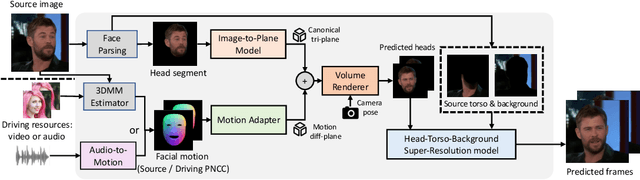

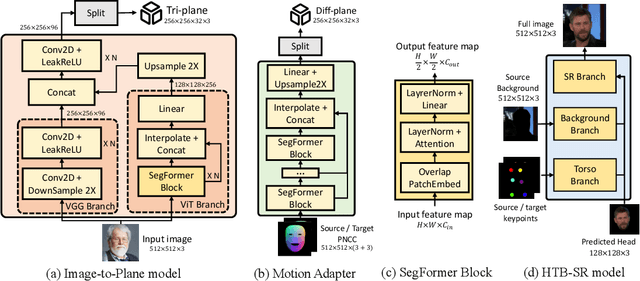
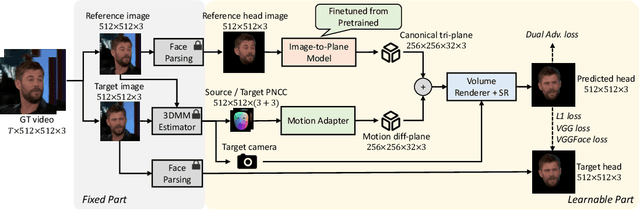
One-shot 3D talking portrait generation aims to reconstruct a 3D avatar from an unseen image, and then animate it with a reference video or audio to generate a talking portrait video. The existing methods fail to simultaneously achieve the goals of accurate 3D avatar reconstruction and stable talking face animation. Besides, while the existing works mainly focus on synthesizing the head part, it is also vital to generate natural torso and background segments to obtain a realistic talking portrait video. To address these limitations, we present Real3D-Potrait, a framework that (1) improves the one-shot 3D reconstruction power with a large image-to-plane model that distills 3D prior knowledge from a 3D face generative model; (2) facilitates accurate motion-conditioned animation with an efficient motion adapter; (3) synthesizes realistic video with natural torso movement and switchable background using a head-torso-background super-resolution model; and (4) supports one-shot audio-driven talking face generation with a generalizable audio-to-motion model. Extensive experiments show that Real3D-Portrait generalizes well to unseen identities and generates more realistic talking portrait videos compared to previous methods. Video samples and source code are available at https://real3dportrait.github.io .
Relative Pose for Nonrigid Multi-Perspective Cameras: The Static Case
Jan 17, 2024Multi-perspective cameras with potentially non-overlapping fields of view have become an important exteroceptive sensing modality in a number of applications such as intelligent vehicles, drones, and mixed reality headsets. In this work, we challenge one of the basic assumptions made in these scenarios, which is that the multi-camera rig is rigid. More specifically, we are considering the problem of estimating the relative pose between a static non-rigid rig in different spatial orientations while taking into account the effect of gravity onto the system. The deformable physical connections between each camera and the body center are approximated by a simple cantilever model, and inserted into the generalized epipolar constraint. Our results lead us to the important insight that the latent parameters of the deformation model, meaning the gravity vector in both views, become observable. We present a concise analysis of the observability of all variables based on noise, outliers, and rig rigidity for two different algorithms. The first one is a vision-only alternative, while the second one makes use of additional gravity measurements. To conclude, we demonstrate the ability to sense gravity in a real-world example, and discuss practical implications.
Learning transformer-based heterogeneously salient graph representation for multimodal fusion classification of hyperspectral image and LiDAR data
Nov 17, 2023Data collected by different modalities can provide a wealth of complementary information, such as hyperspectral image (HSI) to offer rich spectral-spatial properties, synthetic aperture radar (SAR) to provide structural information about the Earth's surface, and light detection and ranging (LiDAR) to cover altitude information about ground elevation. Therefore, a natural idea is to combine multimodal images for refined and accurate land-cover interpretation. Although many efforts have been attempted to achieve multi-source remote sensing image classification, there are still three issues as follows: 1) indiscriminate feature representation without sufficiently considering modal heterogeneity, 2) abundant features and complex computations associated with modeling long-range dependencies, and 3) overfitting phenomenon caused by sparsely labeled samples. To overcome the above barriers, a transformer-based heterogeneously salient graph representation (THSGR) approach is proposed in this paper. First, a multimodal heterogeneous graph encoder is presented to encode distinctively non-Euclidean structural features from heterogeneous data. Then, a self-attention-free multi-convolutional modulator is designed for effective and efficient long-term dependency modeling. Finally, a mean forward is put forward in order to avoid overfitting. Based on the above structures, the proposed model is able to break through modal gaps to obtain differentiated graph representation with competitive time cost, even for a small fraction of training samples. Experiments and analyses on three benchmark datasets with various state-of-the-art (SOTA) methods show the performance of the proposed approach.