 Add to Chrome
 Add to Firefox
 Add to Edge
Koopman Dreamer: Spectrally Constrained Latent Dynamics for Stable World-Model Imagination
Jul 22, 2026
Latent world models improve sample efficiency in continuous control by optimizing policies over imagined latent trajectories, but common neural transitions offer limited direct control over modal persistence and error accumulation in long rollouts. We propose Koopman Dreamer, a Dreamer-style world model with a spectrally constrained deterministic latent dynamics core. Its Koopman-inspired backbone uses two-dimensional rotation--scaling blocks with bounded radii to represent damping, rotation, and near-periodic modes. Linear and low-rank bilinear action terms capture global and state-dependent control effects, while stochastic-state modulation supplies local correction information. To reduce the mismatch between posterior-conditioned training and prior-only imagination, the model combines posterior-conditioned EMA teacher targets with one-step consistency, multi-step rollout, and open-loop observation-prediction objectives. We further derive a multi-step rollout-error bound that separates amplification by the spectral backbone and bilinear interaction from the additive effects of stochastic-state mismatch and modeling residuals, clarifying the trade-off between error attenuation and long-term information retention. Experimental results on proprioceptive continuous-control tasks from the DeepMind Control Suite and UAV-LiDAR autonomous navigation demonstrate that Koopman Dreamer improves the stability of long-horizon latent rollouts and achieves stronger closed-loop control performance on tasks that rely on high-quality multi-step imagination.

SD2AIL: Adversarial Imitation Learning from Synthetic Demonstrations via Diffusion Models
Dec 21, 2025Adversarial Imitation Learning (AIL) is a dominant framework in imitation learning that infers rewards from expert demonstrations to guide policy optimization. Although providing more expert demonstrations typically leads to improved performance and greater stability, collecting such demonstrations can be challenging in certain scenarios. Inspired by the success of diffusion models in data generation, we propose SD2AIL, which utilizes synthetic demonstrations via diffusion models. We first employ a diffusion model in the discriminator to generate synthetic demonstrations as pseudo-expert data that augment the expert demonstrations. To selectively replay the most valuable demonstrations from the large pool of (pseudo-) expert demonstrations, we further introduce a prioritized expert demonstration replay strategy (PEDR). The experimental results on simulation tasks demonstrate the effectiveness and robustness of our method. In particular, in the Hopper task, our method achieves an average return of 3441, surpassing the state-of-the-art method by 89. Our code will be available at https://github.com/positron-lpc/SD2AIL.
Diffusion Policies with Value-Conditional Optimization for Offline Reinforcement Learning
Nov 12, 2025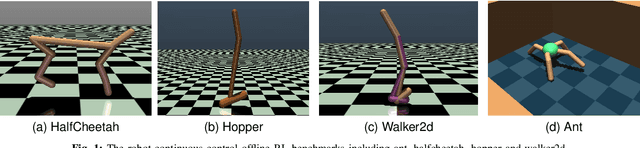
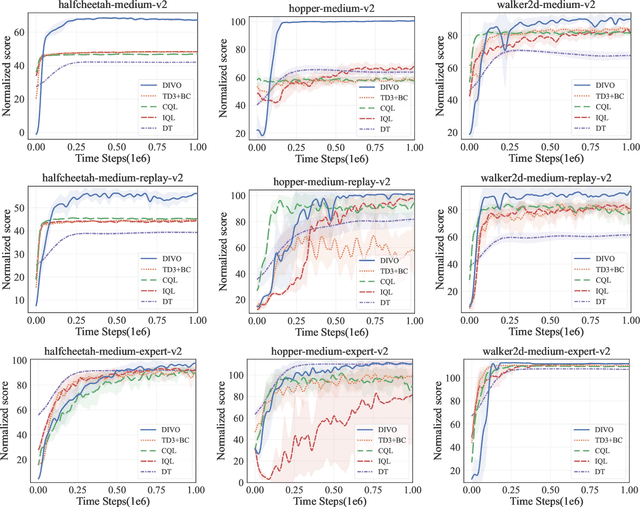

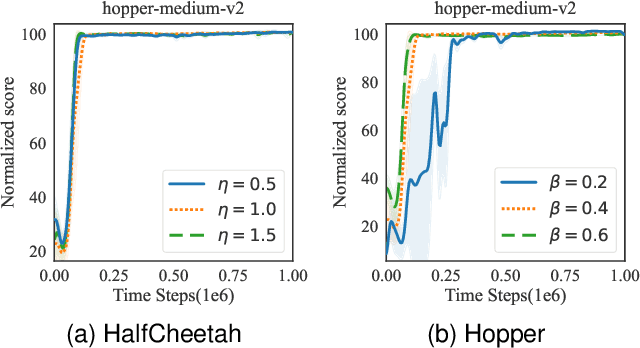
In offline reinforcement learning, value overestimation caused by out-of-distribution (OOD) actions significantly limits policy performance. Recently, diffusion models have been leveraged for their strong distribution-matching capabilities, enforcing conservatism through behavior policy constraints. However, existing methods often apply indiscriminate regularization to redundant actions in low-quality datasets, resulting in excessive conservatism and an imbalance between the expressiveness and efficiency of diffusion modeling. To address these issues, we propose DIffusion policies with Value-conditional Optimization (DIVO), a novel approach that leverages diffusion models to generate high-quality, broadly covered in-distribution state-action samples while facilitating efficient policy improvement. Specifically, DIVO introduces a binary-weighted mechanism that utilizes the advantage values of actions in the offline dataset to guide diffusion model training. This enables a more precise alignment with the dataset's distribution while selectively expanding the boundaries of high-advantage actions. During policy improvement, DIVO dynamically filters high-return-potential actions from the diffusion model, effectively guiding the learned policy toward better performance. This approach achieves a critical balance between conservatism and explorability in offline RL. We evaluate DIVO on the D4RL benchmark and compare it against state-of-the-art baselines. Empirical results demonstrate that DIVO achieves superior performance, delivering significant improvements in average returns across locomotion tasks and outperforming existing methods in the challenging AntMaze domain, where sparse rewards pose a major difficulty.
Skill Expansion and Composition in Parameter Space
Feb 09, 2025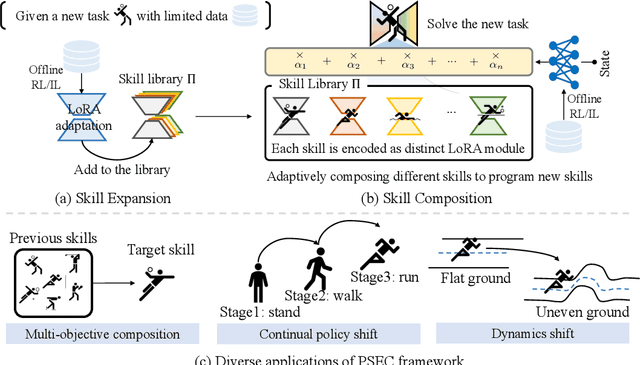
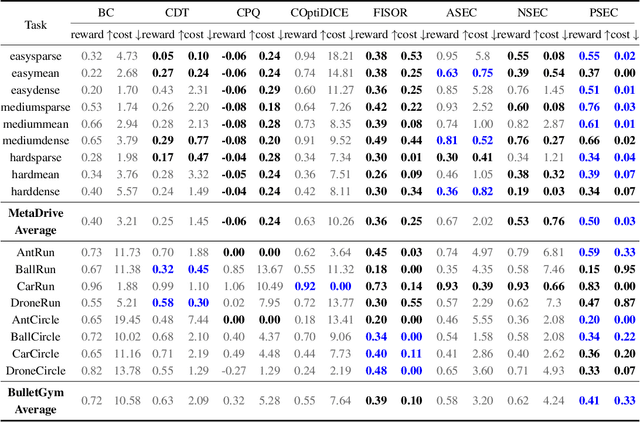
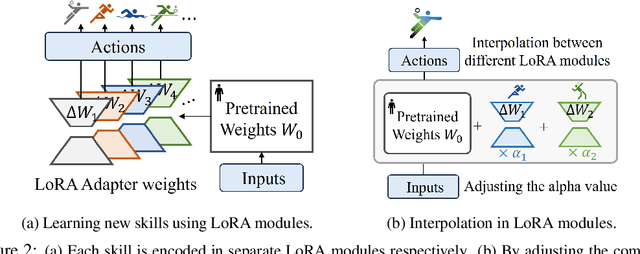
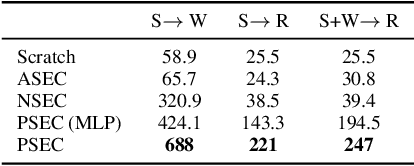
Humans excel at reusing prior knowledge to address new challenges and developing skills while solving problems. This paradigm becomes increasingly popular in the development of autonomous agents, as it develops systems that can self-evolve in response to new challenges like human beings. However, previous methods suffer from limited training efficiency when expanding new skills and fail to fully leverage prior knowledge to facilitate new task learning. In this paper, we propose Parametric Skill Expansion and Composition (PSEC), a new framework designed to iteratively evolve the agents' capabilities and efficiently address new challenges by maintaining a manageable skill library. This library can progressively integrate skill primitives as plug-and-play Low-Rank Adaptation (LoRA) modules in parameter-efficient finetuning, facilitating efficient and flexible skill expansion. This structure also enables the direct skill compositions in parameter space by merging LoRA modules that encode different skills, leveraging shared information across skills to effectively program new skills. Based on this, we propose a context-aware module to dynamically activate different skills to collaboratively handle new tasks. Empowering diverse applications including multi-objective composition, dynamics shift, and continual policy shift, the results on D4RL, DSRL benchmarks, and the DeepMind Control Suite show that PSEC exhibits superior capacity to leverage prior knowledge to efficiently tackle new challenges, as well as expand its skill libraries to evolve the capabilities. Project website: https://ltlhuuu.github.io/PSEC/.
Adaptive Advantage-Guided Policy Regularization for Offline Reinforcement Learning
Jun 01, 2024In offline reinforcement learning, the challenge of out-of-distribution (OOD) is pronounced. To address this, existing methods often constrain the learned policy through policy regularization. However, these methods often suffer from the issue of unnecessary conservativeness, hampering policy improvement. This occurs due to the indiscriminate use of all actions from the behavior policy that generates the offline dataset as constraints. The problem becomes particularly noticeable when the quality of the dataset is suboptimal. Thus, we propose Adaptive Advantage-guided Policy Regularization (A2PR), obtaining high-advantage actions from an augmented behavior policy combined with VAE to guide the learned policy. A2PR can select high-advantage actions that differ from those present in the dataset, while still effectively maintaining conservatism from OOD actions. This is achieved by harnessing the VAE capacity to generate samples matching the distribution of the data points. We theoretically prove that the improvement of the behavior policy is guaranteed. Besides, it effectively mitigates value overestimation with a bounded performance gap. Empirically, we conduct a series of experiments on the D4RL benchmark, where A2PR demonstrates state-of-the-art performance. Furthermore, experimental results on additional suboptimal mixed datasets reveal that A2PR exhibits superior performance. Code is available at https://github.com/ltlhuuu/A2PR.