 Add to Chrome
 Add to Firefox
 Add to Edge
Brep2Shape: Boundary and Shape Representation Alignment via Self-Supervised Transformers
Feb 07, 2026
Boundary representation (B-rep) is the industry standard for computer-aided design (CAD). While deep learning shows promise in processing B-rep models, existing methods suffer from a representation gap: continuous approaches offer analytical precision but are visually abstract, whereas discrete methods provide intuitive clarity at the expense of geometric precision. To bridge this gap, we introduce Brep2Shape, a novel self-supervised pre-training method designed to align abstract boundary representations with intuitive shape representations. Our method employs a geometry-aware task where the model learns to predict dense spatial points from parametric Bézier control points, enabling the network to better understand physical manifolds derived from abstract coefficients. To enhance this alignment, we propose a Dual Transformer backbone with parallel streams that independently encode surface and curve tokens to capture their distinct geometric properties. Moreover, the topology attention is integrated to model the interdependencies between surfaces and curves, thereby maintaining topological consistency. Experimental results demonstrate that Brep2Shape offers significant scalability, achieving state-of-the-art accuracy and faster convergence across various downstream tasks.

DiTS: Multimodal Diffusion Transformers Are Time Series Forecasters
Feb 06, 2026While generative modeling on time series facilitates more capable and flexible probabilistic forecasting, existing generative time series models do not address the multi-dimensional properties of time series data well. The prevalent architecture of Diffusion Transformers (DiT), which relies on simplistic conditioning controls and a single-stream Transformer backbone, tends to underutilize cross-variate dependencies in covariate-aware forecasting. Inspired by Multimodal Diffusion Transformers that integrate textual guidance into video generation, we propose Diffusion Transformers for Time Series (DiTS), a general-purpose architecture that frames endogenous and exogenous variates as distinct modalities. To better capture both inter-variate and intra-variate dependencies, we design a dual-stream Transformer block tailored for time-series data, comprising a Time Attention module for autoregressive modeling along the temporal dimension and a Variate Attention module for cross-variate modeling. Unlike the common approach for images, which flattens 2D token grids into 1D sequences, our design leverages the low-rank property inherent in multivariate dependencies, thereby reducing computational costs. Experiments show that DiTS achieves state-of-the-art performance across benchmarks, regardless of the presence of future exogenous variate observations, demonstrating unique generative forecasting strengths over traditional deterministic deep forecasting models.
Transolver-3: Scaling Up Transformer Solvers to Industrial-Scale Geometries
Feb 04, 2026Deep learning has emerged as a transformative tool for the neural surrogate modeling of partial differential equations (PDEs), known as neural PDE solvers. However, scaling these solvers to industrial-scale geometries with over $10^8$ cells remains a fundamental challenge due to the prohibitive memory complexity of processing high-resolution meshes. We present Transolver-3, a new member of the Transolver family as a highly scalable framework designed for high-fidelity physics simulations. To bridge the gap between limited GPU capacity and the resolution requirements of complex engineering tasks, we introduce two key architectural optimizations: faster slice and deslice by exploiting matrix multiplication associative property and geometry slice tiling to partition the computation of physical states. Combined with an amortized training strategy by learning on random subsets of original high-resolution meshes and a physical state caching technique during inference, Transolver-3 enables high-fidelity field prediction on industrial-scale meshes. Extensive experiments demonstrate that Transolver-3 is capable of handling meshes with over 160 million cells, achieving impressive performance across three challenging simulation benchmarks, including aircraft and automotive design tasks.
CoRA: Covariate-Aware Adaptation of Time Series Foundation Models
Oct 14, 2025Time Series Foundation Models (TSFMs) have shown significant impact through their model capacity, scalability, and zero-shot generalization. However, due to the heterogeneity of inter-variate dependencies and the backbone scalability on large-scale multivariate datasets, most TSFMs are typically pre-trained on univariate time series. This limitation renders them oblivious to crucial information from diverse covariates in real-world forecasting tasks. To further enhance the performance of TSFMs, we propose a general covariate-aware adaptation (CoRA) framework for TSFMs. It leverages pre-trained backbones of foundation models while effectively incorporating exogenous covariates from various modalities, including time series, language, and images, to improve the quality of predictions. Technically, CoRA maintains the equivalence of initialization and parameter consistency during adaptation. With preserved backbones of foundation models as frozen feature extractors, the outcome embeddings from foundation models are empirically demonstrated more informative than raw data. Further, CoRA employs a novel Granger Causality Embedding (GCE) to automatically evaluate covariates regarding their causal predictability with respect to the target variate. We incorporate these weighted embeddings with a zero-initialized condition-injection mechanism, avoiding catastrophic forgetting of pre-trained foundation models and gradually integrates exogenous information. Extensive experiments show that CoRA of TSFMs surpasses state-of-the-art covariate-aware deep forecasters with full or few-shot training samples, achieving 31.1% MSE reduction on covariate-aware forecasting. Compared to other adaptation methods, CoRA exhibits strong compatibility with various advanced TSFMs and extends the scope of covariates to other modalities, presenting a practical paradigm for the application of TSFMs.
ImageDDI: Image-enhanced Molecular Motif Sequence Representation for Drug-Drug Interaction Prediction
Aug 11, 2025To mitigate the potential adverse health effects of simultaneous multi-drug use, including unexpected side effects and interactions, accurately identifying and predicting drug-drug interactions (DDIs) is considered a crucial task in the field of deep learning. Although existing methods have demonstrated promising performance, they suffer from the bottleneck of limited functional motif-based representation learning, as DDIs are fundamentally caused by motif interactions rather than the overall drug structures. In this paper, we propose an Image-enhanced molecular motif sequence representation framework for \textbf{DDI} prediction, called ImageDDI, which represents a pair of drugs from both global and local structures. Specifically, ImageDDI tokenizes molecules into functional motifs. To effectively represent a drug pair, their motifs are combined into a single sequence and embedded using a transformer-based encoder, starting from the local structure representation. By leveraging the associations between drug pairs, ImageDDI further enhances the spatial representation of molecules using global molecular image information (e.g. texture, shadow, color, and planar spatial relationships). To integrate molecular visual information into functional motif sequence, ImageDDI employs Adaptive Feature Fusion, enhancing the generalization of ImageDDI by dynamically adapting the fusion process of feature representations. Experimental results on widely used datasets demonstrate that ImageDDI outperforms state-of-the-art methods. Moreover, extensive experiments show that ImageDDI achieved competitive performance in both 2D and 3D image-enhanced scenarios compared to other models.
FlashBias: Fast Computation of Attention with Bias
May 17, 2025Attention mechanism has emerged as a foundation module of modern deep learning models and has also empowered many milestones in various domains. Moreover, FlashAttention with IO-aware speedup resolves the efficiency issue of standard attention, further promoting its practicality. Beyond canonical attention, attention with bias also widely exists, such as relative position bias in vision and language models and pair representation bias in AlphaFold. In these works, prior knowledge is introduced as an additive bias term of attention weights to guide the learning process, which has been proven essential for model performance. Surprisingly, despite the common usage of attention with bias, its targeted efficiency optimization is still absent, which seriously hinders its wide applications in complex tasks. Diving into the computation of FlashAttention, we prove that its optimal efficiency is determined by the rank of the attention weight matrix. Inspired by this theoretical result, this paper presents FlashBias based on the low-rank compressed sensing theory, which can provide fast-exact computation for many widely used attention biases and a fast-accurate approximation for biases in general formalization. FlashBias can fully take advantage of the extremely optimized matrix multiplication operation in modern GPUs, achieving 1.5$\times$ speedup for AlphaFold, and over 2$\times$ speedup for attention with bias in vision and language models without loss of accuracy.
Domain Guidance: A Simple Transfer Approach for a Pre-trained Diffusion Model
Apr 02, 2025Recent advancements in diffusion models have revolutionized generative modeling. However, the impressive and vivid outputs they produce often come at the cost of significant model scaling and increased computational demands. Consequently, building personalized diffusion models based on off-the-shelf models has emerged as an appealing alternative. In this paper, we introduce a novel perspective on conditional generation for transferring a pre-trained model. From this viewpoint, we propose *Domain Guidance*, a straightforward transfer approach that leverages pre-trained knowledge to guide the sampling process toward the target domain. Domain Guidance shares a formulation similar to advanced classifier-free guidance, facilitating better domain alignment and higher-quality generations. We provide both empirical and theoretical analyses of the mechanisms behind Domain Guidance. Our experimental results demonstrate its substantial effectiveness across various transfer benchmarks, achieving over a 19.6% improvement in FID and a 23.4% improvement in FD$_\text{DINOv2}$ compared to standard fine-tuning. Notably, existing fine-tuned models can seamlessly integrate Domain Guidance to leverage these benefits, without additional training.
Dynamical Diffusion: Learning Temporal Dynamics with Diffusion Models
Mar 02, 2025Diffusion models have emerged as powerful generative frameworks by progressively adding noise to data through a forward process and then reversing this process to generate realistic samples. While these models have achieved strong performance across various tasks and modalities, their application to temporal predictive learning remains underexplored. Existing approaches treat predictive learning as a conditional generation problem, but often fail to fully exploit the temporal dynamics inherent in the data, leading to challenges in generating temporally coherent sequences. To address this, we introduce Dynamical Diffusion (DyDiff), a theoretically sound framework that incorporates temporally aware forward and reverse processes. Dynamical Diffusion explicitly models temporal transitions at each diffusion step, establishing dependencies on preceding states to better capture temporal dynamics. Through the reparameterization trick, Dynamical Diffusion achieves efficient training and inference similar to any standard diffusion model. Extensive experiments across scientific spatiotemporal forecasting, video prediction, and time series forecasting demonstrate that Dynamical Diffusion consistently improves performance in temporal predictive tasks, filling a crucial gap in existing methodologies. Code is available at this repository: https://github.com/thuml/dynamical-diffusion.
TimesBERT: A BERT-Style Foundation Model for Time Series Understanding
Feb 28, 2025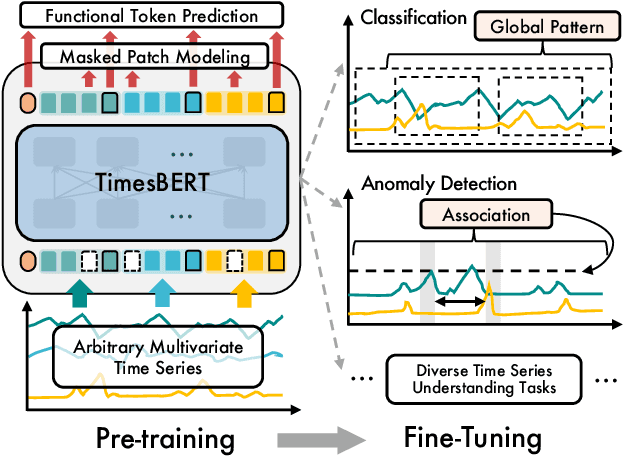

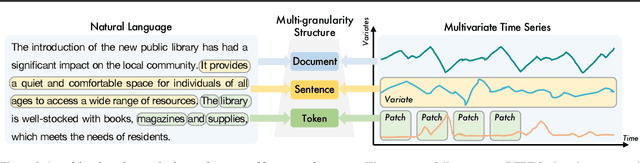
Time series analysis is crucial in diverse scenarios. Beyond forecasting, considerable real-world tasks are categorized into classification, imputation, and anomaly detection, underscoring different capabilities termed time series understanding in this paper. While GPT-style models have been positioned as foundation models for time series forecasting, the BERT-style architecture, which has made significant advances in natural language understanding, has not been fully unlocked for time series understanding, possibly attributed to the undesirable dropout of essential elements of BERT. In this paper, inspired by the shared multi-granularity structure between multivariate time series and multisentence documents, we design TimesBERT to learn generic representations of time series including temporal patterns and variate-centric characteristics. In addition to a natural adaptation of masked modeling, we propose a parallel task of functional token prediction to embody vital multi-granularity structures. Our model is pre-trained on 260 billion time points across diverse domains. Leveraging multi-granularity representations, TimesBERT achieves state-of-the-art performance across four typical downstream understanding tasks, outperforming task-specific models and language pre-trained backbones, positioning it as a versatile foundation model for time series understanding.
LEDD: Large Language Model-Empowered Data Discovery in Data Lakes
Feb 21, 2025Data discovery in data lakes with ever increasing datasets has long been recognized as a big challenge in the realm of data management, especially for semantic search of and hierarchical global catalog generation of tables. While large language models (LLMs) facilitate the processing of data semantics, challenges remain in architecting an end-to-end system that comprehensively exploits LLMs for the two semantics-related tasks. In this demo, we propose LEDD, an end-to-end system with an extensible architecture that leverages LLMs to provide hierarchical global catalogs with semantic meanings and semantic table search for data lakes. Specifically, LEDD can return semantically related tables based on natural-language specification. These features make LEDD an ideal foundation for downstream tasks such as model training and schema linking for text-to-SQL tasks. LEDD also provides a simple Python interface to facilitate the extension and the replacement of data discovery algorithms.