 Add to Chrome
 Add to Firefox
 Add to Edge
Beyond Euclidean Clipping: Overcoming Exploration Collapse in LLM RL via Riemannian Isometric Policy Optimization
Jul 11, 2026
Reinforcement learning (RL) has become a dominant paradigm for enhancing LLMs' reasoning capabilities. However, RL algorithms with PPO-Clip are inherently limited by exploration collapse. Subsequent works remain primarily heuristic and fail to identify the essential cause of PPO-Clip's failure. This work reveals the fundamental flaw of PPO-Clip: it implicitly measures policy discrepancy using Euclidean metric, which is theoretically inconsistent with the intrinsic geometry on the policy Riemannian manifold. This geometric mismatch results in overly conservative updates in low-probability regions while aggressive in high-probability regions, ultimately collapsing exploration. To correct this geometric flaw, we propose Riemannian Isometric Policy Optimization (RIPO), which guarantees isometric policy updates on the Riemannian manifold, effectively balancing exploration and exploitation. We further show that RIPO achieves a favorable bias-variance trade-off, which stabilizes optimization. Extensive experiments demonstrate that RIPO significantly surpasses existing LLM RL algorithms across seven competition-level benchmarks (up to 60% improvement over GRPO on AIME24).

Weak-to-Strong Generalization via Direct On-Policy Distillation
Jul 06, 2026Reinforcement learning with verifiable rewards (RLVR) is a powerful recipe for improving language-model reasoning, but it is expensive to repeat on every new strong model because the target model must generate many rollouts during training. As models scale, post-training itself becomes a bottleneck. We study a weak-to-strong alternative: run RL on a smaller model where rollouts are cheaper, then reuse what that RL run learned to improve a stronger target model. Directly distilling the post-RL weak teacher is not enough, because the teacher's final policy mixes useful RL gains with the limitations of the smaller model. We propose Direct On-Policy Distillation (Direct-OPD), which transfers the teacher's RL-induced policy shift instead. Direct-OPD compares the post-RL teacher with its own pre-RL reference and treats their log-ratio as a dense implicit reward for the student. In plain terms, the checkpoint pair tells us which actions RL made the weak model more or less likely to take, and Direct-OPD applies that signal on the stronger student's own on-policy states. This directly reuses the weak model's RL supervision signal without training an explicit reward model or running sparse-reward RL on the target model. Empirically, Direct-OPD consistently leverages weaker teachers to improve stronger target models; notably, it boosts Qwen3-1.7B from 48.3% to 62.4% on AIME 2024 in just 4 hours on 8 A100 GPUs. It outperforms step-matched direct RL and enables the sequential composition of multiple policy shifts. Our results show that RL outcomes can be reused across model scales as implicit reward signals, not merely as final models to imitate.
Spectral Rewiring for Exploration, Purification, and Model Merging
Jul 03, 2026Reinforcement learning has become a standard post-training recipe for large language models, but dense full-parameter updates create two deployment-relevant bottlenecks: suppressed reasoning performance, often reflected by premature saturation of test-time scaling, and interference when consolidating multiple capabilities through multi-domain training or model merging. We show that the reasoning-effective component of these updates is largely concentrated in the base model's spectral space, motivating Subspace-Aligned Rewiring (SAR), a post-hoc editing method that retains this spectral core while removing orthogonal components. SAR therefore preserves reasoning gains and filters residual update directions that suppress performance or amplify cross-domain interference. Across several model families and scales, SAR extracts compact reasoning cores using as little as approximately 0.58% of total parameters: it preserves over 99% of post-training performance and improves high-k exploration in mathematical reasoning, and generalizes to agentic coding by improving six of seven open benchmarks on an in-house model. SAR also purifies mixed-domain training updates by releasing suppressed coding capability while maintaining math reasoning and instruction following. It further enables model merging across experts, yielding cross-domain generalization that surpasses previous merging baselines and even the best single-domain experts. Overall, SAR shows that extracting reasoning-effective updates from parameter geometry can serve as a training-free mechanism to improve reasoning and multi-domain performance.
Flow-based Gaussian Splatting for Continuous-Scale Remote Sensing Image Super-Resolution
May 21, 2026High-resolution remote sensing images (RSIs) are crucial for Earth observation applications, yet acquiring them is often limited by sensor constraints and costs. In recent years, generative super-resolution (SR) methods, particularly diffusion models, have made significant progress. However, they typically require slow iterative inference with 40--1000 steps and exhibit limited flexibility in continuous-scale SR settings. To address these issues, we propose FlowGS, a generative reconstruction framework for arbitrary-scale SR of RSIs. FlowGS models the high-frequency detail representations between high- and low-resolution images and learns a continuous probability flow from noise to detail priors via flow matching (FM) constrained by shortcut consistency, thereby reducing generative complexity and improving inference efficiency. Additionally, we employ 2D Gaussian splatting to construct a continuous feature field, thereby enabling flexible reconstruction at arbitrary query locations. Experimental results show that FlowGS delivers competitive perceptual quality compared with existing methods in both continuous-scale and fixed-scale SR settings, with substantially improved inference efficiency.
MapSR: Prompt-Driven Land Cover Map Super-Resolution via Vision Foundation Models
Apr 16, 2026High-resolution (HR) land-cover mapping is often constrained by the high cost of dense HR annotations. We revisit this problem from the perspective of map super-resolution, which enhances coarse low-resolution (LR) land-cover products into HR maps at the resolution of the input imagery. Existing weakly supervised methods can leverage LR labels, but they typically use them to retrain dense predictors with substantial computational cost. We propose MapSR, a prompt-driven framework that decouples supervision from model training. MapSR uses LR labels once to extract class prompts from frozen vision foundation model features through a lightweight linear probe, after which HR mapping proceeds via training-free metric inference and graph-based prediction refinement. Specifically, class prompts are estimated by aggregating high-confidence HR features identified by the linear probe, and HR predictions are obtained by cosine-similarity matching followed by graph-based propagation for spatial refinement. Experiments on the Chesapeake Bay dataset show that MapSR achieves 59.64% mIoU without any HR labels, remaining competitive with the strongest weakly supervised baseline and surpassing a fully supervised baseline. Notably, MapSR reduces trainable parameters by four orders of magnitude and shortens training time from hours to minutes, enabling scalable HR mapping under limited annotation and compute budgets. The code is available at https://github.com/rikirikirikiriki/MapSR.
One-Step Face Restoration via Shortcut-Enhanced Coupling Flow
Mar 04, 2026Face restoration has advanced significantly with generative models like diffusion models and flow matching (FM), which learn continuous-time mappings between distributions. However, existing FM-based approaches often start from Gaussian noise, ignoring the inherent dependency between low-quality (LQ) and high-quality (HQ) data, resulting in path crossovers, curved trajectories, and multi-step sampling requirements. To address these issues, we propose Shortcut-enhanced Coupling flow for Face Restoration (SCFlowFR). First, it establishes a \textit{data-dependent coupling} that explicitly models the LQ--HQ dependency, minimizing path crossovers and promoting near-linear transport. Second, we employ conditional mean estimation to obtain a coarse prediction that refines the source anchor to tighten coupling and conditions the velocity field to stabilize large-step updates. Third, a shortcut constraint supervises average velocities over arbitrary time intervals, enabling accurate one-step inference. Experiments demonstrate that SCFlowFR achieves state-of-the-art one-step face restoration quality with inference speed comparable to traditional non-diffusion methods.
CUDA Agent: Large-Scale Agentic RL for High-Performance CUDA Kernel Generation
Feb 27, 2026GPU kernel optimization is fundamental to modern deep learning but remains a highly specialized task requiring deep hardware expertise. Despite strong performance in general programming, large language models (LLMs) remain uncompetitive with compiler-based systems such as torch.compile for CUDA kernel generation. Existing CUDA code generation approaches either rely on training-free refinement or fine-tune models within fixed multi-turn execution-feedback loops, but both paradigms fail to fundamentally improve the model's intrinsic CUDA optimization ability, resulting in limited performance gains. We present CUDA Agent, a large-scale agentic reinforcement learning system that develops CUDA kernel expertise through three components: a scalable data synthesis pipeline, a skill-augmented CUDA development environment with automated verification and profiling to provide reliable reward signals, and reinforcement learning algorithmic techniques enabling stable training. CUDA Agent achieves state-of-the-art results on KernelBench, delivering 100\%, 100\%, and 92\% faster rate over torch.compile on KernelBench Level-1, Level-2, and Level-3 splits, outperforming the strongest proprietary models such as Claude Opus 4.5 and Gemini 3 Pro by about 40\% on the hardest Level-3 setting.
SUG-Occ: An Explicit Semantics and Uncertainty Guided Sparse Learning Framework for Real-Time 3D Occupancy Prediction
Jan 16, 2026As autonomous driving moves toward full scene understanding, 3D semantic occupancy prediction has emerged as a crucial perception task, offering voxel-level semantics beyond traditional detection and segmentation paradigms. However, such a refined representation for scene understanding incurs prohibitive computation and memory overhead, posing a major barrier to practical real-time deployment. To address this, we propose SUG-Occ, an explicit Semantics and Uncertainty Guided Sparse Learning Enabled 3D Occupancy Prediction Framework, which exploits the inherent sparsity of 3D scenes to reduce redundant computation while maintaining geometric and semantic completeness. Specifically, we first utilize semantic and uncertainty priors to suppress projections from free space during view transformation while employing an explicit unsigned distance encoding to enhance geometric consistency, producing a structurally consistent sparse 3D representation. Secondly, we design an cascade sparse completion module via hyper cross sparse convolution and generative upsampling to enable efficiently coarse-to-fine reasoning. Finally, we devise an object contextual representation (OCR) based mask decoder that aggregates global semantic context from sparse features and refines voxel-wise predictions via lightweight query-context interactions, avoiding expensive attention operations over volumetric features. Extensive experiments on SemanticKITTI benchmark demonstrate that the proposed approach outperforms the baselines, achieving a 7.34/% improvement in accuracy and a 57.8\% gain in efficiency.
DeltaVLM: Interactive Remote Sensing Image Change Analysis via Instruction-guided Difference Perception
Jul 30, 2025Accurate interpretation of land-cover changes in multi-temporal satellite imagery is critical for real-world scenarios. However, existing methods typically provide only one-shot change masks or static captions, limiting their ability to support interactive, query-driven analysis. In this work, we introduce remote sensing image change analysis (RSICA) as a new paradigm that combines the strengths of change detection and visual question answering to enable multi-turn, instruction-guided exploration of changes in bi-temporal remote sensing images. To support this task, we construct ChangeChat-105k, a large-scale instruction-following dataset, generated through a hybrid rule-based and GPT-assisted process, covering six interaction types: change captioning, classification, quantification, localization, open-ended question answering, and multi-turn dialogues. Building on this dataset, we propose DeltaVLM, an end-to-end architecture tailored for interactive RSICA. DeltaVLM features three innovations: (1) a fine-tuned bi-temporal vision encoder to capture temporal differences; (2) a visual difference perception module with a cross-semantic relation measuring (CSRM) mechanism to interpret changes; and (3) an instruction-guided Q-former to effectively extract query-relevant difference information from visual changes, aligning them with textual instructions. We train DeltaVLM on ChangeChat-105k using a frozen large language model, adapting only the vision and alignment modules to optimize efficiency. Extensive experiments and ablation studies demonstrate that DeltaVLM achieves state-of-the-art performance on both single-turn captioning and multi-turn interactive change analysis, outperforming existing multimodal large language models and remote sensing vision-language models. Code, dataset and pre-trained weights are available at https://github.com/hanlinwu/DeltaVLM.
Single-Step Latent Consistency Model for Remote Sensing Image Super-Resolution
Mar 25, 2025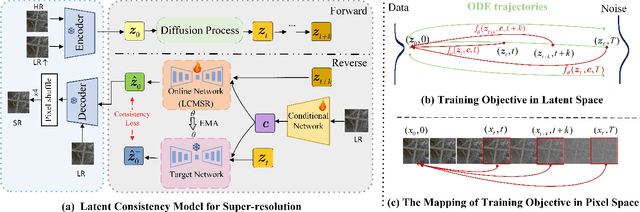
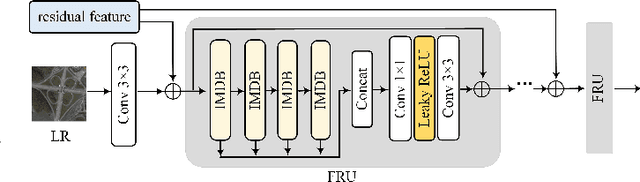
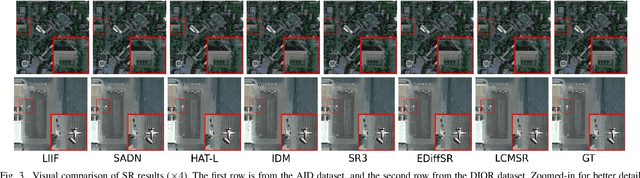
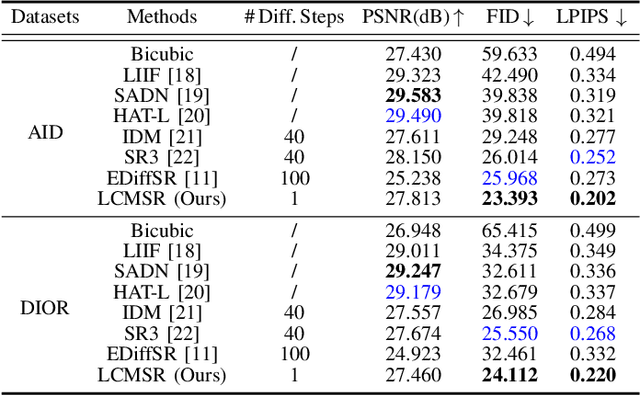
Recent advancements in diffusion models (DMs) have greatly advanced remote sensing image super-resolution (RSISR). However, their iterative sampling processes often result in slow inference speeds, limiting their application in real-time tasks. To address this challenge, we propose the latent consistency model for super-resolution (LCMSR), a novel single-step diffusion approach designed to enhance both efficiency and visual quality in RSISR tasks. Our proposal is structured into two distinct stages. In the first stage, we pretrain a residual autoencoder to encode the differential information between high-resolution (HR) and low-resolution (LR) images, transitioning the diffusion process into a latent space to reduce computational costs. The second stage focuses on consistency diffusion learning, which aims to learn the distribution of residual encodings in the latent space, conditioned on LR images. The consistency constraint enforces that predictions at any two timesteps along the reverse diffusion trajectory remain consistent, enabling direct mapping from noise to data. As a result, the proposed LCMSR reduces the iterative steps of traditional diffusion models from 50-1000 or more to just a single step, significantly improving efficiency. Experimental results demonstrate that LCMSR effectively balances efficiency and performance, achieving inference times comparable to non-diffusion models while maintaining high-quality output.