 Add to Chrome
 Add to Firefox
 Add to Edge
Exposing the Illusion of Erasure in Knowledge Editing for LLMs
Jun 24, 2026
Knowledge Editing (KE) has emerged as a frontier for updating specific facts in LLMs without costly retraining, but its reliability and underlying mechanisms remain poorly understood. In this work, we examine KE from an adversarial elicitation perspective, revealing that edited knowledge is often not fully erased and continues to surface, with consistent failures observed across diverse model architectures. To explain this behavior, we conduct a mechanistic analysis of popular KE methods. We show that low-rank updates do not overwrite existing knowledge but instead redistribute it within the model's representation space. Furthermore, we find that these methods act as targeted suppression mechanisms that reduce the likelihood of expressing original facts, rather than removing them from the model. Analysis of the loss landscape reveals that edited knowledge lies in narrow, anisotropic regions that are highly sensitive to perturbations, making them highly vulnerable to indirect prompting and adversarial attacks. By exposing these profound architectural vulnerabilities, our work proves that KE algorithms are inherently bypassable and motivates a fundamental reevaluation of how we deploy post-hoc updates in several LLM applications.

Doing More With Less: Revisiting the Effectiveness of LLM Pruning for Test-Time Scaling
Apr 28, 2026While current Large Language Models (LLMs) exhibit remarkable reasoning capabilities through test-time compute scaling (TTS), their massive parameter counts and high inference costs have motivated the development of pruning methods that can reduce model size without sacrificing performance. However, specific to reasoning LLMs, prior work has shown that structured pruning (methods which removes entire set of layer blocks), significantly degrades TTS reasoning performance. In this work, we revisit this assumption and instead investigate whether unstructured pruning (methods that carefully remove only certain redundant/detrimental weights) exhibits similar limitations. Surprisingly, our extensive experiments across four reasoning benchmarks on two reasoning LLMs: s1.1-7B and Qwen3-8B, consistently show that unstructured pruning augments TTS performance compared to structured pruning, and at times can even outperform the unpruned full-weight LLMs. Furthermore, we also empirically study the impact of different layer-wise sparsity allocation strategies, which are an important parametric choice for instantiating unstructured pruning methods. These findings challenge the conventional notion that pruning always reduces TTS performance and in fact, suggest that carefully undertaken pruning can improve TTS effectiveness even further.
AFRILANGTUTOR: Advancing Language Tutoring and Culture Education in Low-Resource Languages with Large Language Models
Apr 22, 2026How can language learning systems be developed for languages that lack sufficient training resources? This challenge is increasingly faced by developers across the African continent who aim to build AI systems capable of understanding and responding in local languages. To address this gap, we introduce AFRILANGDICT, a collection of 194.7K African language-English dictionary entries designed as seed resources for generating language-learning materials, enabling us to automatically construct large-scale, diverse, and verifiable student-tutor question-answer interactions suitable for training AI-assisted language tutors. Using AFRILANGDICT, we build AFRILANGEDU, a dataset of 78.9K multi-turn training examples for Supervised Fine-Tuning (SFT) and Direct Preference Optimization (DPO). Using AFRILANGEDU, we train language tutoring models collectively referred to as AFRILANGTUTOR. We fine-tune two multilingual LLMs: Llama-3-8B-IT and Gemma-3-12B-IT on AFRILANGEDU across 10 African languages and evaluate their performance. Our results show that models trained on AFRILANGEDU consistently outperform their base counterparts, and combining SFT and DPO yields substantial improvements, with gains ranging from 1.8% to 15.5% under LLM-as-a-judge evaluations across four criteria. To facilitate further research on low-resource languages -- all resources are available at https://huggingface.co/afrilang-edu.
The Prosocial Ranking Challenge: Reducing Polarization on Social Media without Sacrificing Engagement
Mar 20, 2026We report the first direct comparisons of multiple alternative social media algorithms on multiple platforms on outcomes of societal interest. We used a browser extension to modify which posts were shown to desktop social media users, randomly assigning 9,386 users to a control group or one of five alternative ranking algorithms which simultaneously altered content across three platforms for six months during the US 2024 presidential election. This reduced our preregistered index of affective polarization by an average of 0.03 standard deviations (p < 0.05), including a 1.5 degree decrease in differences between the 100 point inparty and outparty feeling thermometers. We saw reductions in active use time for Facebook (-0.37 min/day) and Reddit (-0.2 min/day), but an increase of 0.32 min/day (p < 0.01) for X/Twitter. We saw an increase in reports of negative social media experiences but found no effects on well-being, news knowledge, outgroup empathy, perceptions of and support for partisan violence. This implies that bridging content can improve some societal outcomes without necessarily conflicting with the engagement-driven business model of social media.
Curvature-Weighted Capacity Allocation: A Minimum Description Length Framework for Layer-Adaptive Large Language Model Optimization
Mar 01, 2026Layer-wise capacity in large language models is highly non-uniform: some layers contribute disproportionately to loss reduction while others are near-redundant. Existing methods for exploiting this non-uniformity, such as influence-function-based layer scoring, produce sensitivity estimates but offer no principled mechanism for translating them into allocation or pruning decisions under hardware constraints. We address this gap with a unified, curvature-aware framework grounded in the Minimum Description Length (MDL) principle. Our central quantity is the curvature-adjusted layer gain $ζ_k^2 = g_k^\top \widetilde{H}_{kk}^{-1} g_k$, which we show equals twice the maximal second-order reduction in empirical risk achievable by updating layer $k$ alone, and which strictly dominates gradient-norm-based scores by incorporating local curvature. Normalizing these gains into layer quality scores $q_k$, we formulate two convex MDL programs: a capacity allocation program that distributes expert slots or LoRA rank preferentially to high-curvature layers under diminishing returns, and a pruning program that concentrates sparsity on low-gain layers while protecting high-gain layers from degradation. Both programs admit unique closed-form solutions parameterized by a single dual variable, computable in $O(K \log 1/\varepsilon)$ via bisection. We prove an $O(δ^2)$ transfer regret bound showing that source-domain allocations remain near-optimal on target tasks when curvature scores drift by $δ$, with explicit constants tied to the condition number of the target program. Together, these results elevate layer-wise capacity optimization from an empirical heuristic to a theoretically grounded, computationally efficient framework with provable optimality and generalization guarantees.
Golden Layers and Where to Find Them: Improved Knowledge Editing for Large Language Models Via Layer Gradient Analysis
Feb 22, 2026Knowledge editing in Large Language Models (LLMs) aims to update the model's prediction for a specific query to a desired target while preserving its behavior on all other inputs. This process typically involves two stages: identifying the layer to edit and performing the parameter update. Intuitively, different queries may localize knowledge at different depths of the model, resulting in different sample-wise editing performance for a fixed editing layer. In this work, we hypothesize the existence of fixed golden layers that can achieve near-optimal editing performance similar to sample-wise optimal layers. To validate this hypothesis, we provide empirical evidence by comparing golden layers against ground-truth sample-wise optimal layers. Furthermore, we show that golden layers can be reliably identified using a proxy dataset and generalize effectively to unseen test set queries across datasets. Finally, we propose a novel method, namely Layer Gradient Analysis (LGA) that estimates golden layers efficiently via gradient-attribution, avoiding extensive trial-and-error across multiple editing runs. Extensive experiments on several benchmark datasets demonstrate the effectiveness and robustness of our LGA approach across different LLM types and various knowledge editing methods.
First is Not Really Better Than Last: Evaluating Layer Choice and Aggregation Strategies in Language Model Data Influence Estimation
Nov 06, 2025Identifying how training samples influence/impact Large Language Model (LLM) decision-making is essential for effectively interpreting model decisions and auditing large-scale datasets. Current training sample influence estimation methods (also known as influence functions) undertake this goal by utilizing information flow through the model via its first-order and higher-order gradient terms. However, owing to the large model sizes of today consisting of billions of parameters, these influence computations are often restricted to some subset of model layers to ensure computational feasibility. Prior seminal work by Yeh et al. (2022) in assessing which layers are best suited for computing language data influence concluded that the first (embedding) layers are the most informative for this purpose, using a hypothesis based on influence scores canceling out (i.e., the cancellation effect). In this work, we propose theoretical and empirical evidence demonstrating how the cancellation effect is unreliable, and that middle attention layers are better estimators for influence. Furthermore, we address the broader challenge of aggregating influence scores across layers, and showcase how alternatives to standard averaging (such as ranking and vote-based methods) can lead to significantly improved performance. Finally, we propose better methods for evaluating influence score efficacy in LLMs without undertaking model retraining, and propose a new metric known as the Noise Detection Rate (NDR) that exhibits strong predictive capability compared to the cancellation effect. Through extensive experiments across LLMs of varying types and scales, we concretely determine that the first (layers) are not necessarily better than the last (layers) for LLM influence estimation, contrasting with prior knowledge in the field.
LayerIF: Estimating Layer Quality for Large Language Models using Influence Functions
May 27, 2025Pretrained Large Language Models (LLMs) achieve strong performance across a wide range of tasks, yet exhibit substantial variability in the various layers' training quality with respect to specific downstream applications, limiting their downstream performance.It is therefore critical to estimate layer-wise training quality in a manner that accounts for both model architecture and training data. However, existing approaches predominantly rely on model-centric heuristics (such as spectral statistics, outlier detection, or uniform allocation) while overlooking the influence of data. To address these limitations, we propose LayerIF, a data-driven framework that leverages Influence Functions to quantify the training quality of individual layers in a principled and task-sensitive manner. By isolating each layer's gradients and measuring the sensitivity of the validation loss to training examples by computing layer-wise influences, we derive data-driven estimates of layer importance. Notably, our method produces task-specific layer importance estimates for the same LLM, revealing how layers specialize for different test-time evaluation tasks. We demonstrate the utility of our scores by leveraging them for two downstream applications: (a) expert allocation in LoRA-MoE architectures and (b) layer-wise sparsity distribution for LLM pruning. Experiments across multiple LLM architectures demonstrate that our model-agnostic, influence-guided allocation leads to consistent gains in task performance.
Unraveling Indirect In-Context Learning Using Influence Functions
Jan 01, 2025


This work introduces a novel paradigm for generalized In-Context Learning (ICL), termed Indirect In-Context Learning. In Indirect ICL, we explore demonstration selection strategies tailored for two distinct real-world scenarios: Mixture of Tasks and Noisy Demonstrations. We systematically evaluate the effectiveness of Influence Functions (IFs) as a selection tool for these settings, highlighting the potential for IFs to better capture the informativeness of examples within the demonstration pool. For the Mixture of Tasks setting, demonstrations are drawn from 28 diverse tasks, including MMLU, BigBench, StrategyQA, and CommonsenseQA. We demonstrate that combining BertScore-Recall (BSR) with an IF surrogate model can significantly improve performance, leading to average absolute accuracy gains of 0.37\% and 1.45\% for 3-shot and 5-shot setups when compared to traditional ICL metrics. In the Noisy Demonstrations setting, we examine scenarios where demonstrations might be mislabeled. Our experiments show that reweighting traditional ICL selectors (BSR and Cosine Similarity) with IF-based selectors boosts accuracy by an average of 2.90\% for Cosine Similarity and 2.94\% for BSR on noisy GLUE benchmarks. In sum, we propose a robust framework for demonstration selection that generalizes beyond traditional ICL, offering valuable insights into the role of IFs for Indirect ICL.
Assessing LLMs for Zero-shot Abstractive Summarization Through the Lens of Relevance Paraphrasing
Jun 06, 2024

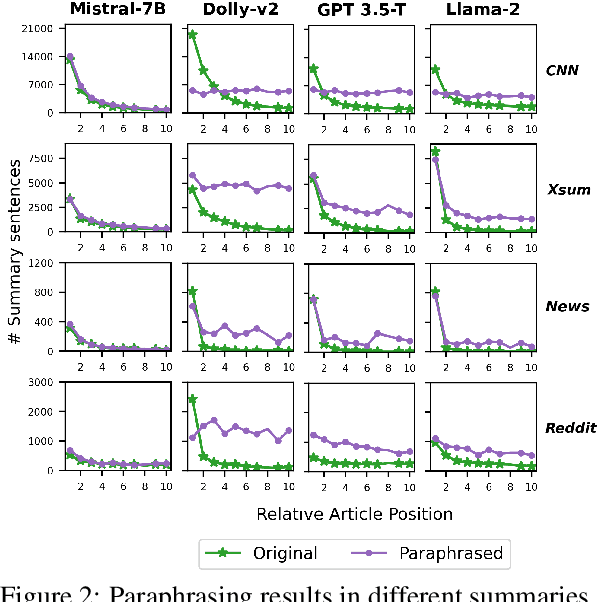
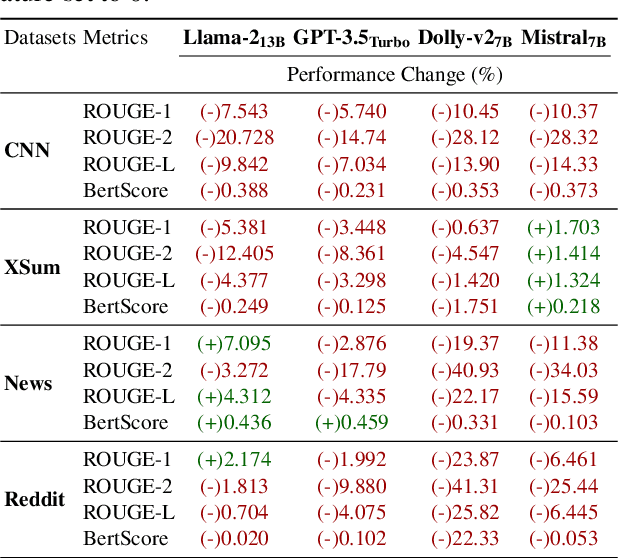
Large Language Models (LLMs) have achieved state-of-the-art performance at zero-shot generation of abstractive summaries for given articles. However, little is known about the robustness of such a process of zero-shot summarization. To bridge this gap, we propose relevance paraphrasing, a simple strategy that can be used to measure the robustness of LLMs as summarizers. The relevance paraphrasing approach identifies the most relevant sentences that contribute to generating an ideal summary, and then paraphrases these inputs to obtain a minimally perturbed dataset. Then, by evaluating model performance for summarization on both the original and perturbed datasets, we can assess the LLM's one aspect of robustness. We conduct extensive experiments with relevance paraphrasing on 4 diverse datasets, as well as 4 LLMs of different sizes (GPT-3.5-Turbo, Llama-2-13B, Mistral-7B, and Dolly-v2-7B). Our results indicate that LLMs are not consistent summarizers for the minimally perturbed articles, necessitating further improvements.