 Add to Chrome
 Add to Firefox
 Add to Edge
The Illusion of Cross-Lingual Safety in Low-Resource Languages
Aug 11, 2026
Safety alignment in large language models (LLMs) is largely developed in English, assuming these safeguards generalize across multilingual settings. However, this assumption remains underexplored and exposes a vulnerability in low-resource languages. We investigate cross-lingual safety transfer in four African languages, Twi, Hausa, Amharic, and Swahili, using LoDNA, a new safety dataset that pairs literal translations with culturally localized prompts. To move beyond generation-based evaluation, we propose a latent geometric framework that probes hidden-state refusal representations in LLMs. Our experimental results show that cross-lingual safety transfer is severely limited; harmful prompts retain less than 10% of the English refusal signal across most language-model pairs. Literal and localized prompts are semantically aligned (cosine 0.95-0.996) but drift across layers, suggesting models encode the concepts without routing them to safety mechanisms. These findings demonstrate that current multilingual safety alignment is superficial, providing strong evidence against the assumption of a universal, language-agnostic harm manifold within the specific low-resource languages studied. Warning: This paper contains example data that may be offensive or harmful.

Temporal Simultaneity Predicts Annotation Quality in Sentiment Corpora
May 26, 2026Annotation quality is difficult to sustain when campaigns span weeks or months with small annotator pools. We present a Setswana sentiment dataset of 3,565 tweets annotated by three native-speaker annotators across eight batches and examine why inter-annotator agreement (IAA) declines over time. Despite an aggregate Randolph's free-marginal Kappa of $κ= 0.76$, "excellent," per-batch $κ$ falls by more than 32 points across the annotation task. Through six targeted analyses, we find that (i) label confusion concentrates on the negative/neutral boundary, (ii) two annotators show run-length drift consistent with autopilot labeling, and (iii) the dominant predictor of $κ$ is temporal simultaneity: tweets labeled within one minute achieve $κ= 0.98$, while those labeled more than a day apart reach only $κ= 0.65$. Annotation speed and tweet-level linguistic features show no meaningful association with $κ$. We benchmark three open multilingual encoders and proprietary models (GPT-5 and Gemini) on three-class sentiment classification; fine-tuning yields gains of 29 to 43 macro-F1 points over pretrained baselines, with GPT-5 few-shot leading overall (62.2 macro-F1). We release the dataset, per-annotation timestamps, and analysis code to support reproducible quality auditing for future African language NLP resources.
Beyond Majority Voting: Agreement-Based Clustering to Model Annotator Perspectives in Subjective NLP Tasks
May 11, 2026Disagreement in annotation is a common phenomenon in the development of NLP datasets and serves as a valuable source of insight. While majority voting remains the dominant strategy for aggregating labels, recent work has explored modeling individual annotators to preserve their perspectives. However, modeling each annotator is resource-intensive and remains underexplored across various NLP tasks. We propose an agreement-based clustering technique to model the disagreement between the annotators. We conduct comprehensive experiments in 40 datasets in 18 typologically diverse languages, covering three subjective NLP tasks: sentiment analysis, emotion classification, and hate speech detection. We evaluate four aggregation approaches: majority vote, ensemble, multi-label, and multitask. The results demonstrate that agreement-based clustering can leverage the full spectrum of annotator perspectives and significantly enhance classification performance in subjective NLP tasks compared to majority voting and individual annotator modeling. Regarding the aggregation approach, the multi-label and multitask approaches are better for modeling clustered annotators than an ensemble and model majority vote.
AFRILANGTUTOR: Advancing Language Tutoring and Culture Education in Low-Resource Languages with Large Language Models
Apr 22, 2026How can language learning systems be developed for languages that lack sufficient training resources? This challenge is increasingly faced by developers across the African continent who aim to build AI systems capable of understanding and responding in local languages. To address this gap, we introduce AFRILANGDICT, a collection of 194.7K African language-English dictionary entries designed as seed resources for generating language-learning materials, enabling us to automatically construct large-scale, diverse, and verifiable student-tutor question-answer interactions suitable for training AI-assisted language tutors. Using AFRILANGDICT, we build AFRILANGEDU, a dataset of 78.9K multi-turn training examples for Supervised Fine-Tuning (SFT) and Direct Preference Optimization (DPO). Using AFRILANGEDU, we train language tutoring models collectively referred to as AFRILANGTUTOR. We fine-tune two multilingual LLMs: Llama-3-8B-IT and Gemma-3-12B-IT on AFRILANGEDU across 10 African languages and evaluate their performance. Our results show that models trained on AFRILANGEDU consistently outperform their base counterparts, and combining SFT and DPO yields substantial improvements, with gains ranging from 1.8% to 15.5% under LLM-as-a-judge evaluations across four criteria. To facilitate further research on low-resource languages -- all resources are available at https://huggingface.co/afrilang-edu.
AfrIFact: Cultural Information Retrieval, Evidence Extraction and Fact Checking for African Languages
Apr 01, 2026Assessing the veracity of a claim made online is a complex and important task with real-world implications. When these claims are directed at communities with limited access to information and the content concerns issues such as healthcare and culture, the consequences intensify, especially in low-resource languages. In this work, we introduce AfrIFact, a dataset that covers the necessary steps for automatic fact-checking (i.e., information retrieval, evidence extraction, and fact checking), in ten African languages and English. Our evaluation results show that even the best embedding models lack cross-lingual retrieval capabilities, and that cultural and news documents are easier to retrieve than healthcare-domain documents, both in large corpora and in single documents. We show that LLMs lack robust multilingual fact-verification capabilities in African languages, while few-shot prompting improves performance by up to 43% in AfriqueQwen-14B, and task-specific fine-tuning further improves fact-checking accuracy by up to 26%. These findings, along with our release of the AfrIFact dataset, encourage work on low-resource information retrieval, evidence retrieval, and fact checking.
MGSM-Pro: A Simple Strategy for Robust Multilingual Mathematical Reasoning Evaluation
Jan 29, 2026Large language models have made substantial progress in mathematical reasoning. However, benchmark development for multilingual evaluation has lagged behind English in both difficulty and recency. Recently, GSM-Symbolic showed a strong evidence of high variance when models are evaluated on different instantiations of the same question; however, the evaluation was conducted only in English. In this paper, we introduce MGSM-Pro, an extension of MGSM dataset with GSM-Symbolic approach. Our dataset provides five instantiations per MGSM question by varying names, digits and irrelevant context. Evaluations across nine languages reveal that many low-resource languages suffer large performance drops when tested on digit instantiations different from those in the original test set. We further find that some proprietary models, notably Gemini 2.5 Flash and GPT-4.1, are less robust to digit instantiation, whereas Claude 4.0 Sonnet is more robust. Among open models, GPT-OSS 120B and DeepSeek V3 show stronger robustness. Based on these findings, we recommend evaluating each problem using at least five digit-varying instantiations to obtain a more robust and realistic assessment of math reasoning.
Exploring Cultural Nuances in Emotion Perception Across 15 African Languages
Mar 25, 2025Understanding how emotions are expressed across languages is vital for building culturally-aware and inclusive NLP systems. However, emotion expression in African languages is understudied, limiting the development of effective emotion detection tools in these languages. In this work, we present a cross-linguistic analysis of emotion expression in 15 African languages. We examine four key dimensions of emotion representation: text length, sentiment polarity, emotion co-occurrence, and intensity variations. Our findings reveal diverse language-specific patterns in emotional expression -- with Somali texts typically longer, while others like IsiZulu and Algerian Arabic show more concise emotional expression. We observe a higher prevalence of negative sentiment in several Nigerian languages compared to lower negativity in languages like IsiXhosa. Further, emotion co-occurrence analysis demonstrates strong cross-linguistic associations between specific emotion pairs (anger-disgust, sadness-fear), suggesting universal psychological connections. Intensity distributions show multimodal patterns with significant variations between language families; Bantu languages display similar yet distinct profiles, while Afroasiatic languages and Nigerian Pidgin demonstrate wider intensity ranges. These findings highlight the need for language-specific approaches to emotion detection while identifying opportunities for transfer learning across related languages.
SemEval-2025 Task 11: Bridging the Gap in Text-Based Emotion Detection
Mar 10, 2025We present our shared task on text-based emotion detection, covering more than 30 languages from seven distinct language families. These languages are predominantly low-resource and spoken across various continents. The data instances are multi-labeled into six emotional classes, with additional datasets in 11 languages annotated for emotion intensity. Participants were asked to predict labels in three tracks: (a) emotion labels in monolingual settings, (b) emotion intensity scores, and (c) emotion labels in cross-lingual settings. The task attracted over 700 participants. We received final submissions from more than 200 teams and 93 system description papers. We report baseline results, as well as findings on the best-performing systems, the most common approaches, and the most effective methods across various tracks and languages. The datasets for this task are publicly available.
AfriHate: A Multilingual Collection of Hate Speech and Abusive Language Datasets for African Languages
Jan 15, 2025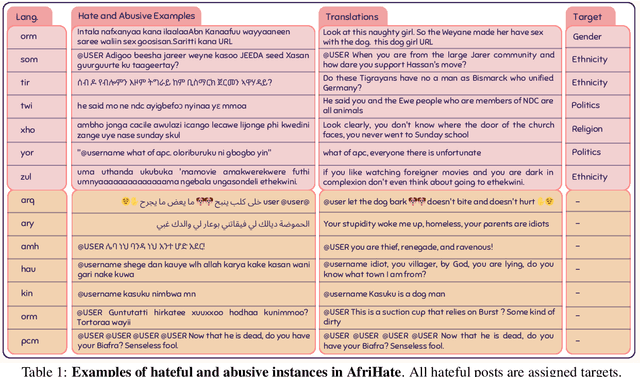

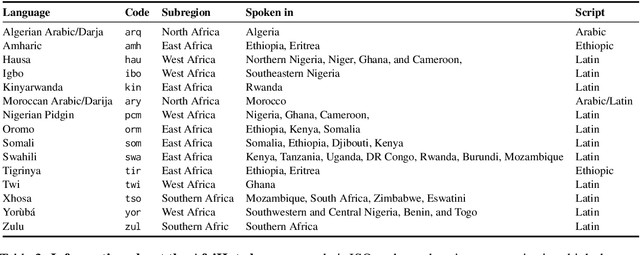

Hate speech and abusive language are global phenomena that need socio-cultural background knowledge to be understood, identified, and moderated. However, in many regions of the Global South, there have been several documented occurrences of (1) absence of moderation and (2) censorship due to the reliance on keyword spotting out of context. Further, high-profile individuals have frequently been at the center of the moderation process, while large and targeted hate speech campaigns against minorities have been overlooked. These limitations are mainly due to the lack of high-quality data in the local languages and the failure to include local communities in the collection, annotation, and moderation processes. To address this issue, we present AfriHate: a multilingual collection of hate speech and abusive language datasets in 15 African languages. Each instance in AfriHate is annotated by native speakers familiar with the local culture. We report the challenges related to the construction of the datasets and present various classification baseline results with and without using LLMs. The datasets, individual annotations, and hate speech and offensive language lexicons are available on https://github.com/AfriHate/AfriHate
Evaluating the Capabilities of Large Language Models for Multi-label Emotion Understanding
Dec 17, 2024Large Language Models (LLMs) show promising learning and reasoning abilities. Compared to other NLP tasks, multilingual and multi-label emotion evaluation tasks are under-explored in LLMs. In this paper, we present EthioEmo, a multi-label emotion classification dataset for four Ethiopian languages, namely, Amharic (amh), Afan Oromo (orm), Somali (som), and Tigrinya (tir). We perform extensive experiments with an additional English multi-label emotion dataset from SemEval 2018 Task 1. Our evaluation includes encoder-only, encoder-decoder, and decoder-only language models. We compare zero and few-shot approaches of LLMs to fine-tuning smaller language models. The results show that accurate multi-label emotion classification is still insufficient even for high-resource languages such as English, and there is a large gap between the performance of high-resource and low-resource languages. The results also show varying performance levels depending on the language and model type. EthioEmo is available publicly to further improve the understanding of emotions in language models and how people convey emotions through various languages.