 Add to Chrome
 Add to Firefox
 Add to Edge
Why Summaries Turn Neutral: Policy Attribution for Sentiment Drift in Reinforcement Learning from Human Feedback
Aug 16, 2026
Reinforcement learning with human feedback (RLHF) aligns LLMs with human preferences, improving summarization fluency and safety, but causes sentiment drift: overly neutral summaries stripped of emotional nuance. We diagnose why RL acts as a sentiment neutralizer and present Policy Attribution, a framework using gradient and logit decomposition to trace drift to reward model (RM) signals and KL (Kullback-Leibler) penalty. Sentiment drift reflects a strategic bias toward "low-risk" tokens maximizing expected rewards under preference uncertainty (Stiennon et al., 2020; Gao, Schulman, and Hilton, 2023). On Reddit TL;DR and CNN/DailyMail, RLHF summaries get higher rewards but show 30-40% lower sentiment variance. Cross-lingual analysis across eight languages shows language-independent drift, with morphologically richer languages more suppressed (Krasitskii et al., 2026). We propose and validate a sentiment-aware regularization technique reducing drift by 18-22% without harming summary quality. The code and toolkit will be public.

Multiclass Sentiment Analysis for Identifying Political Viewpoints
Aug 11, 2026The rapid growth of social media has created vast amounts of political discourse, which provides valuable opportunities to analyze public opinions and identify different political perspectives. Sentiment Analysis (SA) is a core task in Natural Language Processing (NLP) that allows the computational study of attitudes and opinions in textual data, and has become increasingly important for understanding political discourse. In this work, we investigate multiclass sentiment analysis of political view- points on social media, that is to automatically discriminate multiple sentiment classes over political issues and figures. To solve this task we design and evaluate two machine-learning approaches based on XGBoost and BERT. We train and evaluate the models on a labeled dataset of political social media posts using standard classification metrics. The experimental results show that the XGBoost model reaches an F1-score of 0.2835 and the BERT- based model reaches an F1-score of 0.2806 on the test set. These results demonstrate the challenge of classifying complex and contextualized political discourse sentiment and provide a baseline for future research in multiclass political sentiment analysis.
Multilingual Sentiment Aware Text Summarization A Reinforcement Learning Approach for Consistency Maintenance
Jun 08, 2026Reinforcement Learning from Human Feedback (RLHF) has significantly improved the quality and fluency of large language models in text summarization. However, its impact on affective properties remains insufficiently understood. In this work, we study sentiment drift, a systematic shift toward neutral sentiment in RLHF-based summarization outputs compared to source texts. We conduct extensive experiments across multiple datasets, model architectures, and eight languages to analyze how alignment objectives influence sentiment preservation. Our results show that sentiment drift is a consistent phenomenon that becomes stronger with increased KL regularization strength, indicating a trade-off between alignment stability and affective fidelity. To explain this behavior, we introduce a Policy Attribution framework that decomposes the RLHF objective and quantifies the contribution of its components. Our analysis reveals that KL regularization is the primary driver of sentiment suppression across all settings. Based on these findings, we propose a sentiment-aware modification of the KL regularization term, which selectively reduces constraints on sentiment-bearing tokens. Empirical results demonstrate that this approach mitigates sentiment drift while maintaining summarization quality. Overall, our findings highlight a fundamental limitation of current alignment methods: while they improve factual consistency and safety, they may unintentionally suppress emotional expressiveness. This motivates the development of alignment strategies that explicitly account for affective preservation.
Evaluating the Limitations of Protein Sequence Representations for Parkinson's Disease Classification
Apr 13, 2026The identification of reliable molecular biomarkers for Parkinson's disease remains challenging due to its multifactorial nature. Although protein sequences constitute a fundamental and widely available source of biological information, their standalone discriminative capacity for complex disease classification remains unclear. In this work, we present a controlled and leakage-free evaluation of multiple representations derived exclusively from protein primary sequences, including amino acid composition, k-mers, physicochemical descriptors, hybrid representations, and embeddings from protein language models, all assessed under a nested stratified cross-validation framework to ensure unbiased performance estimation. The best-performing configuration (ProtBERT + MLP) achieves an F1-score of 0.704 +/- 0.028 and ROC-AUC of 0.748 +/- 0.047, indicating only moderate discriminative performance. Classical representations such as k-mers reach comparable F1 values (up to approximately 0.667), but exhibit highly imbalanced behavior, with recall close to 0.98 and precision around 0.50, reflecting a strong bias toward positive predictions. Across representations, performance differences remain within a narrow range (F1 between 0.60 and 0.70), while unsupervised analyses reveal no intrinsic structure aligned with class labels, and statistical testing (Friedman test, p = 0.1749) does not indicate significant differences across models. These results demonstrate substantial overlap between classes and indicate that primary sequence information alone provides limited discriminative power for Parkinson's disease classification. This work establishes a reproducible baseline and provides empirical evidence that more informative biological features, such as structural, functional, or interaction-based descriptors, are required for robust disease modeling.
How Psychological Learning Paradigms Shaped and Constrained Artificial Intelligence
Mar 18, 2026The dominant paradigms of artificial intelligence were shaped by learning theories from psychology: behaviorism inspired reinforcement learning, cognitivism gave rise to deep learning and memory-augmented architectures, and constructivism influenced curriculum learning and compositional approaches. This paper argues that each AI paradigm inherited not only the strengths but the structural limitations of the psychological theory that inspired it. Reinforcement learning cannot account for the internal structure of knowledge, deep learning compresses representations into opaque parameter spaces resistant to principled update, and current integrative approaches lack a formal account of how new understanding is constructed from existing components. The paper further examines a cross-cultural divergence in the interpretation of rote learning, arguing that the Eastern conception of memorization as a structured, multi-phase precursor to understanding offers an underexploited bridge between psychological theory and AI methodology. Drawing on the systematicity debate and critique of Aizawa of both classicism and connectionism, this paper introduces ReSynth, a trimodular framework that separates reasoning (Intellect), purpose (Identity), and knowledge (Memory) as architecturally independent components. The paper traces the genealogy from psychological paradigm to AI method, diagnoses the inherited limitations at each stage, and argues that adaptability, the central challenge of artificial general intelligence requires a representational architecture in which systematic behavior is a necessary consequence rather than an accidental property.
Multilingual Hate Speech Detection in Social Media Using Translation-Based Approaches with Large Language Models
Jun 09, 2025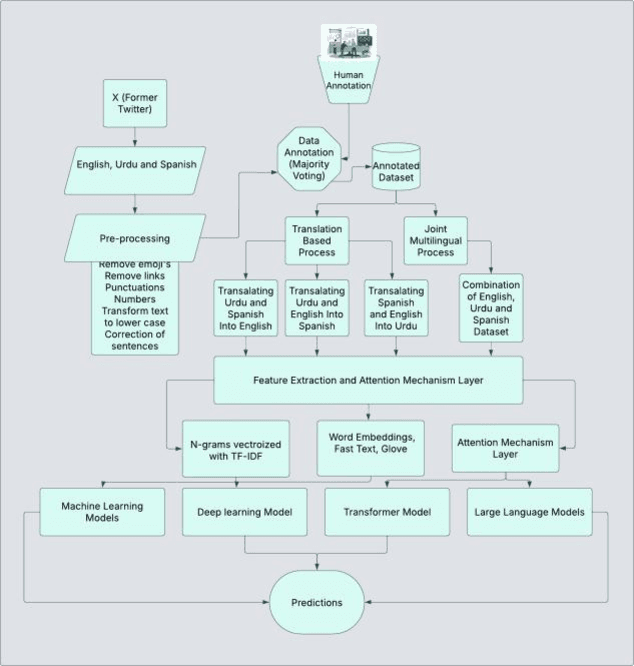
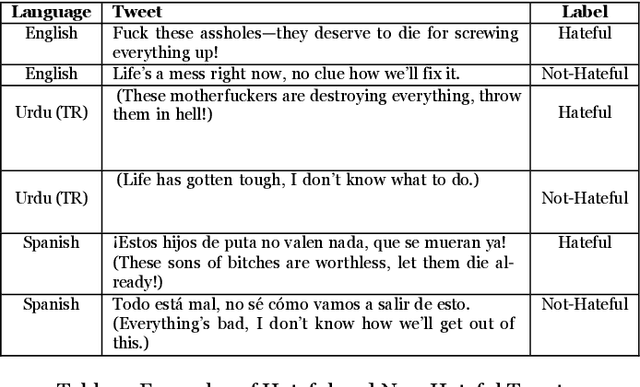
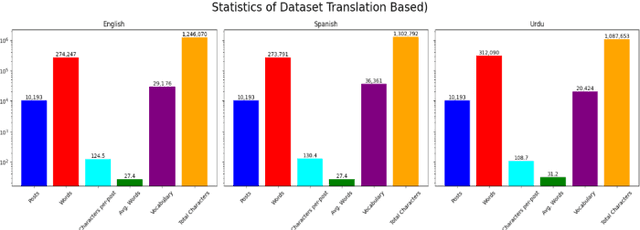
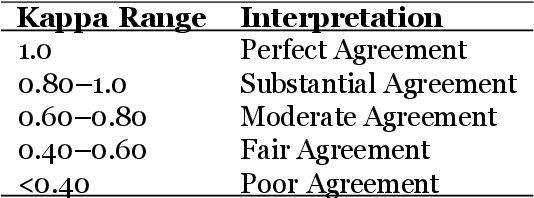
Social media platforms are critical spaces for public discourse, shaping opinions and community dynamics, yet their widespread use has amplified harmful content, particularly hate speech, threatening online safety and inclusivity. While hate speech detection has been extensively studied in languages like English and Spanish, Urdu remains underexplored, especially using translation-based approaches. To address this gap, we introduce a trilingual dataset of 10,193 tweets in English (3,834 samples), Urdu (3,197 samples), and Spanish (3,162 samples), collected via keyword filtering, with a balanced distribution of 4,849 Hateful and 5,344 Not-Hateful labels. Our methodology leverages attention layers as a precursor to transformer-based models and large language models (LLMs), enhancing feature extraction for multilingual hate speech detection. For non-transformer models, we use TF-IDF for feature extraction. The dataset is benchmarked using state-of-the-art models, including GPT-3.5 Turbo and Qwen 2.5 72B, alongside traditional machine learning models like SVM and other transformers (e.g., BERT, RoBERTa). Three annotators, following rigorous guidelines, ensured high dataset quality, achieving a Fleiss' Kappa of 0.821. Our approach, integrating attention layers with GPT-3.5 Turbo and Qwen 2.5 72B, achieves strong performance, with macro F1 scores of 0.87 for English (GPT-3.5 Turbo), 0.85 for Spanish (GPT-3.5 Turbo), 0.81 for Urdu (Qwen 2.5 72B), and 0.88 for the joint multilingual model (Qwen 2.5 72B). These results reflect improvements of 8.75% in English (over SVM baseline 0.80), 8.97% in Spanish (over SVM baseline 0.78), 5.19% in Urdu (over SVM baseline 0.77), and 7.32% in the joint multilingual model (over SVM baseline 0.82). Our framework offers a robust solution for multilingual hate speech detection, fostering safer digital communities worldwide.
Hybrid Extractive Abstractive Summarization for Multilingual Sentiment Analysis
Jun 07, 2025We propose a hybrid approach for multilingual sentiment analysis that combines extractive and abstractive summarization to address the limitations of standalone methods. The model integrates TF-IDF-based extraction with a fine-tuned XLM-R abstractive module, enhanced by dynamic thresholding and cultural adaptation. Experiments across 10 languages show significant improvements over baselines, achieving 0.90 accuracy for English and 0.84 for low-resource languages. The approach also demonstrates 22% greater computational efficiency than traditional methods. Practical applications include real-time brand monitoring and cross-cultural discourse analysis. Future work will focus on optimization for low-resource languages via 8-bit quantization.
Leveraging Large Language Models for Multi-Class and Multi-Label Detection of Drug Use and Overdose Symptoms on Social Media
Apr 16, 2025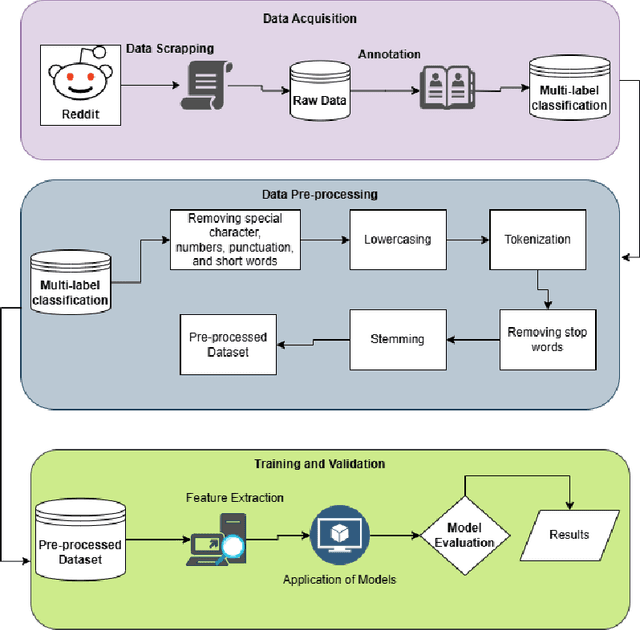
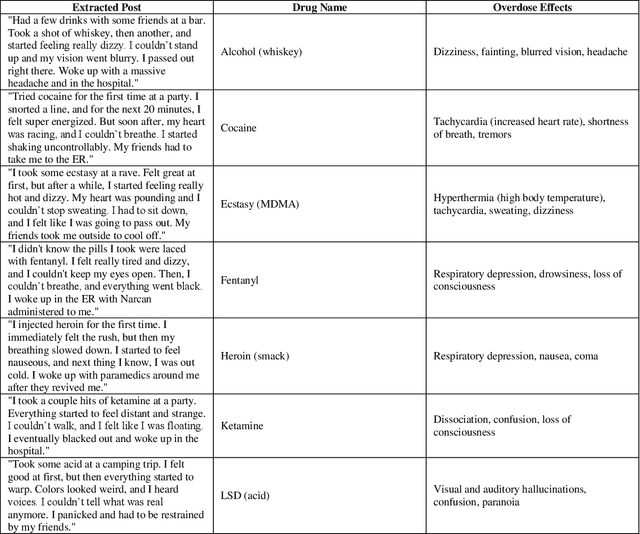

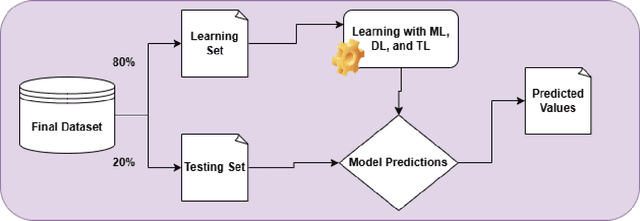
Drug overdose remains a critical global health issue, often driven by misuse of opioids, painkillers, and psychiatric medications. Traditional research methods face limitations, whereas social media offers real-time insights into self-reported substance use and overdose symptoms. This study proposes an AI-driven NLP framework trained on annotated social media data to detect commonly used drugs and associated overdose symptoms. Using a hybrid annotation strategy with LLMs and human annotators, we applied traditional ML models, neural networks, and advanced transformer-based models. Our framework achieved 98% accuracy in multi-class and 97% in multi-label classification, outperforming baseline models by up to 8%. These findings highlight the potential of AI for supporting public health surveillance and personalized intervention strategies.
Multilingual Sentiment Analysis of Summarized Texts: A Cross-Language Study of Text Shortening Effects
Mar 31, 2025Summarization significantly impacts sentiment analysis across languages with diverse morphologies. This study examines extractive and abstractive summarization effects on sentiment classification in English, German, French, Spanish, Italian, Finnish, Hungarian, and Arabic. We assess sentiment shifts post-summarization using multilingual transformers (mBERT, XLM-RoBERTa, T5, and BART) and language-specific models (FinBERT, AraBERT). Results show extractive summarization better preserves sentiment, especially in morphologically complex languages, while abstractive summarization improves readability but introduces sentiment distortion, affecting sentiment accuracy. Languages with rich inflectional morphology, such as Finnish, Hungarian, and Arabic, experience greater accuracy drops than English or German. Findings emphasize the need for language-specific adaptations in sentiment analysis and propose a hybrid summarization approach balancing readability and sentiment preservation. These insights benefit multilingual sentiment applications, including social media monitoring, market analysis, and cross-lingual opinion mining.
Advancing Sentiment Analysis in Tamil-English Code-Mixed Texts: Challenges and Transformer-Based Solutions
Mar 30, 2025
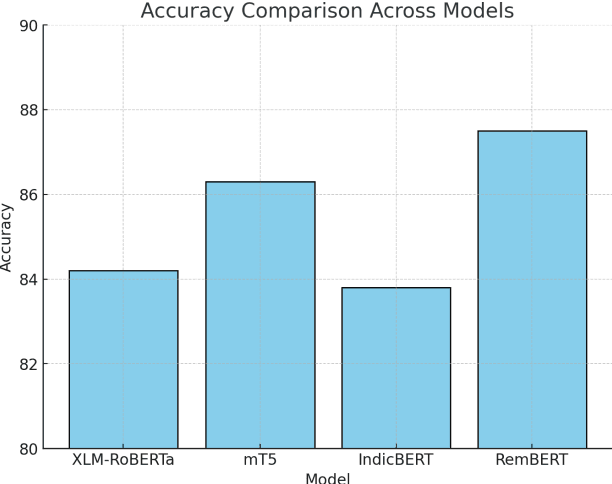
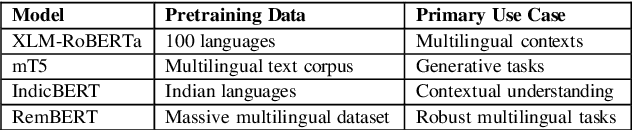
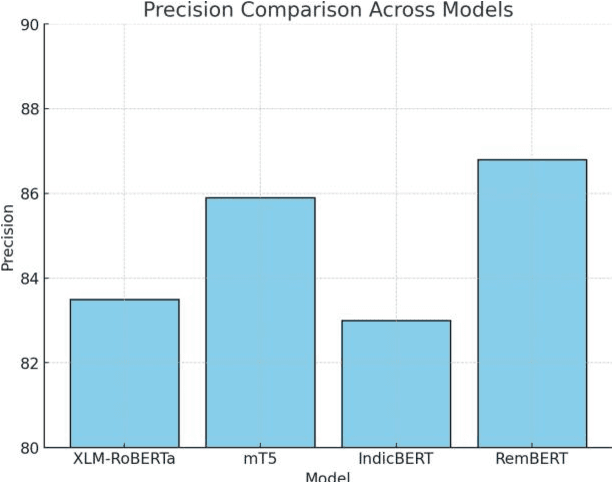
The sentiment analysis task in Tamil-English code-mixed texts has been explored using advanced transformer-based models. Challenges from grammatical inconsistencies, orthographic variations, and phonetic ambiguities have been addressed. The limitations of existing datasets and annotation gaps have been examined, emphasizing the need for larger and more diverse corpora. Transformer architectures, including XLM-RoBERTa, mT5, IndicBERT, and RemBERT, have been evaluated in low-resource, code-mixed environments. Performance metrics have been analyzed, highlighting the effectiveness of specific models in handling multilingual sentiment classification. The findings suggest that further advancements in data augmentation, phonetic normalization, and hybrid modeling approaches are required to enhance accuracy. Future research directions for improving sentiment analysis in code-mixed texts have been proposed.