 Add to Chrome
 Add to Firefox
 Add to Edge
Human detectors are surprisingly powerful reward models
Jan 21, 2026
Video generation models have recently achieved impressive visual fidelity and temporal coherence. Yet, they continue to struggle with complex, non-rigid motions, especially when synthesizing humans performing dynamic actions such as sports, dance, etc. Generated videos often exhibit missing or extra limbs, distorted poses, or physically implausible actions. In this work, we propose a remarkably simple reward model, HuDA, to quantify and improve the human motion in generated videos. HuDA integrates human detection confidence for appearance quality, and a temporal prompt alignment score to capture motion realism. We show this simple reward function that leverages off-the-shelf models without any additional training, outperforms specialized models finetuned with manually annotated data. Using HuDA for Group Reward Policy Optimization (GRPO) post-training of video models, we significantly enhance video generation, especially when generating complex human motions, outperforming state-of-the-art models like Wan 2.1, with win-rate of 73%. Finally, we demonstrate that HuDA improves generation quality beyond just humans, for instance, significantly improving generation of animal videos and human-object interactions.

The Llama 4 Herd: Architecture, Training, Evaluation, and Deployment Notes
Jan 15, 2026This document consolidates publicly reported technical details about Metas Llama 4 model family. It summarizes (i) released variants (Scout and Maverick) and the broader herd context including the previewed Behemoth teacher model, (ii) architectural characteristics beyond a high-level MoE description covering routed/shared-expert structure, early-fusion multimodality, and long-context design elements reported for Scout (iRoPE and length generalization strategies), (iii) training disclosures spanning pre-training, mid-training for long-context extension, and post-training methodology (lightweight SFT, online RL, and lightweight DPO) as described in release materials, (iv) developer-reported benchmark results for both base and instruction-tuned checkpoints, and (v) practical deployment constraints observed across major serving environments, including provider-specific context limits and quantization packaging. The manuscript also summarizes licensing obligations relevant to redistribution and derivative naming, and reviews publicly described safeguards and evaluation practices. The goal is to provide a compact technical reference for researchers and practitioners who need precise, source-backed facts about Llama 4.
Generating Multi-Image Synthetic Data for Text-to-Image Customization
Feb 03, 2025Customization of text-to-image models enables users to insert custom concepts and generate the concepts in unseen settings. Existing methods either rely on costly test-time optimization or train encoders on single-image training datasets without multi-image supervision, leading to worse image quality. We propose a simple approach that addresses both limitations. We first leverage existing text-to-image models and 3D datasets to create a high-quality Synthetic Customization Dataset (SynCD) consisting of multiple images of the same object in different lighting, backgrounds, and poses. We then propose a new encoder architecture based on shared attention mechanisms that better incorporate fine-grained visual details from input images. Finally, we propose a new inference technique that mitigates overexposure issues during inference by normalizing the text and image guidance vectors. Through extensive experiments, we show that our model, trained on the synthetic dataset with the proposed encoder and inference algorithm, outperforms existing tuning-free methods on standard customization benchmarks.
LLMs can see and hear without any training
Jan 30, 2025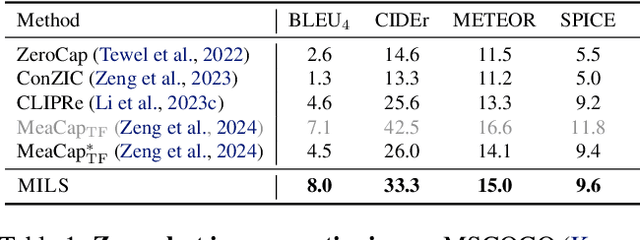
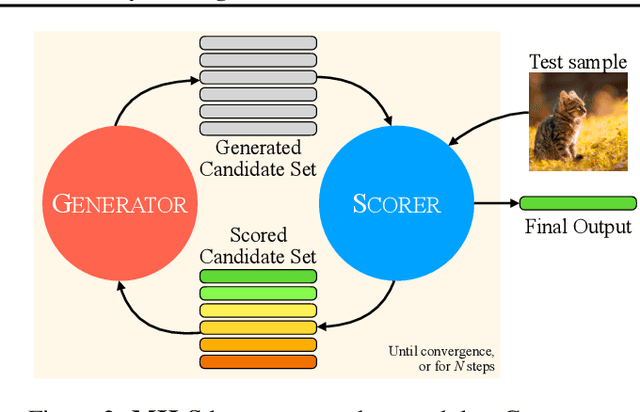
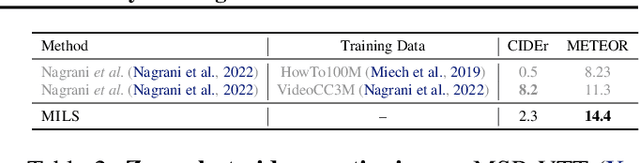
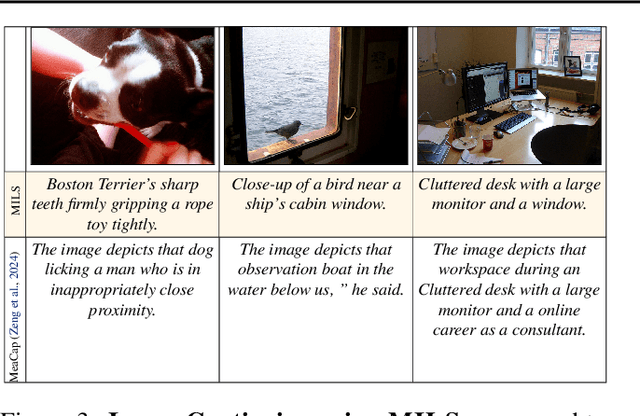
We present MILS: Multimodal Iterative LLM Solver, a surprisingly simple, training-free approach, to imbue multimodal capabilities into your favorite LLM. Leveraging their innate ability to perform multi-step reasoning, MILS prompts the LLM to generate candidate outputs, each of which are scored and fed back iteratively, eventually generating a solution to the task. This enables various applications that typically require training specialized models on task-specific data. In particular, we establish a new state-of-the-art on emergent zero-shot image, video and audio captioning. MILS seamlessly applies to media generation as well, discovering prompt rewrites to improve text-to-image generation, and even edit prompts for style transfer! Finally, being a gradient-free optimization approach, MILS can invert multimodal embeddings into text, enabling applications like cross-modal arithmetic.
Diffusion Autoencoders are Scalable Image Tokenizers
Jan 30, 2025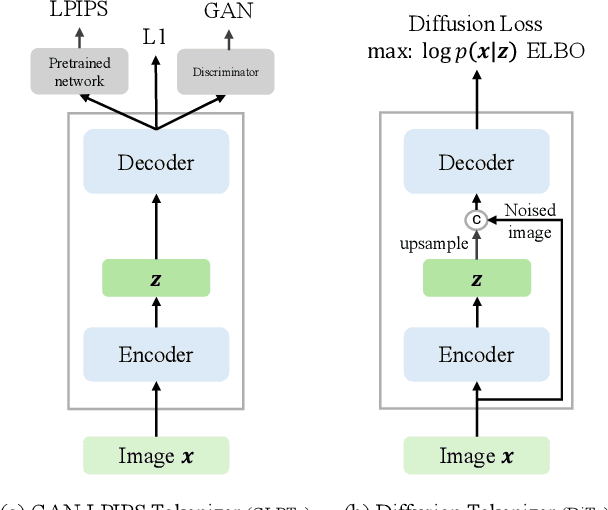
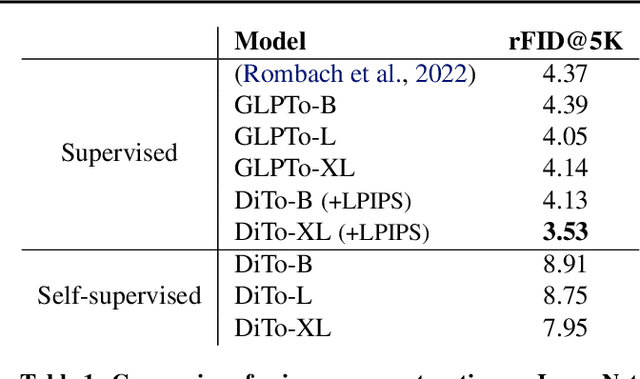
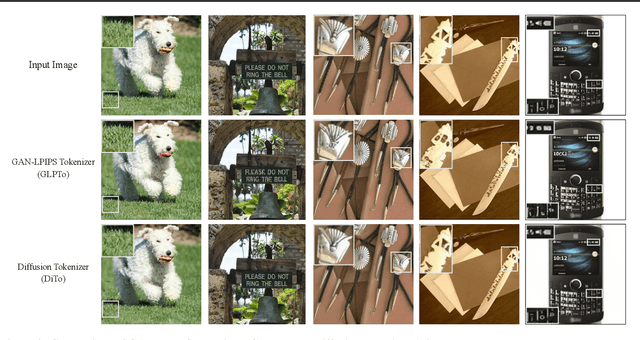
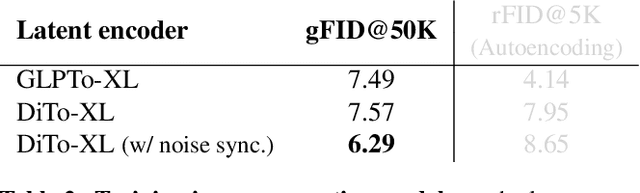
Tokenizing images into compact visual representations is a key step in learning efficient and high-quality image generative models. We present a simple diffusion tokenizer (DiTo) that learns compact visual representations for image generation models. Our key insight is that a single learning objective, diffusion L2 loss, can be used for training scalable image tokenizers. Since diffusion is already widely used for image generation, our insight greatly simplifies training such tokenizers. In contrast, current state-of-the-art tokenizers rely on an empirically found combination of heuristics and losses, thus requiring a complex training recipe that relies on non-trivially balancing different losses and pretrained supervised models. We show design decisions, along with theoretical grounding, that enable us to scale DiTo for learning competitive image representations. Our results show that DiTo is a simpler, scalable, and self-supervised alternative to the current state-of-the-art image tokenizer which is supervised. DiTo achieves competitive or better quality than state-of-the-art in image reconstruction and downstream image generation tasks.
CAT: Content-Adaptive Image Tokenization
Jan 06, 2025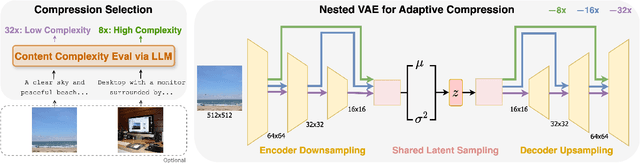

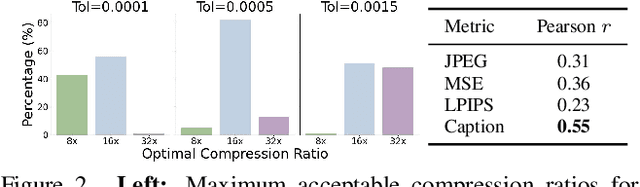
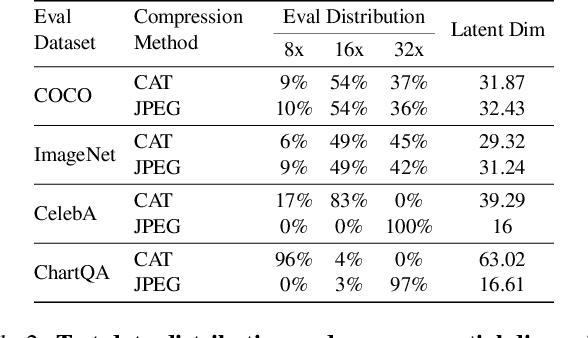
Most existing image tokenizers encode images into a fixed number of tokens or patches, overlooking the inherent variability in image complexity. To address this, we introduce Content-Adaptive Tokenizer (CAT), which dynamically adjusts representation capacity based on the image content and encodes simpler images into fewer tokens. We design a caption-based evaluation system that leverages large language models (LLMs) to predict content complexity and determine the optimal compression ratio for a given image, taking into account factors critical to human perception. Trained on images with diverse compression ratios, CAT demonstrates robust performance in image reconstruction. We also utilize its variable-length latent representations to train Diffusion Transformers (DiTs) for ImageNet generation. By optimizing token allocation, CAT improves the FID score over fixed-ratio baselines trained with the same flops and boosts the inference throughput by 18.5%.
Movie Gen: A Cast of Media Foundation Models
Oct 17, 2024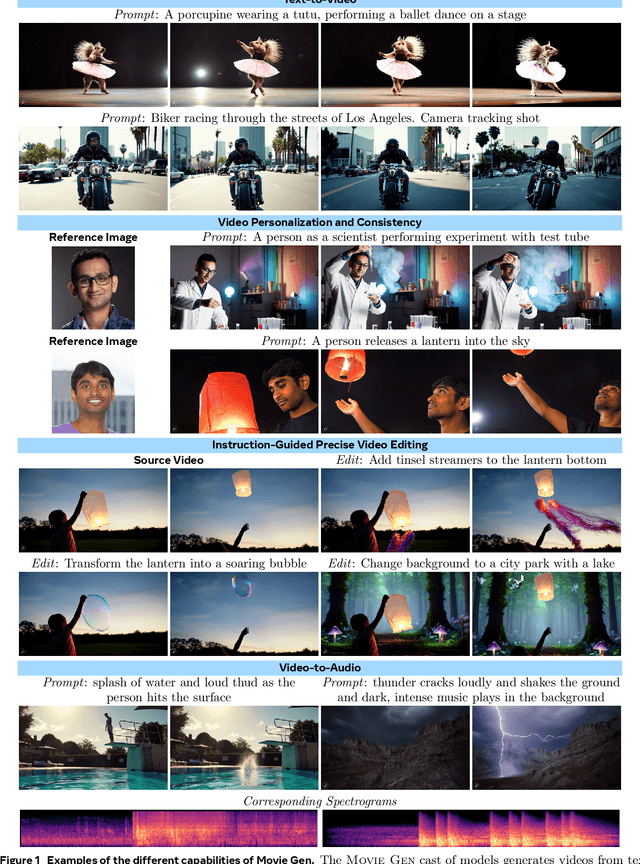

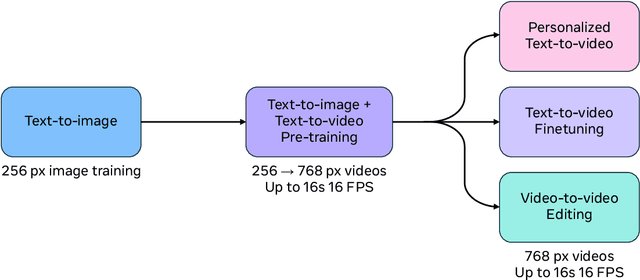

We present Movie Gen, a cast of foundation models that generates high-quality, 1080p HD videos with different aspect ratios and synchronized audio. We also show additional capabilities such as precise instruction-based video editing and generation of personalized videos based on a user's image. Our models set a new state-of-the-art on multiple tasks: text-to-video synthesis, video personalization, video editing, video-to-audio generation, and text-to-audio generation. Our largest video generation model is a 30B parameter transformer trained with a maximum context length of 73K video tokens, corresponding to a generated video of 16 seconds at 16 frames-per-second. We show multiple technical innovations and simplifications on the architecture, latent spaces, training objectives and recipes, data curation, evaluation protocols, parallelization techniques, and inference optimizations that allow us to reap the benefits of scaling pre-training data, model size, and training compute for training large scale media generation models. We hope this paper helps the research community to accelerate progress and innovation in media generation models. All videos from this paper are available at https://go.fb.me/MovieGenResearchVideos.
The Llama 3 Herd of Models
Jul 31, 2024Modern artificial intelligence (AI) systems are powered by foundation models. This paper presents a new set of foundation models, called Llama 3. It is a herd of language models that natively support multilinguality, coding, reasoning, and tool usage. Our largest model is a dense Transformer with 405B parameters and a context window of up to 128K tokens. This paper presents an extensive empirical evaluation of Llama 3. We find that Llama 3 delivers comparable quality to leading language models such as GPT-4 on a plethora of tasks. We publicly release Llama 3, including pre-trained and post-trained versions of the 405B parameter language model and our Llama Guard 3 model for input and output safety. The paper also presents the results of experiments in which we integrate image, video, and speech capabilities into Llama 3 via a compositional approach. We observe this approach performs competitively with the state-of-the-art on image, video, and speech recognition tasks. The resulting models are not yet being broadly released as they are still under development.
InstanceDiffusion: Instance-level Control for Image Generation
Feb 05, 2024Text-to-image diffusion models produce high quality images but do not offer control over individual instances in the image. We introduce InstanceDiffusion that adds precise instance-level control to text-to-image diffusion models. InstanceDiffusion supports free-form language conditions per instance and allows flexible ways to specify instance locations such as simple single points, scribbles, bounding boxes or intricate instance segmentation masks, and combinations thereof. We propose three major changes to text-to-image models that enable precise instance-level control. Our UniFusion block enables instance-level conditions for text-to-image models, the ScaleU block improves image fidelity, and our Multi-instance Sampler improves generations for multiple instances. InstanceDiffusion significantly surpasses specialized state-of-the-art models for each location condition. Notably, on the COCO dataset, we outperform previous state-of-the-art by 20.4% AP$_{50}^\text{box}$ for box inputs, and 25.4% IoU for mask inputs.
FlowVid: Taming Imperfect Optical Flows for Consistent Video-to-Video Synthesis
Dec 29, 2023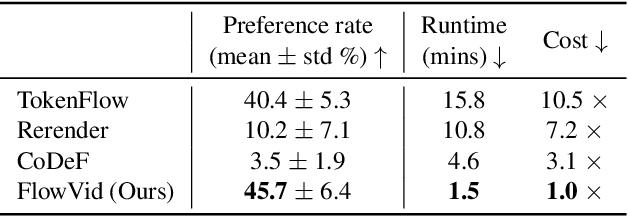
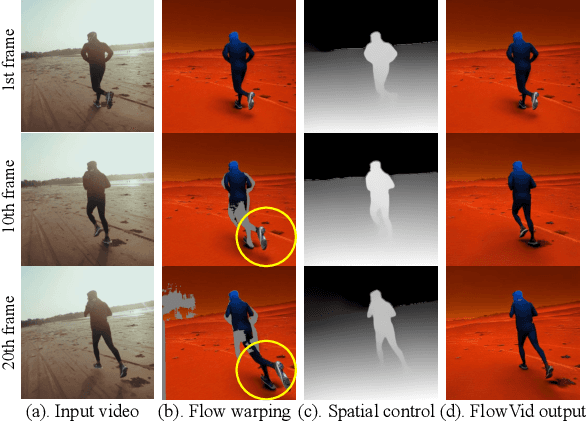
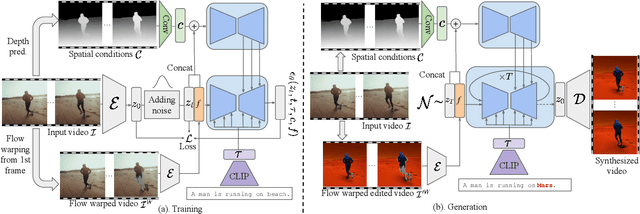
Diffusion models have transformed the image-to-image (I2I) synthesis and are now permeating into videos. However, the advancement of video-to-video (V2V) synthesis has been hampered by the challenge of maintaining temporal consistency across video frames. This paper proposes a consistent V2V synthesis framework by jointly leveraging spatial conditions and temporal optical flow clues within the source video. Contrary to prior methods that strictly adhere to optical flow, our approach harnesses its benefits while handling the imperfection in flow estimation. We encode the optical flow via warping from the first frame and serve it as a supplementary reference in the diffusion model. This enables our model for video synthesis by editing the first frame with any prevalent I2I models and then propagating edits to successive frames. Our V2V model, FlowVid, demonstrates remarkable properties: (1) Flexibility: FlowVid works seamlessly with existing I2I models, facilitating various modifications, including stylization, object swaps, and local edits. (2) Efficiency: Generation of a 4-second video with 30 FPS and 512x512 resolution takes only 1.5 minutes, which is 3.1x, 7.2x, and 10.5x faster than CoDeF, Rerender, and TokenFlow, respectively. (3) High-quality: In user studies, our FlowVid is preferred 45.7% of the time, outperforming CoDeF (3.5%), Rerender (10.2%), and TokenFlow (40.4%).