 Add to Chrome
 Add to Firefox
 Add to Edge
COSMO-Agent: Tool-Augmented Agent for Closed-loop Optimization,Simulation,and Modeling Orchestration
Apr 07, 2026
Iterative industrial design-simulation optimization is bottlenecked by the CAD-CAE semantic gap: translating simulation feedback into valid geometric edits under diverse, coupled constraints. To fill this gap, we propose COSMO-Agent (Closed-loop Optimization, Simulation, and Modeling Orchestration), a tool-augmented reinforcement learning (RL) framework that teaches LLMs to complete the closed-loop CAD-CAE process. Specifically, we cast CAD generation, CAE solving, result parsing, and geometry revision as an interactive RL environment, where an LLM learns to orchestrate external tools and revise parametric geometries until constraints are satisfied. To make this learning stable and industrially usable, we design a multi-constraint reward that jointly encourages feasibility, toolchain robustness, and structured output validity. In addition, we contribute an industry-aligned dataset that covers 25 component categories with executable CAD-CAE tasks to support realistic training and evaluation. Experiments show that COSMO-Agent training substantially improves small open-source LLMs for constraint-driven design, exceeding large open-source and strong closed-source models in feasibility, efficiency, and stability.

FinToolBench: Evaluating LLM Agents for Real-World Financial Tool Use
Mar 09, 2026The integration of Large Language Models (LLMs) into the financial domain is driving a paradigm shift from passive information retrieval to dynamic, agentic interaction. While general-purpose tool learning has witnessed a surge in benchmarks, the financial sector, characterized by high stakes, strict compliance, and rapid data volatility, remains critically underserved. Existing financial evaluations predominantly focus on static textual analysis or document-based QA, ignoring the complex reality of tool execution. Conversely, general tool benchmarks lack the domain-specific rigor required for finance, often relying on toy environments or a negligible number of financial APIs. To bridge this gap, we introduce FinToolBench, the first real-world, runnable benchmark dedicated to evaluating financial tool learning agents. Unlike prior works limited to a handful of mock tools, FinToolBench establishes a realistic ecosystem coupling 760 executable financial tools with 295 rigorous, tool-required queries. We propose a novel evaluation framework that goes beyond binary execution success, assessing agents on finance-critical dimensions: timeliness, intent type, and regulatory domain alignment. Furthermore, we present FATR, a finance-aware tool retrieval and reasoning baseline that enhances stability and compliance. By providing the first testbed for auditable, agentic financial execution, FinToolBench sets a new standard for trustworthy AI in finance. The tool manifest, execution environment, and evaluation code will be open-sourced to facilitate future research.
Learning Multi-level Features For Sensor-based Human Action Recognition
Sep 02, 2017
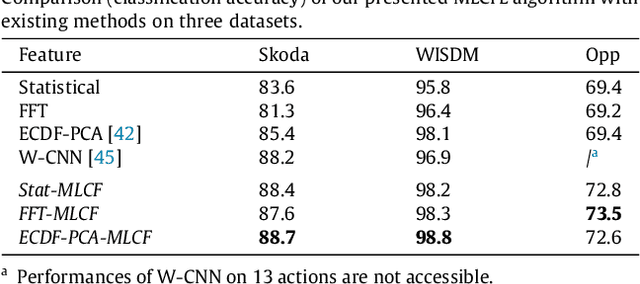
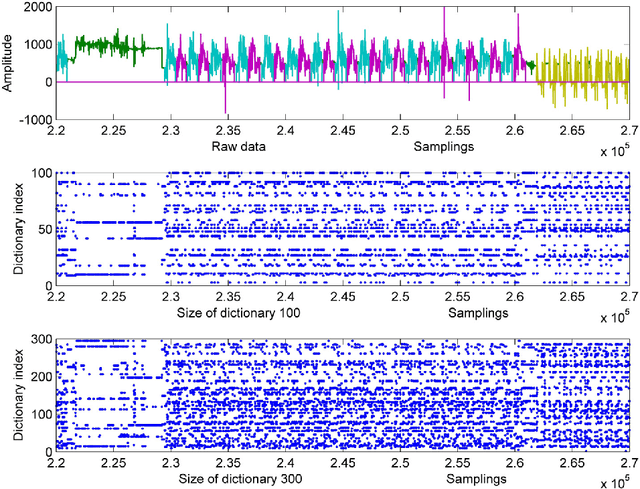
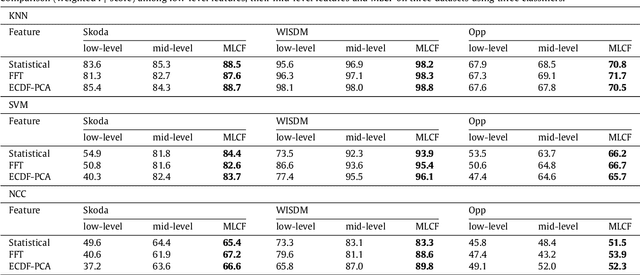
This paper proposes a multi-level feature learning framework for human action recognition using a single body-worn inertial sensor. The framework consists of three phases, respectively designed to analyze signal-based (low-level), components (mid-level) and semantic (high-level) information. Low-level features capture the time and frequency domain property while mid-level representations learn the composition of the action. The Max-margin Latent Pattern Learning (MLPL) method is proposed to learn high-level semantic descriptions of latent action patterns as the output of our framework. The proposed method achieves the state-of-the-art performances, 88.7%, 98.8% and 72.6% (weighted F1 score) respectively, on Skoda, WISDM and OPP datasets.
* 26 pages, 23 figures