 Add to Chrome
 Add to Firefox
 Add to Edge
Distill What the Student Can See: Fisher-Projected On-Policy Distillation for Vision-Language Models
Aug 02, 2026
On-policy distillation (OPD) samples trajectories from the current student policy and minimizes token-level divergence between student and teacher next-token distributions at prefixes along those trajectories. This aligns the distillation states with the student's own generation distribution. However, it still assumes that the complete teacher distribution is an appropriate target across student capacities. In vision--language reasoning, teacher corrections can depend on visual distinctions that a compact student cannot represent. Our target-scaling study shows that, as the target approaches the complete teacher distribution, the student realizes less of the prescribed shift and obtains worse downstream performance. We therefore propose \emph{Fisher-Projected On-Policy Distillation} (FP-OPD), which distills only locally realizable teacher corrections. FP-OPD uses continuous visual perturbations to estimate the student's local visual tangent space and projects the centered teacher--student log-probability gap onto this space under the student's Fisher metric. The resulting capacity-aware target is optimized with full-vocabulary reverse KL on student trajectories, retaining the standard OPD framework. In 8B-to-2B distillation, FP-OPD improves all seven evaluated multimodal benchmarks. It raises the average score by 2.77 points over the pretrained student and by 1.60 points over standard OPD. These results demonstrate that locally realizable teacher corrections provide a more effective target for distilling compact vision--language models.

BrainJanus: A Unified Model for Understanding and Generation across Brain, Vision, and Language
Jun 29, 2026Modeling the bidirectional correspondence between external sensory stimuli and internal neural activity has emerged as a critical frontier in neuroscience. However, existing approaches predominantly treat brain encoding and decoding as isolated tasks, relying heavily on unimodal alignment and external priors while overlooking the brain's intrinsic nature as a multimodal integration system. To address these limitations, we propose BrainJanus, the first unified brain model that integrates brain, vision, and language within a single framework. Specifically, we introduce a Unified Brain Tokenizer to quantize continuous neural dynamics into discrete tokens aligned with visual and linguistic representations in a shared Omni space. Building on this, we utilize an All-in-One autoregressive architecture that leverages next-token prediction to enable seamless any-to-any generation, which encompasses image-to-brain and text-to-brain encoding, and brain-to-image and brain-to-text decoding. Extensive experiments demonstrate that BrainJanus achieves superior performance across diverse benchmarks. Furthermore, our framework exhibits zero-shot generalization and preserves interpretable biological topography, highlighting its potential as a general-purpose brain modeling paradigm. The code is available at \href{https://github.com/HaitaoWuTJU/BrainJanus}{GitHub}.
Estimating the Black-box LLM Uncertainty with Distribution-Aligned Adversarial Distillation
May 07, 2026Large language models (LLMs) have progressed rapidly in complex reasoning and question answering, yet LLM hallucination remains a central bottleneck that hinders practical deployment, especially for commercial black-box LLMs accessible only via APIs. Existing uncertainty quantification methods typically depend on computationally expensive multiple sampling or internal parameters, which prevents real-time estimation and fails to capture information implicit in the black-box reasoning process. To address this issue, we propose Distribution-Aligned Adversarial Distillation (DisAAD), which introduces a generation-discrimination architecture to guide a lightweight proxy model to learn the high-quality regions of the output distribution of the black-box LLM, thus effectively endowing it with the ability to know whether the black-box LLM knows or not. Subsequently, we use the proxy model to reproduce the specific responses of the black-box LLM and estimate the corresponding uncertainty based on evidence learning. Extensive experiments have verified the effectiveness and promise of our proposed method, indicating that a proxy model even one that only accounts for 1\% of the target LLM's size can achieve reliable uncertainty quantification.
TEMPO: Scaling Test-time Training for Large Reasoning Models
Apr 21, 2026Test-time training (TTT) adapts model parameters on unlabeled test instances during inference time, which continuously extends capabilities beyond the reach of offline training. Despite initial gains, existing TTT methods for LRMs plateau quickly and do not benefit from additional test-time compute. Without external calibration, the self-generated reward signal increasingly drifts as the policy model evolves, leading to both performance plateaus and diversity collapse. We propose TEMPO, a TTT framework that interleaves policy refinement on unlabeled questions with periodic critic recalibration on a labeled dataset. By formalizing this alternating procedure through the Expectation-Maximization (EM) algorithm, we reveal that prior methods can be interpreted as incomplete variants that omit the crucial recalibration step. Reintroducing this step tightens the evidence lower bound (ELBO) and enables sustained improvement. Across diverse model families (Qwen3 and OLMO3) and reasoning tasks, TEMPO improves OLMO3-7B on AIME 2024 from 33.0% to 51.1% and Qwen3-14B from 42.3% to 65.8%, while maintaining high diversity.
MULTIBENCH++: A Unified and Comprehensive Multimodal Fusion Benchmarking Across Specialized Domains
Nov 14, 2025Although multimodal fusion has made significant progress, its advancement is severely hindered by the lack of adequate evaluation benchmarks. Current fusion methods are typically evaluated on a small selection of public datasets, a limited scope that inadequately represents the complexity and diversity of real-world scenarios, potentially leading to biased evaluations. This issue presents a twofold challenge. On one hand, models may overfit to the biases of specific datasets, hindering their generalization to broader practical applications. On the other hand, the absence of a unified evaluation standard makes fair and objective comparisons between different fusion methods difficult. Consequently, a truly universal and high-performance fusion model has yet to emerge. To address these challenges, we have developed a large-scale, domain-adaptive benchmark for multimodal evaluation. This benchmark integrates over 30 datasets, encompassing 15 modalities and 20 predictive tasks across key application domains. To complement this, we have also developed an open-source, unified, and automated evaluation pipeline that includes standardized implementations of state-of-the-art models and diverse fusion paradigms. Leveraging this platform, we have conducted large-scale experiments, successfully establishing new performance baselines across multiple tasks. This work provides the academic community with a crucial platform for rigorous and reproducible assessment of multimodal models, aiming to propel the field of multimodal artificial intelligence to new heights.
Semantic Energy: Detecting LLM Hallucination Beyond Entropy
Aug 20, 2025Large Language Models (LLMs) are being increasingly deployed in real-world applications, but they remain susceptible to hallucinations, which produce fluent yet incorrect responses and lead to erroneous decision-making. Uncertainty estimation is a feasible approach to detect such hallucinations. For example, semantic entropy estimates uncertainty by considering the semantic diversity across multiple sampled responses, thus identifying hallucinations. However, semantic entropy relies on post-softmax probabilities and fails to capture the model's inherent uncertainty, causing it to be ineffective in certain scenarios. To address this issue, we introduce Semantic Energy, a novel uncertainty estimation framework that leverages the inherent confidence of LLMs by operating directly on logits of penultimate layer. By combining semantic clustering with a Boltzmann-inspired energy distribution, our method better captures uncertainty in cases where semantic entropy fails. Experiments across multiple benchmarks show that Semantic Energy significantly improves hallucination detection and uncertainty estimation, offering more reliable signals for downstream applications such as hallucination detection.
Turing Machine Evaluation for Large Language Model
Apr 29, 2025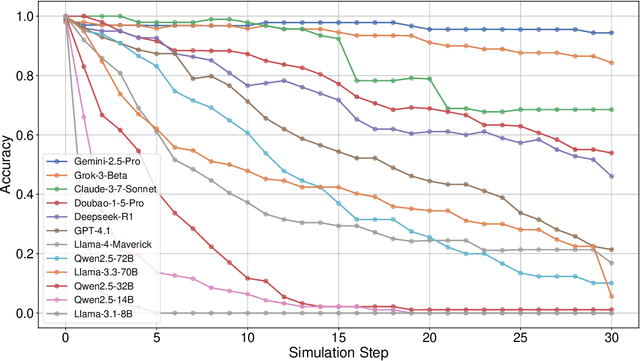
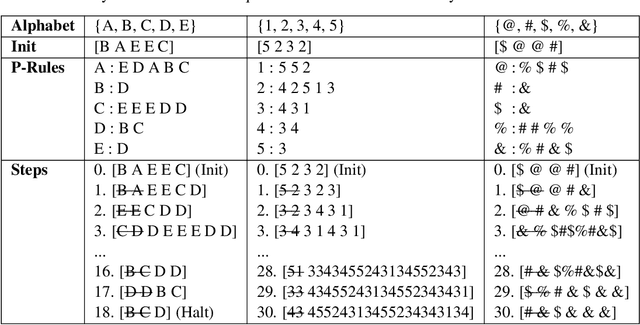
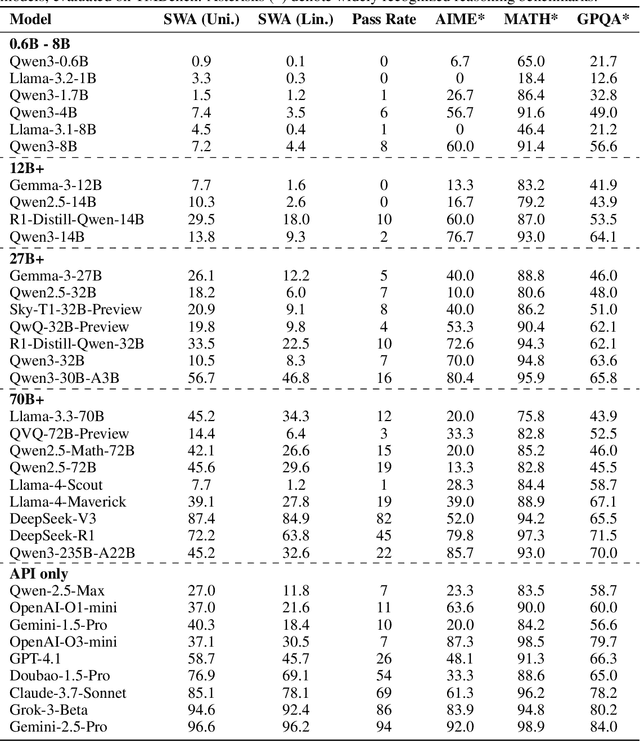
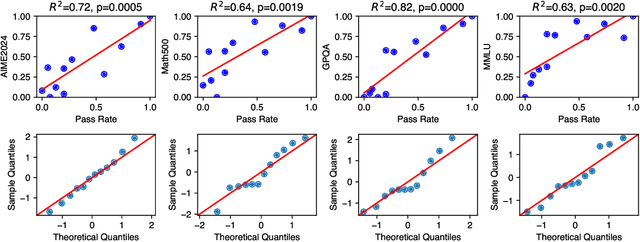
With the rapid development and widespread application of Large Language Models (LLMs), rigorous evaluation has become particularly crucial. This research adopts a novel perspective, focusing on evaluating the core computational reasoning ability of LLMs, defined as the capacity of model to accurately understand rules, and execute logically computing operations. This capability assesses the reliability of LLMs as precise executors, and is critical to advanced tasks such as complex code generation and multi-step problem-solving. We propose an evaluation framework based on Universal Turing Machine (UTM) simulation. This framework requires LLMs to strictly follow instructions and track dynamic states, such as tape content and read/write head position, during multi-step computations. To enable standardized evaluation, we developed TMBench, a benchmark for systematically studying the computational reasoning capabilities of LLMs. TMBench provides several key advantages, including knowledge-agnostic evaluation, adjustable difficulty, foundational coverage through Turing machine encoding, and unlimited capacity for instance generation, ensuring scalability as models continue to evolve. We find that model performance on TMBench correlates strongly with performance on other recognized reasoning benchmarks (Pearson correlation coefficient is 0.73), clearly demonstrating that computational reasoning is a significant dimension for measuring the deep capabilities of LLMs. Code and data are available at https://github.com/HaitaoWuTJU/Turing-Machine-Bench.
A Clinician-Friendly Platform for Ophthalmic Image Analysis Without Technical Barriers
Apr 22, 2025Artificial intelligence (AI) shows remarkable potential in medical imaging diagnostics, but current models typically require retraining when deployed across different clinical centers, limiting their widespread adoption. We introduce GlobeReady, a clinician-friendly AI platform that enables ocular disease diagnosis without retraining/fine-tuning or technical expertise. GlobeReady achieves high accuracy across imaging modalities: 93.9-98.5% for an 11-category fundus photo dataset and 87.2-92.7% for a 15-category OCT dataset. Through training-free local feature augmentation, it addresses domain shifts across centers and populations, reaching an average accuracy of 88.9% across five centers in China, 86.3% in Vietnam, and 90.2% in the UK. The built-in confidence-quantifiable diagnostic approach further boosted accuracy to 94.9-99.4% (fundus) and 88.2-96.2% (OCT), while identifying out-of-distribution cases at 86.3% (49 CFP categories) and 90.6% (13 OCT categories). Clinicians from multiple countries rated GlobeReady highly (average 4.6 out of 5) for its usability and clinical relevance. These results demonstrate GlobeReady's robust, scalable diagnostic capability and potential to support ophthalmic care without technical barriers.
Right Question is Already Half the Answer: Fully Unsupervised LLM Reasoning Incentivization
Apr 08, 2025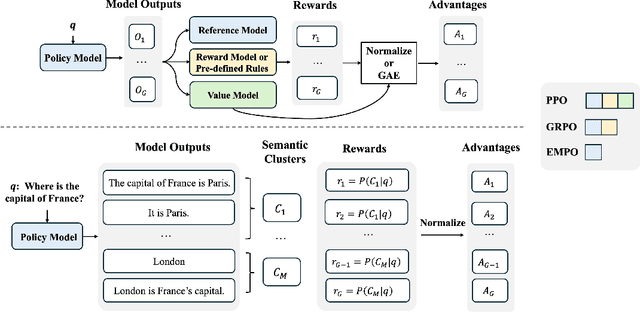
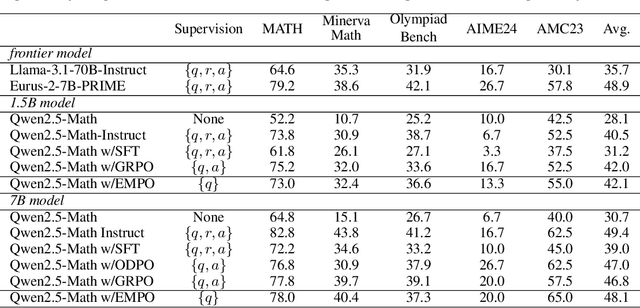
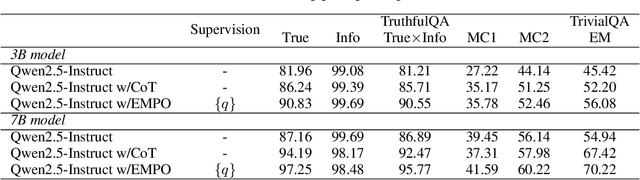
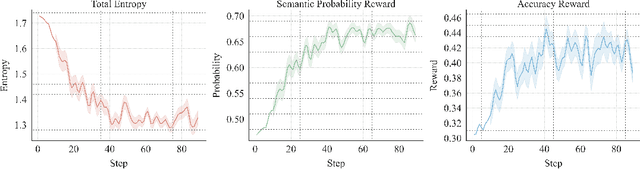
While large language models (LLMs) have demonstrated exceptional capabilities in challenging tasks such as mathematical reasoning, existing methods to enhance reasoning ability predominantly rely on supervised fine-tuning (SFT) followed by reinforcement learning (RL) on reasoning-specific data after pre-training. However, these approaches critically depend on external supervisions--such as human labelled reasoning traces, verified golden answers, or pre-trained reward models--which limits scalability and practical applicability. In this work, we propose Entropy Minimized Policy Optimization (EMPO), which makes an early attempt at fully unsupervised LLM reasoning incentivization. EMPO does not require any supervised information for incentivizing reasoning capabilities (i.e., neither verifiable reasoning traces, problems with golden answers, nor additional pre-trained reward models). By continuously minimizing the predictive entropy of LLMs on unlabeled user queries in a latent semantic space, EMPO enables purely self-supervised evolution of reasoning capabilities with strong flexibility and practicality. Our experiments demonstrate competitive performance of EMPO on both mathematical reasoning and free-form commonsense reasoning tasks. Specifically, without any supervised signals, EMPO boosts the accuracy of Qwen2.5-Math-7B Base from 30.7\% to 48.1\% on mathematical benchmarks and improves truthfulness accuracy of Qwen2.5-7B Instruct from 87.16\% to 97.25\% on TruthfulQA.
Dig2DIG: Dig into Diffusion Information Gains for Image Fusion
Mar 24, 2025Image fusion integrates complementary information from multi-source images to generate more informative results. Recently, the diffusion model, which demonstrates unprecedented generative potential, has been explored in image fusion. However, these approaches typically incorporate predefined multimodal guidance into diffusion, failing to capture the dynamically changing significance of each modality, while lacking theoretical guarantees. To address this issue, we reveal a significant spatio-temporal imbalance in image denoising; specifically, the diffusion model produces dynamic information gains in different image regions with denoising steps. Based on this observation, we Dig into the Diffusion Information Gains (Dig2DIG) and theoretically derive a diffusion-based dynamic image fusion framework that provably reduces the upper bound of the generalization error. Accordingly, we introduce diffusion information gains (DIG) to quantify the information contribution of each modality at different denoising steps, thereby providing dynamic guidance during the fusion process. Extensive experiments on multiple fusion scenarios confirm that our method outperforms existing diffusion-based approaches in terms of both fusion quality and inference efficiency.