 Add to Chrome
 Add to Firefox
 Add to Edge
Tracing the Roots: A Multi-Agent Framework for Uncovering Data Lineage in Post-Training LLMs
Apr 12, 2026
Post-training data plays a pivotal role in shaping the capabilities of Large Language Models (LLMs), yet datasets are often treated as isolated artifacts, overlooking the systemic connections that underlie their evolution. To disentangle these complex relationships, we introduce the concept of \textbf{data lineage} to the LLM ecosystem and propose an automated multi-agent framework to reconstruct the evolutionary graph of dataset development. Through large-scale lineage analysis, we characterize domain-specific structural patterns, such as vertical refinement in math-oriented datasets and horizontal aggregation in general-domain corpora. Moreover, we uncover pervasive systemic issues, including \textit{structural redundancy} induced by implicit dataset intersections and the \textit{propagation of benchmark contamination} along lineage paths. To demonstrate the practical value of lineage analysis for data construction, we leverage the reconstructed lineage graph to create a \textit{lineage-aware diversity-oriented dataset}. By anchoring instruction sampling at upstream root sources, this approach mitigates downstream homogenization and hidden redundancy, yielding a more diverse post-training corpus. We further highlight lineage-centric analysis as an efficient and robust topological alternative to sample-level dataset comparison for large-scale data ecosystems. By grounding data construction in explicit lineage structures, our work advances post-training data curation toward a more systematic and controllable paradigm.

Scientific Graphics Program Synthesis via Dual Self-Consistency Reinforcement Learning
Apr 07, 2026Graphics Program Synthesis is pivotal for interpreting and editing visual data, effectively facilitating the reverse-engineering of static visuals into editable TikZ code. While TikZ is the de facto standard for scientific schematics due to its programmatic flexibility, its requirement for rigorous spatial precision presents a significant challenge for Multimodal Large Language Models. Progress is currently stifled by two primary gaps: (1) Data Quality Gap: existing image-TikZ corpora often lack strict executability and reliable visual alignment; (2) Evaluation Gap: a lack of benchmarks for both structural and visual fidelity. To address these, we present a closed-loop framework featuring: SciTikZ-230K, a large-scale, high-quality dataset from our Execution-Centric Data Engine covering 11 diverse scientific disciplines; SciTikZ-Bench, a multifaceted benchmark spanning from basic geometric constructs to intricate hierarchical schematics to evaluate both visual fidelity and structural logic. To further broaden the scope of visual-code optimization methodology, we introduce a novel Dual Self-Consistency Reinforcement Learning optimization paradigm, which utilizes Round-Trip Verification to penalize degenerate code and boost overall self-consistency. Empowered by these, our trained model SciTikZer-8B achieves state-of-the-art performance, consistently outperforming proprietary giants like Gemini-2.5-Pro and massive models like Qwen3-VL-235B-A22B-Instruct.
SciFlow-Bench: Evaluating Structure-Aware Scientific Diagram Generation via Inverse Parsing
Feb 10, 2026Scientific diagrams convey explicit structural information, yet modern text-to-image models often produce visually plausible but structurally incorrect results. Existing benchmarks either rely on image-centric or subjective metrics insensitive to structure, or evaluate intermediate symbolic representations rather than final rendered images, leaving pixel-based diagram generation underexplored. We introduce SciFlow-Bench, a structure-first benchmark for evaluating scientific diagram generation directly from pixel-level outputs. Built from real scientific PDFs, SciFlow-Bench pairs each source framework figure with a canonical ground-truth graph and evaluates models as black-box image generators under a closed-loop, round-trip protocol that inverse-parses generated diagram images back into structured graphs for comparison. This design enforces evaluation by structural recoverability rather than visual similarity alone, and is enabled by a hierarchical multi-agent system that coordinates planning, perception, and structural reasoning. Experiments show that preserving structural correctness remains a fundamental challenge, particularly for diagrams with complex topology, underscoring the need for structure-aware evaluation.
MMFineReason: Closing the Multimodal Reasoning Gap via Open Data-Centric Methods
Jan 29, 2026Recent advances in Vision Language Models (VLMs) have driven significant progress in visual reasoning. However, open-source VLMs still lag behind proprietary systems, largely due to the lack of high-quality reasoning data. Existing datasets offer limited coverage of challenging domains such as STEM diagrams and visual puzzles, and lack consistent, long-form Chain-of-Thought (CoT) annotations essential for eliciting strong reasoning capabilities. To bridge this gap, we introduce MMFineReason, a large-scale multimodal reasoning dataset comprising 1.8M samples and 5.1B solution tokens, featuring high-quality reasoning annotations distilled from Qwen3-VL-235B-A22B-Thinking. The dataset is established via a systematic three-stage pipeline: (1) large-scale data collection and standardization, (2) CoT rationale generation, and (3) comprehensive selection based on reasoning quality and difficulty awareness. The resulting dataset spans STEM problems, visual puzzles, games, and complex diagrams, with each sample annotated with visually grounded reasoning traces. We fine-tune Qwen3-VL-Instruct on MMFineReason to develop MMFineReason-2B/4B/8B versions. Our models establish new state-of-the-art results for their size class. Notably, MMFineReason-4B succesfully surpasses Qwen3-VL-8B-Thinking, and MMFineReason-8B even outperforms Qwen3-VL-30B-A3B-Thinking while approaching Qwen3-VL-32B-Thinking, demonstrating remarkable parameter efficiency. Crucially, we uncover a "less is more" phenomenon via our difficulty-aware filtering strategy: a subset of just 7\% (123K samples) achieves performance comparable to the full dataset. Notably, we reveal a synergistic effect where reasoning-oriented data composition simultaneously boosts general capabilities.
ChartVerse: Scaling Chart Reasoning via Reliable Programmatic Synthesis from Scratch
Jan 20, 2026Chart reasoning is a critical capability for Vision Language Models (VLMs). However, the development of open-source models is severely hindered by the lack of high-quality training data. Existing datasets suffer from a dual challenge: synthetic charts are often simplistic and repetitive, while the associated QA pairs are prone to hallucinations and lack the reasoning depth required for complex tasks. To bridge this gap, we propose ChartVerse, a scalable framework designed to synthesize complex charts and reliable reasoning data from scratch. (1) To address the bottleneck of simple patterns, we first introduce Rollout Posterior Entropy (RPE), a novel metric that quantifies chart complexity. Guided by RPE, we develop complexity-aware chart coder to autonomously synthesize diverse, high-complexity charts via executable programs. (2) To guarantee reasoning rigor, we develop truth-anchored inverse QA synthesis. Diverging from standard generation, we adopt an answer-first paradigm: we extract deterministic answers directly from the source code, generate questions conditional on these anchors, and enforce strict consistency verification. To further elevate difficulty and reasoning depth, we filter samples based on model fail-rate and distill high-quality Chain-of-Thought (CoT) reasoning. We curate ChartVerse-SFT-600K and ChartVerse-RL-40K using Qwen3-VL-30B-A3B-Thinking as the teacher. Experimental results demonstrate that ChartVerse-8B achieves state-of-the-art performance, notably surpassing its teacher and rivaling the stronger Qwen3-VL-32B-Thinking.
Scientific Image Synthesis: Benchmarking, Methodologies, and Downstream Utility
Jan 17, 2026While synthetic data has proven effective for improving scientific reasoning in the text domain, multimodal reasoning remains constrained by the difficulty of synthesizing scientifically rigorous images. Existing Text-to-Image (T2I) models often produce outputs that are visually plausible yet scientifically incorrect, resulting in a persistent visual-logic divergence that limits their value for downstream reasoning. Motivated by recent advances in next-generation T2I models, we conduct a systematic study of scientific image synthesis across generation paradigms, evaluation, and downstream use. We analyze both direct pixel-based generation and programmatic synthesis, and propose ImgCoder, a logic-driven framework that follows an explicit "understand - plan - code" workflow to improve structural precision. To rigorously assess scientific correctness, we introduce SciGenBench, which evaluates generated images based on information utility and logical validity. Our evaluation reveals systematic failure modes in pixel-based models and highlights a fundamental expressiveness-precision trade-off. Finally, we show that fine-tuning Large Multimodal Models (LMMs) on rigorously verified synthetic scientific images yields consistent reasoning gains, with potential scaling trends analogous to the text domain, validating high-fidelity scientific synthesis as a viable path to unlocking massive multimodal reasoning capabilities.
OpenDataArena: A Fair and Open Arena for Benchmarking Post-Training Dataset Value
Dec 16, 2025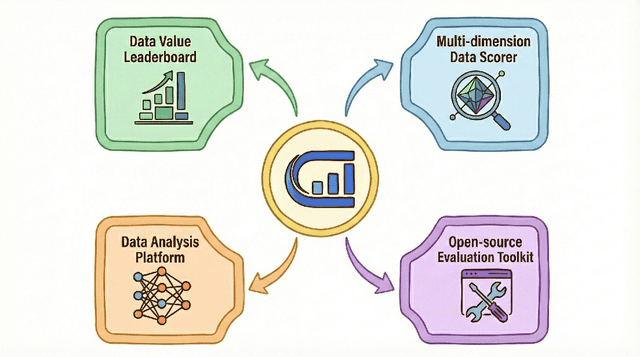
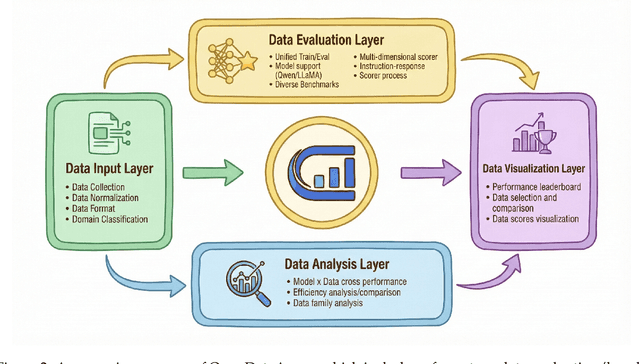
The rapid evolution of Large Language Models (LLMs) is predicated on the quality and diversity of post-training datasets. However, a critical dichotomy persists: while models are rigorously benchmarked, the data fueling them remains a black box--characterized by opaque composition, uncertain provenance, and a lack of systematic evaluation. This opacity hinders reproducibility and obscures the causal link between data characteristics and model behaviors. To bridge this gap, we introduce OpenDataArena (ODA), a holistic and open platform designed to benchmark the intrinsic value of post-training data. ODA establishes a comprehensive ecosystem comprising four key pillars: (i) a unified training-evaluation pipeline that ensures fair, open comparisons across diverse models (e.g., Llama, Qwen) and domains; (ii) a multi-dimensional scoring framework that profiles data quality along tens of distinct axes; (iii) an interactive data lineage explorer to visualize dataset genealogy and dissect component sources; and (iv) a fully open-source toolkit for training, evaluation, and scoring to foster data research. Extensive experiments on ODA--covering over 120 training datasets across multiple domains on 22 benchmarks, validated by more than 600 training runs and 40 million processed data points--reveal non-trivial insights. Our analysis uncovers the inherent trade-offs between data complexity and task performance, identifies redundancy in popular benchmarks through lineage tracing, and maps the genealogical relationships across datasets. We release all results, tools, and configurations to democratize access to high-quality data evaluation. Rather than merely expanding a leaderboard, ODA envisions a shift from trial-and-error data curation to a principled science of Data-Centric AI, paving the way for rigorous studies on data mixing laws and the strategic composition of foundation models.
Can One Domain Help Others? A Data-Centric Study on Multi-Domain Reasoning via Reinforcement Learning
Jul 23, 2025Reinforcement Learning with Verifiable Rewards (RLVR) has emerged as a powerful paradigm for enhancing the reasoning capabilities of LLMs. Existing research has predominantly concentrated on isolated reasoning domains such as mathematical problem-solving, coding tasks, or logical reasoning. However, real world reasoning scenarios inherently demand an integrated application of multiple cognitive skills. Despite this, the interplay among these reasoning skills under reinforcement learning remains poorly understood. To bridge this gap, we present a systematic investigation of multi-domain reasoning within the RLVR framework, explicitly focusing on three primary domains: mathematical reasoning, code generation, and logical puzzle solving. We conduct a comprehensive study comprising four key components: (1) Leveraging the GRPO algorithm and the Qwen-2.5-7B model family, our study thoroughly evaluates the models' in-domain improvements and cross-domain generalization capabilities when trained on single-domain datasets. (2) Additionally, we examine the intricate interactions including mutual enhancements and conflicts that emerge during combined cross-domain training. (3) To further understand the influence of SFT on RL, we also analyze and compare performance differences between base and instruct models under identical RL configurations. (4) Furthermore, we delve into critical RL training details, systematically exploring the impacts of curriculum learning strategies, variations in reward design, and language-specific factors. Through extensive experiments, our results offer significant insights into the dynamics governing domain interactions, revealing key factors influencing both specialized and generalizable reasoning performance. These findings provide valuable guidance for optimizing RL methodologies to foster comprehensive, multi-domain reasoning capabilities in LLMs.
CipherBank: Exploring the Boundary of LLM Reasoning Capabilities through Cryptography Challenges
Apr 27, 2025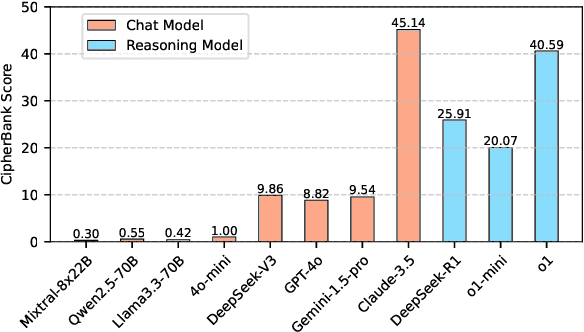
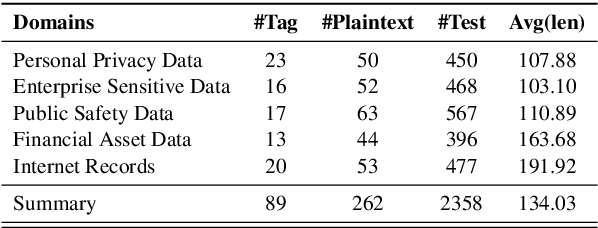
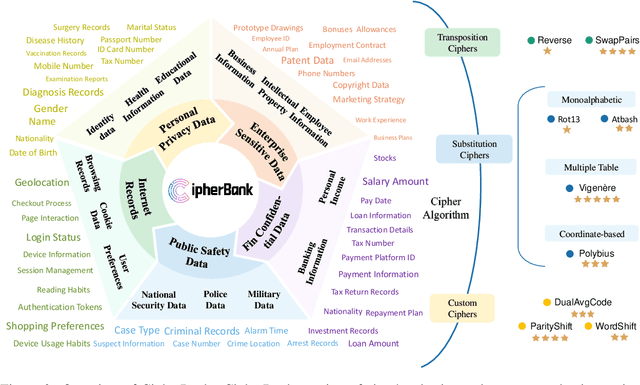
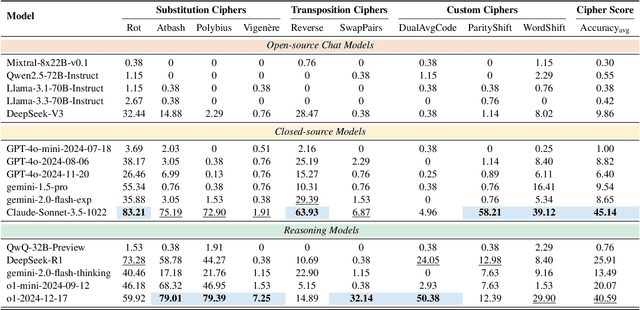
Large language models (LLMs) have demonstrated remarkable capabilities, especially the recent advancements in reasoning, such as o1 and o3, pushing the boundaries of AI. Despite these impressive achievements in mathematics and coding, the reasoning abilities of LLMs in domains requiring cryptographic expertise remain underexplored. In this paper, we introduce CipherBank, a comprehensive benchmark designed to evaluate the reasoning capabilities of LLMs in cryptographic decryption tasks. CipherBank comprises 2,358 meticulously crafted problems, covering 262 unique plaintexts across 5 domains and 14 subdomains, with a focus on privacy-sensitive and real-world scenarios that necessitate encryption. From a cryptographic perspective, CipherBank incorporates 3 major categories of encryption methods, spanning 9 distinct algorithms, ranging from classical ciphers to custom cryptographic techniques. We evaluate state-of-the-art LLMs on CipherBank, e.g., GPT-4o, DeepSeek-V3, and cutting-edge reasoning-focused models such as o1 and DeepSeek-R1. Our results reveal significant gaps in reasoning abilities not only between general-purpose chat LLMs and reasoning-focused LLMs but also in the performance of current reasoning-focused models when applied to classical cryptographic decryption tasks, highlighting the challenges these models face in understanding and manipulating encrypted data. Through detailed analysis and error investigations, we provide several key observations that shed light on the limitations and potential improvement areas for LLMs in cryptographic reasoning. These findings underscore the need for continuous advancements in LLM reasoning capabilities.
MathFusion: Enhancing Mathematic Problem-solving of LLM through Instruction Fusion
Mar 20, 2025Large Language Models (LLMs) have shown impressive progress in mathematical reasoning. While data augmentation is promising to enhance mathematical problem-solving ability, current approaches are predominantly limited to instance-level modifications-such as rephrasing or generating syntactic variations-which fail to capture and leverage the intrinsic relational structures inherent in mathematical knowledge. Inspired by human learning processes, where mathematical proficiency develops through systematic exposure to interconnected concepts, we introduce MathFusion, a novel framework that enhances mathematical reasoning through cross-problem instruction synthesis. MathFusion implements this through three fusion strategies: (1) sequential fusion, which chains related problems to model solution dependencies; (2) parallel fusion, which combines analogous problems to reinforce conceptual understanding; and (3) conditional fusion, which creates context-aware selective problems to enhance reasoning flexibility. By applying these strategies, we generate a new dataset, \textbf{MathFusionQA}, followed by fine-tuning models (DeepSeekMath-7B, Mistral-7B, Llama3-8B) on it. Experimental results demonstrate that MathFusion achieves substantial improvements in mathematical reasoning while maintaining high data efficiency, boosting performance by 18.0 points in accuracy across diverse benchmarks while requiring only 45K additional synthetic instructions, representing a substantial improvement over traditional single-instruction approaches. Our datasets, models, and code are publicly available at https://github.com/QizhiPei/mathfusion.