 Add to Chrome
 Add to Firefox
 Add to Edge
Spectral-Aware Low-Rank Adaptation for Speaker Verification
Jan 07, 2025
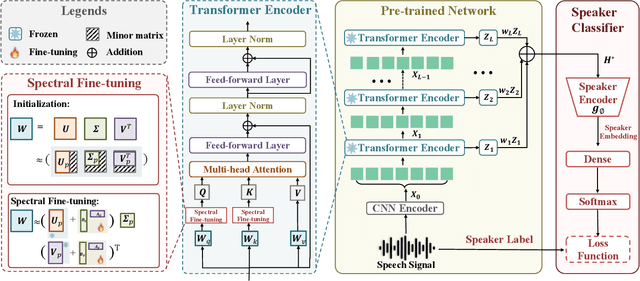
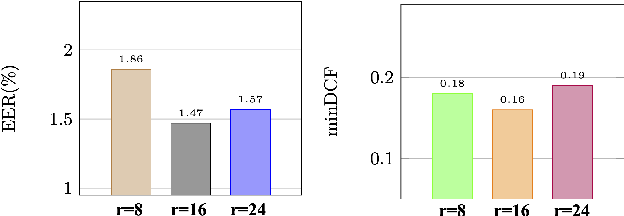
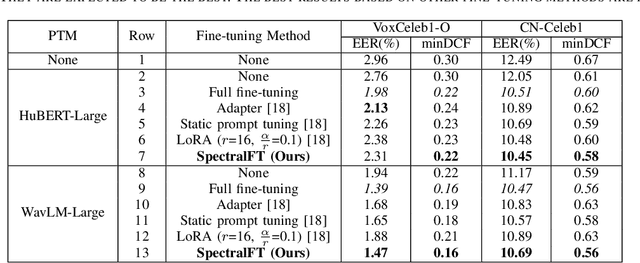
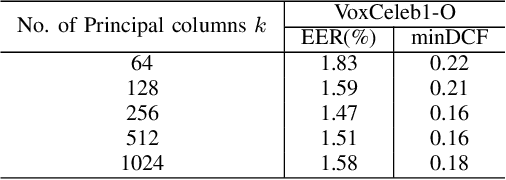
Previous research has shown that the principal singular vectors of a pre-trained model's weight matrices capture critical knowledge. In contrast, those associated with small singular values may contain noise or less reliable information. As a result, the LoRA-based parameter-efficient fine-tuning (PEFT) approach, which does not constrain the use of the spectral space, may not be effective for tasks that demand high representation capacity. In this study, we enhance existing PEFT techniques by incorporating the spectral information of pre-trained weight matrices into the fine-tuning process. We investigate spectral adaptation strategies with a particular focus on the additive adjustment of top singular vectors. This is accomplished by applying singular value decomposition (SVD) to the pre-trained weight matrices and restricting the fine-tuning within the top spectral space. Extensive speaker verification experiments on VoxCeleb1 and CN-Celeb1 demonstrate enhanced tuning performance with the proposed approach. Code is released at https://github.com/lizhepolyu/SpectralFT.

Disambiguation of Chinese Polyphones in an End-to-End Framework with Semantic Features Extracted by Pre-trained BERT
Jan 02, 2025


Grapheme-to-phoneme (G2P) conversion serves as an essential component in Chinese Mandarin text-to-speech (TTS) system, where polyphone disambiguation is the core issue. In this paper, we propose an end-to-end framework to predict the pronunciation of a polyphonic character, which accepts sentence containing polyphonic character as input in the form of Chinese character sequence without the necessity of any preprocessing. The proposed method consists of a pre-trained bidirectional encoder representations from Transformers (BERT) model and a neural network (NN) based classifier. The pre-trained BERT model extracts semantic features from a raw Chinese character sequence and the NN based classifier predicts the polyphonic character's pronunciation according to BERT output. In out experiments, we implemented three classifiers, a fully-connected network based classifier, a long short-term memory (LSTM) network based classifier and a Transformer block based classifier. The experimental results compared with the baseline approach based on LSTM demonstrate that, the pre-trained model extracts effective semantic features, which greatly enhances the performance of polyphone disambiguation. In addition, we also explored the impact of contextual information on polyphone disambiguation.
* Accepted at INTERSPEECH 2019
learning discriminative features from spectrograms using center loss for speech emotion recognition
Jan 02, 2025Identifying the emotional state from speech is essential for the natural interaction of the machine with the speaker. However, extracting effective features for emotion recognition is difficult, as emotions are ambiguous. We propose a novel approach to learn discriminative features from variable length spectrograms for emotion recognition by cooperating softmax cross-entropy loss and center loss together. The softmax cross-entropy loss enables features from different emotion categories separable, and center loss efficiently pulls the features belonging to the same emotion category to their center. By combining the two losses together, the discriminative power will be highly enhanced, which leads to network learning more effective features for emotion recognition. As demonstrated by the experimental results, after introducing center loss, both the unweighted accuracy and weighted accuracy are improved by over 3\% on Mel-spectrogram input, and more than 4\% on Short Time Fourier Transform spectrogram input.
* Accepted at ICASSP 2019
Ontology-grounded Automatic Knowledge Graph Construction by LLM under Wikidata schema
Dec 30, 2024

We propose an ontology-grounded approach to Knowledge Graph (KG) construction using Large Language Models (LLMs) on a knowledge base. An ontology is authored by generating Competency Questions (CQ) on knowledge base to discover knowledge scope, extracting relations from CQs, and attempt to replace equivalent relations by their counterpart in Wikidata. To ensure consistency and interpretability in the resulting KG, we ground generation of KG with the authored ontology based on extracted relations. Evaluation on benchmark datasets demonstrates competitive performance in knowledge graph construction task. Our work presents a promising direction for scalable KG construction pipeline with minimal human intervention, that yields high quality and human-interpretable KGs, which are interoperable with Wikidata semantics for potential knowledge base expansion.
* Presented at HI-AI@KDD, Human-Interpretable AI Workshop at the KDD 2024, 26th of August 2024, Barcelona, Spain
Structured Speaker-Deficiency Adaptation of Foundation Models for Dysarthric and Elderly Speech Recognition
Dec 25, 2024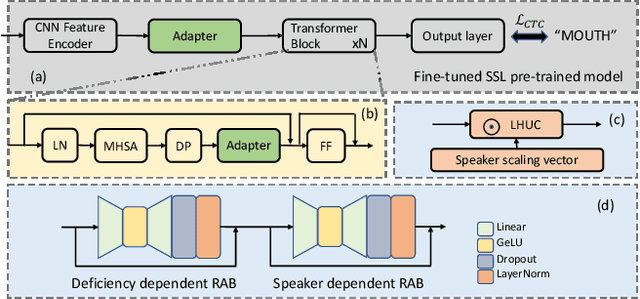
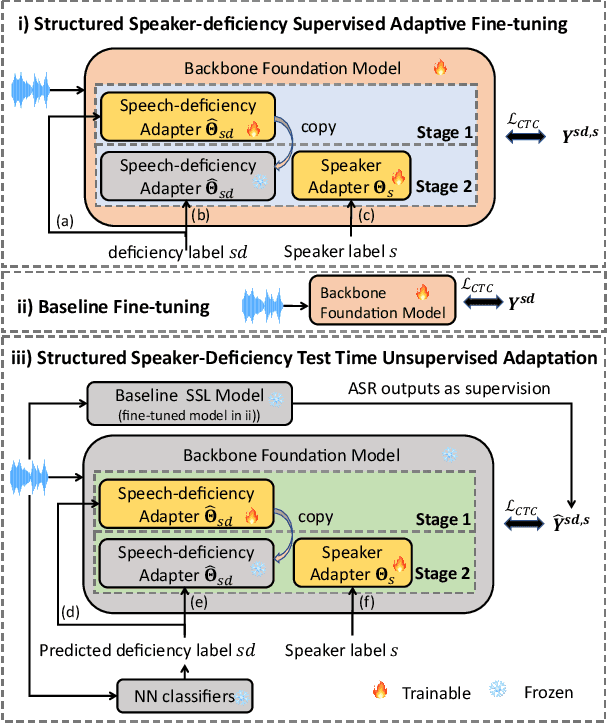
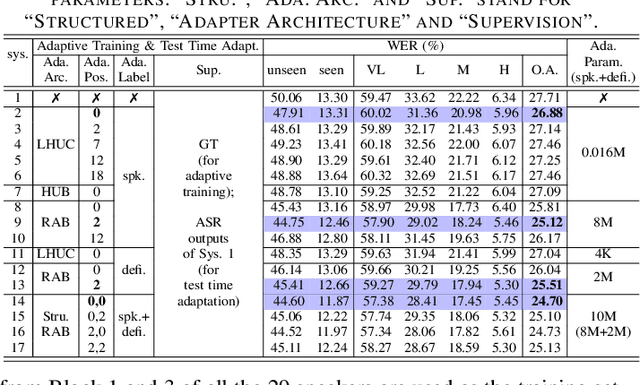
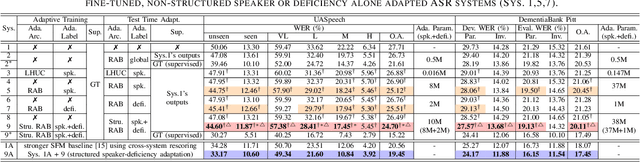
Data-intensive fine-tuning of speech foundation models (SFMs) to scarce and diverse dysarthric and elderly speech leads to data bias and poor generalization to unseen speakers. This paper proposes novel structured speaker-deficiency adaptation approaches for SSL pre-trained SFMs on such data. Speaker and speech deficiency invariant SFMs were constructed in their supervised adaptive fine-tuning stage to reduce undue bias to training data speakers, and serves as a more neutral and robust starting point for test time unsupervised adaptation. Speech variability attributed to speaker identity and speech impairment severity, or aging induced neurocognitive decline, are modelled using separate adapters that can be combined together to model any seen or unseen speaker. Experiments on the UASpeech dysarthric and DementiaBank Pitt elderly speech corpora suggest structured speaker-deficiency adaptation of HuBERT and Wav2vec2-conformer models consistently outperforms baseline SFMs using either: a) no adapters; b) global adapters shared among all speakers; or c) single attribute adapters modelling speaker or deficiency labels alone by statistically significant WER reductions up to 3.01% and 1.50% absolute (10.86% and 6.94% relative) on the two tasks respectively. The lowest published WER of 19.45% (49.34% on very low intelligibility, 33.17% on unseen words) is obtained on the UASpeech test set of 16 dysarthric speakers.
Not All Errors Are Equal: Investigation of Speech Recognition Errors in Alzheimer's Disease Detection
Dec 09, 2024Automatic Speech Recognition (ASR) plays an important role in speech-based automatic detection of Alzheimer's disease (AD). However, recognition errors could propagate downstream, potentially impacting the detection decisions. Recent studies have revealed a non-linear relationship between word error rates (WER) and AD detection performance, where ASR transcriptions with notable errors could still yield AD detection accuracy equivalent to that based on manual transcriptions. This work presents a series of analyses to explore the effect of ASR transcription errors in BERT-based AD detection systems. Our investigation reveals that not all ASR errors contribute equally to detection performance. Certain words, such as stopwords, despite constituting a large proportion of errors, are shown to play a limited role in distinguishing AD. In contrast, the keywords related to diagnosis tasks exhibit significantly greater importance relative to other words. These findings provide insights into the interplay between ASR errors and the downstream detection model.
Devising a Set of Compact and Explainable Spoken Language Feature for Screening Alzheimer's Disease
Nov 28, 2024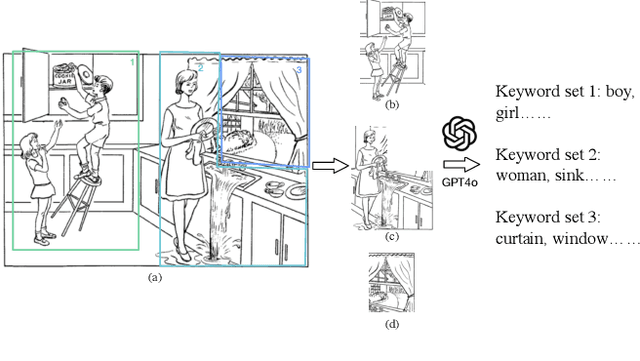

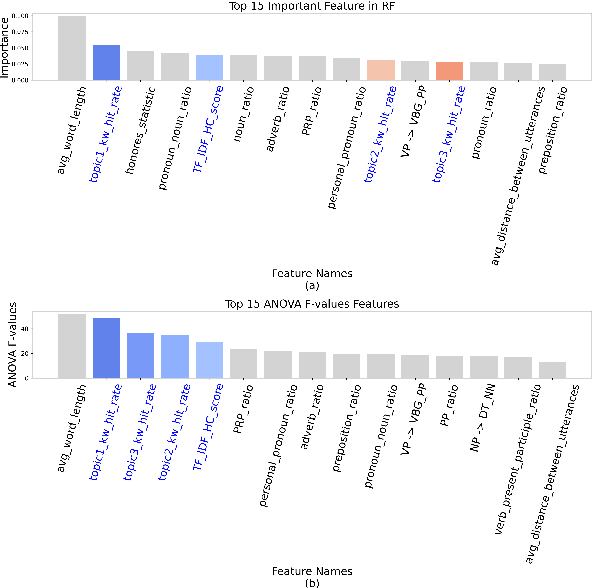

Alzheimer's disease (AD) has become one of the most significant health challenges in an aging society. The use of spoken language-based AD detection methods has gained prevalence due to their scalability due to their scalability. Based on the Cookie Theft picture description task, we devised an explainable and effective feature set that leverages the visual capabilities of a large language model (LLM) and the Term Frequency-Inverse Document Frequency (TF-IDF) model. Our experimental results show that the newly proposed features consistently outperform traditional linguistic features across two different classifiers with high dimension efficiency. Our new features can be well explained and interpreted step by step which enhance the interpretability of automatic AD screening.
A Comparative Study of Discrete Speech Tokens for Semantic-Related Tasks with Large Language Models
Nov 13, 2024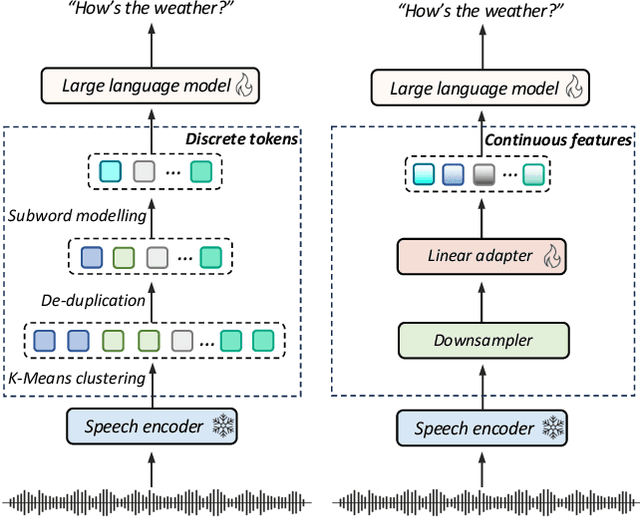
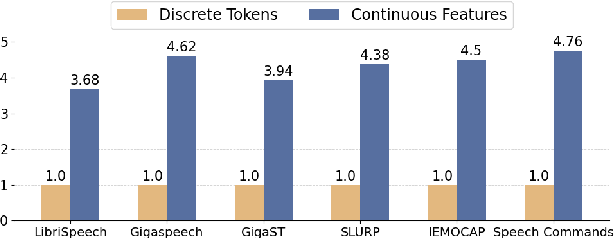
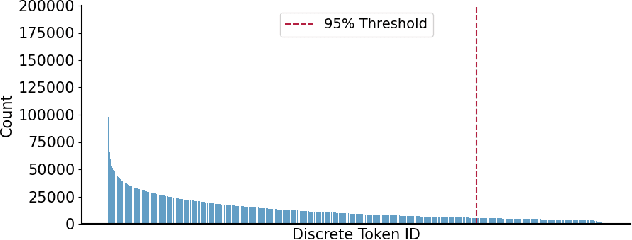
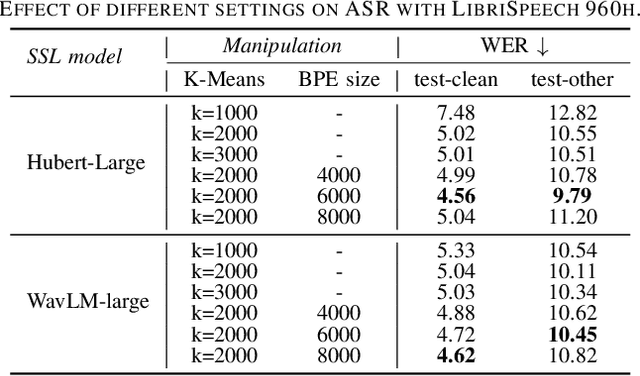
With the rise of Speech Large Language Models (Speech LLMs), there has been growing interest in discrete speech tokens for their ability to integrate with text-based tokens seamlessly. Compared to most studies that focus on continuous speech features, although discrete-token based LLMs have shown promising results on certain tasks, the performance gap between these two paradigms is rarely explored. In this paper, we present a fair and thorough comparison between discrete and continuous features across a variety of semantic-related tasks using a light-weight LLM (Qwen1.5-0.5B). Our findings reveal that continuous features generally outperform discrete tokens, particularly in tasks requiring fine-grained semantic understanding. Moreover, this study goes beyond surface-level comparison by identifying key factors behind the under-performance of discrete tokens, such as limited token granularity and inefficient information retention. To enhance the performance of discrete tokens, we explore potential aspects based on our analysis. We hope our results can offer new insights into the opportunities for advancing discrete speech tokens in Speech LLMs.
Improving Grapheme-to-Phoneme Conversion through In-Context Knowledge Retrieval with Large Language Models
Nov 12, 2024Grapheme-to-phoneme (G2P) conversion is a crucial step in Text-to-Speech (TTS) systems, responsible for mapping grapheme to corresponding phonetic representations. However, it faces ambiguities problems where the same grapheme can represent multiple phonemes depending on contexts, posing a challenge for G2P conversion. Inspired by the remarkable success of Large Language Models (LLMs) in handling context-aware scenarios, contextual G2P conversion systems with LLMs' in-context knowledge retrieval (ICKR) capabilities are proposed to promote disambiguation capability. The efficacy of incorporating ICKR into G2P conversion systems is demonstrated thoroughly on the Librig2p dataset. In particular, the best contextual G2P conversion system using ICKR outperforms the baseline with weighted average phoneme error rate (PER) reductions of 2.0% absolute (28.9% relative). Using GPT-4 in the ICKR system can increase of 3.5% absolute (3.8% relative) on the Librig2p dataset.
Decoding on Graphs: Faithful and Sound Reasoning on Knowledge Graphs through Generation of Well-Formed Chains
Oct 24, 2024
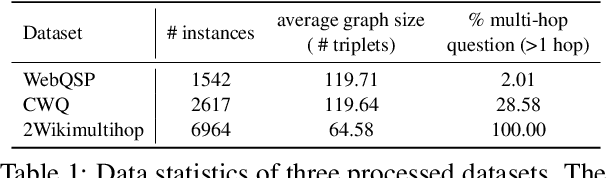

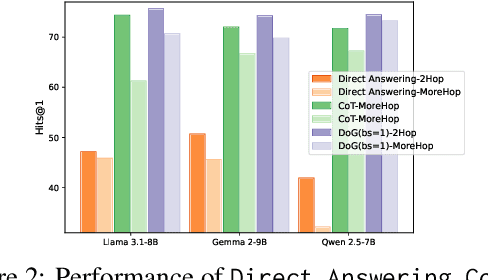
Knowledge Graphs (KGs) can serve as reliable knowledge sources for question answering (QA) due to their structured representation of knowledge. Existing research on the utilization of KG for large language models (LLMs) prevalently relies on subgraph retriever or iterative prompting, overlooking the potential synergy of LLMs' step-wise reasoning capabilities and KGs' structural nature. In this paper, we present DoG (Decoding on Graphs), a novel framework that facilitates a deep synergy between LLMs and KGs. We first define a concept, well-formed chain, which consists of a sequence of interrelated fact triplets on the KGs, starting from question entities and leading to answers. We argue that this concept can serve as a principle for making faithful and sound reasoning for KGQA. To enable LLMs to generate well-formed chains, we propose graph-aware constrained decoding, in which a constraint derived from the topology of the KG regulates the decoding process of the LLMs. This constrained decoding method ensures the generation of well-formed chains while making full use of the step-wise reasoning capabilities of LLMs. Based on the above, DoG, a training-free approach, is able to provide faithful and sound reasoning trajectories grounded on the KGs. Experiments across various KGQA tasks with different background KGs demonstrate that DoG achieves superior and robust performance. DoG also shows general applicability with various open-source LLMs.