 Add to Chrome
 Add to Firefox
 Add to Edge
Xiaomi-GUI-0 Technical Report
Jul 01, 2026
Graphical user interface (GUI) agents build on vision-language models to complete user tasks end-to-end in real applications through interface actions such as tapping, swiping, text entry, and navigation. However, existing GUI agents are trained and evaluated largely on offline trajectories, simulated environments, and standardized benchmarks. These differ substantially from real applications in interface layout, interaction logic, and abnormal-state distribution, and cannot faithfully characterize execution stability in real-world use, where account states, permission dialogs, payment authentication, and risk control continually reshape the state distribution and open a persistent gap between benchmark scores and real usability. To close this gap, we propose Xiaomi-GUI-0, a native multimodal GUI agent for real mobile environments, trained and evaluated within a real-device closed loop. At its core is a real-device-dominant hybrid infrastructure, where physical devices are the primary execution environment and sandboxes provide auxiliary support, so that data collection, training, rollout, and evaluation share an execution distribution close to real deployment. We construct multi-source training data spanning high-frequency head tasks, high-generalization data for long-tail intents, and capability-enhancement data for reflection and memory, and introduce an error-driven data flywheel that turns failure trajectories into corrected actions, reflective explanations, and recovery demonstrations. The model is trained through a progressive three-stage pipeline of supervised fine-tuning, step-level reinforcement learning, and agentic reinforcement learning. Evaluated on public benchmarks and our in-house RealMobile, Xiaomi-GUI-0 achieves 72.0% success on RealMobile and 78.9% on AndroidWorld, while substantially improving execution stability and abnormal-state recognition in real-world tasks.

Power Reinforcement Post-Training of Text-to-Image Models with Super-Linear Advantage Shaping
May 11, 2026Recently, post-training methods based on reinforcement learning, with a particular focus on Group Relative Policy Optimization (GRPO), have emerged as the robust paradigm for further advancement of text-to-image (T2I) models. However, these methods are often prone to reward hacking, wherein models exploit biases in imperfect reward functions rather than yielding genuine performance gains. In this work, we identify that normalization could lead to miscalibration and directly removing the prompt-level standard deviation term yields an optimal policy ascent direction that is linear in the advantage but still limits the separation of genuine signals from noise. To mitigate the above issues, we propose Super-Linear Advantage Shaping (SLAS) by revisiting the functional update from an information geometry perspective. By extending the Fisher-Rao information metric with advantage-dependent weighting, SLAS introduces a non-linear geometric structure that reshapes the local policy space. This design relaxes constraints along high-advantage directions to amplify informative updates, while tightening those in low-advantage regions to suppress illusory gradients. In addition, batch-level normalization is applied to stabilize training under varying reward scales. Extensive evaluations demonstrate that SLAS consistently surpasses the DanceGRPO baseline across multiple backbones and benchmarks. In particular, it yields faster training dynamics, improved out-of-domain performance on GenEval and UniGenBench++, and enhanced robustness to model scaling, while mitigating reward hacking and preserving semantic and compositional fidelity in generations.
Online Learning for Supervisory Switching Control
Mar 16, 2026We study supervisory switching control for partially-observed linear dynamical systems. The objective is to identify and deploy the best controller for the unknown system by periodically selecting among a collection of $N$ candidate controllers, some of which may destabilize the underlying system. While classical estimator-based supervisory control guarantees asymptotic stability, it lacks quantitative finite-time performance bounds. Conversely, current non-asymptotic methods in both online learning and system identification require restrictive assumptions that are incompatible in a control setting, such as system stability, which preclude testing potentially unstable controllers. To bridge this gap, we propose a novel, non-asymptotic analysis of supervisory control that adapts multi-armed bandit algorithms to address these control-theoretic challenges. Our data-driven algorithm evaluates candidate controllers via scoring criteria that leverage system observability to isolate the effects of historical states, enabling both detection of destabilizing controllers and accurate system identification. We present two algorithmic variants with dimension-free, finite-time guarantees, where each identifies the most suitable controller in $\mathcal{O}(N \log N)$ steps, while simultaneously achieving finite $L_2$-gain with respect to system disturbances.
When to Lock Attention: Training-Free KV Control in Video Diffusion
Mar 10, 2026Maintaining background consistency while enhancing foreground quality remains a core challenge in video editing. Injecting full-image information often leads to background artifacts, whereas rigid background locking severely constrains the model's capacity for foreground generation. To address this issue, we propose KV-Lock, a training-free framework tailored for DiT-based video diffusion models. Our core insight is that the hallucination metric (variance of denoising prediction) directly quantifies generation diversity, which is inherently linked to the classifier-free guidance (CFG) scale. Building upon this, KV-Lock leverages diffusion hallucination detection to dynamically schedule two key components: the fusion ratio between cached background key-values (KVs) and newly generated KVs, and the CFG scale. When hallucination risk is detected, KV-Lock strengthens background KV locking and simultaneously amplifies conditional guidance for foreground generation, thereby mitigating artifacts and improving generation fidelity. As a training-free, plug-and-play module, KV-Lock can be easily integrated into any pre-trained DiT-based models. Extensive experiments validate that our method outperforms existing approaches in improved foreground quality with high background fidelity across various video editing tasks.
CoLoGen: Progressive Learning of Concept-Localization Duality for Unified Image Generation
Feb 26, 2026Unified conditional image generation remains difficult because different tasks depend on fundamentally different internal representations. Some require conceptual understanding for semantic synthesis, while others rely on localization cues for spatial precision. Forcing these heterogeneous tasks to share a single representation leads to concept-localization representational conflict. To address this issue, we propose CoLoGen, a unified diffusion framework that progressively learns and reconciles this concept-localization duality. CoLoGen uses a staged curriculum that first builds core conceptual and localization abilities, then adapts them to diverse visual conditions, and finally refines their synergy for complex instruction-driven tasks. Central to this process is the Progressive Representation Weaving (PRW) module, which dynamically routes features to specialized experts and stably integrates their outputs across stages. Experiments on editing, controllable generation, and customized generation show that CoLoGen achieves competitive or superior performance, offering a principled representational perspective for unified image generation.
ViSS-R1: Self-Supervised Reinforcement Video Reasoning
Nov 17, 2025Complex video reasoning remains a significant challenge for Multimodal Large Language Models (MLLMs), as current R1-based methodologies often prioritize text-centric reasoning derived from text-based and image-based developments. In video tasks, such strategies frequently underutilize rich visual information, leading to potential shortcut learning and increased susceptibility to hallucination. To foster a more robust, visual-centric video understanding, we start by introducing a novel self-supervised reinforcement learning GRPO algorithm (Pretext-GRPO) within the standard R1 pipeline, in which positive rewards are assigned for correctly solving pretext tasks on transformed visual inputs, which makes the model to non-trivially process the visual information. Building on the effectiveness of Pretext-GRPO, we further propose the ViSS-R1 framework, which streamlines and integrates pretext-task-based self-supervised learning directly into the MLLM's R1 post-training paradigm. Instead of relying solely on sparse visual cues, our framework compels models to reason about transformed visual input by simultaneously processing both pretext questions (concerning transformations) and true user queries. This necessitates identifying the applied transformation and reconstructing the original video to formulate accurate final answers. Comprehensive evaluations on six widely-used video reasoning and understanding benchmarks demonstrate the effectiveness and superiority of our Pretext-GRPO and ViSS-R1 for complex video reasoning. Our codes and models will be publicly available.
Distribution Preference Optimization: A Fine-grained Perspective for LLM Unlearning
Oct 06, 2025As Large Language Models (LLMs) demonstrate remarkable capabilities learned from vast corpora, concerns regarding data privacy and safety are receiving increasing attention. LLM unlearning, which aims to remove the influence of specific data while preserving overall model utility, is becoming an important research area. One of the mainstream unlearning classes is optimization-based methods, which achieve forgetting directly through fine-tuning, exemplified by Negative Preference Optimization (NPO). However, NPO's effectiveness is limited by its inherent lack of explicit positive preference signals. Attempts to introduce such signals by constructing preferred responses often necessitate domain-specific knowledge or well-designed prompts, fundamentally restricting their generalizability. In this paper, we shift the focus to the distribution-level, directly targeting the next-token probability distribution instead of entire responses, and derive a novel unlearning algorithm termed \textbf{Di}stribution \textbf{P}reference \textbf{O}ptimization (DiPO). We show that the requisite preference distribution pairs for DiPO, which are distributions over the model's output tokens, can be constructed by selectively amplifying or suppressing the model's high-confidence output logits, thereby effectively overcoming NPO's limitations. We theoretically prove the consistency of DiPO's loss function with the desired unlearning direction. Extensive experiments demonstrate that DiPO achieves a strong trade-off between model utility and forget quality. Notably, DiPO attains the highest forget quality on the TOFU benchmark, and maintains leading scalability and sustainability in utility preservation on the MUSE benchmark.
Reinforcement Fine-Tuning Powers Reasoning Capability of Multimodal Large Language Models
May 24, 2025Standing in 2025, at a critical juncture in the pursuit of Artificial General Intelligence (AGI), reinforcement fine-tuning (RFT) has demonstrated significant potential in enhancing the reasoning capability of large language models (LLMs) and has led to the development of cutting-edge AI models such as OpenAI-o1 and DeepSeek-R1. Moreover, the efficient application of RFT to enhance the reasoning capability of multimodal large language models (MLLMs) has attracted widespread attention from the community. In this position paper, we argue that reinforcement fine-tuning powers the reasoning capability of multimodal large language models. To begin with, we provide a detailed introduction to the fundamental background knowledge that researchers interested in this field should be familiar with. Furthermore, we meticulously summarize the improvements of RFT in powering reasoning capability of MLLMs into five key points: diverse modalities, diverse tasks and domains, better training algorithms, abundant benchmarks and thriving engineering frameworks. Finally, we propose five promising directions for future research that the community might consider. We hope that this position paper will provide valuable insights to the community at this pivotal stage in the advancement toward AGI. Summary of works done on RFT for MLLMs is available at https://github.com/Sun-Haoyuan23/Awesome-RL-based-Reasoning-MLLMs.
In-Context Learning of Polynomial Kernel Regression in Transformers with GLU Layers
Jan 30, 2025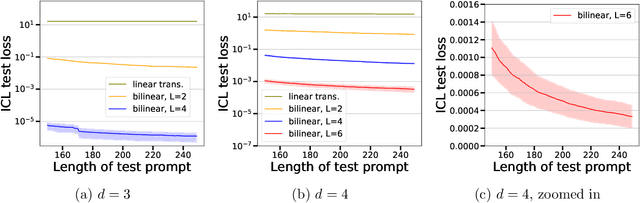
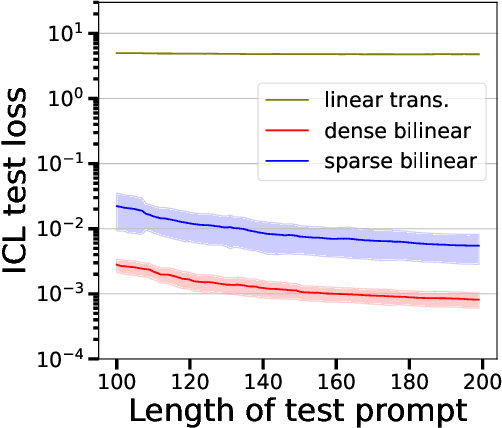
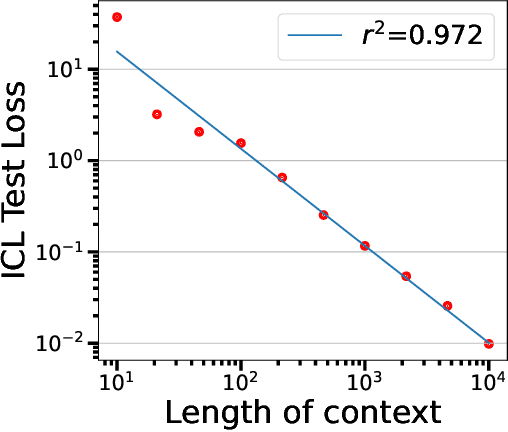
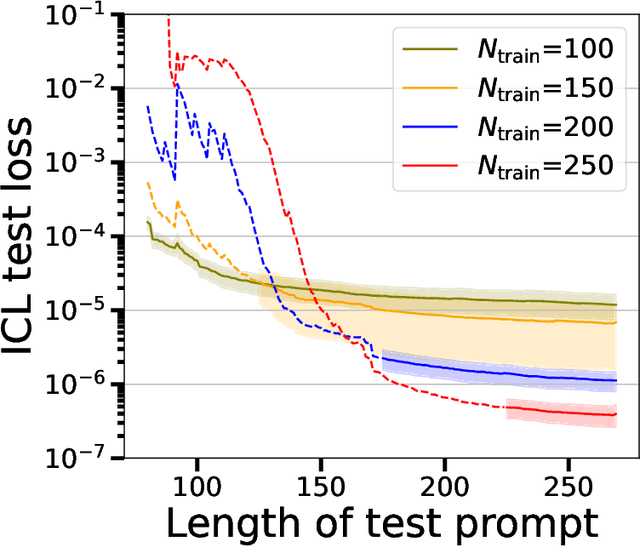
Transformer-based models have demonstrated remarkable ability in in-context learning (ICL), where they can adapt to unseen tasks from a prompt with a few examples, without requiring parameter updates. Recent research has provided insight into how linear Transformers can perform ICL by implementing gradient descent estimators. In particular, it has been shown that the optimal linear self-attention (LSA) mechanism can implement one step of gradient descent with respect to a linear least-squares objective when trained on random linear regression tasks. However, the theoretical understanding of ICL for nonlinear function classes remains limited. In this work, we address this gap by first showing that LSA is inherently restricted to solving linear least-squares objectives and thus, the solutions in prior works cannot readily extend to nonlinear ICL tasks. To overcome this limitation, drawing inspiration from modern architectures, we study a mechanism that combines LSA with GLU-like feed-forward layers and show that this allows the model to perform one step of gradient descent on a polynomial kernel regression. Further, we characterize the scaling behavior of the resulting Transformer model, highlighting the necessary model size to effectively handle quadratic ICL tasks. Our findings highlight the distinct roles of attention and feed-forward layers in nonlinear ICL and identify key challenges when extending ICL to nonlinear function classes.
Generalizing Alignment Paradigm of Text-to-Image Generation with Preferences through $f$-divergence Minimization
Sep 15, 2024
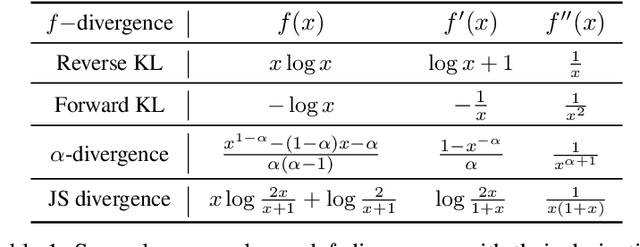
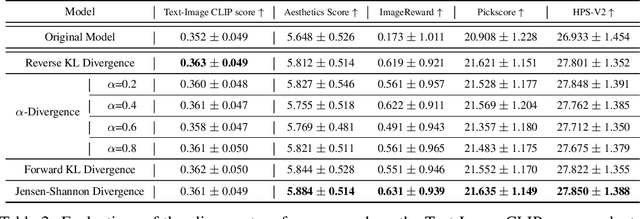
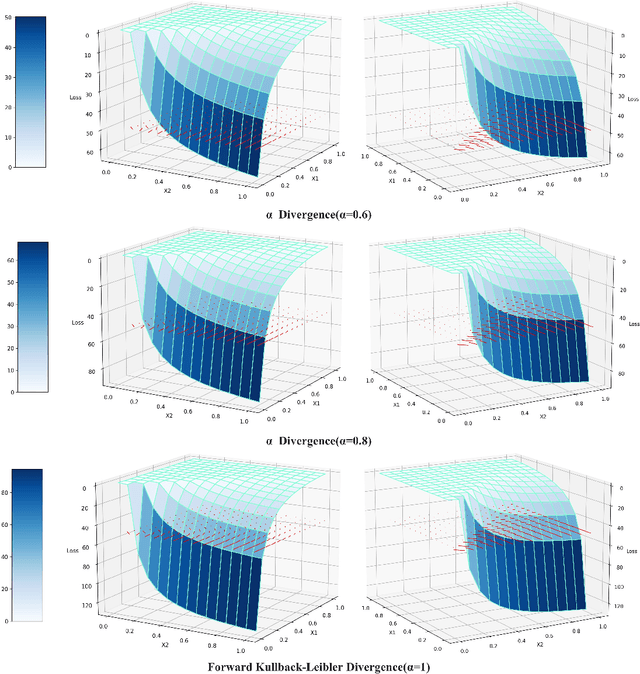
Direct Preference Optimization (DPO) has recently expanded its successful application from aligning large language models (LLMs) to aligning text-to-image models with human preferences, which has generated considerable interest within the community. However, we have observed that these approaches rely solely on minimizing the reverse Kullback-Leibler divergence during alignment process between the fine-tuned model and the reference model, neglecting the incorporation of other divergence constraints. In this study, we focus on extending reverse Kullback-Leibler divergence in the alignment paradigm of text-to-image models to $f$-divergence, which aims to garner better alignment performance as well as good generation diversity. We provide the generalized formula of the alignment paradigm under the $f$-divergence condition and thoroughly analyze the impact of different divergence constraints on alignment process from the perspective of gradient fields. We conduct comprehensive evaluation on image-text alignment performance, human value alignment performance and generation diversity performance under different divergence constraints, and the results indicate that alignment based on Jensen-Shannon divergence achieves the best trade-off among them. The option of divergence employed for aligning text-to-image models significantly impacts the trade-off between alignment performance (especially human value alignment) and generation diversity, which highlights the necessity of selecting an appropriate divergence for practical applications.