 Add to Chrome
 Add to Firefox
 Add to Edge
Massive Activations in Hybrid Linear Attention Large Language Models: Pre-Attention Spikes and Inter-Spike Plateaus
Aug 12, 2026
We present the first systematic study of Massive activations (MAs) in layer-interleaved HLA LLMs and uncover two architecture-aligned morphologies: MAs consistently spike immediately before full attention layers, forming pre-attention spikes (PAS), and can persist through intervening linear attention layers, giving rise to inter-spike plateaus (ISP). As full attention becomes denser, successive PAS become increasingly connected through ISP, ultimately recovering the stable MA morphology of full attention LLMs. We establish the recurrence of this organization across five linear attention architectures, six hybridization configurations, five data domains, and representative open-source hybrid models spanning 1.2B to 397B total parameters. Controlled pretraining of GDN-based hybrids at scales up to 1.3B shows that both morphologies emerge early and respond asymmetrically to output gating: full attention output gating strongly attenuates their absolute magnitudes without eliminating their layerwise organization, whereas removing GDN gates yields comparatively modest amplification. Mechanistically, our systematic-outlier analysis supports a shared lifecycle account governed by the timing of MA cancellation. PAS follows a localized write-sink-cancel process, while the extended persistence of ISP is consistent with delayed cancellation. At the full attention limit, this account recovers the stable MA morphology characteristic of full attention LLMs. Our code is available at https://github.com/StartluxLabs/Massive-Activations-HLA.

Beyond Isolation: Unlocking Reinforcement Learning Component Synergy for Sample-Efficient Continuous Control
Aug 07, 2026Reinforcement learning systems are significantly more complex than other machine learning paradigms due to inherent properties, causing RL system design to jointly account for many tightly coupled factors. Despite advances in individual algorithmic components, their functional interdependencies remain underexplored: do they exhibit mutual synergy or counterproductive interference? To bridge this gap, we conduct a systematic investigation and find that the efficacy of different components exhibits significant task-dependency, and naively stacking state-of-the-art techniques does not necessarily yield performance gains; instead, it often triggers emergent challenges, such as compounded non-stationarity. Building upon these findings, we distill a suite of actionable insights into the principled coordination of these components. Guided by these insights, we propose ROSER, an RL framework that coordinates three critical dimensions: Model-based Representation, Optimization Stability, and Experience Replay. Across diverse continuous-control benchmarks, ROSER consistently outperforms vanilla baselines and achieves 17.60% gains over naive stack. Our findings underscore the necessity of a holistic perspective in RL system design and paves the way for developing sample-efficient agents.
Mirror Horizon: Viable Path Entropy as a Measure of Bounded Reflection
Jul 11, 2026Mirror Theory proposes that an intelligent system should be studied not only by what it represents, but by what coherent continuations it can sustain under repeated reflection. We make this claim operational through \emph{viable path entropy} (VPE), a finite-budget measure of verified continuation capacity. Given a mirror state, a rollout protocol, a verifier, and a mode map, VPE decomposes bounded capability into two parts: the probability of reaching a viable continuation and the diversity of verified continuation modes reached among successful rollouts. This paper restores the full theoretical scaffold behind the measure: intuition as local underdetermining constraint, taste as invariant-selecting pressure, reflection as taste-guided resolution of underdetermination, and geometry as the learned structure that makes future reflection stable. We then instantiate the theory in language-model reasoning experiments on GSM8K. Across Qwen2.5-Instruct models, 32 sampled rollouts per problem, and two reflection horizons, increasing the token budget from 96 to 160 substantially expands verified reachability, reduces zero-reachability, increases verified-mode entropy, and improves smoothed VPE. At 160 tokens, Qwen2.5-1.5B realizes the strongest mirror horizon among the tested models, even though Qwen2.5-3B has more parameters. This shows that mirror horizon is not parameter count, but accessible verified continuation capacity under a bounded reflection protocol. The result supports Mirror Theory as a measure-level account: capability is the structure of viable continuations made reachable, not merely one-shot accuracy or pass@k.
Power Reinforcement Post-Training of Text-to-Image Models with Super-Linear Advantage Shaping
May 11, 2026Recently, post-training methods based on reinforcement learning, with a particular focus on Group Relative Policy Optimization (GRPO), have emerged as the robust paradigm for further advancement of text-to-image (T2I) models. However, these methods are often prone to reward hacking, wherein models exploit biases in imperfect reward functions rather than yielding genuine performance gains. In this work, we identify that normalization could lead to miscalibration and directly removing the prompt-level standard deviation term yields an optimal policy ascent direction that is linear in the advantage but still limits the separation of genuine signals from noise. To mitigate the above issues, we propose Super-Linear Advantage Shaping (SLAS) by revisiting the functional update from an information geometry perspective. By extending the Fisher-Rao information metric with advantage-dependent weighting, SLAS introduces a non-linear geometric structure that reshapes the local policy space. This design relaxes constraints along high-advantage directions to amplify informative updates, while tightening those in low-advantage regions to suppress illusory gradients. In addition, batch-level normalization is applied to stabilize training under varying reward scales. Extensive evaluations demonstrate that SLAS consistently surpasses the DanceGRPO baseline across multiple backbones and benchmarks. In particular, it yields faster training dynamics, improved out-of-domain performance on GenEval and UniGenBench++, and enhanced robustness to model scaling, while mitigating reward hacking and preserving semantic and compositional fidelity in generations.
DDO-RM for LLM Preference Optimization: A Minimal Held-Out Benchmark against DPO
Apr 13, 2026This paper reorganizes the current manuscript around the DPO versus DDO-RM preference-optimization project and focuses on two parts: the algorithmic view and the preliminary held-out benchmark. The benchmark asks a narrow question: even in a minimal pairwise chosen-versus-rejected setting, can a reward-guided decision-distribution update outperform a direct pairwise objective? We compare Direct Preference Optimization (DPO) against DDO-RM on EleutherAI/pythia-410m using HuggingFaceH4/ultrafeedback\_binarized, evaluate on the held-out test\_prefs split, and report results for seeds 42, 13, and 3407. Algorithmically, DDO-RM treats each prompt as a finite decision problem over candidate responses. Instead of optimizing only a binary chosen-rejected relation, it forms a policy distribution over candidates, centers reward-model scores under that distribution, and distills a reward-guided target distribution back into the policy. In the current public benchmark, DDO-RM improves mean pair accuracy from 0.5238 to 0.5602, AUC from 0.5315 to 0.5382, and mean margin from 0.1377 to 0.5353 relative to DPO. These are encouraging but still preliminary results: the study covers one model family, one dataset, one held-out evaluation split, and three seeds.
Few-for-Many Personalized Federated Learning
Mar 12, 2026Personalized Federated Learning (PFL) aims to train customized models for clients with highly heterogeneous data distributions while preserving data privacy. Existing approaches often rely on heuristics like clustering or model interpolation, which lack principled mechanisms for balancing heterogeneous client objectives. Serving $M$ clients with distinct data distributions is inherently a multi-objective optimization problem, where achieving optimal personalization ideally requires $M$ distinct models on the Pareto front. However, maintaining $M$ separate models poses significant scalability challenges in federated settings with hundreds or thousands of clients. To address this challenge, we reformulate PFL as a few-for-many optimization problem that maintains only $K$ shared server models ($K \ll M$) to collectively serve all $M$ clients. We prove that this framework achieves near-optimal personalization: the approximation error diminishes as $K$ increases and each client's model converges to each client's optimum as data grows. Building on this reformulation, we propose FedFew, a practical algorithm that jointly optimizes the $K$ server models through efficient gradient-based updates. Unlike clustering-based approaches that require manual client partitioning or interpolation-based methods that demand careful hyperparameter tuning, FedFew automatically discovers the optimal model diversity through its optimization process. Experiments across vision, NLP, and real-world medical imaging datasets demonstrate that FedFew, with just 3 models, consistently outperforms other state-of-the-art approaches. Code is available at https://github.com/pgg3/FedFew.
AirHunt: Bridging VLM Semantics and Continuous Planning for Efficient Aerial Object Navigation
Jan 19, 2026Recent advances in large Vision-Language Models (VLMs) have provided rich semantic understanding that empowers drones to search for open-set objects via natural language instructions. However, prior systems struggle to integrate VLMs into practical aerial systems due to orders-of-magnitude frequency mismatch between VLM inference and real-time planning, as well as VLMs' limited 3D scene understanding. They also lack a unified mechanism to balance semantic guidance with motion efficiency in large-scale environments. To address these challenges, we present AirHunt, an aerial object navigation system that efficiently locates open-set objects with zero-shot generalization in outdoor environments by seamlessly fusing VLM semantic reasoning with continuous path planning. AirHunt features a dual-pathway asynchronous architecture that establishes a synergistic interface between VLM reasoning and path planning, enabling continuous flight with adaptive semantic guidance that evolves through motion. Moreover, we propose an active dual-task reasoning module that exploits geometric and semantic redundancy to enable selective VLM querying, and a semantic-geometric coherent planning module that dynamically reconciles semantic priorities and motion efficiency in a unified framework, enabling seamless adaptation to environmental heterogeneity. We evaluate AirHunt across diverse object navigation tasks and environments, demonstrating a higher success rate with lower navigation error and reduced flight time compared to state-of-the-art methods. Real-world experiments further validate AirHunt's practical capability in complex and challenging environments. Code and dataset will be made publicly available before publication.
UACER: An Uncertainty-Aware Critic Ensemble Framework for Robust Adversarial Reinforcement Learning
Dec 11, 2025Robust adversarial reinforcement learning has emerged as an effective paradigm for training agents to handle uncertain disturbance in real environments, with critical applications in sequential decision-making domains such as autonomous driving and robotic control. Within this paradigm, agent training is typically formulated as a zero-sum Markov game between a protagonist and an adversary to enhance policy robustness. However, the trainable nature of the adversary inevitably induces non-stationarity in the learning dynamics, leading to exacerbated training instability and convergence difficulties, particularly in high-dimensional complex environments. In this paper, we propose a novel approach, Uncertainty-Aware Critic Ensemble for robust adversarial Reinforcement learning (UACER), which consists of two strategies: 1) Diversified critic ensemble: a diverse set of K critic networks is exploited in parallel to stabilize Q-value estimation rather than conventional single-critic architectures for both variance reduction and robustness enhancement. 2) Time-varying Decay Uncertainty (TDU) mechanism: advancing beyond simple linear combinations, we develop a variance-derived Q-value aggregation strategy that explicitly incorporates epistemic uncertainty to dynamically regulate the exploration-exploitation trade-off while simultaneously stabilizing the training process. Comprehensive experiments across several MuJoCo control problems validate the superior effectiveness of UACER, outperforming state-of-the-art methods in terms of overall performance, stability, and efficiency.
Sample By Step, Optimize By Chunk: Chunk-Level GRPO For Text-to-Image Generation
Oct 24, 2025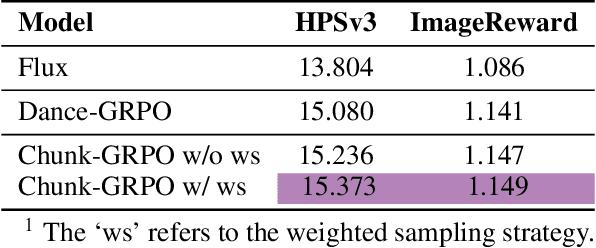
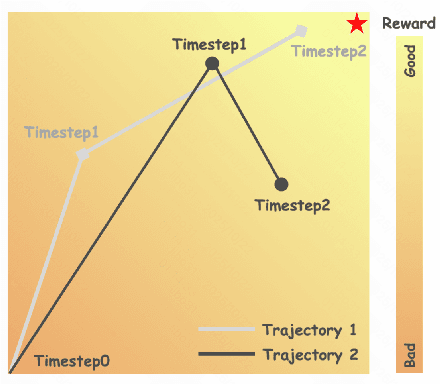
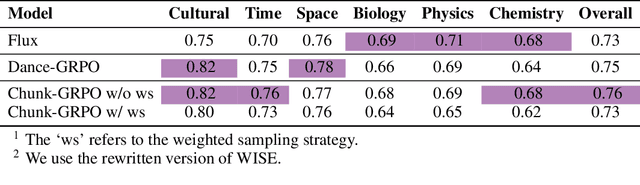
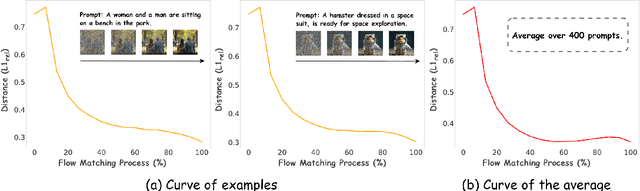
Group Relative Policy Optimization (GRPO) has shown strong potential for flow-matching-based text-to-image (T2I) generation, but it faces two key limitations: inaccurate advantage attribution, and the neglect of temporal dynamics of generation. In this work, we argue that shifting the optimization paradigm from the step level to the chunk level can effectively alleviate these issues. Building on this idea, we propose Chunk-GRPO, the first chunk-level GRPO-based approach for T2I generation. The insight is to group consecutive steps into coherent 'chunk's that capture the intrinsic temporal dynamics of flow matching, and to optimize policies at the chunk level. In addition, we introduce an optional weighted sampling strategy to further enhance performance. Extensive experiments show that ChunkGRPO achieves superior results in both preference alignment and image quality, highlighting the promise of chunk-level optimization for GRPO-based methods.
Distribution Preference Optimization: A Fine-grained Perspective for LLM Unlearning
Oct 06, 2025As Large Language Models (LLMs) demonstrate remarkable capabilities learned from vast corpora, concerns regarding data privacy and safety are receiving increasing attention. LLM unlearning, which aims to remove the influence of specific data while preserving overall model utility, is becoming an important research area. One of the mainstream unlearning classes is optimization-based methods, which achieve forgetting directly through fine-tuning, exemplified by Negative Preference Optimization (NPO). However, NPO's effectiveness is limited by its inherent lack of explicit positive preference signals. Attempts to introduce such signals by constructing preferred responses often necessitate domain-specific knowledge or well-designed prompts, fundamentally restricting their generalizability. In this paper, we shift the focus to the distribution-level, directly targeting the next-token probability distribution instead of entire responses, and derive a novel unlearning algorithm termed \textbf{Di}stribution \textbf{P}reference \textbf{O}ptimization (DiPO). We show that the requisite preference distribution pairs for DiPO, which are distributions over the model's output tokens, can be constructed by selectively amplifying or suppressing the model's high-confidence output logits, thereby effectively overcoming NPO's limitations. We theoretically prove the consistency of DiPO's loss function with the desired unlearning direction. Extensive experiments demonstrate that DiPO achieves a strong trade-off between model utility and forget quality. Notably, DiPO attains the highest forget quality on the TOFU benchmark, and maintains leading scalability and sustainability in utility preservation on the MUSE benchmark.