 Add to Chrome
 Add to Firefox
 Add to Edge
A Deep Equilibrium Network for Hyperspectral Unmixing
Apr 13, 2026
Hyperspectral unmixing (HU) is crucial for analyzing hyperspectral imagery, yet achieving accurate unmixing remains challenging. While traditional methods struggle to effectively model complex spectral-spatial features, deep learning approaches often lack physical interpretability. Unrolling-based methods, despite offering network interpretability, inadequately exploit spectral-spatial information and incur high memory costs and numerical precision issues during backpropagation. To address these limitations, we propose DEQ-Unmix, which reformulates abundance estimation as a deep equilibrium model, enabling efficient constant-memory training via implicit differentiation. It replaces the gradient operator of the data reconstruction term with a trainable convolutional network to capture spectral-spatial information. By leveraging implicit differentiation, DEQ-Unmix enables efficient and constant-memory backpropagation. Experiments on synthetic and two real-world datasets demonstrate that DEQ-Unmix achieves superior unmixing performance while maintaining constant memory cost.

When to Lock Attention: Training-Free KV Control in Video Diffusion
Mar 10, 2026Maintaining background consistency while enhancing foreground quality remains a core challenge in video editing. Injecting full-image information often leads to background artifacts, whereas rigid background locking severely constrains the model's capacity for foreground generation. To address this issue, we propose KV-Lock, a training-free framework tailored for DiT-based video diffusion models. Our core insight is that the hallucination metric (variance of denoising prediction) directly quantifies generation diversity, which is inherently linked to the classifier-free guidance (CFG) scale. Building upon this, KV-Lock leverages diffusion hallucination detection to dynamically schedule two key components: the fusion ratio between cached background key-values (KVs) and newly generated KVs, and the CFG scale. When hallucination risk is detected, KV-Lock strengthens background KV locking and simultaneously amplifies conditional guidance for foreground generation, thereby mitigating artifacts and improving generation fidelity. As a training-free, plug-and-play module, KV-Lock can be easily integrated into any pre-trained DiT-based models. Extensive experiments validate that our method outperforms existing approaches in improved foreground quality with high background fidelity across various video editing tasks.
AgentVista: Evaluating Multimodal Agents in Ultra-Challenging Realistic Visual Scenarios
Feb 26, 2026Real-world multimodal agents solve multi-step workflows grounded in visual evidence. For example, an agent can troubleshoot a device by linking a wiring photo to a schematic and validating the fix with online documentation, or plan a trip by interpreting a transit map and checking schedules under routing constraints. However, existing multimodal benchmarks mainly evaluate single-turn visual reasoning or specific tool skills, and they do not fully capture the realism, visual subtlety, and long-horizon tool use that practical agents require. We introduce AgentVista, a benchmark for generalist multimodal agents that spans 25 sub-domains across 7 categories, pairing realistic and detail-rich visual scenarios with natural hybrid tool use. Tasks require long-horizon tool interactions across modalities, including web search, image search, page navigation, and code-based operations for both image processing and general programming. Comprehensive evaluation of state-of-the-art models exposes significant gaps in their ability to carry out long-horizon multimodal tool use. Even the best model in our evaluation, Gemini-3-Pro with tools, achieves only 27.3% overall accuracy, and hard instances can require more than 25 tool-calling turns. We expect AgentVista to accelerate the development of more capable and reliable multimodal agents for realistic and ultra-challenging problem solving.
DTU-Net: A Multi-Scale Dilated Transformer Network for Nonlinear Hyperspectral Unmixing
Mar 06, 2025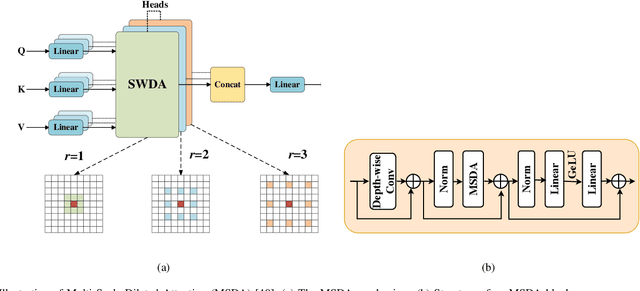
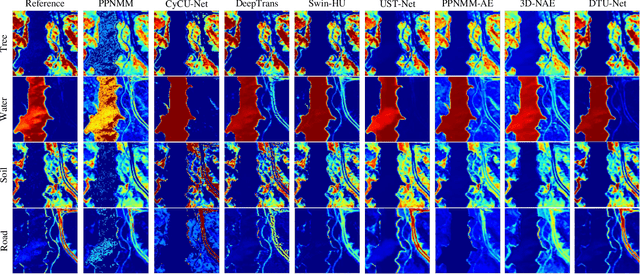
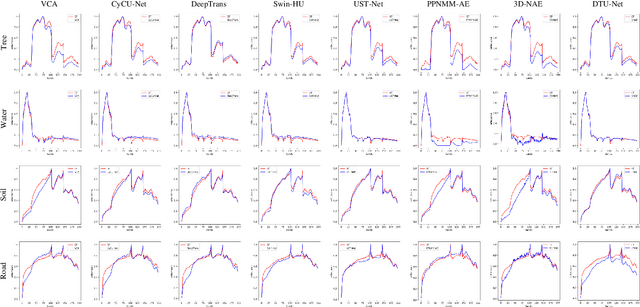
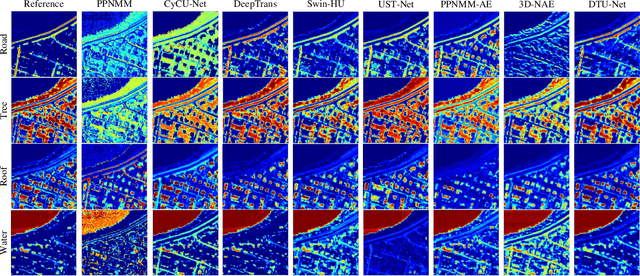
Transformers have shown significant success in hyperspectral unmixing (HU). However, challenges remain. While multi-scale and long-range spatial correlations are essential in unmixing tasks, current Transformer-based unmixing networks, built on Vision Transformer (ViT) or Swin-Transformer, struggle to capture them effectively. Additionally, current Transformer-based unmixing networks rely on the linear mixing model, which lacks the flexibility to accommodate scenarios where nonlinear effects are significant. To address these limitations, we propose a multi-scale Dilated Transformer-based unmixing network for nonlinear HU (DTU-Net). The encoder employs two branches. The first one performs multi-scale spatial feature extraction using Multi-Scale Dilated Attention (MSDA) in the Dilated Transformer, which varies dilation rates across attention heads to capture long-range and multi-scale spatial correlations. The second one performs spectral feature extraction utilizing 3D-CNNs with channel attention. The outputs from both branches are then fused to integrate multi-scale spatial and spectral information, which is subsequently transformed to estimate the abundances. The decoder is designed to accommodate both linear and nonlinear mixing scenarios. Its interpretability is enhanced by explicitly modeling the relationships between endmembers, abundances, and nonlinear coefficients in accordance with the polynomial post-nonlinear mixing model (PPNMM). Experiments on synthetic and real datasets validate the effectiveness of the proposed DTU-Net compared to PPNMM-derived methods and several advanced unmixing networks.
MLLM-SUL: Multimodal Large Language Model for Semantic Scene Understanding and Localization in Traffic Scenarios
Dec 27, 2024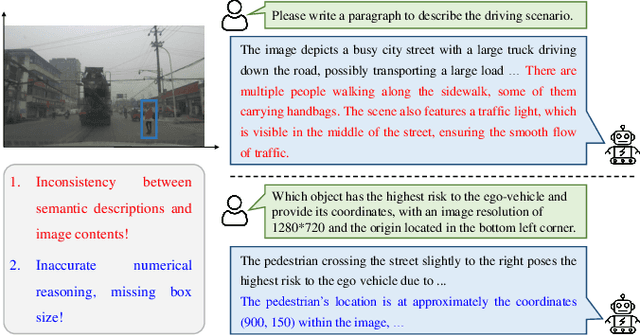
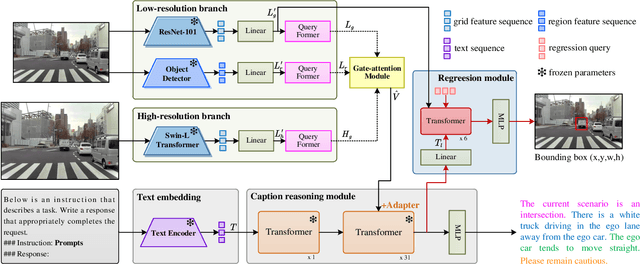
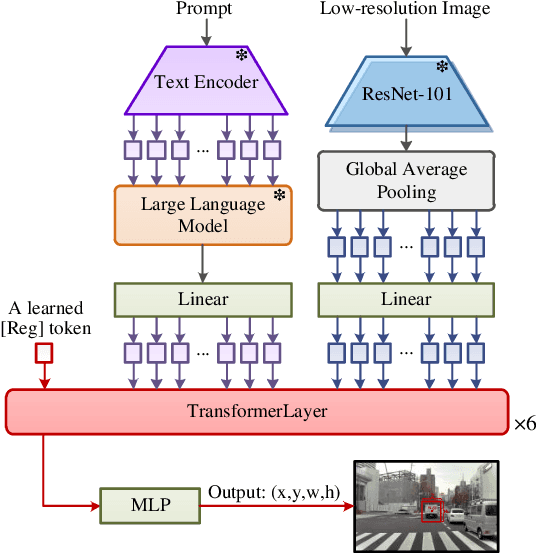
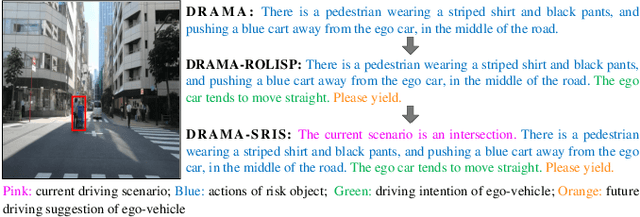
Multimodal large language models (MLLMs) have shown satisfactory effects in many autonomous driving tasks. In this paper, MLLMs are utilized to solve joint semantic scene understanding and risk localization tasks, while only relying on front-view images. In the proposed MLLM-SUL framework, a dual-branch visual encoder is first designed to extract features from two resolutions, and rich visual information is conducive to the language model describing risk objects of different sizes accurately. Then for the language generation, LLaMA model is fine-tuned to predict scene descriptions, containing the type of driving scenario, actions of risk objects, and driving intentions and suggestions of ego-vehicle. Ultimately, a transformer-based network incorporating a regression token is trained to locate the risk objects. Extensive experiments on the existing DRAMA-ROLISP dataset and the extended DRAMA-SRIS dataset demonstrate that our method is efficient, surpassing many state-of-the-art image-based and video-based methods. Specifically, our method achieves 80.1% BLEU-1 score and 298.5% CIDEr score in the scene understanding task, and 59.6% accuracy in the localization task. Codes and datasets are available at https://github.com/fjq-tongji/MLLM-SUL.