 Add to Chrome
 Add to Firefox
 Add to Edge
DBPnet: Damper Characteristics-Based Bayesian Physics-Informed Neural Network for Wheel Load Estimation
May 24, 2026
Advanced driver assistance systems (ADAS) play an important role in modern automotive intelligence, significantly enhancing vehicle safety and stability. The performance of ADAS critically relies on accurate and reliable vehicle state estimation, particularly from vehicle dynamic sensors. Among these signals, wheel load is a key variable for chassis control and safety-critical functions, yet it remains difficult to estimate robustly due to complex suspension geometry, nonlinear dynamics, and measurement noise. To address this issue, we propose DBPnet, a Bayesian physics-informed neural network (PINN) with a physics-aware embedding module inspired by damper characteristics. First, this paper presents a suspension linkage-level modeling (SLLM) approach that constructs a nonlinear instantaneous dynamic model by explicitly considering the complex geometric structure of the suspension. Building upon SLLM, Bayesian inference is integrated into the PINN to effectively cope with noise and uncertainty in the vehicle chassis system, thereby improving the model's robustness. Then, a physics-informed loss function is employed to ensure consistency with fundamental physical principles, while the damper characteristics-inspired embedding module extracts temporal variation features of input signals and incorporates them into each layer of the PINN, ensuring that physical observations guide the neural network without being constrained by fixed physical models. Extensive evaluations on high-fidelity simulations and real-world experiments demonstrate that our DBPnet consistently achieves lower RMSE and MaxError than baseline methods. These results highlight the potential of our DBPnet to advance wheel load estimation and contribute to the development of more reliable ADAS actuator functions.

PAVE: A Cognitive Architecture for Legitimate Violation in Generative Agent Societies
May 19, 2026Generative agents based on large language models reproduce believable human behavior in cooperative settings, but how they should reason in situations where rule-breaking may be required, such as fire evacuation or authority-supervised emergency, remains poorly characterized. We propose PAVE (Perception, Assessment, Verdict, Emulation), a novel four-module cognitive architecture that addresses this gap end to end: (i) Perception extracts a structured context with explicit authority distance, peer behaviors, and severity-tagged situational cues; (ii) Assessment scores the context along five scalars including an explicit legitimacy judgment that checks necessity, proportionality, and absence of alternatives; (iii) Verdict decides to comply or violate under a hard legitimacy gate, with a per-agent threshold elicited from the persona; (iv) Emulation enacts the verdict and scopes the violation to the rule the trigger justifies. We instantiate PAVE in Voville, a tile-based traffic environment forked from Smallville, and evaluate across three scenarios, four LLM backbones, and a focused ablation. PAVE agents satisfy four properties simultaneously: legitimate violation (only when a trigger justifies it), authority deference (officer instructions override even high legitimacy), bounded scope (violations confined to the targeted rule), and recovery (baseline restored once the trigger ends). PAVE agents make more structured and interpretable decisions than vanilla across all four properties, and human evaluators rate them as more plausible. Ablating the legitimacy gate reproduces vanilla-like failures. We release Voville, the PAVE prompts and code, and the evaluation pipeline.
EgoTraj: Real-World Egocentric Human Trajectory Dataset for Multimodal Prediction
May 18, 2026Accurately forecasting human trajectories from an egocentric perspective plays a central role in applications such as humanoid robotics, wearable sensing systems, and assistive navigation. However, progress in this direction remains limited due to the scarcity of egocentric trajectory datasets collected in real-world environments. Addressing this need, we introduce EgoTraj, an egocentric multimodal open dataset recorded using Meta Quest Pro (MQPro). EgoTraj contains 75 sequences of human navigation collected from multiple MQPro wearers in real-world urban environments. Each recording provides synchronized RGB video along with ground-truth data, including continuous time-synchronized 6-degree-of-freedom head poses, per-frame 3D eye gaze vectors, scene annotations. To the best of our knowledge, EgoTraj differs from typical egocentric trajectory datasets by capturing long-horizon, self-directed navigation across diverse urban routes with broad participant diversity. To demonstrate the potential of the dataset, we benchmark several state-of-the-art methods for egocentric trajectory prediction and conduct ablation studies to analyze the contributions of gaze, scene, and motion cues. The results highlight the utility of EgoTraj for AR-based perception, navigation, and assistive systems. The EgoTraj dataset, code, and EgoViz Dashboard are publicly available at https://github.com/yehiahmad/EgoTraj.
When to Lock Attention: Training-Free KV Control in Video Diffusion
Mar 10, 2026Maintaining background consistency while enhancing foreground quality remains a core challenge in video editing. Injecting full-image information often leads to background artifacts, whereas rigid background locking severely constrains the model's capacity for foreground generation. To address this issue, we propose KV-Lock, a training-free framework tailored for DiT-based video diffusion models. Our core insight is that the hallucination metric (variance of denoising prediction) directly quantifies generation diversity, which is inherently linked to the classifier-free guidance (CFG) scale. Building upon this, KV-Lock leverages diffusion hallucination detection to dynamically schedule two key components: the fusion ratio between cached background key-values (KVs) and newly generated KVs, and the CFG scale. When hallucination risk is detected, KV-Lock strengthens background KV locking and simultaneously amplifies conditional guidance for foreground generation, thereby mitigating artifacts and improving generation fidelity. As a training-free, plug-and-play module, KV-Lock can be easily integrated into any pre-trained DiT-based models. Extensive experiments validate that our method outperforms existing approaches in improved foreground quality with high background fidelity across various video editing tasks.
LLM-MLFFN: Multi-Level Autonomous Driving Behavior Feature Fusion via Large Language Model
Mar 03, 2026Accurate classification of autonomous vehicle (AV) driving behaviors is critical for safety validation, performance diagnosis, and traffic integration analysis. However, existing approaches primarily rely on numerical time-series modeling and often lack semantic abstraction, limiting interpretability and robustness in complex traffic environments. This paper presents LLM-MLFFN, a novel large language model (LLM)-enhanced multi-level feature fusion network designed to address the complexities of multi-dimensional driving data. The proposed LLM-MLFFN framework integrates priors from largescale pre-trained models and employs a multi-level approach to enhance classification accuracy. LLM-MLFFN comprises three core components: (1) a multi-level feature extraction module that extracts statistical, behavioral, and dynamic features to capture the quantitative aspects of driving behaviors; (2) a semantic description module that leverages LLMs to transform raw data into high-level semantic features; and (3) a dual-channel multi-level feature fusion network that combines numerical and semantic features using weighted attention mechanisms to improve robustness and prediction accuracy. Evaluation on the Waymo open trajectory dataset demonstrates the superior performance of the proposed LLM-MLFFN, achieving a classification accuracy of over 94%, surpassing existing machine learning models. Ablation studies further validate the critical contributions of multi-level fusion, feature extraction strategies, and LLM-derived semantic reasoning. These results suggest that integrating structured feature modeling with language-driven semantic abstraction provides a principled and interpretable pathway for robust autonomous driving behavior classification.
PILD: Physics-Informed Learning via Diffusion
Jan 29, 2026Diffusion models have emerged as powerful generative tools for modeling complex data distributions, yet their purely data-driven nature limits applicability in practical engineering and scientific problems where physical laws need to be followed. This paper proposes Physics-Informed Learning via Diffusion (PILD), a framework that unifies diffusion modeling and first-principles physical constraints by introducing a virtual residual observation sampled from a Laplace distribution to supervise generation during training. To further integrate physical laws, a conditional embedding module is incorporated to inject physical information into the denoising network at multiple layers, ensuring consistent guidance throughout the diffusion process. The proposed PILD framework is concise, modular, and broadly applicable to problems governed by ordinary differential equations, partial differential equations, as well as algebraic equations or inequality constraints. Extensive experiments across engineering and scientific tasks including estimating vehicle trajectories, tire forces, Darcy flow and plasma dynamics, demonstrate that our PILD substantially improves accuracy, stability, and generalization over existing physics-informed and diffusion-based baselines.
UAV-Based Intelligent Traffic Surveillance System: Real-Time Vehicle Detection, Classification, Tracking, and Behavioral Analysis
Sep 04, 2025Traffic congestion and violations pose significant challenges for urban mobility and road safety. Traditional traffic monitoring systems, such as fixed cameras and sensor-based methods, are often constrained by limited coverage, low adaptability, and poor scalability. To address these challenges, this paper introduces an advanced unmanned aerial vehicle (UAV)-based traffic surveillance system capable of accurate vehicle detection, classification, tracking, and behavioral analysis in real-world, unconstrained urban environments. The system leverages multi-scale and multi-angle template matching, Kalman filtering, and homography-based calibration to process aerial video data collected from altitudes of approximately 200 meters. A case study in urban area demonstrates robust performance, achieving a detection precision of 91.8%, an F1-score of 90.5%, and tracking metrics (MOTA/MOTP) of 92.1% and 93.7%, respectively. Beyond precise detection, the system classifies five vehicle types and automatically detects critical traffic violations, including unsafe lane changes, illegal double parking, and crosswalk obstructions, through the fusion of geofencing, motion filtering, and trajectory deviation analysis. The integrated analytics module supports origin-destination tracking, vehicle count visualization, inter-class correlation analysis, and heatmap-based congestion modeling. Additionally, the system enables entry-exit trajectory profiling, vehicle density estimation across road segments, and movement direction logging, supporting comprehensive multi-scale urban mobility analytics. Experimental results confirms the system's scalability, accuracy, and practical relevance, highlighting its potential as an enforcement-aware, infrastructure-independent traffic monitoring solution for next-generation smart cities.
HCOMC: A Hierarchical Cooperative On-Ramp Merging Control Framework in Mixed Traffic Environment on Two-Lane Highways
Jul 15, 2025Highway on-ramp merging areas are common bottlenecks to traffic congestion and accidents. Currently, a cooperative control strategy based on connected and automated vehicles (CAVs) is a fundamental solution to this problem. While CAVs are not fully widespread, it is necessary to propose a hierarchical cooperative on-ramp merging control (HCOMC) framework for heterogeneous traffic flow on two-lane highways to address this gap. This paper extends longitudinal car-following models based on the intelligent driver model and lateral lane-changing models using the quintic polynomial curve to account for human-driven vehicles (HDVs) and CAVs, comprehensively considering human factors and cooperative adaptive cruise control. Besides, this paper proposes a HCOMC framework, consisting of a hierarchical cooperative planning model based on the modified virtual vehicle model, a discretionary lane-changing model based on game theory, and a multi-objective optimization model using the elitist non-dominated sorting genetic algorithm to ensure the safe, smooth, and efficient merging process. Then, the performance of our HCOMC is analyzed under different traffic densities and CAV penetration rates through simulation. The findings underscore our HCOMC's pronounced comprehensive advantages in enhancing the safety of group vehicles, stabilizing and expediting merging process, optimizing traffic efficiency, and economizing fuel consumption compared with benchmarks.
Trust-MARL: Trust-Based Multi-Agent Reinforcement Learning Framework for Cooperative On-Ramp Merging Control in Heterogeneous Traffic Flow
Jun 14, 2025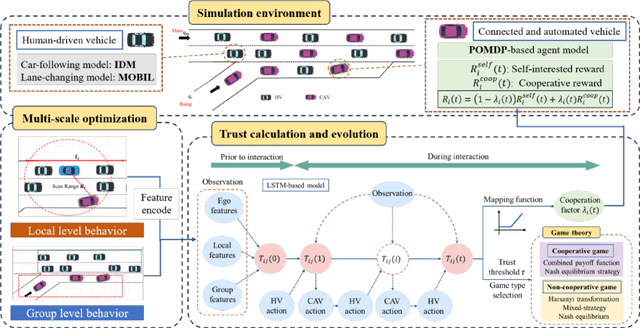

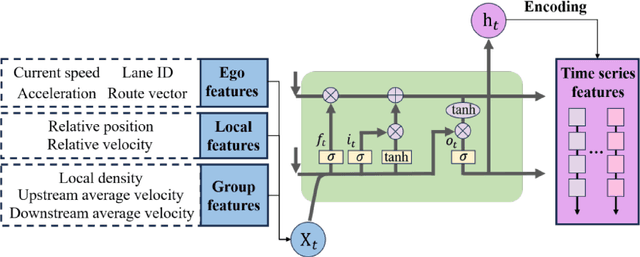
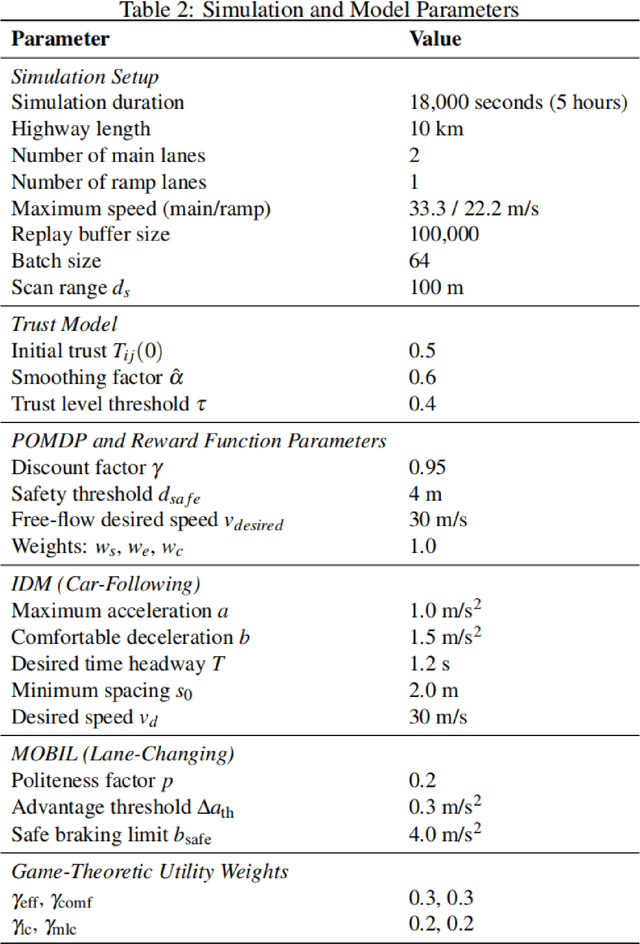
Intelligent transportation systems require connected and automated vehicles (CAVs) to conduct safe and efficient cooperation with human-driven vehicles (HVs) in complex real-world traffic environments. However, the inherent unpredictability of human behaviour, especially at bottlenecks such as highway on-ramp merging areas, often disrupts traffic flow and compromises system performance. To address the challenge of cooperative on-ramp merging in heterogeneous traffic environments, this study proposes a trust-based multi-agent reinforcement learning (Trust-MARL) framework. At the macro level, Trust-MARL enhances global traffic efficiency by leveraging inter-agent trust to improve bottleneck throughput and mitigate traffic shockwave through emergent group-level coordination. At the micro level, a dynamic trust mechanism is designed to enable CAVs to adjust their cooperative strategies in response to real-time behaviors and historical interactions with both HVs and other CAVs. Furthermore, a trust-triggered game-theoretic decision-making module is integrated to guide each CAV in adapting its cooperation factor and executing context-aware lane-changing decisions under safety, comfort, and efficiency constraints. An extensive set of ablation studies and comparative experiments validates the effectiveness of the proposed Trust-MARL approach, demonstrating significant improvements in safety, efficiency, comfort, and adaptability across varying CAV penetration rates and traffic densities.
Learning to Seek: Multi-Agent Online Source Seeking Against Non-Stochastic Disturbances
Apr 29, 2023This paper proposes to leverage the emerging~learning techniques and devise a multi-agent online source {seeking} algorithm under unknown environment. Of particular significance in our problem setups are: i) the underlying environment is not only unknown, but dynamically changing and also perturbed by two types of non-stochastic disturbances; and ii) a group of agents is deployed and expected to cooperatively seek as many sources as possible. Correspondingly, a new technique of discounted Kalman filter is developed to tackle with the non-stochastic disturbances, and a notion of confidence bound in polytope nature is utilized~to aid the computation-efficient cooperation among~multiple agents. With standard assumptions on the unknown environment as well as the disturbances, our algorithm is shown to achieve sub-linear regrets under the two~types of non-stochastic disturbances; both results are comparable to the state-of-the-art. Numerical examples on a real-world pollution monitoring application are provided to demonstrate the effectiveness of our algorithm.