 Add to Chrome
 Add to Firefox
 Add to Edge
Learning from the Self-future: On-policy Self-distillation for dLLMs
Jun 16, 2026
On-policy self-distillation (OPSD) has proven effective for post-training large language models (LLMs), yet its application to diffusion LLMs (dLLMs) remains unexplored. Existing OPSD methods are inherently autoregressive-centric. They inject privileged information via left-to-right prefix conditioning with token-level divergence supervision, a design that fundamentally conflicts with the arbitraryorder generation of dLLMs. We introduce d-OPSD, the first OPSD framework tailored for dLLMs. Our approach makes two core contributions. First, we reframe self-teacher construction by using self-generated answers as suffix conditioning, enabling the student model to learn from "self future-experience" rather than privileged prefixes. Second, we shift supervision from token-level to step-level, aligning training with the iterative denoising process of dLLMs. Experiments across four reasoning benchmarks show that d-OPSD consistently outperforms RLVR and SFT baselines with superior sample efficiency, requiring only around 10% of the optimization steps by RLVR and opening a promising pathway for dLLM posttraining. The code is available at https://github.com/xingzhejun/d-OPSD.

No Hidden Prompts Needed! You Can Game AI Peer Review with Presentation-Only Revisions
Jun 11, 2026As AI-generated reviews move from experimental tools into peer-review infrastructure, most robustness concerns have focused on explicit attacks such as hidden instructions and prompt injection. We study a harder and more policy-relevant failure mode: no hidden text, no prompt injection, and no changes to methods, experiments, figures, equations, proofs, or numerical results. The attacker modifies only presentation-level content, such as the abstract, contribution framing, related work, discussion, and narrative structure. We introduce adversarial repackaging: a closed-loop attack that uses AI-reviewer feedback to search for presentation-level revisions while keeping the scientific evidence fixed. Across three mainstream AI reviewers, adversarial repackaging achieves a 75.1% attack success rate and a mean score gain of +1.21/10. The effect is not explained by ordinary prose polishing. We also reveal that strategies that change how the reviewer interprets the paper, such as related-work repositioning and analytical discussion expansion, substantially outperform surface edits such as local polishing, table formatting, and algorithm boxes. Our analysis reveals two deeper structural failure modes. First, AI reviewers are easier to impress than to convince: highlighting strengths reliably increases perceived merit, while attempts to dissolve weaknesses frequently backfire. Second, AI reviewers can confuse the appearance of addressing a limitation with actually resolving it, allowing unchanged evidence to be reinterpreted as stronger scientific contribution. These results show that the deployment risk is not only malicious hidden instructions, but the emergence of paper presentation itself as an optimization surface. We release a contamination-free rolling benchmark and attack framework for testing whether AI reviewers remain anchored to scientific content under presentation-only edits.
Power Reinforcement Post-Training of Text-to-Image Models with Super-Linear Advantage Shaping
May 11, 2026Recently, post-training methods based on reinforcement learning, with a particular focus on Group Relative Policy Optimization (GRPO), have emerged as the robust paradigm for further advancement of text-to-image (T2I) models. However, these methods are often prone to reward hacking, wherein models exploit biases in imperfect reward functions rather than yielding genuine performance gains. In this work, we identify that normalization could lead to miscalibration and directly removing the prompt-level standard deviation term yields an optimal policy ascent direction that is linear in the advantage but still limits the separation of genuine signals from noise. To mitigate the above issues, we propose Super-Linear Advantage Shaping (SLAS) by revisiting the functional update from an information geometry perspective. By extending the Fisher-Rao information metric with advantage-dependent weighting, SLAS introduces a non-linear geometric structure that reshapes the local policy space. This design relaxes constraints along high-advantage directions to amplify informative updates, while tightening those in low-advantage regions to suppress illusory gradients. In addition, batch-level normalization is applied to stabilize training under varying reward scales. Extensive evaluations demonstrate that SLAS consistently surpasses the DanceGRPO baseline across multiple backbones and benchmarks. In particular, it yields faster training dynamics, improved out-of-domain performance on GenEval and UniGenBench++, and enhanced robustness to model scaling, while mitigating reward hacking and preserving semantic and compositional fidelity in generations.
Sample By Step, Optimize By Chunk: Chunk-Level GRPO For Text-to-Image Generation
Oct 24, 2025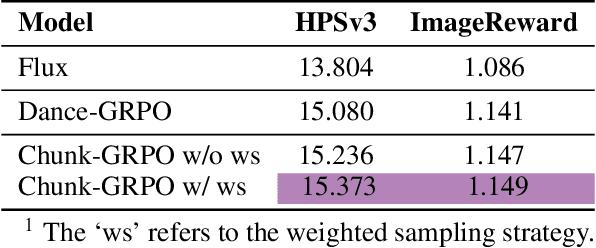
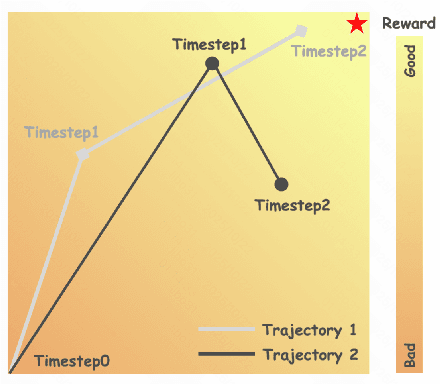
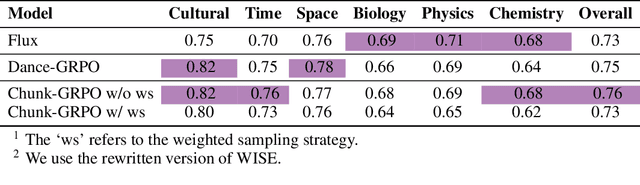
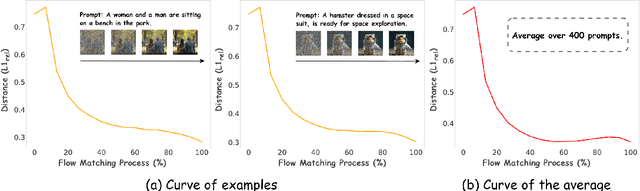
Group Relative Policy Optimization (GRPO) has shown strong potential for flow-matching-based text-to-image (T2I) generation, but it faces two key limitations: inaccurate advantage attribution, and the neglect of temporal dynamics of generation. In this work, we argue that shifting the optimization paradigm from the step level to the chunk level can effectively alleviate these issues. Building on this idea, we propose Chunk-GRPO, the first chunk-level GRPO-based approach for T2I generation. The insight is to group consecutive steps into coherent 'chunk's that capture the intrinsic temporal dynamics of flow matching, and to optimize policies at the chunk level. In addition, we introduce an optional weighted sampling strategy to further enhance performance. Extensive experiments show that ChunkGRPO achieves superior results in both preference alignment and image quality, highlighting the promise of chunk-level optimization for GRPO-based methods.
Reinforcement Fine-Tuning Powers Reasoning Capability of Multimodal Large Language Models
May 24, 2025Standing in 2025, at a critical juncture in the pursuit of Artificial General Intelligence (AGI), reinforcement fine-tuning (RFT) has demonstrated significant potential in enhancing the reasoning capability of large language models (LLMs) and has led to the development of cutting-edge AI models such as OpenAI-o1 and DeepSeek-R1. Moreover, the efficient application of RFT to enhance the reasoning capability of multimodal large language models (MLLMs) has attracted widespread attention from the community. In this position paper, we argue that reinforcement fine-tuning powers the reasoning capability of multimodal large language models. To begin with, we provide a detailed introduction to the fundamental background knowledge that researchers interested in this field should be familiar with. Furthermore, we meticulously summarize the improvements of RFT in powering reasoning capability of MLLMs into five key points: diverse modalities, diverse tasks and domains, better training algorithms, abundant benchmarks and thriving engineering frameworks. Finally, we propose five promising directions for future research that the community might consider. We hope that this position paper will provide valuable insights to the community at this pivotal stage in the advancement toward AGI. Summary of works done on RFT for MLLMs is available at https://github.com/Sun-Haoyuan23/Awesome-RL-based-Reasoning-MLLMs.