 Add to Chrome
 Add to Firefox
 Add to Edge
Real-time fall detection based on vision for low-power edge platforms
Jul 14, 2026
Falling detection is vital for elderly care and intelligent surveillance; however, prevailing vision-based approaches predominantly frame it as static pose classification or discrete temporal pattern matching, fundamentally overlooking the instability dynamics of the human support system. This paper proposes a physics-informed falling detection framework that recasts falling as a stability-loss event in a coupled dynamical system. We introduce a novel dual-LTC architecture comprising a Center-of-Mass (CoM) subsystem and a Base-of-Support (BoS) subsystem, both instantiated as Liquid Time-Constant (LTC) neural networks to continuously model inertial trajectory evolution and ground-contact adjustment through adaptive time constants, Physical interpretability of falling motion. A learnable coupling module emulates physical interaction between the two subsystems, while a Stability Manifold classifier operates in the joint latent space to detect boundary crossing via Lyapunov-inspired stability metrics. Complementary counterfactual trajectory projection and Time-to-Collision (TTC) estimation further enable irreversibility assessment and early warning. The architecture is designed to support a three-state prediction paradigm (Normal, Falling, Fallen); in this preliminary study, we validate the core stability discrimination capability on a two-class dataset (Normal vs. Falling), leaving the full three-state temporal transition to future work. Unlike conventional CNN--RNN pipelines, the proposed formulation encodes continuous-time mechanical inertia, yielding a sub-50K-parameter network capable of real-time inference on resource-constrained edge devices. Extensive experiments demonstrate competitive accuracy with superior physical interpretability, validating its efficacy for low-compute visual fall detection.

GARCIA: Powering Representations of Long-tail Query with Multi-granularity Contrastive Learning
Apr 25, 2023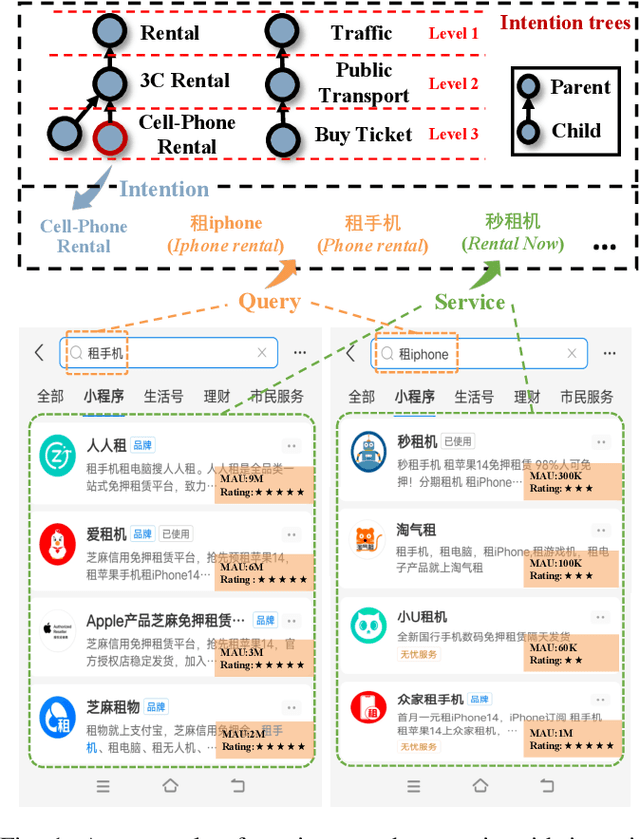
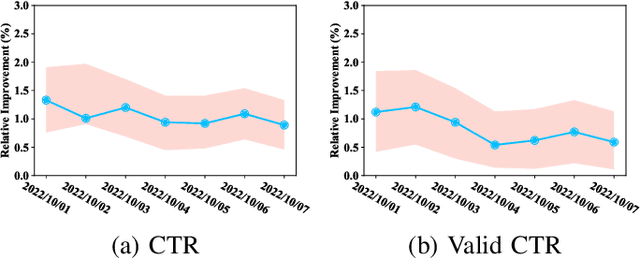
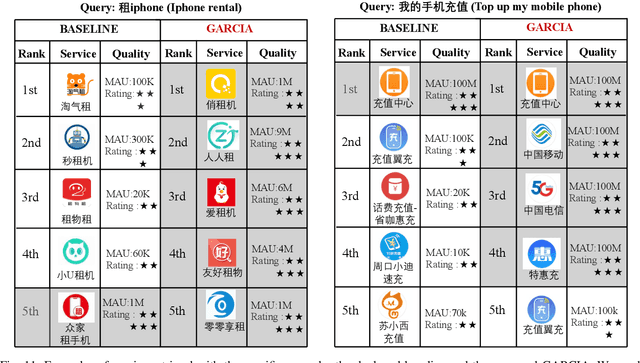
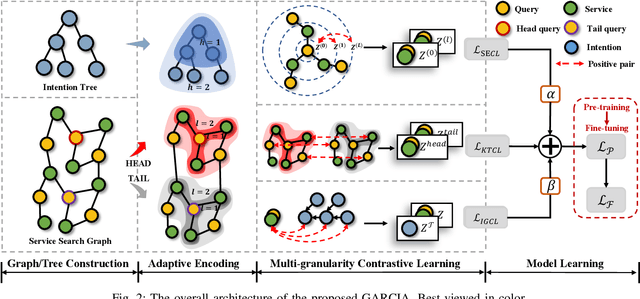
Recently, the growth of service platforms brings great convenience to both users and merchants, where the service search engine plays a vital role in improving the user experience by quickly obtaining desirable results via textual queries. Unfortunately, users' uncontrollable search customs usually bring vast amounts of long-tail queries, which severely threaten the capability of search models. Inspired by recently emerging graph neural networks (GNNs) and contrastive learning (CL), several efforts have been made in alleviating the long-tail issue and achieve considerable performance. Nevertheless, they still face a few major weaknesses. Most importantly, they do not explicitly utilize the contextual structure between heads and tails for effective knowledge transfer, and intention-level information is commonly ignored for more generalized representations. To this end, we develop a novel framework GARCIA, which exploits the graph based knowledge transfer and intention based representation generalization in a contrastive setting. In particular, we employ an adaptive encoder to produce informative representations for queries and services, as well as hierarchical structure aware representations of intentions. To fully understand tail queries and services, we equip GARCIA with a novel multi-granularity contrastive learning module, which powers representations through knowledge transfer, structure enhancement and intention generalization. Subsequently, the complete GARCIA is well trained in a pre-training&fine-tuning manner. At last, we conduct extensive experiments on both offline and online environments, which demonstrates the superior capability of GARCIA in improving tail queries and overall performance in service search scenarios.