 Add to Chrome
 Add to Firefox
 Add to Edge
Last-Iterate Convergence Properties of Regret-Matching Algorithms in Games
Nov 01, 2023
Algorithms based on regret matching, specifically regret matching$^+$ (RM$^+$), and its variants are the most popular approaches for solving large-scale two-player zero-sum games in practice. Unlike algorithms such as optimistic gradient descent ascent, which have strong last-iterate and ergodic convergence properties for zero-sum games, virtually nothing is known about the last-iterate properties of regret-matching algorithms. Given the importance of last-iterate convergence for numerical optimization reasons and relevance as modeling real-word learning in games, in this paper, we study the last-iterate convergence properties of various popular variants of RM$^+$. First, we show numerically that several practical variants such as simultaneous RM$^+$, alternating RM$^+$, and simultaneous predictive RM$^+$, all lack last-iterate convergence guarantees even on a simple $3\times 3$ game. We then prove that recent variants of these algorithms based on a smoothing technique do enjoy last-iterate convergence: we prove that extragradient RM$^{+}$ and smooth Predictive RM$^+$ enjoy asymptotic last-iterate convergence (without a rate) and $1/\sqrt{t}$ best-iterate convergence. Finally, we introduce restarted variants of these algorithms, and show that they enjoy linear-rate last-iterate convergence.

Online Learning in Contextual Second-Price Pay-Per-Click Auctions
Oct 08, 2023We study online learning in contextual pay-per-click auctions where at each of the $T$ rounds, the learner receives some context along with a set of ads and needs to make an estimate on their click-through rate (CTR) in order to run a second-price pay-per-click auction. The learner's goal is to minimize her regret, defined as the gap between her total revenue and that of an oracle strategy that always makes perfect CTR predictions. We first show that $\sqrt{T}$-regret is obtainable via a computationally inefficient algorithm and that it is unavoidable since our algorithm is no easier than the classical multi-armed bandit problem. A by-product of our results is a $\sqrt{T}$-regret bound for the simpler non-contextual setting, improving upon a recent work of [Feng et al., 2023] by removing the inverse CTR dependency that could be arbitrarily large. Then, borrowing ideas from recent advances on efficient contextual bandit algorithms, we develop two practically efficient contextual auction algorithms: the first one uses the exponential weight scheme with optimistic square errors and maintains the same $\sqrt{T}$-regret bound, while the second one reduces the problem to online regression via a simple epsilon-greedy strategy, albeit with a worse regret bound. Finally, we conduct experiments on a synthetic dataset to showcase the effectiveness and superior performance of our algorithms.
WizardMath: Empowering Mathematical Reasoning for Large Language Models via Reinforced Evol-Instruct
Aug 18, 2023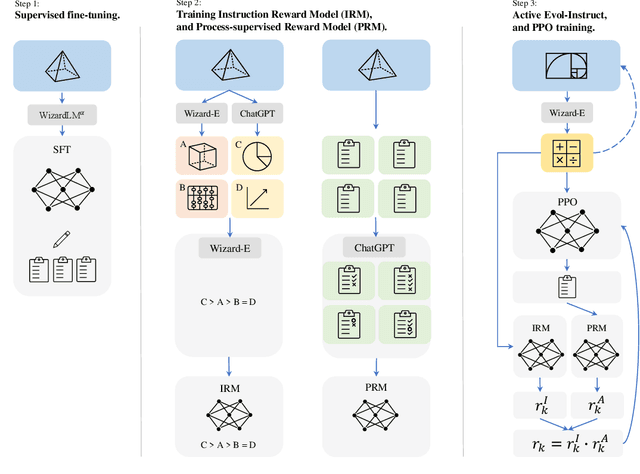
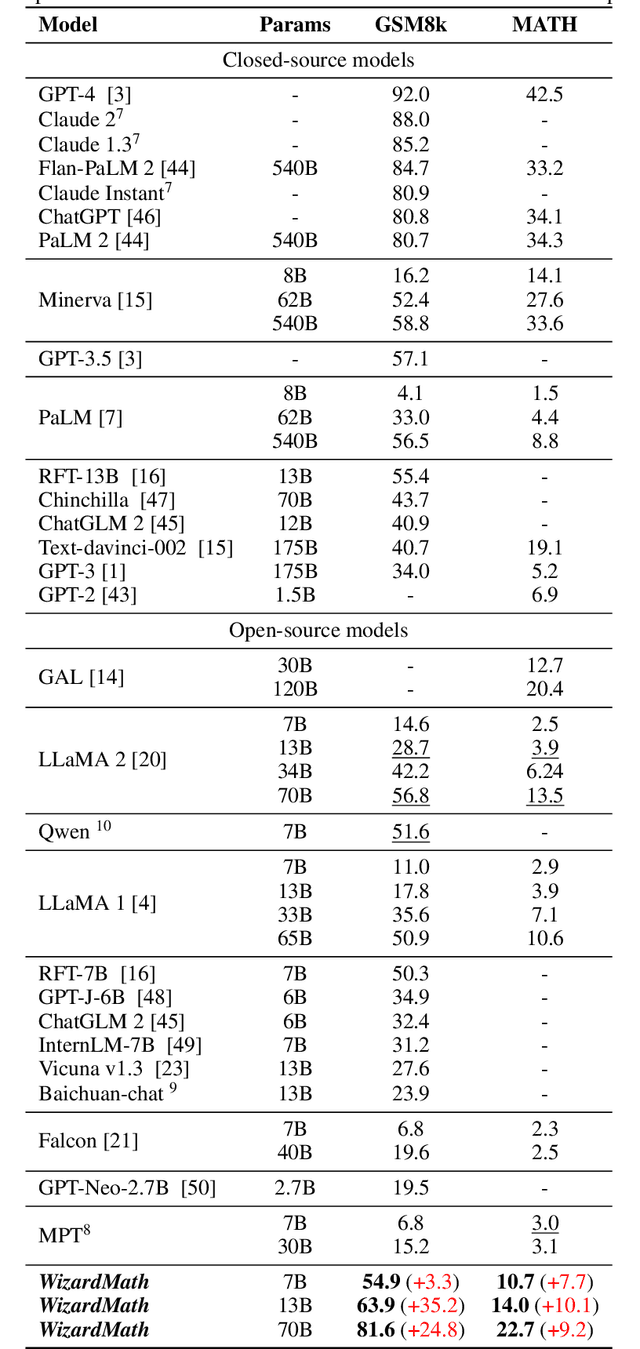
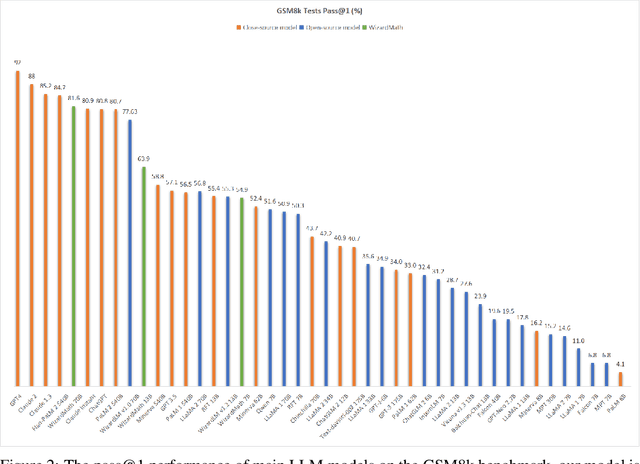
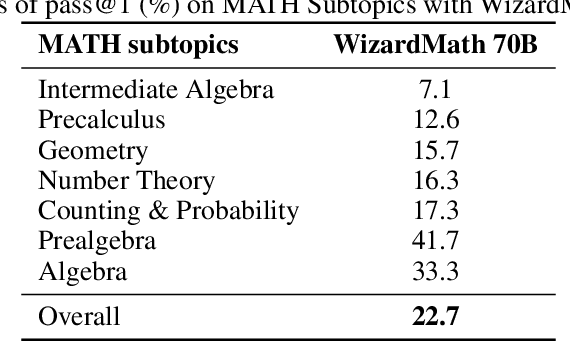
Large language models (LLMs), such as GPT-4, have shown remarkable performance in natural language processing (NLP) tasks, including challenging mathematical reasoning. However, most existing open-source models are only pre-trained on large-scale internet data and without math-related optimization. In this paper, we present WizardMath, which enhances the mathematical reasoning abilities of Llama-2, by applying our proposed Reinforcement Learning from Evol-Instruct Feedback (RLEIF) method to the domain of math. Through extensive experiments on two mathematical reasoning benchmarks, namely GSM8k and MATH, we reveal the extraordinary capabilities of our model. WizardMath surpasses all other open-source LLMs by a substantial margin. Furthermore, our model even outperforms ChatGPT-3.5, Claude Instant-1, PaLM-2 and Minerva on GSM8k, simultaneously surpasses Text-davinci-002, PaLM-1 and GPT-3 on MATH. More details and model weights are public at https://github.com/nlpxucan/WizardLM and https://huggingface.co/WizardLM.
No-Regret Online Reinforcement Learning with Adversarial Losses and Transitions
May 30, 2023Existing online learning algorithms for adversarial Markov Decision Processes achieve ${O}(\sqrt{T})$ regret after $T$ rounds of interactions even if the loss functions are chosen arbitrarily by an adversary, with the caveat that the transition function has to be fixed. This is because it has been shown that adversarial transition functions make no-regret learning impossible. Despite such impossibility results, in this work, we develop algorithms that can handle both adversarial losses and adversarial transitions, with regret increasing smoothly in the degree of maliciousness of the adversary. More concretely, we first propose an algorithm that enjoys $\widetilde{{O}}(\sqrt{T} + C^{\textsf{P}})$ regret where $C^{\textsf{P}}$ measures how adversarial the transition functions are and can be at most ${O}(T)$. While this algorithm itself requires knowledge of $C^{\textsf{P}}$, we further develop a black-box reduction approach that removes this requirement. Moreover, we also show that further refinements of the algorithm not only maintains the same regret bound, but also simultaneously adapts to easier environments (where losses are generated in a certain stochastically constrained manner as in Jin et al. [2021]) and achieves $\widetilde{{O}}(U + \sqrt{UC^{\textsf{L}}} + C^{\textsf{P}})$ regret, where $U$ is some standard gap-dependent coefficient and $C^{\textsf{L}}$ is the amount of corruption on losses.
Regret Matching+: (In)Stability and Fast Convergence in Games
May 24, 2023Regret Matching+ (RM+) and its variants are important algorithms for solving large-scale games. However, a theoretical understanding of their success in practice is still a mystery. Moreover, recent advances on fast convergence in games are limited to no-regret algorithms such as online mirror descent, which satisfy stability. In this paper, we first give counterexamples showing that RM+ and its predictive version can be unstable, which might cause other players to suffer large regret. We then provide two fixes: restarting and chopping off the positive orthant that RM+ works in. We show that these fixes are sufficient to get $O(T^{1/4})$ individual regret and $O(1)$ social regret in normal-form games via RM+ with predictions. We also apply our stabilizing techniques to clairvoyant updates in the uncoupled learning setting for RM+ and prove desirable results akin to recent works for Clairvoyant online mirror descent. Our experiments show the advantages of our algorithms over vanilla RM+-based algorithms in matrix and extensive-form games.
Uncoupled and Convergent Learning in Two-Player Zero-Sum Markov Games
Mar 05, 2023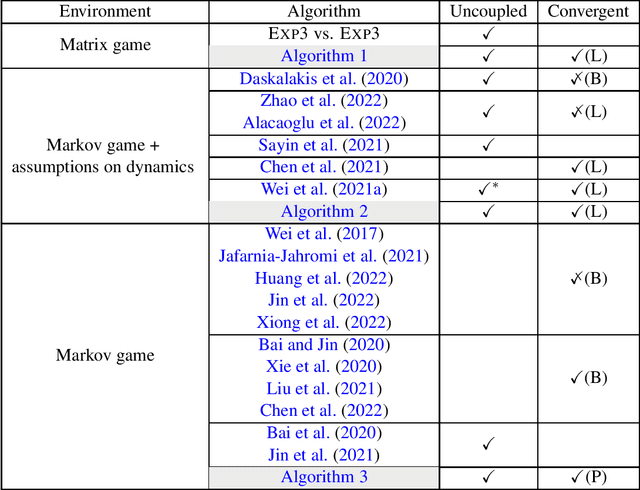
We revisit the problem of learning in two-player zero-sum Markov games, focusing on developing an algorithm that is $uncoupled$, $convergent$, and $rational$, with non-asymptotic convergence rates. We start from the case of stateless matrix game with bandit feedback as a warm-up, showing an $\mathcal{O}(t^{-\frac{1}{8}})$ last-iterate convergence rate. To the best of our knowledge, this is the first result that obtains finite last-iterate convergence rate given access to only bandit feedback. We extend our result to the case of irreducible Markov games, providing a last-iterate convergence rate of $\mathcal{O}(t^{-\frac{1}{9+\varepsilon}})$ for any $\varepsilon>0$. Finally, we study Markov games without any assumptions on the dynamics, and show a $path convergence$ rate, which is a new notion of convergence we defined, of $\mathcal{O}(t^{-\frac{1}{10}})$. Our algorithm removes the synchronization and prior knowledge requirement of [Wei et al., 2021], which pursued the same goals as us for irreducible Markov games. Our algorithm is related to [Chen et al., 2021, Cen et al., 2021] and also builds on the entropy regularization technique. However, we remove their requirement of communications on the entropy values, making our algorithm entirely uncoupled.
Improved Best-of-Both-Worlds Guarantees for Multi-Armed Bandits: FTRL with General Regularizers and Multiple Optimal Arms
Feb 27, 2023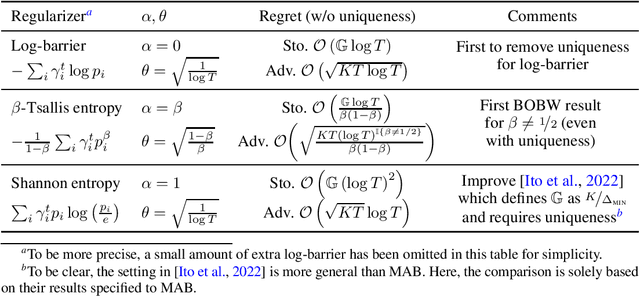
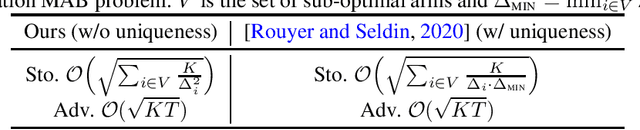
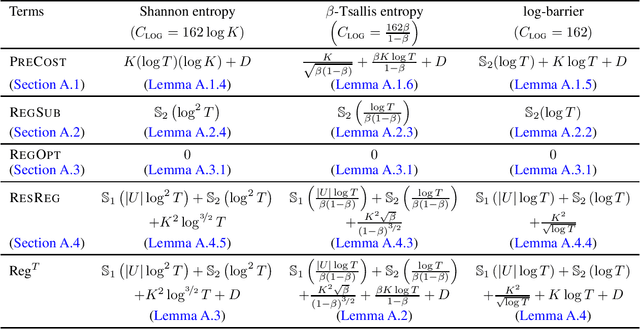
We study the problem of designing adaptive multi-armed bandit algorithms that perform optimally in both the stochastic setting and the adversarial setting simultaneously (often known as a best-of-both-world guarantee). A line of recent works shows that when configured and analyzed properly, the Follow-the-Regularized-Leader (FTRL) algorithm, originally designed for the adversarial setting, can in fact optimally adapt to the stochastic setting as well. Such results, however, critically rely on an assumption that there exists one unique optimal arm. Recently, Ito (2021) took the first step to remove such an undesirable uniqueness assumption for one particular FTRL algorithm with the $\frac{1}{2}$-Tsallis entropy regularizer. In this work, we significantly improve and generalize this result, showing that uniqueness is unnecessary for FTRL with a broad family of regularizers and a new learning rate schedule. For some regularizers, our regret bounds also improve upon prior results even when uniqueness holds. We further provide an application of our results to the decoupled exploration and exploitation problem, demonstrating that our techniques are broadly applicable.
Average-Constrained Policy Optimization
Feb 02, 2023Reinforcement Learning (RL) with constraints is becoming an increasingly important problem for various applications. Often, the average criterion is more suitable. Yet, RL for average criterion-constrained MDPs remains a challenging problem. Algorithms designed for discounted constrained RL problems often do not perform well for the average CMDP setting. In this paper, we introduce a new (possibly the first) policy optimization algorithm for constrained MDPs with the average criterion. The Average-Constrained Policy Optimization (ACPO) algorithm is inspired by the famed PPO-type algorithms based on trust region methods. We develop basic sensitivity theory for average MDPs, and then use the corresponding bounds in the design of the algorithm. We provide theoretical guarantees on its performance, and through extensive experimental work in various challenging MuJoCo environments, show the superior performance of the algorithm when compared to other state-of-the-art algorithms adapted for the average CMDP setting.
Refined Regret for Adversarial MDPs with Linear Function Approximation
Jan 30, 2023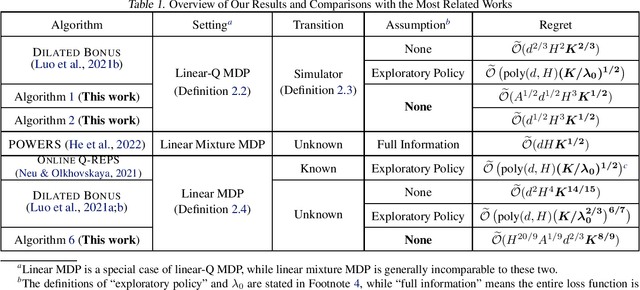
We consider learning in an adversarial Markov Decision Process (MDP) where the loss functions can change arbitrarily over $K$ episodes and the state space can be arbitrarily large. We assume that the Q-function of any policy is linear in some known features, that is, a linear function approximation exists. The best existing regret upper bound for this setting (Luo et al., 2021) is of order $\tilde{\mathcal O}(K^{2/3})$ (omitting all other dependencies), given access to a simulator. This paper provides two algorithms that improve the regret to $\tilde{\mathcal O}(\sqrt K)$ in the same setting. Our first algorithm makes use of a refined analysis of the Follow-the-Regularized-Leader (FTRL) algorithm with the log-barrier regularizer. This analysis allows the loss estimators to be arbitrarily negative and might be of independent interest. Our second algorithm develops a magnitude-reduced loss estimator, further removing the polynomial dependency on the number of actions in the first algorithm and leading to the optimal regret bound (up to logarithmic terms and dependency on the horizon). Moreover, we also extend the first algorithm to simulator-free linear MDPs, which achieves $\tilde{\mathcal O}(K^{8/9})$ regret and greatly improves over the best existing bound $\tilde{\mathcal O}(K^{14/15})$. This algorithm relies on a better alternative to the Matrix Geometric Resampling procedure by Neu & Olkhovskaya (2020), which could again be of independent interest.
Cap4Video: What Can Auxiliary Captions Do for Text-Video Retrieval?
Dec 31, 2022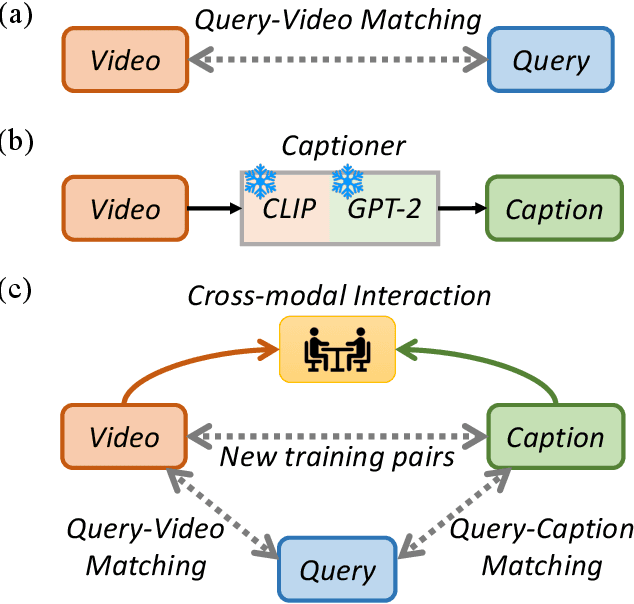
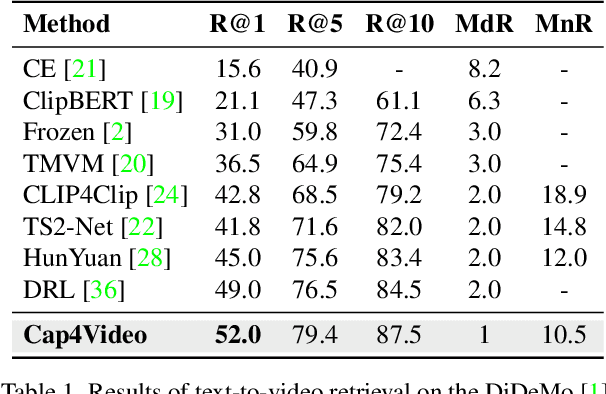
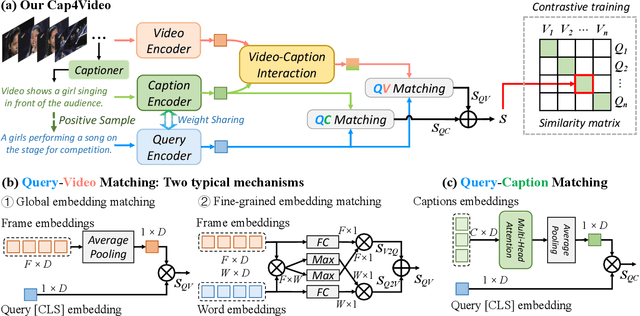
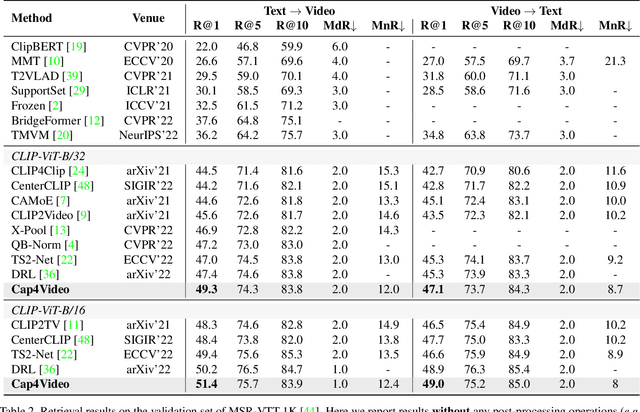
Most existing text-video retrieval methods focus on cross-modal matching between the visual content of offline videos and textual query sentences. However, in real scenarios, online videos are frequently accompanied by relevant text information such as titles, tags, and even subtitles, which can be utilized to match textual queries. This inspires us to generate associated captions from offline videos to help with existing text-video retrieval methods. To do so, we propose to use the zero-shot video captioner with knowledge of pre-trained web-scale models (e.g., CLIP and GPT-2) to generate captions for offline videos without any training. Given the captions, one question naturally arises: what can auxiliary captions do for text-video retrieval? In this paper, we present a novel framework Cap4Video, which makes use of captions from three aspects: i) Input data: The video and captions can form new video-caption pairs as data augmentation for training. ii) Feature interaction: We perform feature interaction between video and caption to yield enhanced video representations. iii) Output score: The Query-Caption matching branch can be complementary to the original Query-Video matching branch for text-video retrieval. We conduct thorough ablation studies to demonstrate the effectiveness of our method. Without any post-processing, our Cap4Video achieves state-of-the-art performance on MSR-VTT (51.4%), VATEX (66.6%), MSVD (51.8%), and DiDeMo (52.0%).