 Add to Chrome
 Add to Firefox
 Add to Edge
Near-Optimal Stochastic Linear Bandits with Delay
Jun 15, 2026
We study stochastic linear bandits with delayed feedback under several delay models and establish near-optimal regret guarantees. Our results identify when delayed linear bandits exhibit the same qualitative behavior as multi-armed bandits (MAB), and when the linear structure creates fundamentally new challenges. Specifically, (1) for \emph{loss-independent delays}, where the delay does not depend on the realized loss (but potentially depends on the arm), we show that delays incur only an additive regret penalty. Under stochastic delays, this penalty scales with the expected delay, while under adversarial delays, it scales with the maximum number of outstanding observations. Notably, both delay penalties are dimension-free, improving upon the state-of-the-art results; (2) for \emph{loss-dependent delays}, we show that linear bandits are substantially harder than MAB: unlike in MAB, we prove matching (up to log factors) upper and lower bounds in linear bandits, whose delay penalty depends on the square root of the dimension. (3) for the \emph{delay-as-payoff model}, a special case of loss-dependent delay, we show that the optimal MAB guarantee, which depends only on the delay of the optimal arm, is also unattainable in linear bandits. Together, these results provide a sharp characterization of how delayed feedback interacts with linear generalization.

Near-Optimal Last-Iterate Convergence for Zero-Sum Games with Bandit Feedback and Opponent Actions
May 10, 2026Last-iterate convergence of learning dynamics in games has attracted significant recent attention. In two-player zero-sum games with bandit feedback, where only the loss of the selected action pair is observed, Fiegel et al. (2025) show a separation between average-iterate and last-iterate convergence in duality gap: while the optimal t^(-1/2) rate after t rounds is achievable for the former via standard no-regret algorithms, the latter cannot converge faster than t^(-1/3) in expectation or t^(-1/4) with high probability. However, in many practical settings, such as preference learning, the players observe not only their loss but also the opponent's action. This raises a natural question: can such additional information enable faster last-iterate convergence? We answer this question affirmatively, showing that t^(-1/2) last-iterate convergence is achievable with high probability in this setting, via an efficient algorithm that updates its strategy infrequently by solving an estimated log-barrier-regularized game. We identify fundamental obstacles preventing standard analysis for multi-armed bandits, the single-player case, from generalizing to games, and develop a novel analysis to overcome them. Experiments confirm that our algorithm indeed converges faster than naive baselines and prior methods that do not exploit opponent-action feedback. Finally, we note that our results also improve those for dueling bandits, a special case with skew-symmetric game matrices.
Pricing Query Complexity of Multiplicative Revenue Approximation
Feb 11, 2026We study the pricing query complexity of revenue maximization for a single buyer whose private valuation is drawn from an unknown distribution. In this setting, the seller must learn the optimal monopoly price by posting prices and observing only binary purchase decisions, rather than the realized valuations. Prior work has established tight query complexity bounds for learning a near-optimal price with additive error $\varepsilon$ when the valuation distribution is supported on $[0,1]$. However, our understanding of how to learn a near-optimal price that achieves at least a $(1-\varepsilon)$ fraction of the optimal revenue remains limited. In this paper, we study the pricing query complexity of the single-buyer revenue maximization problem under such multiplicative error guarantees in several settings. Observe that when pricing queries are the only source of information about the buyer's distribution, no algorithm can achieve a non-trivial approximation, since the scale of the distribution cannot be learned from pricing queries alone. Motivated by this fundamental impossibility, we consider two natural and well-motivated models that provide "scale hints": (i) a one-sample hint, in which the algorithm observes a single realized valuation before making pricing queries; and (ii) a value-range hint, in which the valuation support is known to lie within $[1, H]$. For each type of hint, we establish pricing query complexity guarantees that are tight up to polylogarithmic factors for several classes of distributions, including monotone hazard rate (MHR) distributions, regular distributions, and general distributions.
Interaction-Grounded Learning for Contextual Markov Decision Processes with Personalized Feedback
Feb 09, 2026In this paper, we study Interaction-Grounded Learning (IGL) [Xie et al., 2021], a paradigm designed for realistic scenarios where the learner receives indirect feedback generated by an unknown mechanism, rather than explicit numerical rewards. While prior work on IGL provides efficient algorithms with provable guarantees, those results are confined to single-step settings, restricting their applicability to modern sequential decision-making systems such as multi-turn Large Language Model (LLM) deployments. To bridge this gap, we propose a computationally efficient algorithm that achieves a sublinear regret guarantee for contextual episodic Markov Decision Processes (MDPs) with personalized feedback. Technically, we extend the reward-estimator construction of Zhang et al. [2024a] from the single-step to the multi-step setting, addressing the unique challenges of decoding latent rewards under MDPs. Building on this estimator, we design an Inverse-Gap-Weighting (IGW) algorithm for policy optimization. Finally, we demonstrate the effectiveness of our method in learning personalized objectives from multi-turn interactions through experiments on both a synthetic episodic MDP and a real-world user booking dataset.
Parameter-free Dynamic Regret: Time-varying Movement Costs, Delayed Feedback, and Memory
Feb 06, 2026In this paper, we study dynamic regret in unconstrained online convex optimization (OCO) with movement costs. Specifically, we generalize the standard setting by allowing the movement cost coefficients $λ_t$ to vary arbitrarily over time. Our main contribution is a novel algorithm that establishes the first comparator-adaptive dynamic regret bound for this setting, guaranteeing $\widetilde{\mathcal{O}}(\sqrt{(1+P_T)(T+\sum_t λ_t)})$ regret, where $P_T$ is the path length of the comparator sequence over $T$ rounds. This recovers the optimal guarantees for both static and dynamic regret in standard OCO as a special case where $λ_t=0$ for all rounds. To demonstrate the versatility of our results, we consider two applications: OCO with delayed feedback and OCO with time-varying memory. We show that both problems can be translated into time-varying movement costs, establishing a novel reduction specifically for the delayed feedback setting that is of independent interest. A crucial observation is that the first-order dependence on movement costs in our regret bound plays a key role in enabling optimal comparator-adaptive dynamic regret guarantees in both settings.
Near-Optimal Regret for Distributed Adversarial Bandits: A Black-Box Approach
Feb 06, 2026We study distributed adversarial bandits, where $N$ agents cooperate to minimize the global average loss while observing only their own local losses. We show that the minimax regret for this problem is $\tildeΘ(\sqrt{(ρ^{-1/2}+K/N)T})$, where $T$ is the horizon, $K$ is the number of actions, and $ρ$ is the spectral gap of the communication matrix. Our algorithm, based on a novel black-box reduction to bandits with delayed feedback, requires agents to communicate only through gossip. It achieves an upper bound that significantly improves over the previous best bound $\tilde{O}(ρ^{-1/3}(KT)^{2/3})$ of Yi and Vojnovic (2023). We complement this result with a matching lower bound, showing that the problem's difficulty decomposes into a communication cost $ρ^{-1/4}\sqrt{T}$ and a bandit cost $\sqrt{KT/N}$. We further demonstrate the versatility of our approach by deriving first-order and best-of-both-worlds bounds in the distributed adversarial setting. Finally, we extend our framework to distributed linear bandits in $R^d$, obtaining a regret bound of $\tilde{O}(\sqrt{(ρ^{-1/2}+1/N)dT})$, achieved with only $O(d)$ communication cost per agent and per round via a volumetric spanner.
Decentralized Online Convex Optimization with Unknown Feedback Delays
Jan 12, 2026Decentralized online convex optimization (D-OCO), where multiple agents within a network collaboratively learn optimal decisions in real-time, arises naturally in applications such as federated learning, sensor networks, and multi-agent control. In this paper, we study D-OCO under unknown, time-and agent-varying feedback delays. While recent work has addressed this problem (Nguyen et al., 2024), existing algorithms assume prior knowledge of the total delay over agents and still suffer from suboptimal dependence on both the delay and network parameters. To overcome these limitations, we propose a novel algorithm that achieves an improved regret bound of O N $\sqrt$ d tot + N $\sqrt$ T (1-$σ$2) 1/4 , where T is the total horizon, d tot denotes the average total delay across agents, N is the number of agents, and 1 -$σ$ 2 is the spectral gap of the network. Our approach builds upon recent advances in D-OCO (Wan et al., 2024a), but crucially incorporates an adaptive learning rate mechanism via a decentralized communication protocol. This enables each agent to estimate delays locally using a gossip-based strategy without the prior knowledge of the total delay. We further extend our framework to the strongly convex setting and derive a sharper regret bound of O N $δ$max ln T $α$ , where $α$ is the strong convexity parameter and $δ$ max is the maximum number of missing observations averaged over agents. We also show that our upper bounds for both settings are tight up to logarithmic factors. Experimental results validate the effectiveness of our approach, showing improvements over existing benchmark algorithms.
Exploiting Curvature in Online Convex Optimization with Delayed Feedback
Jun 09, 2025In this work, we study the online convex optimization problem with curved losses and delayed feedback. When losses are strongly convex, existing approaches obtain regret bounds of order $d_{\max} \ln T$, where $d_{\max}$ is the maximum delay and $T$ is the time horizon. However, in many cases, this guarantee can be much worse than $\sqrt{d_{\mathrm{tot}}}$ as obtained by a delayed version of online gradient descent, where $d_{\mathrm{tot}}$ is the total delay. We bridge this gap by proposing a variant of follow-the-regularized-leader that obtains regret of order $\min\{\sigma_{\max}\ln T, \sqrt{d_{\mathrm{tot}}}\}$, where $\sigma_{\max}$ is the maximum number of missing observations. We then consider exp-concave losses and extend the Online Newton Step algorithm to handle delays with an adaptive learning rate tuning, achieving regret $\min\{d_{\max} n\ln T, \sqrt{d_{\mathrm{tot}}}\}$ where $n$ is the dimension. To our knowledge, this is the first algorithm to achieve such a regret bound for exp-concave losses. We further consider the problem of unconstrained online linear regression and achieve a similar guarantee by designing a variant of the Vovk-Azoury-Warmuth forecaster with a clipping trick. Finally, we implement our algorithms and conduct experiments under various types of delay and losses, showing an improved performance over existing methods.
Comparator-Adaptive $Φ$-Regret: Improved Bounds, Simpler Algorithms, and Applications to Games
May 22, 2025In the classic expert problem, $\Phi$-regret measures the gap between the learner's total loss and that achieved by applying the best action transformation $\phi \in \Phi$. A recent work by Lu et al., [2025] introduces an adaptive algorithm whose regret against a comparator $\phi$ depends on a certain sparsity-based complexity measure of $\phi$, (almost) recovering and interpolating optimal bounds for standard regret notions such as external, internal, and swap regret. In this work, we propose a general idea to achieve an even better comparator-adaptive $\Phi$-regret bound via much simpler algorithms compared to Lu et al., [2025]. Specifically, we discover a prior distribution over all possible binary transformations and show that it suffices to achieve prior-dependent regret against these transformations. Then, we propose two concrete and efficient algorithms to achieve so, where the first one learns over multiple copies of a prior-aware variant of the Kernelized MWU algorithm of Farina et al., [2022], and the second one learns over multiple copies of a prior-aware variant of the BM-reduction [Blum and Mansour, 2007]. To further showcase the power of our methods and the advantages over Lu et al., [2025] besides the simplicity and better regret bounds, we also show that our second approach can be extended to the game setting to achieve accelerated and adaptive convergence rate to $\Phi$-equilibria for a class of general-sum games. When specified to the special case of correlated equilibria, our bound improves over the existing ones from Anagnostides et al., [2022a,b]
Contextual Linear Bandits with Delay as Payoff
Feb 20, 2025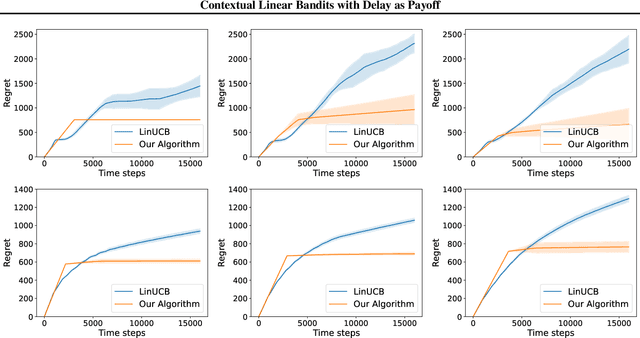
A recent work by Schlisselberg et al. (2024) studies a delay-as-payoff model for stochastic multi-armed bandits, where the payoff (either loss or reward) is delayed for a period that is proportional to the payoff itself. While this captures many real-world applications, the simple multi-armed bandit setting limits the practicality of their results. In this paper, we address this limitation by studying the delay-as-payoff model for contextual linear bandits. Specifically, we start from the case with a fixed action set and propose an efficient algorithm whose regret overhead compared to the standard no-delay case is at most $D\Delta_{\max}\log T$, where $T$ is the total horizon, $D$ is the maximum delay, and $\Delta_{\max}$ is the maximum suboptimality gap. When payoff is loss, we also show further improvement of the bound, demonstrating a separation between reward and loss similar to Schlisselberg et al. (2024). Contrary to standard linear bandit algorithms that construct least squares estimator and confidence ellipsoid, the main novelty of our algorithm is to apply a phased arm elimination procedure by only picking actions in a volumetric spanner of the action set, which addresses challenges arising from both payoff-dependent delays and large action sets. We further extend our results to the case with varying action sets by adopting the reduction from Hanna et al. (2023). Finally, we implement our algorithm and showcase its effectiveness and superior performance in experiments.