 Add to Chrome
 Add to Firefox
 Add to Edge
Equilibrium with Internal Transfers
Jun 18, 2026
Nash equilibrium (NE) arises from selfish utility maximization, yet its social welfare can be arbitrarily far from optimal. Moreover, computing an NE is intractable in general. We study augmented game models in which players use budget-balanced internal transfers to improve incentives before play. We first introduce \emph{Self-Enforcing Transfer Equilibrium} (SETE), where players commit to nonnegative peer-to-peer transfers that are paid only if the recipient does not deviate from a prescribed strategy. For polymatrix games, we show that every stationary point of the social welfare function, in particular any socially optimal strategy profile, can be sustained as a SETE. This induces a Nash equilibrium in the agent normal form of the corresponding augmented game. We further propose a polynomial-time algorithm and a decentralized learning dynamic to compute such product-form equilibria. We then introduce \emph{Mediated Self-Enforcing Transfer Equilibrium} (M-SETE), where a mediator makes both the payment schedule and the prescribed strategies binding offers. This additional enforcement resolves the agent-normal-form limitation: an M-SETE is a Nash equilibrium of the augmented game itself, not merely of its agent normal form, and any socially optimal strategy profile can be supported as an M-SETE in any finite game while preserving budget balance. Thus, internal transfers improve welfare and computation while preserving independent play on the equilibrium path. When full sequential-game stability is required, binding mediation provides the corresponding implementation.

GAE Falls Short in Imperfect-Information Self-Play Reinforcement Learning
May 19, 2026Competitive multi-agent reinforcement learning in imperfect-information games requires agents to act under partial observability and against adversarial opponents, necessitating stochastic policies. While self-play reinforcement learning with Proximal Policy Optimization (PPO) has achieved strong empirical success, its standard advantage estimator, generalized advantage estimation, suffers from additional variance due to the sampling of stochastic future actions. This variance is amplified in equilibrium self-play because of the stochastic nature of the equilibrium policy and persists even when the critic is exact. We address this bottleneck by introducing $Q$-boosting, a variance-reduced advantage estimator based on a centralized action-value critic, and propose Variance-Reduced Policy Optimization (VRPO), incorporating this new estimator. The algorithm replaces sampled multi-step backups with a multi-step Expected SARSA$(λ)$ trace, computing policy expectations at each step to average out action-sampling noise, while retaining PPO's clipped objective and on-policy actor updates. Empirically, VRPO consistently achieves strong performance from mid-sized to large-scale games including Dou Dizhu and Heads-Up No-Limit Texas Hold'em.
An Efficient Black-Box Reduction from Online Learning to Multicalibration, and a New Route to $Φ$-Regret Minimization
Apr 21, 2026We give a Gordon-Greenwald-Marks (GGM) style black-box reduction from online learning to online multicalibration. Concretely, we show that to achieve high-dimensional multicalibration with respect to a class of functions H, it suffices to combine any no-regret learner over H with an expected variational inequality (EVI) solver. We also prove a converse statement showing that efficient multicalibration implies efficient EVI solving, highlighting how EVIs in multicalibration mirror the role of fixed points in the GGM result for $Φ$-regret. This first set of results resolves the main open question in Garg, Jung, Reingold, and Roth (SODA '24), showing that oracle-efficient online multicalibration with $\sqrt{T}$-type guarantees is possible in full generality. Furthermore, our GGM-style reduction unifies the analyses of existing online multicalibration algorithms, enables new algorithms for challenging environments with delayed observations or censored outcomes, and yields the first efficient black-box reduction between online learning and multiclass omniprediction. Our second main result is a fine-grained reduction from high-dimensional online multicalibration to (contextual) $Φ$-regret minimization. Together with our first result, this establishes a new route from external regret to Phi-regret that bypasses sophisticated fixed-point or semi-separation machinery, dramatically simplifies a result of Daskalakis, Farina, Fishelson, Pipis, and Schneider (STOC '25) while improving rates, and yields new algorithms that are robust to richer deviation classes, such as those belonging to any reproducing kernel Hilbert space.
Online Learning and Equilibrium Computation with Ranking Feedback
Mar 19, 2026Online learning in arbitrary, and possibly adversarial, environments has been extensively studied in sequential decision-making, and it is closely connected to equilibrium computation in game theory. Most existing online learning algorithms rely on \emph{numeric} utility feedback from the environment, which may be unavailable in human-in-the-loop applications and/or may be restricted by privacy concerns. In this paper, we study an online learning model in which the learner only observes a \emph{ranking} over a set of proposed actions at each timestep. We consider two ranking mechanisms: rankings induced by the \emph{instantaneous} utility at the current timestep, and rankings induced by the \emph{time-average} utility up to the current timestep, under both \emph{full-information} and \emph{bandit} feedback settings. Using the standard external-regret metric, we show that sublinear regret is impossible with instantaneous-utility ranking feedback in general. Moreover, when the ranking model is relatively deterministic, \emph{i.e.}, under the Plackett-Luce model with a temperature that is sufficiently small, sublinear regret is also impossible with time-average utility ranking feedback. We then develop new algorithms that achieve sublinear regret under the additional assumption that the utility sequence has sublinear total variation. Notably, for full-information time-average utility ranking feedback, this additional assumption can be removed. As a consequence, when all players in a normal-form game follow our algorithms, repeated play yields an approximate coarse correlated equilibrium. We also demonstrate the effectiveness of our algorithms in an online large-language-model routing task.
The Stability of Online Algorithms in Performative Prediction
Feb 27, 2026The use of algorithmic predictions in decision-making leads to a feedback loop where the models we deploy actively influence the data distributions we see, and later use to retrain on. This dynamic was formalized by Perdomo et al. 2020 in their work on performative prediction. Our main result is an unconditional reduction showing that any no-regret algorithm deployed in performative settings converges to a (mixed) performatively stable equilibrium: a solution in which models actively shape data distributions in ways that their own predictions look optimal in hindsight. Prior to our work, all positive results in this area made strong restrictions on how models influenced distributions. By using a martingale argument and allowing randomization, we avoid any such assumption and sidestep recent hardness results for finding stable models. Lastly, on a more conceptual note, our connection sheds light on why common algorithms, like gradient descent, are naturally stabilizing and prevent runaway feedback loops. We hope our work enables future technical transfer of ideas between online optimization and performativity.
Defensive Generation
Feb 24, 2026We study the problem of efficiently producing, in an online fashion, generative models of scalar, multiclass, and vector-valued outcomes that cannot be falsified on the basis of the observed data and a pre-specified collection of computational tests. Our contributions are twofold. First, we expand on connections between online high-dimensional multicalibration with respect to an RKHS and recent advances in expected variational inequality problems, enabling efficient algorithms for the former. We then apply this algorithmic machinery to the problem of outcome indistinguishability. Our procedure, Defensive Generation, is the first to efficiently produce online outcome indistinguishable generative models of non-Bernoulli outcomes that are unfalsifiable with respect to infinite classes of tests, including those that examine higher-order moments of the generated distributions. Furthermore, our method runs in near-linear time in the number of samples and achieves the optimal, vanishing T^{-1/2} rate for generation error.
Swap Regret Minimization Through Response-Based Approachability
Feb 05, 2026We consider the problem of minimizing different notions of swap regret in online optimization. These forms of regret are tightly connected to correlated equilibrium concepts in games, and have been more recently shown to guarantee non-manipulability against strategic adversaries. The only computationally efficient algorithm for minimizing linear swap regret over a general convex set in $\mathbb{R}^d$ was developed recently by Daskalakis, Farina, Fishelson, Pipis, and Schneider (STOC '25). However, it incurs a highly suboptimal regret bound of $Ω(d^4 \sqrt{T})$ and also relies on computationally intensive calls to the ellipsoid algorithm at each iteration. In this paper, we develop a significantly simpler, computationally efficient algorithm that guarantees $O(d^{3/2} \sqrt{T})$ linear swap regret for a general convex set and $O(d \sqrt{T})$ when the set is centrally symmetric. Our approach leverages the powerful response-based approachability framework of Bernstein and Shimkin (JMLR '15) -- previously overlooked in the line of work on swap regret minimization -- combined with geometric preconditioning via the John ellipsoid. Our algorithm simultaneously minimizes profile swap regret, which was recently shown to guarantee non-manipulability. Moreover, we establish a matching information-theoretic lower bound: any learner must incur in expectation $Ω(d \sqrt{T})$ linear swap regret for large enough $T$, even when the set is centrally symmetric. This also shows that the classic algorithm of Gordon, Greenwald, and Marks (ICML '08) is existentially optimal for minimizing linear swap regret, although it is computationally inefficient. Finally, we extend our approach to minimize regret with respect to the set of swap deviations with polynomial dimension, unifying and strengthening recent results in equilibrium computation and online learning.
Superhuman AI for Stratego Using Self-Play Reinforcement Learning and Test-Time Search
Nov 10, 2025Few classical games have been regarded as such significant benchmarks of artificial intelligence as to have justified training costs in the millions of dollars. Among these, Stratego -- a board wargame exemplifying the challenge of strategic decision making under massive amounts of hidden information -- stands apart as a case where such efforts failed to produce performance at the level of top humans. This work establishes a step change in both performance and cost for Stratego, showing that it is now possible not only to reach the level of top humans, but to achieve vastly superhuman level -- and that doing so requires not an industrial budget, but merely a few thousand dollars. We achieved this result by developing general approaches for self-play reinforcement learning and test-time search under imperfect information.
Cautious Optimism: A Meta-Algorithm for Near-Constant Regret in General Games
Jun 05, 2025Recent work [Soleymani et al., 2025] introduced a variant of Optimistic Multiplicative Weights Updates (OMWU) that adaptively controls the learning pace in a dynamic, non-monotone manner, achieving new state-of-the-art regret minimization guarantees in general games. In this work, we demonstrate that no-regret learning acceleration through adaptive pacing of the learners is not an isolated phenomenon. We introduce \emph{Cautious Optimism}, a framework for substantially faster regularized learning in general games. Cautious Optimism takes as input any instance of Follow-the-Regularized-Leader (FTRL) and outputs an accelerated no-regret learning algorithm by pacing the underlying FTRL with minimal computational overhead. Importantly, we retain uncoupledness (learners do not need to know other players' utilities). Cautious Optimistic FTRL achieves near-optimal $O_T(\log T)$ regret in diverse self-play (mixing-and-matching regularizers) while preserving the optimal $O(\sqrt{T})$ regret in adversarial scenarios. In contrast to prior works (e.g. Syrgkanis et al. [2015], Daskalakis et al. [2021]), our analysis does not rely on monotonic step-sizes, showcasing a novel route for fast learning in general games.
UFT: Unifying Supervised and Reinforcement Fine-Tuning
May 22, 2025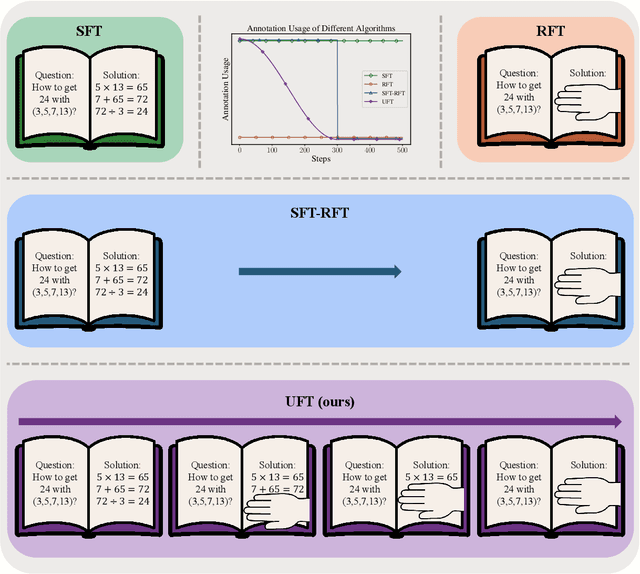
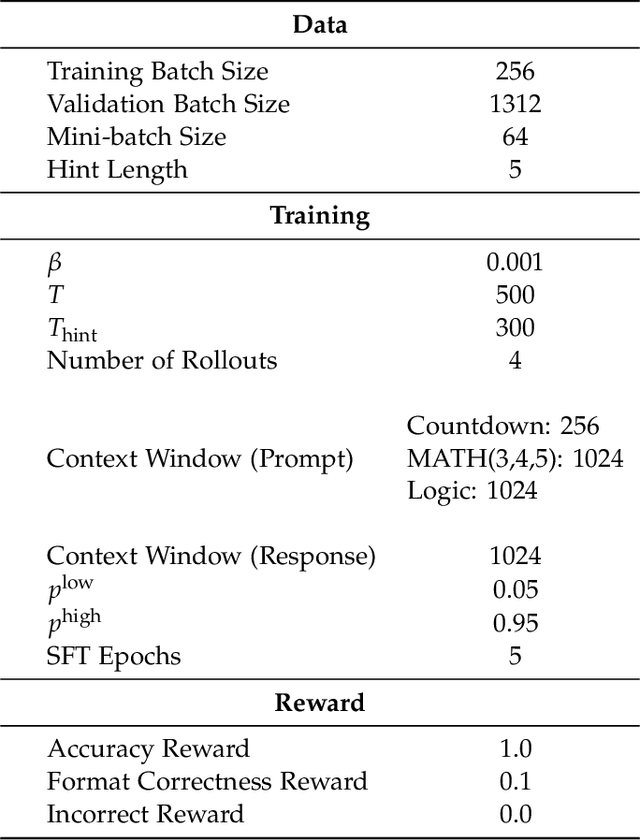
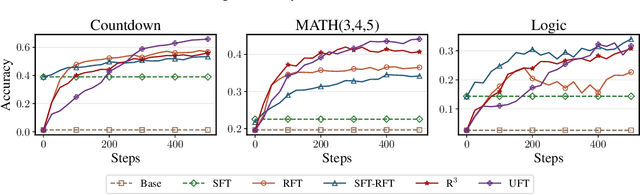
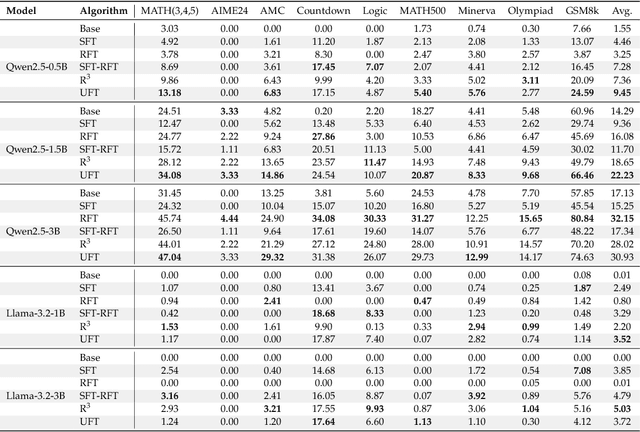
Post-training has demonstrated its importance in enhancing the reasoning capabilities of large language models (LLMs). The primary post-training methods can be categorized into supervised fine-tuning (SFT) and reinforcement fine-tuning (RFT). SFT is efficient and well-suited for small language models, but it may lead to overfitting and limit the reasoning abilities of larger models. In contrast, RFT generally yields better generalization but depends heavily on the strength of the base model. To address the limitations of SFT and RFT, we propose Unified Fine-Tuning (UFT), a novel post-training paradigm that unifies SFT and RFT into a single, integrated process. UFT enables the model to effectively explore solutions while incorporating informative supervision signals, bridging the gap between memorizing and thinking underlying existing methods. Notably, UFT outperforms both SFT and RFT in general, regardless of model sizes. Furthermore, we theoretically prove that UFT breaks RFT's inherent exponential sample complexity bottleneck, showing for the first time that unified training can exponentially accelerate convergence on long-horizon reasoning tasks.