 Add to Chrome
 Add to Firefox
 Add to Edge
Surg-R1: A Hierarchical Reasoning Foundation Model for Scalable and Interpretable Surgical Decision Support with Multi-Center Clinical Validation
Mar 12, 2026
Surgical scene understanding demands not only accurate predictions but also interpretable reasoning that surgeons can verify against clinical expertise. However, existing surgical vision-language models generate predictions without reasoning chains, and general-purpose reasoning models fail on compositional surgical tasks without domain-specific knowledge. We present Surg-R1, a surgical Vision-Language Model that addresses this gap through hierarchical reasoning trained via a four-stage pipeline. Our approach introduces three key contributions: (1) a three-level reasoning hierarchy decomposing surgical interpretation into perceptual grounding, relational understanding, and contextual reasoning; (2) the largest surgical chain-of-thought dataset with 320,000 reasoning pairs; and (3) a four-stage training pipeline progressing from supervised fine-tuning to group relative policy optimization and iterative self-improvement. Evaluation on SurgBench, comprising six public benchmarks and six multi-center external validation datasets from five institutions, demonstrates that Surg-R1 achieves the highest Arena Score (64.9%) on public benchmarks versus Gemini 3.0 Pro (46.1%) and GPT-5.1 (37.9%), outperforming both proprietary reasoning models and specialized surgical VLMs on the majority of tasks spanning instrument localization, triplet recognition, phase recognition, action recognition, and critical view of safety assessment, with a 15.2 percentage point improvement over the strongest surgical baseline on external validation.

On the Strengths and Weaknesses of Data for Open-set Embodied Assistance
Mar 05, 2026Embodied foundation models are increasingly performant in real-world domains such as robotics or autonomous driving. These models are often deployed in interactive or assistive settings, where it is important that these assistive models generalize to new users and new tasks. Diverse interactive data generation offers a promising avenue for providing data-efficient generalization capabilities for interactive embodied foundation models. In this paper, we investigate the generalization capabilities of a multimodal foundation model fine-tuned on diverse interactive assistance data in a synthetic domain. We explore generalization along two axes: a) assistance with unseen categories of user behavior and b) providing guidance in new configurations not encountered during training. We study a broad capability called \textbf{Open-Set Corrective Assistance}, in which the model needs to inspect lengthy user behavior and provide assistance through either corrective actions or language-based feedback. This task remains unsolved in prior work, which typically assumes closed corrective categories or relies on external planners, making it a challenging testbed for evaluating the limits of assistive data. To support this task, we generate synthetic assistive datasets in Overcooked and fine-tune a LLaMA-based model to evaluate generalization to novel tasks and user behaviors. Our approach provides key insights into the nature of assistive datasets required to enable open-set assistive intelligence. In particular, we show that performant models benefit from datasets that cover different aspects of assistance, including multimodal grounding, defect inference, and exposure to diverse scenarios.
Learning to Plan, Planning to Learn: Adaptive Hierarchical RL-MPC for Sample-Efficient Decision Making
Dec 18, 2025We propose a new approach for solving planning problems with a hierarchical structure, fusing reinforcement learning and MPC planning. Our formulation tightly and elegantly couples the two planning paradigms. It leverages reinforcement learning actions to inform the MPPI sampler, and adaptively aggregates MPPI samples to inform the value estimation. The resulting adaptive process leverages further MPPI exploration where value estimates are uncertain, and improves training robustness and the overall resulting policies. This results in a robust planning approach that can handle complex planning problems and easily adapts to different applications, as demonstrated over several domains, including race driving, modified Acrobot, and Lunar Lander with added obstacles. Our results in these domains show better data efficiency and overall performance in terms of both rewards and task success, with up to a 72% increase in success rate compared to existing approaches, as well as accelerated convergence (x2.1) compared to non-adaptive sampling.
SAFe-Copilot: Unified Shared Autonomy Framework
Nov 06, 2025Autonomous driving systems remain brittle in rare, ambiguous, and out-of-distribution scenarios, where human driver succeed through contextual reasoning. Shared autonomy has emerged as a promising approach to mitigate such failures by incorporating human input when autonomy is uncertain. However, most existing methods restrict arbitration to low-level trajectories, which represent only geometric paths and therefore fail to preserve the underlying driving intent. We propose a unified shared autonomy framework that integrates human input and autonomous planners at a higher level of abstraction. Our method leverages Vision Language Models (VLMs) to infer driver intent from multi-modal cues -- such as driver actions and environmental context -- and to synthesize coherent strategies that mediate between human and autonomous control. We first study the framework in a mock-human setting, where it achieves perfect recall alongside high accuracy and precision. A human-subject survey further shows strong alignment, with participants agreeing with arbitration outcomes in 92% of cases. Finally, evaluation on the Bench2Drive benchmark demonstrates a substantial reduction in collision rate and improvement in overall performance compared to pure autonomy. Arbitration at the level of semantic, language-based representations emerges as a design principle for shared autonomy, enabling systems to exercise common-sense reasoning and maintain continuity with human intent.
ReGen: Generative Robot Simulation via Inverse Design
Nov 06, 2025Simulation plays a key role in scaling robot learning and validating policies, but constructing simulations remains a labor-intensive process. This paper introduces ReGen, a generative simulation framework that automates simulation design via inverse design. Given a robot's behavior -- such as a motion trajectory or an objective function -- and its textual description, ReGen infers plausible scenarios and environments that could have caused the behavior. ReGen leverages large language models to synthesize scenarios by expanding a directed graph that encodes cause-and-effect relationships, relevant entities, and their properties. This structured graph is then translated into a symbolic program, which configures and executes a robot simulation environment. Our framework supports (i) augmenting simulations based on ego-agent behaviors, (ii) controllable, counterfactual scenario generation, (iii) reasoning about agent cognition and mental states, and (iv) reasoning with distinct sensing modalities, such as braking due to faulty GPS signals. We demonstrate ReGen in autonomous driving and robot manipulation tasks, generating more diverse, complex simulated environments compared to existing simulations with high success rates, and enabling controllable generation for corner cases. This approach enhances the validation of robot policies and supports data or simulation augmentation, advancing scalable robot learning for improved generalization and robustness. We provide code and example videos at: https://regen-sim.github.io/
Estimating cognitive biases with attention-aware inverse planning
Oct 29, 2025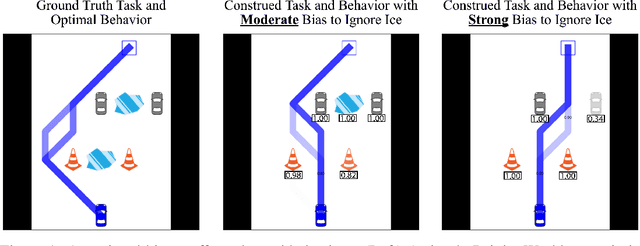
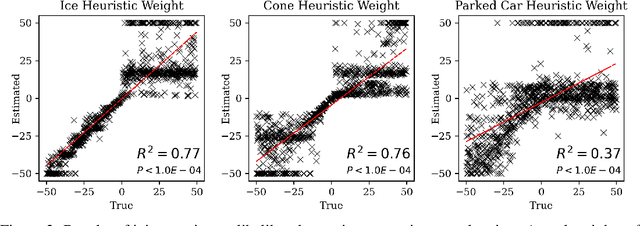
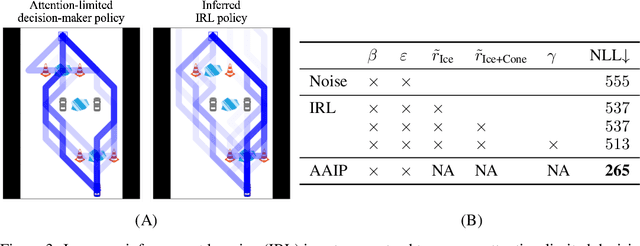
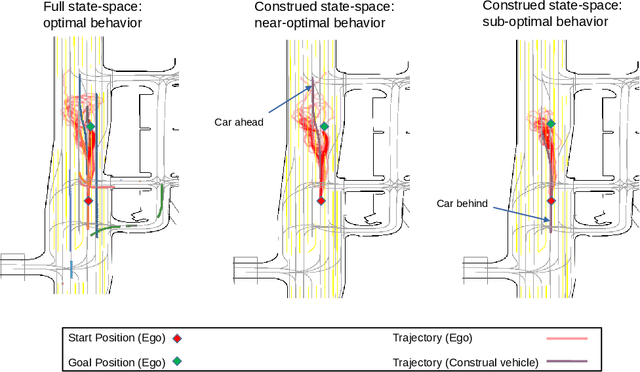
People's goal-directed behaviors are influenced by their cognitive biases, and autonomous systems that interact with people should be aware of this. For example, people's attention to objects in their environment will be biased in a way that systematically affects how they perform everyday tasks such as driving to work. Here, building on recent work in computational cognitive science, we formally articulate the attention-aware inverse planning problem, in which the goal is to estimate a person's attentional biases from their actions. We demonstrate how attention-aware inverse planning systematically differs from standard inverse reinforcement learning and how cognitive biases can be inferred from behavior. Finally, we present an approach to attention-aware inverse planning that combines deep reinforcement learning with computational cognitive modeling. We use this approach to infer the attentional strategies of RL agents in real-life driving scenarios selected from the Waymo Open Dataset, demonstrating the scalability of estimating cognitive biases with attention-aware inverse planning.
SimCoachCorpus: A naturalistic dataset with language and trajectories for embodied teaching
Sep 18, 2025Curated datasets are essential for training and evaluating AI approaches, but are often lacking in domains where language and physical action are deeply intertwined. In particular, few datasets capture how people acquire embodied skills through verbal instruction over time. To address this gap, we introduce SimCoachCorpus: a unique dataset of race car simulator driving that allows for the investigation of rich interactive phenomena during guided and unguided motor skill acquisition. In this dataset, 29 humans were asked to drive in a simulator around a race track for approximately ninety minutes. Fifteen participants were given personalized one-on-one instruction from a professional performance driving coach, and 14 participants drove without coaching. \name\ includes embodied features such as vehicle state and inputs, map (track boundaries and raceline), and cone landmarks. These are synchronized with concurrent verbal coaching from a professional coach and additional feedback at the end of each lap. We further provide annotations of coaching categories for each concurrent feedback utterance, ratings on students' compliance with coaching advice, and self-reported cognitive load and emotional state of participants (gathered from surveys during the study). The dataset includes over 20,000 concurrent feedback utterances, over 400 terminal feedback utterances, and over 40 hours of vehicle driving data. Our naturalistic dataset can be used for investigating motor learning dynamics, exploring linguistic phenomena, and training computational models of teaching. We demonstrate applications of this dataset for in-context learning, imitation learning, and topic modeling. The dataset introduced in this work will be released publicly upon publication of the peer-reviewed version of this paper. Researchers interested in early access may register at https://tinyurl.com/SimCoachCorpusForm.
Timing the Message: Language-Based Notifications for Time-Critical Assistive Settings
Sep 09, 2025In time-critical settings such as assistive driving, assistants often rely on alerts or haptic signals to prompt rapid human attention, but these cues usually leave humans to interpret situations and decide responses independently, introducing potential delays or ambiguity in meaning. Language-based assistive systems can instead provide instructions backed by context, offering more informative guidance. However, current approaches (e.g., social assistive robots) largely prioritize content generation while overlooking critical timing factors such as verbal conveyance duration, human comprehension delays, and subsequent follow-through duration. These timing considerations are crucial in time-critical settings, where even minor delays can substantially affect outcomes. We aim to study this inherent trade-off between timeliness and informativeness by framing the challenge as a sequential decision-making problem using an augmented-state Markov Decision Process. We design a framework combining reinforcement learning and a generated offline taxonomy dataset, where we balance the trade-off while enabling a scalable taxonomy dataset generation pipeline. Empirical evaluation with synthetic humans shows our framework improves success rates by over 40% compared to methods that ignore time delays, while effectively balancing timeliness and informativeness. It also exposes an often-overlooked trade-off between these two factors, opening new directions for optimizing communication in time-critical human-AI assistance.
Holistic Surgical Phase Recognition with Hierarchical Input Dependent State Space Models
Jun 26, 2025Surgical workflow analysis is essential in robot-assisted surgeries, yet the long duration of such procedures poses significant challenges for comprehensive video analysis. Recent approaches have predominantly relied on transformer models; however, their quadratic attention mechanism restricts efficient processing of lengthy surgical videos. In this paper, we propose a novel hierarchical input-dependent state space model that leverages the linear scaling property of state space models to enable decision making on full-length videos while capturing both local and global dynamics. Our framework incorporates a temporally consistent visual feature extractor, which appends a state space model head to a visual feature extractor to propagate temporal information. The proposed model consists of two key modules: a local-aggregation state space model block that effectively captures intricate local dynamics, and a global-relation state space model block that models temporal dependencies across the entire video. The model is trained using a hybrid discrete-continuous supervision strategy, where both signals of discrete phase labels and continuous phase progresses are propagated through the network. Experiments have shown that our method outperforms the current state-of-the-art methods by a large margin (+2.8% on Cholec80, +4.3% on MICCAI2016, and +12.9% on Heichole datasets). Code will be publicly available after paper acceptance.
Safety with Agency: Human-Centered Safety Filter with Application to AI-Assisted Motorsports
Apr 16, 2025We propose a human-centered safety filter (HCSF) for shared autonomy that significantly enhances system safety without compromising human agency. Our HCSF is built on a neural safety value function, which we first learn scalably through black-box interactions and then use at deployment to enforce a novel quality control barrier function (Q-CBF) safety constraint. Since this Q-CBF safety filter does not require any knowledge of the system dynamics for both synthesis and runtime safety monitoring and intervention, our method applies readily to complex, black-box shared autonomy systems. Notably, our HCSF's CBF-based interventions modify the human's actions minimally and smoothly, avoiding the abrupt, last-moment corrections delivered by many conventional safety filters. We validate our approach in a comprehensive in-person user study using Assetto Corsa-a high-fidelity car racing simulator with black-box dynamics-to assess robustness in "driving on the edge" scenarios. We compare both trajectory data and drivers' perceptions of our HCSF assistance against unassisted driving and a conventional safety filter. Experimental results show that 1) compared to having no assistance, our HCSF improves both safety and user satisfaction without compromising human agency or comfort, and 2) relative to a conventional safety filter, our proposed HCSF boosts human agency, comfort, and satisfaction while maintaining robustness.