 Add to Chrome
 Add to Firefox
 Add to Edge
G$^2$SR: Geometric Methods for Fast and Memory-Efficient Gaussian-based Surface Reconstruction
Jul 16, 2026
Few-view surface reconstruction recovers the visible surfaces of a scene from a few posed RGB images, providing the 3D models that robots need to explore and interact online. On mobile platforms, the reconstruction must be fast and geometrically accurate while keeping a small memory footprint to ensure safe and efficient operation. 3D Gaussian Splatting (3DGS) offers a high-fidelity scene representation, but building it from a few views is ill-posed, as many distinct surfaces reproduce the same images, making traditional photometric methods prone to "floater" artifacts. End-to-end methods resolve the ambiguity by regressing splats with large, usually Transformer-based, networks that require heavy compute and memory while generalizing poorly to new scenes. We propose G2SR, which exploits a well-posed core of the task: given cross-view 2D splat correspondences, 3D splats follow analytically from multi-view geometry. G2SR employs a lightweight neural frontend to detect and track 2D Gaussian splats on the image plane and an analytic backend to triangulate each into a metric-scale 3D splat. On ScanNet, Replica, and DTU, G2SR matches or exceeds the geometric accuracy of state-of-the-art end-to-end methods while running at 69-89 reconstructions per second within 203 MB of GPU memory (5-107x less) for 2- and 3-view inputs at 384 x 512 resolution, offering a practical path to online Gaussian-based surface reconstruction.

Motion Planning in Compressed Representation Spaces
Jun 29, 2026Deep learning methods have vastly expanded the capabilities of motion planning in robotics applications, as learning priors from large-scale data has been shown to be essential in capturing the highly complex behavior required for solving tasks such as manipulation or navigation for autonomous vehicles. At the same time, model-based planning algorithms based on search or optimization remain an essential tool due to their flexibility, efficiency, and the ability to incorporate domain knowledge via expert-designed algorithms and objective functions. We propose a new generative framework to unify these two paradigms. First, we learn an autoencoder with a high compression ratio and a latent space of hierarchically ordered, discrete-valued tokens. Leveraging both the dimensionality reduction and the hierarchical coarse-to-fine structure learned by this autoencoder, we then perform motion planning by directly searching in the latent space of tokens. This search can optimize arbitrary objective functions specified at test time, providing a large degree of flexibility while maintaining efficiency and producing realistic solutions by relying on the generative capabilities of the highly compressed autoencoder. We evaluate our method on nuPlan and the Waymo Open Motion Dataset, showing how latent space search can be used for a variety of guided behavior generation tasks, achieving strong performance for closed-loop motion planning and multi-agent guided scenario synthesis without requiring any task-specific training.
UfM*: Uncertainty from Motion* for DNN Depth Estimation Using Gaussians
May 21, 2026Reliable uncertainty estimation is critical for deploying monocular depth deep neural networks (DNNs) in safety-critical robotic systems. Conventional uncertainty methods such as ensembles and sampling-based approaches require multiple inferences per image, incurring substantial compute and memory overhead. Moreover, uncertainty predicted from a single image misses out on measuring disagreement between predictions across views of the same region. We propose Uncertainty from Motion* (UfM*), an uncertainty estimation algorithm that measures multiview disagreement efficiently by comparing previous and current views using a compact Gaussian mixture, requiring only a single DNN inference per image. Using Gaussians to compute multiview disagreement is not only more compute- and memory-efficient than a prior approach using a point cloud, but also improves uncertainty by measuring disagreement across regions of 3D space. UfM* paired with aleatoric uncertainty improves expected calibration error by 24-28% compared to an ensemble, while requiring only 3% of the energy and 0.02% of the memory on 100 out-of-distribution ScanNet sequences. We demonstrate UfM* consumes only 63 mJ per 224x224 image while running real-time at 30 FPS on an Arm Cortex-A76 CPU onboard a miniature energy-constrained robot, highlighting that measuring multiview disagreement using Gaussians enables efficient uncertainty for resource-constrained robotic systems.
Gleanmer: A 6 mW SoC for Real-Time 3D Gaussian Occupancy Mapping
Mar 30, 2026High-fidelity 3D occupancy mapping is essential for many edge-based applications (such as AR/VR and autonomous navigation) but is limited by power constraints. We present Gleanmer, a system on chip (SoC) with an accelerator for GMMap, a 3D occupancy map using Gaussians. Through algorithm-hardware co-optimizations for direct computation and efficient reuse of these compact Gaussians, Gleanmer reduces construction and query energy by up to 63% and 81%, respectively. Approximate computation on Gaussians reduces accelerator area by 38%. Using 16nm CMOS, Gleanmer processes 640x480 images in real time beyond 88 fps during map construction and processes over 540K coordinates per second during map query. To our knowledge, Gleanmer is the first fabricated SoC to achieve real-time 3D occupancy mapping under 6 mW for edge-based applications.
Flow Matching with Uncertainty Quantification and Guidance
Feb 10, 2026Despite the remarkable success of sampling-based generative models such as flow matching, they can still produce samples of inconsistent or degraded quality. To assess sample reliability and generate higher-quality outputs, we propose uncertainty-aware flow matching (UA-Flow), a lightweight extension of flow matching that predicts the velocity field together with heteroscedastic uncertainty. UA-Flow estimates per-sample uncertainty by propagating velocity uncertainty through the flow dynamics. These uncertainty estimates act as a reliability signal for individual samples, and we further use them to steer generation via uncertainty-aware classifier guidance and classifier-free guidance. Experiments on image generation show that UA-Flow produces uncertainty signals more highly correlated with sample fidelity than baseline methods, and that uncertainty-guided sampling further improves generation quality.
ReGen: Generative Robot Simulation via Inverse Design
Nov 06, 2025Simulation plays a key role in scaling robot learning and validating policies, but constructing simulations remains a labor-intensive process. This paper introduces ReGen, a generative simulation framework that automates simulation design via inverse design. Given a robot's behavior -- such as a motion trajectory or an objective function -- and its textual description, ReGen infers plausible scenarios and environments that could have caused the behavior. ReGen leverages large language models to synthesize scenarios by expanding a directed graph that encodes cause-and-effect relationships, relevant entities, and their properties. This structured graph is then translated into a symbolic program, which configures and executes a robot simulation environment. Our framework supports (i) augmenting simulations based on ego-agent behaviors, (ii) controllable, counterfactual scenario generation, (iii) reasoning about agent cognition and mental states, and (iv) reasoning with distinct sensing modalities, such as braking due to faulty GPS signals. We demonstrate ReGen in autonomous driving and robot manipulation tasks, generating more diverse, complex simulated environments compared to existing simulations with high success rates, and enabling controllable generation for corner cases. This approach enhances the validation of robot policies and supports data or simulation augmentation, advancing scalable robot learning for improved generalization and robustness. We provide code and example videos at: https://regen-sim.github.io/
SAFe-Copilot: Unified Shared Autonomy Framework
Nov 06, 2025Autonomous driving systems remain brittle in rare, ambiguous, and out-of-distribution scenarios, where human driver succeed through contextual reasoning. Shared autonomy has emerged as a promising approach to mitigate such failures by incorporating human input when autonomy is uncertain. However, most existing methods restrict arbitration to low-level trajectories, which represent only geometric paths and therefore fail to preserve the underlying driving intent. We propose a unified shared autonomy framework that integrates human input and autonomous planners at a higher level of abstraction. Our method leverages Vision Language Models (VLMs) to infer driver intent from multi-modal cues -- such as driver actions and environmental context -- and to synthesize coherent strategies that mediate between human and autonomous control. We first study the framework in a mock-human setting, where it achieves perfect recall alongside high accuracy and precision. A human-subject survey further shows strong alignment, with participants agreeing with arbitration outcomes in 92% of cases. Finally, evaluation on the Bench2Drive benchmark demonstrates a substantial reduction in collision rate and improvement in overall performance compared to pure autonomy. Arbitration at the level of semantic, language-based representations emerges as a design principle for shared autonomy, enabling systems to exercise common-sense reasoning and maintain continuity with human intent.
SCREP: Scene Coordinate Regression and Evidential Learning-based Perception-Aware Trajectory Generation
Jul 10, 2025Autonomous flight in GPS denied indoor spaces requires trajectories that keep visual localization error tightly bounded across varied missions. Whereas visual inertial odometry (VIO) accumulates drift over time, scene coordinate regression (SCR) yields drift-free, high accuracy absolute pose estimation. We present a perception-aware framework that couples an evidential learning-based SCR pose estimator with a receding horizon trajectory optimizer. The optimizer steers the onboard camera toward pixels whose uncertainty predicts reliable scene coordinates, while a fixed-lag smoother fuses the low rate SCR stream with high rate IMU data to close the perception control loop in real time. In simulation, our planner reduces translation (rotation) mean error by 54% / 15% (40% / 31%) relative to yaw fixed and forward-looking baselines, respectively. Moreover, hardware in the loop experiment validates the feasibility of our proposed framework.
Real-Time Sampling-based Online Planning for Drone Interception
Feb 20, 2025This paper studies high-speed online planning in dynamic environments. The problem requires finding time-optimal trajectories that conform to system dynamics, meeting computational constraints for real-time adaptation, and accounting for uncertainty from environmental changes. To address these challenges, we propose a sampling-based online planning algorithm that leverages neural network inference to replace time-consuming nonlinear trajectory optimization, enabling rapid exploration of multiple trajectory options under uncertainty. The proposed method is applied to the drone interception problem, where a defense drone must intercept a target while avoiding collisions and handling imperfect target predictions. The algorithm efficiently generates trajectories toward multiple potential target drone positions in parallel. It then assesses trajectory reachability by comparing traversal times with the target drone's predicted arrival time, ultimately selecting the minimum-time reachable trajectory. Through extensive validation in both simulated and real-world environments, we demonstrate our method's capability for high-rate online planning and its adaptability to unpredictable movements in unstructured settings.
Generating Out-Of-Distribution Scenarios Using Language Models
Nov 25, 2024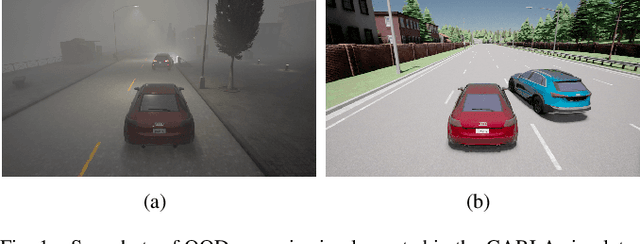
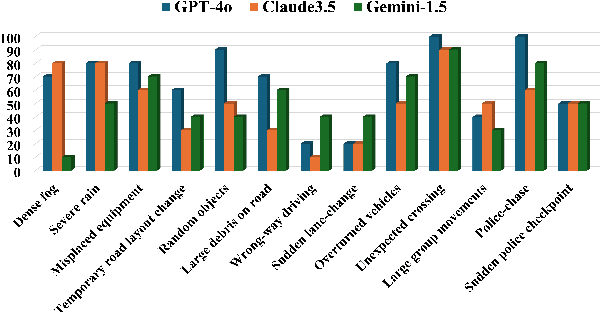
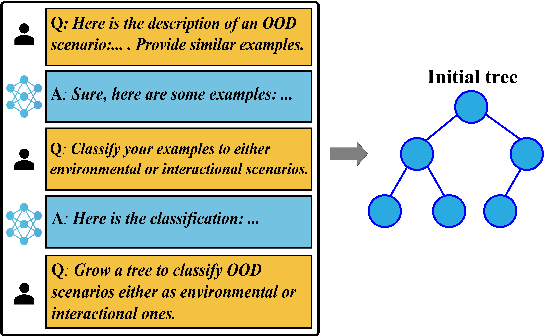
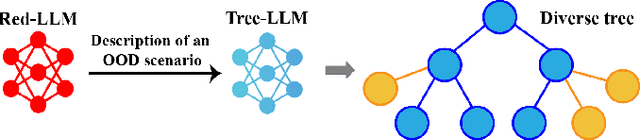
The deployment of autonomous vehicles controlled by machine learning techniques requires extensive testing in diverse real-world environments, robust handling of edge cases and out-of-distribution scenarios, and comprehensive safety validation to ensure that these systems can navigate safely and effectively under unpredictable conditions. Addressing Out-Of-Distribution (OOD) driving scenarios is essential for enhancing safety, as OOD scenarios help validate the reliability of the models within the vehicle's autonomy stack. However, generating OOD scenarios is challenging due to their long-tailed distribution and rarity in urban driving dataset. Recently, Large Language Models (LLMs) have shown promise in autonomous driving, particularly for their zero-shot generalization and common-sense reasoning capabilities. In this paper, we leverage these LLM strengths to introduce a framework for generating diverse OOD driving scenarios. Our approach uses LLMs to construct a branching tree, where each branch represents a unique OOD scenario. These scenarios are then simulated in the CARLA simulator using an automated framework that aligns scene augmentation with the corresponding textual descriptions. We evaluate our framework through extensive simulations, and assess its performance via a diversity metric that measures the richness of the scenarios. Additionally, we introduce a new "OOD-ness" metric, which quantifies how much the generated scenarios deviate from typical urban driving conditions. Furthermore, we explore the capacity of modern Vision-Language Models (VLMs) to interpret and safely navigate through the simulated OOD scenarios. Our findings offer valuable insights into the reliability of language models in addressing OOD scenarios within the context of urban driving.