 Add to Chrome
 Add to Firefox
 Add to Edge
Spatio-Temporal Retrieval-based Priors for Adaptive Computational Teaching in Driving
Jun 23, 2026
Learning-based automated coaching systems for complex motor tasks such as high-performance driving remain limited in the ability to be adaptive by their reliance only on local, context-dependent reasoning, failing to account for the long-term temporal nature of student learning and the cumulative impact of repeated teacher-student interactions. In this paper, we propose an imitation learning based computational model for adaptive teaching with a dedicated temporal reasoning module that can reason over the interaction history under low-data regimes. To compensate for limited amounts of interactive training data, and based on the repetitive nature of the teaching process, the model relies on a nearest neighbor retrieval and cross attention prior, reasoning only on a narrowed-down set of semantically similar past interactions with an encoder-decoder based concurrent teaching model. We validate our approach with (i) a novel semi-synthetic closed-loop longitudinal student-teacher interaction dataset based on Waymo Open Motion Dataset and (ii) a small-scale real-world naturalistic simulator race coaching dataset. Our results reveal the consistent advantage of our adaptive teaching model with the nearest neighbor retrieval and cross-attention prior over a non-adaptive baseline as well as a suite of adaptive models that differ in their choice of priors and temporal fusion mechanisms.

On the Strengths and Weaknesses of Data for Open-set Embodied Assistance
Mar 05, 2026Embodied foundation models are increasingly performant in real-world domains such as robotics or autonomous driving. These models are often deployed in interactive or assistive settings, where it is important that these assistive models generalize to new users and new tasks. Diverse interactive data generation offers a promising avenue for providing data-efficient generalization capabilities for interactive embodied foundation models. In this paper, we investigate the generalization capabilities of a multimodal foundation model fine-tuned on diverse interactive assistance data in a synthetic domain. We explore generalization along two axes: a) assistance with unseen categories of user behavior and b) providing guidance in new configurations not encountered during training. We study a broad capability called \textbf{Open-Set Corrective Assistance}, in which the model needs to inspect lengthy user behavior and provide assistance through either corrective actions or language-based feedback. This task remains unsolved in prior work, which typically assumes closed corrective categories or relies on external planners, making it a challenging testbed for evaluating the limits of assistive data. To support this task, we generate synthetic assistive datasets in Overcooked and fine-tune a LLaMA-based model to evaluate generalization to novel tasks and user behaviors. Our approach provides key insights into the nature of assistive datasets required to enable open-set assistive intelligence. In particular, we show that performant models benefit from datasets that cover different aspects of assistance, including multimodal grounding, defect inference, and exposure to diverse scenarios.
SimCoachCorpus: A naturalistic dataset with language and trajectories for embodied teaching
Sep 18, 2025Curated datasets are essential for training and evaluating AI approaches, but are often lacking in domains where language and physical action are deeply intertwined. In particular, few datasets capture how people acquire embodied skills through verbal instruction over time. To address this gap, we introduce SimCoachCorpus: a unique dataset of race car simulator driving that allows for the investigation of rich interactive phenomena during guided and unguided motor skill acquisition. In this dataset, 29 humans were asked to drive in a simulator around a race track for approximately ninety minutes. Fifteen participants were given personalized one-on-one instruction from a professional performance driving coach, and 14 participants drove without coaching. \name\ includes embodied features such as vehicle state and inputs, map (track boundaries and raceline), and cone landmarks. These are synchronized with concurrent verbal coaching from a professional coach and additional feedback at the end of each lap. We further provide annotations of coaching categories for each concurrent feedback utterance, ratings on students' compliance with coaching advice, and self-reported cognitive load and emotional state of participants (gathered from surveys during the study). The dataset includes over 20,000 concurrent feedback utterances, over 400 terminal feedback utterances, and over 40 hours of vehicle driving data. Our naturalistic dataset can be used for investigating motor learning dynamics, exploring linguistic phenomena, and training computational models of teaching. We demonstrate applications of this dataset for in-context learning, imitation learning, and topic modeling. The dataset introduced in this work will be released publicly upon publication of the peer-reviewed version of this paper. Researchers interested in early access may register at https://tinyurl.com/SimCoachCorpusForm.
Computational Teaching for Driving via Multi-Task Imitation Learning
Oct 02, 2024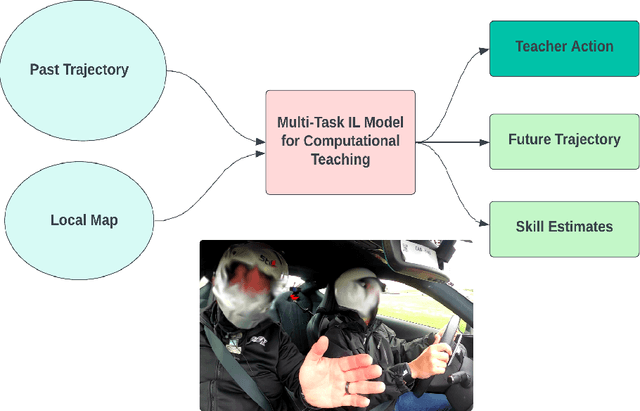
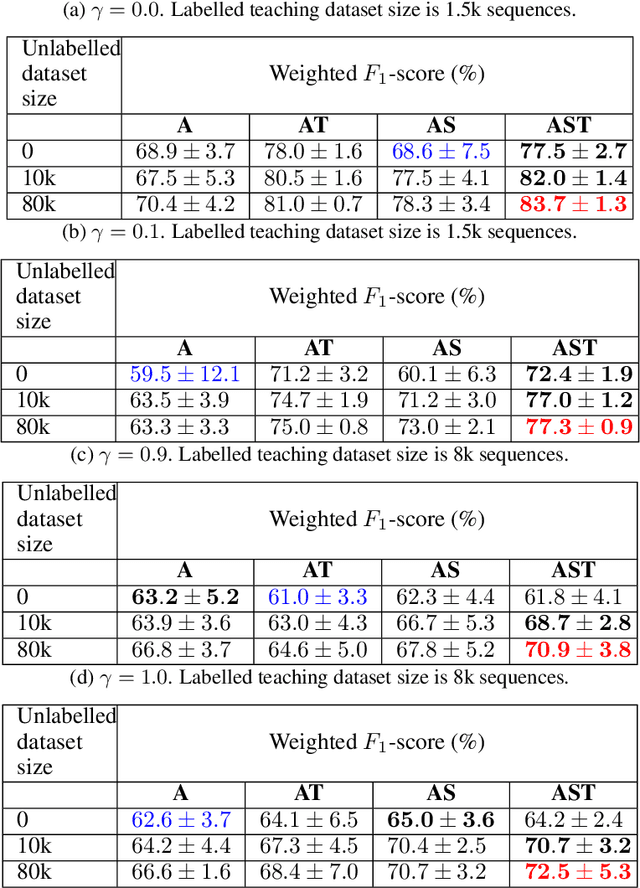

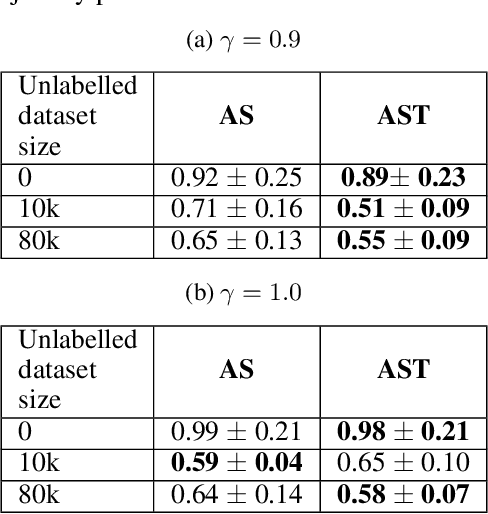
Learning motor skills for sports or performance driving is often done with professional instruction from expert human teachers, whose availability is limited. Our goal is to enable automated teaching via a learned model that interacts with the student similar to a human teacher. However, training such automated teaching systems is limited by the availability of high-quality annotated datasets of expert teacher and student interactions that are difficult to collect at scale. To address this data scarcity problem, we propose an approach for training a coaching system for complex motor tasks such as high performance driving via a Multi-Task Imitation Learning (MTIL) paradigm. MTIL allows our model to learn robust representations by utilizing self-supervised training signals from more readily available non-interactive datasets of humans performing the task of interest. We validate our approach with (1) a semi-synthetic dataset created from real human driving trajectories, (2) a professional track driving instruction dataset, (3) a track-racing driving simulator human-subject study, and (4) a system demonstration on an instrumented car at a race track. Our experiments show that the right set of auxiliary machine learning tasks improves performance in predicting teaching instructions. Moreover, in the human subjects study, students exposed to the instructions from our teaching system improve their ability to stay within track limits, and show favorable perception of the model's interaction with them, in terms of usefulness and satisfaction.
GAME-UP: Game-Aware Mode Enumeration and Understanding for Trajectory Prediction
May 28, 2023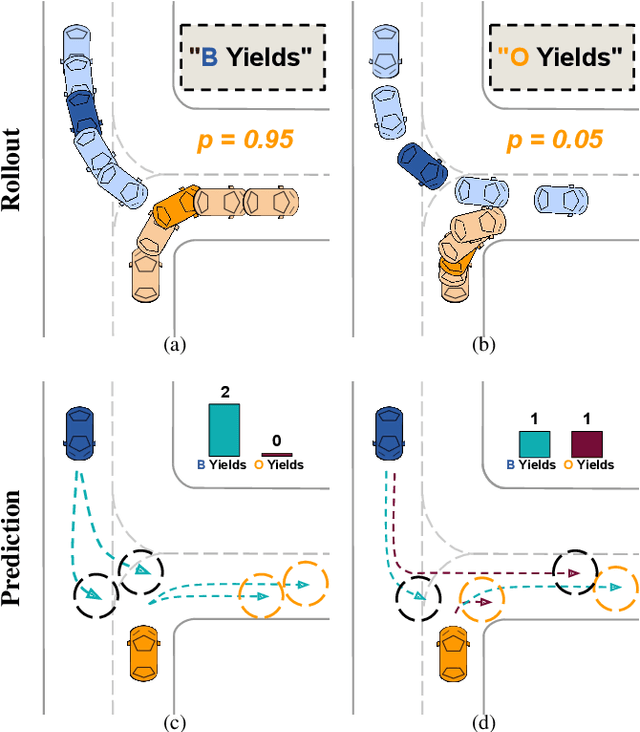
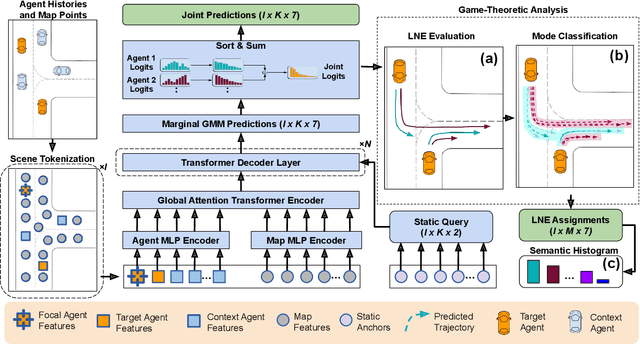
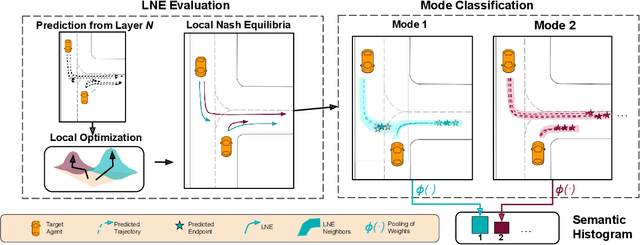
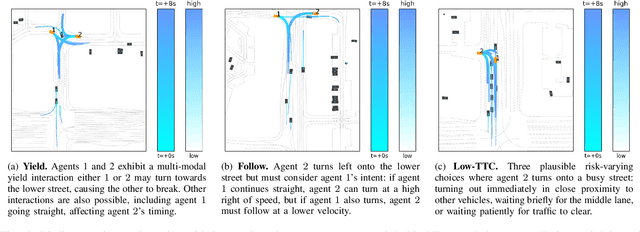
Interactions between road agents present a significant challenge in trajectory prediction, especially in cases involving multiple agents. Because existing diversity-aware predictors do not account for the interactive nature of multi-agent predictions, they may miss these important interaction outcomes. In this paper, we propose GAME-UP, a framework for trajectory prediction that leverages game-theoretic inverse reinforcement learning to improve coverage of multi-modal predictions. We use a training-time game-theoretic numerical analysis as an auxiliary loss resulting in improved coverage and accuracy without presuming a taxonomy of actions for the agents. We demonstrate our approach on the interactive subset of Waymo Open Motion Dataset, including three subsets involving scenarios with high interaction complexity. Experiment results show that our predictor produces accurate predictions while covering twice as many possible interactions versus a baseline model.