 Add to Chrome
 Add to Firefox
 Add to Edge
Synthesis and Deployment of Maximal Robust Control Barrier Functions through Adversarial Reinforcement Learning
Apr 14, 2026
Robust control barrier functions (CBFs) provide a principled mechanism for smooth safety enforcement under worst-case disturbances. However, existing approaches typically rely on explicit, closed-form structure in the dynamics (e.g., control-affine) and uncertainty models. This has led to limited scalability and generality, with most robust CBFs certifying only conservative subsets of the maximal robust safe set. In this paper, we introduce a new robust CBF framework for general nonlinear systems under bounded uncertainty. We first show that the safety value function solving the dynamic programming Isaacs equation is a valid robust discrete-time CBF that enforces safety on the maximal robust safe set. We then adopt the key reinforcement learning (RL) notion of quality function (or Q-function), which removes the need for explicit dynamics by lifting the barrier certificate into state-action space and yields a novel robust Q-CBF constraint for safety filtering. Combined with adversarial RL, this enables the synthesis and deployment of robust Q-CBFs on general nonlinear systems with black-box dynamics and unknown uncertainty structure. We validate the framework on a canonical inverted pendulum benchmark and a 36-D quadruped simulator, achieving substantially less conservative safe sets than barrier-based baselines on the pendulum and reliable safety enforcement even under adversarial uncertainty realizations on the quadruped.

Safety with Agency: Human-Centered Safety Filter with Application to AI-Assisted Motorsports
Apr 16, 2025We propose a human-centered safety filter (HCSF) for shared autonomy that significantly enhances system safety without compromising human agency. Our HCSF is built on a neural safety value function, which we first learn scalably through black-box interactions and then use at deployment to enforce a novel quality control barrier function (Q-CBF) safety constraint. Since this Q-CBF safety filter does not require any knowledge of the system dynamics for both synthesis and runtime safety monitoring and intervention, our method applies readily to complex, black-box shared autonomy systems. Notably, our HCSF's CBF-based interventions modify the human's actions minimally and smoothly, avoiding the abrupt, last-moment corrections delivered by many conventional safety filters. We validate our approach in a comprehensive in-person user study using Assetto Corsa-a high-fidelity car racing simulator with black-box dynamics-to assess robustness in "driving on the edge" scenarios. We compare both trajectory data and drivers' perceptions of our HCSF assistance against unassisted driving and a conventional safety filter. Experimental results show that 1) compared to having no assistance, our HCSF improves both safety and user satisfaction without compromising human agency or comfort, and 2) relative to a conventional safety filter, our proposed HCSF boosts human agency, comfort, and satisfaction while maintaining robustness.
Stable Contact Guaranteeing Motion/Force Control for an Aerial Manipulator on an Arbitrarily Tilted Surface
Jan 19, 2023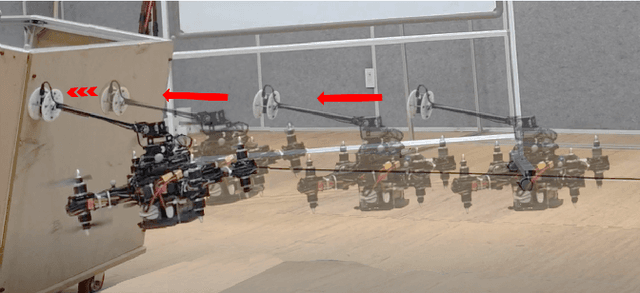

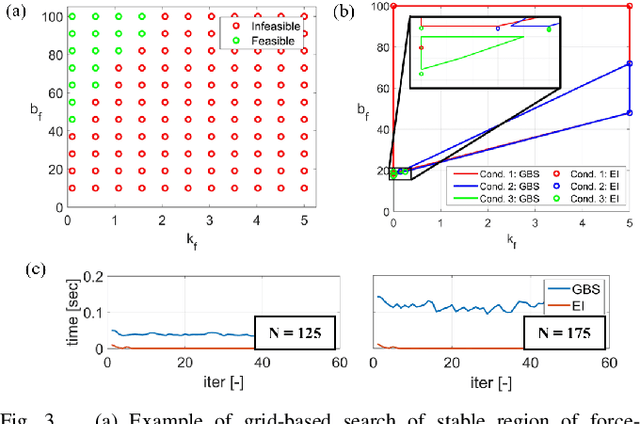

This study aims to design a motion/force controller for an aerial manipulator which guarantees the tracking of time-varying motion/force trajectories as well as the stability during the transition between free and contact motions. To this end, we model the force exerted on the end-effector as the Kelvin-Voigt linear model and estimate its parameters by recursive least-squares estimator. Then, the gains of the disturbance-observer (DOB)-based motion/force controller are calculated based on the stability conditions considering both the model uncertainties in the dynamic equation and switching between the free and contact motions. To validate the proposed controller, we conducted the time-varying motion/force tracking experiments with different approach speeds and orientations of the surface. The results show that our controller enables the aerial manipulator to track the time-varying motion/force trajectories.