 Add to Chrome
 Add to Firefox
 Add to Edge
SEED: Customize Large Language Models with Sample-Efficient Adaptation for Code Generation
Feb 29, 2024
Although Large Language Models (LLMs) have made significant progress in code generation, they still struggle with code generation tasks in specific scenarios. These scenarios usually necessitate the adaptation of LLMs to fulfill specific needs, but the limited training data available in practice leads to poor code generation performance. How to effectively adapt LLMs to new scenarios with fewer training samples is a major challenge for current code generation. In this paper, we propose a novel adaptation approach named SEED, which stands for Sample-Efficient adaptation with Error-Driven learning for code generation. SEED leverages the errors made by LLMs as learning opportunities, using error revision to overcome its own shortcomings, thus achieving efficient learning. Specifically, SEED involves identifying error code generated by LLMs, employing Self-revise for code revision, optimizing the model with revised code, and iteratively adapting the process for continuous improvement. Experimental results show that, compared to traditional fine-tuning approaches, SEED achieves superior performance with fewer training samples, showing a relative improvement of 27.2%-325.0% in Pass@1. We also validate the effectiveness of Self-revise, which generates revised code that optimizes the model more efficiently compared to the code samples from datasets. Moreover, SEED consistently demonstrates strong performance across various LLMs, underscoring its generalizability.

Generalization or Memorization: Data Contamination and Trustworthy Evaluation for Large Language Models
Feb 24, 2024Recent statements about the impressive capabilities of large language models (LLMs) are usually supported by evaluating on open-access benchmarks. Considering the vast size and wide-ranging sources of LLMs' training data, it could explicitly or implicitly include test data, leading to LLMs being more susceptible to data contamination. However, due to the opacity of training data, the black-box access of models, and the rapid growth of synthetic training data, detecting and mitigating data contamination for LLMs faces significant challenges. In this paper, we propose CDD, which stands for Contamination Detection via output Distribution for LLMs. CDD necessitates only the sampled texts to detect data contamination, by identifying the peakedness of LLM's output distribution. To mitigate the impact of data contamination in evaluation, we also present TED: Trustworthy Evaluation via output Distribution, based on the correction of LLM's output distribution. To facilitate this study, we introduce two benchmarks, i.e., DetCon and ComiEval, for data contamination detection and contamination mitigation evaluation tasks. Extensive experimental results show that CDD achieves the average relative improvements of 21.8\%-30.2\% over other contamination detection approaches in terms of Accuracy, F1 Score, and AUC metrics, and can effectively detect contamination caused by the variants of test data. TED significantly mitigates performance improvements up to 66.9\% attributed to data contamination across 24 settings and 21 contamination degrees. In real-world applications, we reveal that ChatGPT exhibits a high potential to suffer from data contamination on HumanEval benchmark.
Hierarchical Prior-based Super Resolution for Point Cloud Geometry Compression
Feb 17, 2024


The Geometry-based Point Cloud Compression (G-PCC) has been developed by the Moving Picture Experts Group to compress point clouds. In its lossy mode, the reconstructed point cloud by G-PCC often suffers from noticeable distortions due to the na\"{i}ve geometry quantization (i.e., grid downsampling). This paper proposes a hierarchical prior-based super resolution method for point cloud geometry compression. The content-dependent hierarchical prior is constructed at the encoder side, which enables coarse-to-fine super resolution of the point cloud geometry at the decoder side. A more accurate prior generally yields improved reconstruction performance, at the cost of increased bits required to encode this side information. With a proper balance between prior accuracy and bit consumption, the proposed method demonstrates substantial Bjontegaard-delta bitrate savings on the MPEG Cat1A dataset, surpassing the octree-based and trisoup-based G-PCC v14. We provide our implementations for reproducible research at https://github.com/lidq92/mpeg-pcc-tmc13.
DevEval: Evaluating Code Generation in Practical Software Projects
Jan 26, 2024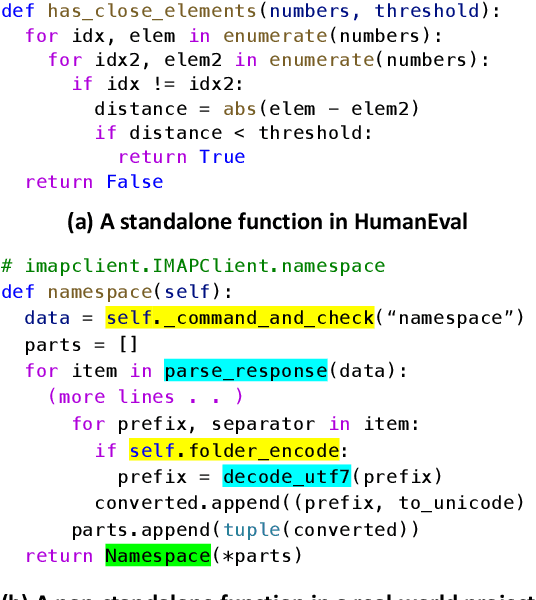
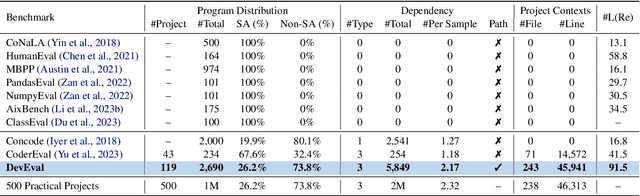
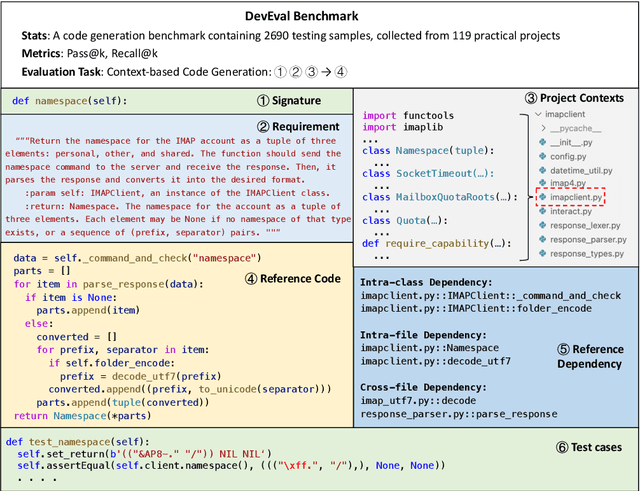
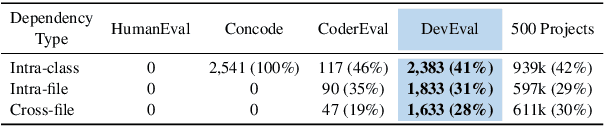
How to evaluate Large Language Models (LLMs) in code generation is an open question. Many benchmarks have been proposed but are inconsistent with practical software projects, e.g., unreal program distributions, insufficient dependencies, and small-scale project contexts. Thus, the capabilities of LLMs in practical projects are still unclear. In this paper, we propose a new benchmark named DevEval, aligned with Developers' experiences in practical projects. DevEval is collected through a rigorous pipeline, containing 2,690 samples from 119 practical projects and covering 10 domains. Compared to previous benchmarks, DevEval aligns to practical projects in multiple dimensions, e.g., real program distributions, sufficient dependencies, and enough-scale project contexts. We assess five popular LLMs on DevEval (e.g., gpt-4, gpt-3.5-turbo, CodeLLaMa, and StarCoder) and reveal their actual abilities in code generation. For instance, the highest Pass@1 of gpt-3.5-turbo only is 42 in our experiments. We also discuss the challenges and future directions of code generation in practical projects. We open-source DevEval and hope it can facilitate the development of code generation in practical projects.
Open the Black Box: Step-based Policy Updates for Temporally-Correlated Episodic Reinforcement Learning
Jan 21, 2024Current advancements in reinforcement learning (RL) have predominantly focused on learning step-based policies that generate actions for each perceived state. While these methods efficiently leverage step information from environmental interaction, they often ignore the temporal correlation between actions, resulting in inefficient exploration and unsmooth trajectories that are challenging to implement on real hardware. Episodic RL (ERL) seeks to overcome these challenges by exploring in parameters space that capture the correlation of actions. However, these approaches typically compromise data efficiency, as they treat trajectories as opaque \emph{black boxes}. In this work, we introduce a novel ERL algorithm, Temporally-Correlated Episodic RL (TCE), which effectively utilizes step information in episodic policy updates, opening the 'black box' in existing ERL methods while retaining the smooth and consistent exploration in parameter space. TCE synergistically combines the advantages of step-based and episodic RL, achieving comparable performance to recent ERL methods while maintaining data efficiency akin to state-of-the-art (SoTA) step-based RL.
Uncertainty-aware No-Reference Point Cloud Quality Assessment
Jan 17, 2024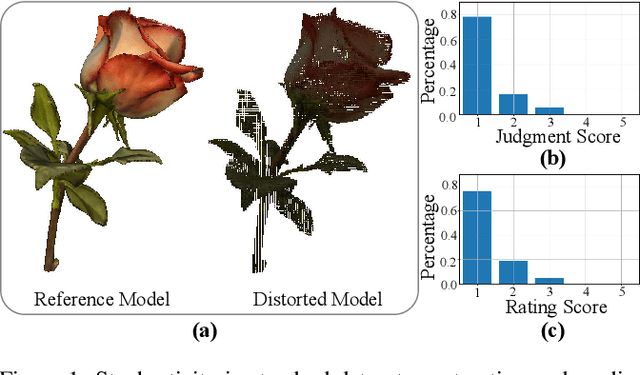
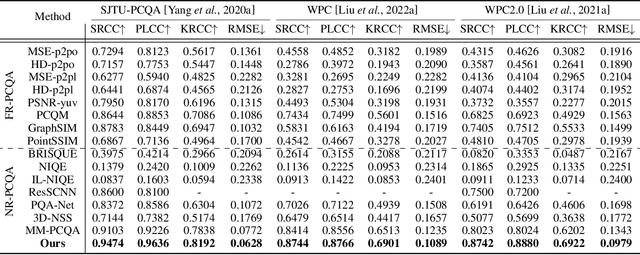
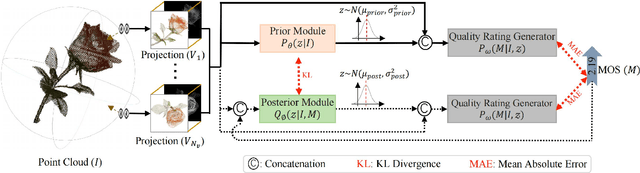
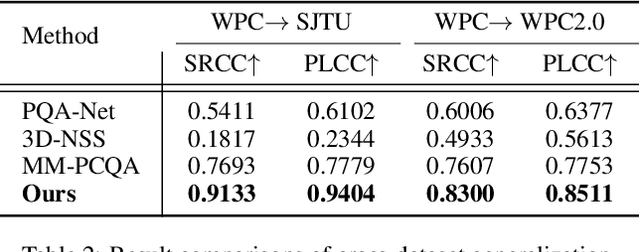
The evolution of compression and enhancement algorithms necessitates an accurate quality assessment for point clouds. Previous works consistently regard point cloud quality assessment (PCQA) as a MOS regression problem and devise a deterministic mapping, ignoring the stochasticity in generating MOS from subjective tests. Besides, the viewpoint switching of 3D point clouds in subjective tests reinforces the judging stochasticity of different subjects compared with traditional images. This work presents the first probabilistic architecture for no-reference PCQA, motivated by the labeling process of existing datasets. The proposed method can model the quality judging stochasticity of subjects through a tailored conditional variational autoencoder (CVAE) and produces multiple intermediate quality ratings. These intermediate ratings simulate the judgments from different subjects and are then integrated into an accurate quality prediction, mimicking the generation process of a ground truth MOS. Specifically, our method incorporates a Prior Module, a Posterior Module, and a Quality Rating Generator, where the former two modules are introduced to model the judging stochasticity in subjective tests, while the latter is developed to generate diverse quality ratings. Extensive experiments indicate that our approach outperforms previous cutting-edge methods by a large margin and exhibits gratifying cross-dataset robustness.
TACO: Topics in Algorithmic COde generation dataset
Dec 27, 2023
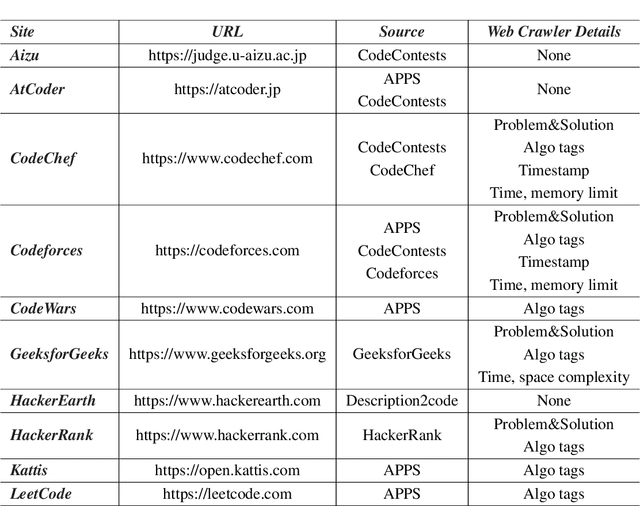


We introduce TACO, an open-source, large-scale code generation dataset, with a focus on the optics of algorithms, designed to provide a more challenging training dataset and evaluation benchmark in the field of code generation models. TACO includes competition-level programming questions that are more challenging, to enhance or evaluate problem understanding and reasoning abilities in real-world programming scenarios. There are 25433 and 1000 coding problems in training and test set, as well as up to 1.55 million diverse solution answers. Moreover, each TACO problem includes several fine-grained labels such as task topics, algorithms, programming skills, and difficulty levels, providing a more precise reference for the training and evaluation of code generation models. The dataset and evaluation scripts are available on Hugging Face Hub (https://huggingface.co/datasets/BAAI/TACO) and Github (https://github.com/FlagOpen/TACO).
Adaptive Annotation Distribution for Weakly Supervised Point Cloud Semantic Segmentation
Dec 11, 2023Weakly supervised point cloud semantic segmentation has attracted a lot of attention due to its ability to alleviate the heavy reliance on fine-grained annotations of point clouds. However, in practice, sparse annotation usually exhibits a distinct non-uniform distribution in point cloud, which poses challenges for weak supervision. To address these issues, we propose an adaptive annotation distribution method for weakly supervised point cloud semantic segmentation. Specifically, we introduce the probability density function into the gradient sampling approximation analysis and investigate the impact of sparse annotations distributions. Based on our analysis, we propose a label-aware point cloud downsampling strategy to increase the proportion of annotations involved in the training stage. Furthermore, we design the multiplicative dynamic entropy as the gradient calibration function to mitigate the gradient bias caused by non-uniformly distributed sparse annotations and explicitly reduce the epistemic uncertainty. Without any prior restrictions and additional information, our proposed method achieves comprehensive performance improvements at multiple label rates with different annotation distributions on S3DIS, ScanNetV2 and SemanticKITTI.
Mug-STAN: Adapting Image-Language Pretrained Models for General Video Understanding
Nov 25, 2023Large-scale image-language pretrained models, e.g., CLIP, have demonstrated remarkable proficiency in acquiring general multi-modal knowledge through web-scale image-text data. Despite the impressive performance of image-language models on various image tasks, how to effectively expand them on general video understanding remains an area of ongoing exploration. In this paper, we investigate the image-to-video transferring from the perspective of the model and the data, unveiling two key obstacles impeding the adaptation of image-language models: non-generalizable temporal modeling and partially misaligned video-text data. To address these challenges, we propose Spatial-Temporal Auxiliary Network with Mutual-guided alignment module (Mug-STAN), a simple yet effective framework extending image-text model to diverse video tasks and video-text data.Specifically, STAN adopts a branch structure with decomposed spatial-temporal modules to enable generalizable temporal modeling, while Mug suppresses misalignment by introducing token-wise feature aggregation of either modality from the other. Extensive experimental results verify Mug-STAN significantly improves adaptation of language-image pretrained models such as CLIP and CoCa at both video-text post-pretraining and finetuning stages. With our solution, state-of-the-art zero-shot and finetuning results on various downstream datasets, including MSR-VTT, DiDeMo, LSMDC, Kinetics-400, Something-Something-2, HMDB-51, UCF- 101, and AVA, are achieved. Moreover, by integrating pretrained Mug-STAN with the emerging multimodal dialogue model, we can realize zero-shot video chatting. Codes are available at https://github.com/farewellthree/STAN
Lightweight super resolution network for point cloud geometry compression
Nov 02, 2023This paper presents an approach for compressing point cloud geometry by leveraging a lightweight super-resolution network. The proposed method involves decomposing a point cloud into a base point cloud and the interpolation patterns for reconstructing the original point cloud. While the base point cloud can be efficiently compressed using any lossless codec, such as Geometry-based Point Cloud Compression, a distinct strategy is employed for handling the interpolation patterns. Rather than directly compressing the interpolation patterns, a lightweight super-resolution network is utilized to learn this information through overfitting. Subsequently, the network parameter is transmitted to assist in point cloud reconstruction at the decoder side. Notably, our approach differentiates itself from lookup table-based methods, allowing us to obtain more accurate interpolation patterns by accessing a broader range of neighboring voxels at an acceptable computational cost. Experiments on MPEG Cat1 (Solid) and Cat2 datasets demonstrate the remarkable compression performance achieved by our method.