 Add to Chrome
 Add to Firefox
 Add to Edge
BiRD: A Bidirectional Ranking Defense Mechanism for Retrieval Augmented Generation
May 19, 2026
The growing adoption of Retrieval-Augmented Generation (RAG) has led to a rise in adversarial attacks. Existing defenses, relying on semantic analysis or voting, face a trade-off between high computational cost and limited robustness under strong poisoning attacks. Their fundamental limitation is the exclusive focus on semantic content relevance, while neglecting the retrieval context that is critically defined by ranking structures. To this end, we investigate the bidirectional ranking behavior of poisoned and benign documents, and discover a key discriminative pattern: poisoned documents exhibit significantly stronger alignment between their backward rankings and the query's forward ranking. Capitalizing on this, we propose BiRD, a bidirectional ranking defense mechanism built upon a dual-signal framework that leverages forward ranking to assess semantic content relevance and backward ranking to quantify ranking context consistency. This design directly addresses the fundamental limitation of prior approaches, enabling simultaneous efficiency and robustness. Extensive evaluation across 3 datasets with 3 retrievers and 3 LLMs under 2 attack scenarios validates BiRD's effectiveness. Notably, BiRD reduces the attack success rate of PoisonedRAG by up to 54% while simultaneously improving task accuracy by up to 56%, with average additional latency under 1 second.

TACO: Topics in Algorithmic COde generation dataset
Dec 27, 2023
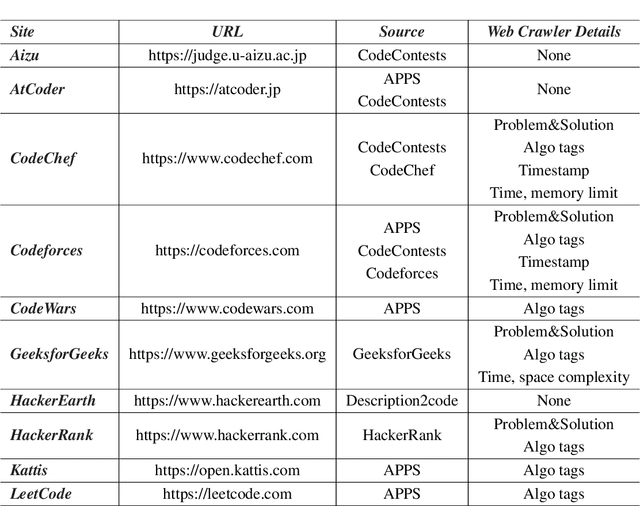


We introduce TACO, an open-source, large-scale code generation dataset, with a focus on the optics of algorithms, designed to provide a more challenging training dataset and evaluation benchmark in the field of code generation models. TACO includes competition-level programming questions that are more challenging, to enhance or evaluate problem understanding and reasoning abilities in real-world programming scenarios. There are 25433 and 1000 coding problems in training and test set, as well as up to 1.55 million diverse solution answers. Moreover, each TACO problem includes several fine-grained labels such as task topics, algorithms, programming skills, and difficulty levels, providing a more precise reference for the training and evaluation of code generation models. The dataset and evaluation scripts are available on Hugging Face Hub (https://huggingface.co/datasets/BAAI/TACO) and Github (https://github.com/FlagOpen/TACO).