 Add to Chrome
 Add to Firefox
 Add to Edge
Evaluating and Enhancing Large Language Models Performance in Domain-specific Medicine: Osteoarthritis Management with DocOA
Jan 20, 2024
The efficacy of large language models (LLMs) in domain-specific medicine, particularly for managing complex diseases such as osteoarthritis (OA), remains largely unexplored. This study focused on evaluating and enhancing the clinical capabilities of LLMs in specific domains, using osteoarthritis (OA) management as a case study. A domain specific benchmark framework was developed, which evaluate LLMs across a spectrum from domain-specific knowledge to clinical applications in real-world clinical scenarios. DocOA, a specialized LLM tailored for OA management that integrates retrieval-augmented generation (RAG) and instruction prompts, was developed. The study compared the performance of GPT-3.5, GPT-4, and a specialized assistant, DocOA, using objective and human evaluations. Results showed that general LLMs like GPT-3.5 and GPT-4 were less effective in the specialized domain of OA management, particularly in providing personalized treatment recommendations. However, DocOA showed significant improvements. This study introduces a novel benchmark framework which assesses the domain-specific abilities of LLMs in multiple aspects, highlights the limitations of generalized LLMs in clinical contexts, and demonstrates the potential of tailored approaches for developing domain-specific medical LLMs.

Deep Radon Prior: A Fully Unsupervised Framework for Sparse-View CT Reconstruction
Dec 30, 2023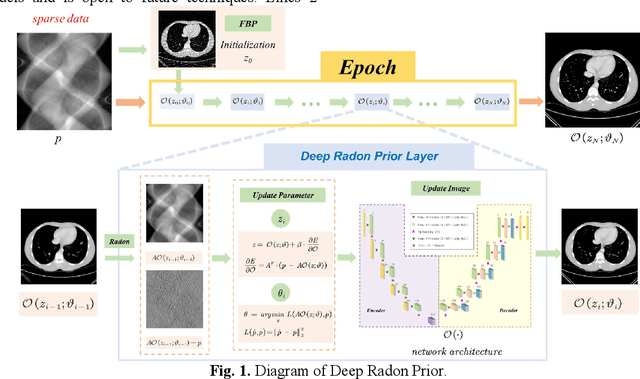
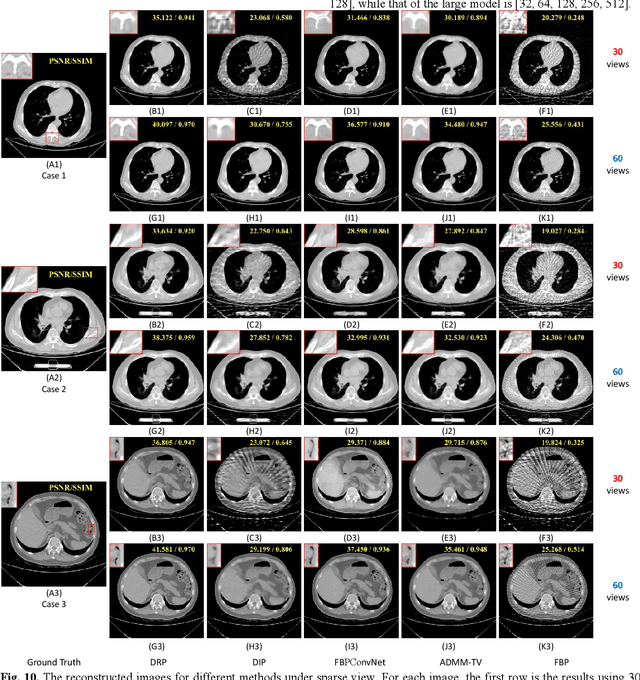

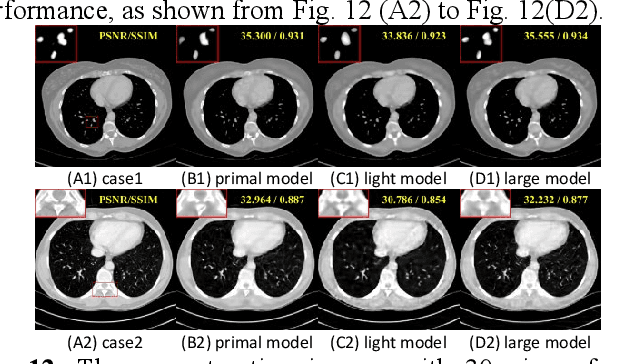
Although sparse-view computed tomography (CT) has significantly reduced radiation dose, it also introduces severe artifacts which degrade the image quality. In recent years, deep learning-based methods for inverse problems have made remarkable progress and have become increasingly popular in CT reconstruction. However, most of these methods suffer several limitations: dependence on high-quality training data, weak interpretability, etc. In this study, we propose a fully unsupervised framework called Deep Radon Prior (DRP), inspired by Deep Image Prior (DIP), to address the aforementioned limitations. DRP introduces a neural network as an implicit prior into the iterative method, thereby realizing cross-domain gradient feedback. During the reconstruction process, the neural network is progressively optimized in multiple stages to narrow the solution space in radon domain for the under-constrained imaging protocol, and the convergence of the proposed method has been discussed in this work. Compared with the popular pre-trained method, the proposed framework requires no dataset and exhibits superior interpretability and generalization ability. The experimental results demonstrate that the proposed method can generate detailed images while effectively suppressing image artifacts.Meanwhile, DRP achieves comparable or better performance than the supervised methods.
CARAT: Contrastive Feature Reconstruction and Aggregation for Multi-modal Multi-label Emotion Recognition
Dec 29, 2023Multi-modal multi-label emotion recognition (MMER) aims to identify relevant emotions from multiple modalities. The challenge of MMER is how to effectively capture discriminative features for multiple labels from heterogeneous data. Recent studies are mainly devoted to exploring various fusion strategies to integrate multi-modal information into a unified representation for all labels. However, such a learning scheme not only overlooks the specificity of each modality but also fails to capture individual discriminative features for different labels. Moreover, dependencies of labels and modalities cannot be effectively modeled. To address these issues, this paper presents ContrAstive feature Reconstruction and AggregaTion (CARAT) for the MMER task. Specifically, we devise a reconstruction-based fusion mechanism to better model fine-grained modality-to-label dependencies by contrastively learning modal-separated and label-specific features. To further exploit the modality complementarity, we introduce a shuffle-based aggregation strategy to enrich co-occurrence collaboration among labels. Experiments on two benchmark datasets CMU-MOSEI and M3ED demonstrate the effectiveness of CARAT over state-of-the-art methods. Code is available at https://github.com/chengzju/CARAT.
FreeAL: Towards Human-Free Active Learning in the Era of Large Language Models
Nov 27, 2023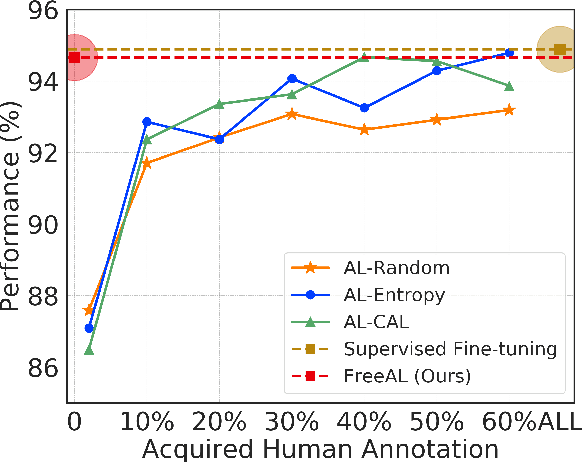
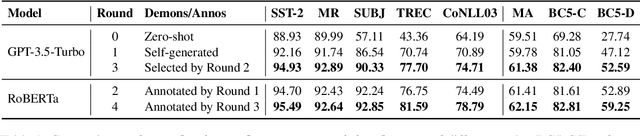
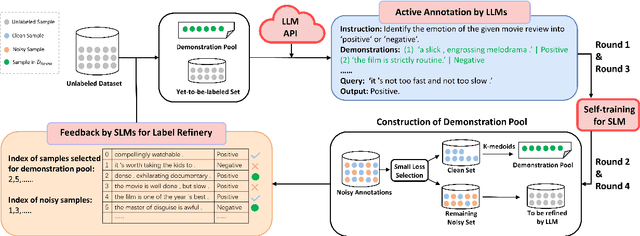
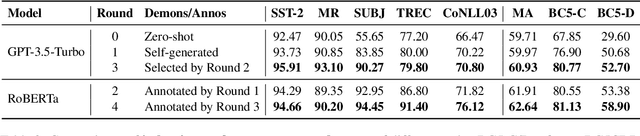
Collecting high-quality labeled data for model training is notoriously time-consuming and labor-intensive for various NLP tasks. While copious solutions, such as active learning for small language models (SLMs) and prevalent in-context learning in the era of large language models (LLMs), have been proposed and alleviate the labeling burden to some extent, their performances are still subject to human intervention. It is still underexplored how to reduce the annotation cost in the LLMs era. To bridge this, we revolutionize traditional active learning and propose an innovative collaborative learning framework FreeAL to interactively distill and filter the task-specific knowledge from LLMs. During collaborative training, an LLM serves as an active annotator inculcating its coarse-grained knowledge, while a downstream SLM is incurred as a student to filter out high-quality in-context samples to feedback LLM for the subsequent label refinery. Extensive experiments on eight benchmark datasets demonstrate that FreeAL largely enhances the zero-shot performances for both SLM and LLM without any human supervision. The code is available at https://github.com/Justherozen/FreeAL .
TLM: Token-Level Masking for Transformers
Oct 28, 2023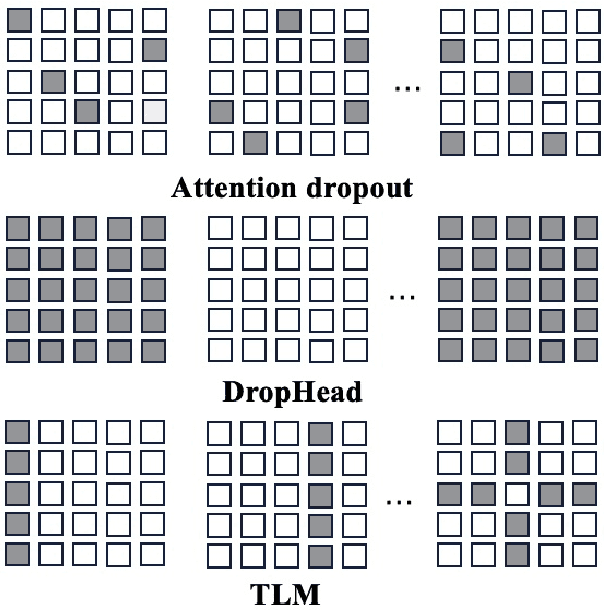
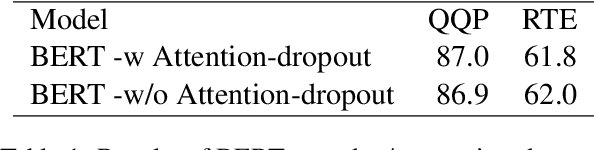
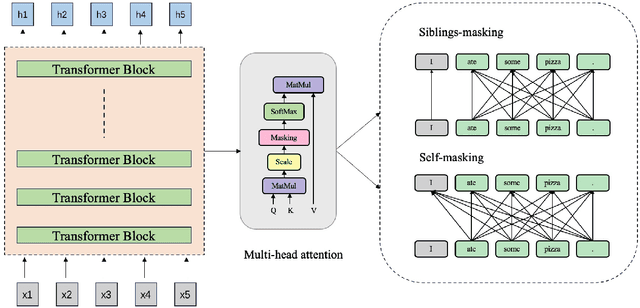
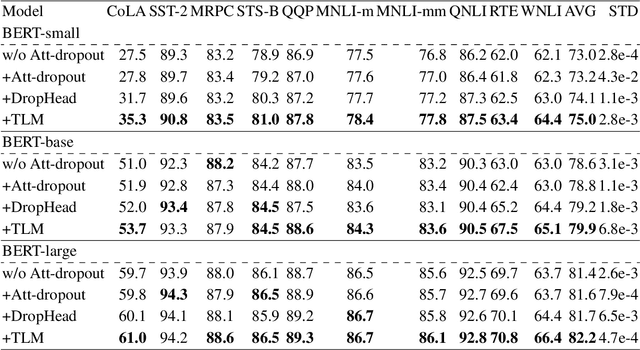
Structured dropout approaches, such as attention dropout and DropHead, have been investigated to regularize the multi-head attention mechanism in Transformers. In this paper, we propose a new regularization scheme based on token-level rather than structure-level to reduce overfitting. Specifically, we devise a novel Token-Level Masking (TLM) training strategy for Transformers to regularize the connections of self-attention, which consists of two masking techniques that are effective and easy to implement. The underlying idea is to manipulate the connections between tokens in the multi-head attention via masking, where the networks are forced to exploit partial neighbors' information to produce a meaningful representation. The generality and effectiveness of TLM are thoroughly evaluated via extensive experiments on 4 diversified NLP tasks across 18 datasets, including natural language understanding benchmark GLUE, ChineseGLUE, Chinese Grammatical Error Correction, and data-to-text generation. The results indicate that TLM can consistently outperform attention dropout and DropHead, e.g., it increases by 0.5 points relative to DropHead with BERT-large on GLUE. Moreover, TLM can establish a new record on the data-to-text benchmark Rotowire (18.93 BLEU). Our code will be publicly available at https://github.com/Young1993/tlm.
SPA: A Graph Spectral Alignment Perspective for Domain Adaptation
Oct 27, 2023Unsupervised domain adaptation (UDA) is a pivotal form in machine learning to extend the in-domain model to the distinctive target domains where the data distributions differ. Most prior works focus on capturing the inter-domain transferability but largely overlook rich intra-domain structures, which empirically results in even worse discriminability. In this work, we introduce a novel graph SPectral Alignment (SPA) framework to tackle the tradeoff. The core of our method is briefly condensed as follows: (i)-by casting the DA problem to graph primitives, SPA composes a coarse graph alignment mechanism with a novel spectral regularizer towards aligning the domain graphs in eigenspaces; (ii)-we further develop a fine-grained message propagation module -- upon a novel neighbor-aware self-training mechanism -- in order for enhanced discriminability in the target domain. On standardized benchmarks, the extensive experiments of SPA demonstrate that its performance has surpassed the existing cutting-edge DA methods. Coupled with dense model analysis, we conclude that our approach indeed possesses superior efficacy, robustness, discriminability, and transferability. Code and data are available at: https://github.com/CrownX/SPA.
Learning to Solve Climate Sensor Placement Problems with a Transformer
Oct 18, 2023The optimal placement of sensors for environmental monitoring and disaster management is a challenging problem due to its NP-hard nature. Traditional methods for sensor placement involve exact, approximation, or heuristic approaches, with the latter being the most widely used. However, heuristic methods are limited by expert intuition and experience. Deep learning (DL) has emerged as a promising approach for generating heuristic algorithms automatically. In this paper, we introduce a novel sensor placement approach focused on learning improvement heuristics using deep reinforcement learning (RL) methods. Our approach leverages an RL formulation for learning improvement heuristics, driven by an actor-critic algorithm for training the policy network. We compare our method with several state-of-the-art approaches by conducting comprehensive experiments, demonstrating the effectiveness and superiority of our proposed approach in producing high-quality solutions. Our work presents a promising direction for applying advanced DL and RL techniques to challenging climate sensor placement problems.
Large-Scale OD Matrix Estimation with A Deep Learning Method
Oct 09, 2023The estimation of origin-destination (OD) matrices is a crucial aspect of Intelligent Transport Systems (ITS). It involves adjusting an initial OD matrix by regressing the current observations like traffic counts of road sections (e.g., using least squares). However, the OD estimation problem lacks sufficient constraints and is mathematically underdetermined. To alleviate this problem, some researchers incorporate a prior OD matrix as a target in the regression to provide more structural constraints. However, this approach is highly dependent on the existing prior matrix, which may be outdated. Others add structural constraints through sensor data, such as vehicle trajectory and speed, which can reflect more current structural constraints in real-time. Our proposed method integrates deep learning and numerical optimization algorithms to infer matrix structure and guide numerical optimization. This approach combines the advantages of both deep learning and numerical optimization algorithms. The neural network(NN) learns to infer structural constraints from probe traffic flows, eliminating dependence on prior information and providing real-time performance. Additionally, due to the generalization capability of NN, this method is economical in engineering. We conducted tests to demonstrate the good generalization performance of our method on a large-scale synthetic dataset. Subsequently, we verified the stability of our method on real traffic data. Our experiments provided confirmation of the benefits of combining NN and numerical optimization.
A Simple Text to Video Model via Transformer
Sep 26, 2023We present a general and simple text to video model based on Transformer. Since both text and video are sequential data, we encode both texts and images into the same hidden space, which are further fed into Transformer to capture the temporal consistency and then decoder to generate either text or images. Considering the image signal may become weak in the long sequence, we introduce the U-Net to reconstruct image from its noised version. Specifically, we increase the noise level to the original image in the long sequence, then use the $down$ module from U-Net to encode noised images, which are further input to transformer to predict next clear images. We also add a constraint to promote motion between any generated image pair in the video. We use GPT2 and test our approach on UCF101 dataset and show it can generate promising videos.
ModelGiF: Gradient Fields for Model Functional Distance
Sep 20, 2023The last decade has witnessed the success of deep learning and the surge of publicly released trained models, which necessitates the quantification of the model functional distance for various purposes. However, quantifying the model functional distance is always challenging due to the opacity in inner workings and the heterogeneity in architectures or tasks. Inspired by the concept of "field" in physics, in this work we introduce Model Gradient Field (abbr. ModelGiF) to extract homogeneous representations from the heterogeneous pre-trained models. Our main assumption underlying ModelGiF is that each pre-trained deep model uniquely determines a ModelGiF over the input space. The distance between models can thus be measured by the similarity between their ModelGiFs. We validate the effectiveness of the proposed ModelGiF with a suite of testbeds, including task relatedness estimation, intellectual property protection, and model unlearning verification. Experimental results demonstrate the versatility of the proposed ModelGiF on these tasks, with significantly superiority performance to state-of-the-art competitors. Codes are available at https://github.com/zju-vipa/modelgif.